The track record on banking on solar energy innovation becoming cost competitive
18 Aug 2015 Leave a comment
in economic history, energy economics, entrepreneurship, environmental economics, global warming, politics - USA, Public Choice, rentseeking Tags: Big Solar, creative destruction, green rent seeking, renewable energy, renewable resources, solar energy
The Battle Over Global Warming Is All in Your Head
16 Aug 2015 Leave a comment
in applied price theory, applied welfare economics, economics of information, economics of media and culture, energy economics, environmental economics, global warming Tags: climate alarmism, doomsday prophecies, global warming, political psychology
Unexpected kind word for Parliament House protesters @GreenpeaceNZ @RusselNorman @NZGreens @greencatherine
15 Aug 2015 2 Comments
in constitutional political economy, economics of crime, environmental economics, global warming, law and economics, liberalism, politics - New Zealand, Public Choice, Rawls and Nozick, rentseeking Tags: civil disobedience, climate alarmism, expressive voting, Greenpeace, John Rawls, Justice Scalia, Leftover Left, rule of law
PRESS RELEASE: Greenpeace Parliament Climbers Convicted of Trespass bit.ly/1DRfKMG #realclimateaction http://t.co/sxRokpwRNk—
Greenpeace NZ (@GreenpeaceNZ) August 13, 2015
The Greenpeace vandals who trespassed at Parliament, climbing up to put signs down the front in flagrant disregard of the most ample possible options for peaceful protest right outside at least had the integrity to plead guilty. That shows some sort of fidelity to law and an acknowledgement that what they did was a criminal offence.
John Rawls makes the point that the purpose of civil disobedience is not to impose your will upon others but through your protest to implore them to reconsider their position and change the law or policy you are disputing.
Rawls argues that civil disobedience is never covert or secretive; it is only ever committed in public, openly, and with fair notice to legal authorities. Openness and publicity, even at the cost of having one’s protest frustrated, offers ways for the protesters to show their willingness to deal fairly with authorities. Rawls argues:
- for a public, non-violent, conscientious yet political act contrary to law being done (usually) with the aim of bringing about a change in the law or policies of the government;
- that appeals to the sense of justice of the majority;
- which may be direct or indirect;
- within the bounds of fidelity to the law; and
- whose protesters are willing to accept punishment. Although civil disobedience involves breaking the law, it is for moral rather than selfish reasons; the willingness to accept arrest is proof of the integrity of the act.
Rawls argues, and too many forget, that civil disobedience and dissent more generally contribute to the democratic exchange of ideas by forcing the champions of dominant opinion to defend their views.
Legitimate non-violent direct action are publicity stunts to gain attention and provoke debate within the democratic framework, where we resolve our differences by trying to persuade each other and convince the electorate.
Too many acts of non-violent direct action aim to impose their will on others rather than peaceful protests designed to bring about democratic change in the laws or policies of the incumbent government. That ‘might does not make right’ is fundamental to the rule of law. As United States Supreme Court Justice Antonin Scalia said
The virtue of a democratic system [with a constitutionally guaranteed right to free speech] is that it readily enables the people, over time, to be persuaded that what they took for granted is not so and to change their laws accordingly..
Both sides passionately but respectfully attempt to persuade their fellow citizens to accept their views. Win or lose, advocates for today’s losing causes can continued pressing their cases, secure in the knowledge that an electoral loss today can be negated by a later electoral win, which is democracy in action as Justice Kennedy explains:
…a democracy has the capacity—and the duty—to learn from its past mistakes; to discover and confront persisting biases; and by respectful, rationale deliberation to rise above those flaws and injustices…
It is demeaning to the democratic process to presume that the voters are not capable of deciding an issue of this sensitivity on decent and rational grounds.
The process of public discourse and political debate should not be foreclosed even if there is a risk that during a public campaign there will be those, on both sides, who seek to use racial division and discord to their own political advantage. An informed public can, and must, rise above this. The idea of democracy is that it can, and must, mature.
Freedom embraces the right, indeed the duty, to engage in a rational, civic discourse in order to determine how best to form a consensus to shape the destiny of the Nation and its people. These First Amendment dynamics would be disserved if this Court were to say that the question here at issue is beyond the capacity of the voters to debate and then to determine.
John Rawls’ view that fidelity to law and democratic change through trying to persuade each other is at the heart of civil disobedience reflects the difference between the liberal and the left-wing on democracy and social change as Jonathan Chait observed this week:
Liberals treat political rights as sacrosanct. The left treats social and economic justice as sacrosanct. The liberal vision of political rights requires being neutral about substance.
To the left, this neutrality is a mere guise for maintaining existing privilege; debates about “rights” can only be resolved by defining which side represents the privileged class and which side represents the oppressed…
Liberals believe that social justice can be advanced without giving up democratic rights and norms. The ends of social justice do not justify any and all means.
How the left-wing and liberal visions of democracy are different nymag.com/daily/intellig… http://t.co/Qk5vS9SaV4—
Jonathan Chait (@jonathanchait) August 13, 2015
Why are Australian power prices so high?
15 Aug 2015 Leave a comment
in energy economics, environmental economics, global warming, politics - Australia, politics - New Zealand, politics - USA Tags: carbon pricing, climate alarmism, power prices, solao energy, solar power, wind power
‘Climate culture’ versus ‘knowing disbelief’
15 Aug 2015 Leave a comment
in applied price theory, economics of information, economics of media and culture, environmental economics, global warming Tags: climate change, conjecture and refutation, global warming, philosophy of science, political psychology

by Andy West
Climate culture versus knowing disbelief.
View original post 2,438 more words
The rhetoric of climate alarmism
14 Aug 2015 1 Comment
in environmental economics, global warming Tags: climate alarmism, expressive voting, rational irrationality
Australia announces its futile carbon emissions target
12 Aug 2015 Leave a comment
in applied price theory, applied welfare economics, environmental economics, global warming, politics - Australia, politics - New Zealand, politics - USA, Public Choice, rentseeking Tags: Australia, China, climate alarmism, climate change treaties, free-riders, game theory, global warming, international free riders, international public goods, public goods

The climate alarmists need to lift their game on their scaremongering
11 Aug 2015 Leave a comment
in economics of media and culture, environmental economics, global warming, politics - USA, Public Choice Tags: climate alarmism, doomsday prophecies, global warming, scaremongering, voter demographics
Analysing environmental benefits from driving electric vehicles
09 Aug 2015 Leave a comment
in applied welfare economics, energy economics, environmental economics, global warming, politics - USA, Public Choice, rentseeking Tags: coal power, electric cars, green rent seeking, hydroelectric power, nuclear energy, nuclear power, offsetting behaviour, The fatal conceit, The pretense to knowledge, unintended consequences
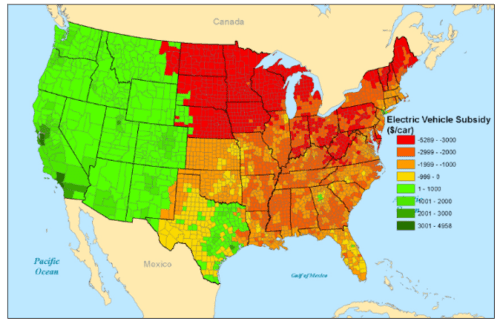
- The benefit is large and positive in many places in the west because the western electricity grid is relatively clean – primarily a mix of hydro, nuclear, and natural gas.
- The benefit is large and negative in many places in the east because the eastern electricity grid primarily relies more heavily on coal and natural gas.
via Economist’s View.
@NZGreens and co. must face an inconvenient truth about global poverty
09 Aug 2015 Leave a comment
in development economics, energy economics, environmental economics, global warming, growth disasters, growth miracles, politics - New Zealand Tags: expressive voting, extreme poverty, global poverty, rational irrationality, The Great Escape, The Great Fact
Climate change that is worth worrying about
05 Aug 2015 Leave a comment
in economic history, environmental economics, global warming Tags: global cooling, global warming, ice ages, Little ice age
Europe during Weichselian- & Würm-Glaciation period (which ended 11,700 years ago). http://t.co/Sx58qdIEAA—
Amazing Maps™ (@amazingmap) August 03, 2015
Why Obama’s Climate-Change Plan Is Hopeless Without China
05 Aug 2015 Leave a comment
in environmental economics, global warming, politics - USA Tags: China, climate treaties, global warming


What difference did the Kyoto protocol make and that’s before you consider 3rd World development
04 Aug 2015 Leave a comment
in development economics, economic history, energy economics, environmental economics, global warming, growth miracles, politics - Australia, politics - New Zealand, politics - USA Tags: climate alarmism clock, climate treaties, expressive voting, free-riders, Kyoto Protocol, rational ignorance, rational irrationality
Why do @NZGreens want NZ to lead the world by example on a carbon tax, but not unilateral free trade?
31 Jul 2015 Leave a comment
in David Friedman, environmental economics, global warming, international economics, Milton Friedman, Murray Rothbard, politics - New Zealand Tags: antiforeign bias, antimarket bias, carbon tax, carbon trading, climate treaties, expressive voting, free trade, global warming, left-wing double standards, Left-wing hypocrisy, New Zealand Greens, protectionism, rational ignorance, rational irrationality, unilateral free trade


NZ’s greenhouse gas emissions are high per person and unit of GDP but have fallen since 1990 oe.cd/10z http://t.co/f5BMLMvTjq—
OECD Publications (@OECD_Pubs) June 10, 2015
It’s a worry when James Hansen is talking sense on energy policy
30 Jul 2015 Leave a comment
in economics of media and culture, energy economics, environmental economics, global warming, politics - USA, Public Choice, rentseeking Tags: Big Solar, green rent seeking, James Hansen, renewable energy, solar energy, solar power
James Hansen just totally destroyed Hillary Clinton's climate plan. goo.gl/N8n9Cz http://t.co/ef8bElDBBn—
Steve Milloy (@JunkScience) July 29, 2015


Recent Comments