https://twitter.com/EpicHistoryPics/status/566737046438678528
How are the computer predictions of global warming going?
13 Feb 2015 2 Comments
in environmental economics, global warming Tags: climate alarmists, conjecture and refutation

HT: dailymail.co.uk
Deciding science by voting – updated
13 Feb 2015 1 Comment
in economics of religion, environmental economics, global warming, Public Choice, rentseeking Tags: appeal to authority, climate alarmism, conjecture and refutation, global cooling, global warming, JS Mill, logical fallacies, marketing, persuasion
 One of the troubling aspects of climate alarmism is its repeated appeals to authority. Rather odd for a bunch left-wingers trying to overthrow the status quo and the established order.
The most obvious manifestation of this tactics to go on about how there is a consensus of scientists, the science is settled or the debate is over.

These repeated and unimaginative appeals to authority are either to champion the existing scientific views about global warming or to suggest that previous scientific predictions of global cooling in the 1960s and 1970s were only a minority view.

Again, an appeal to authority is an odd communication strategy for the climate alarmists. Their movement is made up more of young people because of the overweening conceit of youth. Many of their recruits are young people.The debate over the causes of global warming and its likelihood must be repeated over and over again, if only to introduce and socialise their new recruits to the arguments and counterarguments.
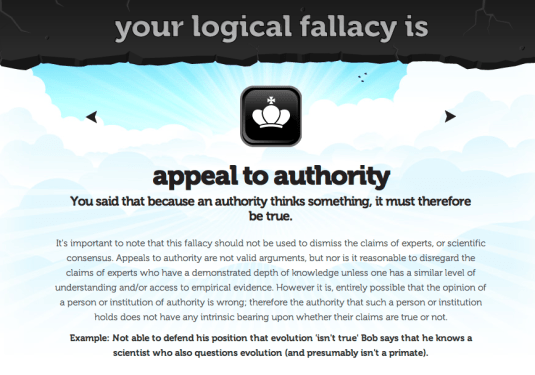
One of the reasons I changed my mind on the economics and politics of climate science is these repeated appeals to authority and general bully boy tactics made me suspicious of the underlying merits of the arguments canvassed.

The only profession I know of which actually does take a vote on what is the truth in a scientific sense is psychiatrists. Their American annual conference has a vote on what to put out their professional diagnostic manual. This science by voting never went well with various psychiatric disorders voted in and out of their professional diagnostic manual on the basis of politics, cultural bias and the medicalisation of human distress.

John Stuart Mill emphasise the value of even completely false arguments in keeping us on our toes. His scenarios involves both parties of opinion, majority and minority, having a portion of the truth but not the whole of it. He regards this as the most common of the three scenarios, and his argument here is very simple. To enlarge its grasp of the truth the majority must encourage the minority to express its partially truthful view.
J.S. Mill pointed out that critics who are totally wrong still add value because they keep you on your toes and sharpened both your argument and the communication of your message.
If the righteous majority silences or ignores its opponents, it will never have to defend its belief and over time will forget the arguments for it. As well as losing its grasp of the arguments for its belief, J.S. Mill adds that the majority will in due course even lose a sense of the real meaning and substance of its belief. What earlier may have been a vital belief will be reduced in time to a series of phrases retained by rote. The belief will be held as a dead dogma rather than as a living truth.
Three scenarios – the majority is wrong, partly wrong, or totally right – exhaust for Mill the possible permutations on the distribution of truth, and he holds that in each case the search for truth is best served by allowing free discussion.
Mill thinks history repeatedly demonstrates this process at work where silencing falsehood led to dogmas rather than living truth. He offered Christianity as an illustrative example. By suppressing opposition to it over the centuries Christians ironically weakened rather than strengthened Christian belief. Mill thinks this explains the decline of Christianity in the modern world. Christians forgot why they were Christians and in the Reformation could not successfully rebut who came up with valid criticisms of their existing profession of faith.
Going on about how climate science is settled and the debate is over is bad tactics for the climate alarmists. Attempts to close the debate this way provokes suspicion among those who expect some attempt to persuade them rather than to instruct them from on high. Presumptuousness is never a good persuasion tactic nor is dismissiveness.
A salesman trying to sell a product would never use any of the persuasion tactics or selling tactics of the climate alarmists. They would quickly go out of business if they did.
Anti-science Left alert: NZ Greens reject scientific consensus on GMOs but not global warming
11 Feb 2015 Leave a comment
in environmental economics, global warming, health economics, politics - USA Tags: antiscience left, argument from authority, climate alarmism, GMOs, green hypocrisy, Green Left, Green Party of New Zealand, Quacks

But I’m not going to focus this speech on the dire consequences of doing nothing on climate change. I’m sure all of us have heard the science; we’ve read about the wicked storms and wildfires and droughts, the risks to agriculture and forestry, the threats posed to our homes and wildlife. We’ve probably even seen some of the changes first hand in our own backyard.
Russel Norman, co-leader, Green Party of New Zealand, 10 February 2015,
But on genetic engineering,the Green Party of New Zealand takes its leave of the scientific consensus, scientific consensus as strong as that on global warming. To quote the policy platform of the Green Party of New Zealand:
GE crops have a huge effect on farmers, scientists and the market, and their development is driven by big agribusiness for big profits.
GE crops and foods have an uncertain effect on our health and the environment.
We have opposed the release of GE into the environment and have worked in parliament to improve legislation covering GE organisms.
The Green Party remains committed to keeping the Aotearoa New Zealand environment free of GE organisms.
GE needs to stay in the lab, releasing it would destroy our clean green image which is so important to our economy


Does global warming denial and the anti-vaccination movement march to the same anti-science step?
03 Feb 2015 Leave a comment
in climate change, economics of information, economics of media and culture, environmental economics, global warming, health economics, politics - Australia, politics - New Zealand, politics - USA, Public Choice Tags: anti-vaccination movement, climate alarmists, expressive politics, expressive voting, psychology of persuasion

In the last post, I presented evidence, collected as part of the CCP Vaccine Risk Perception study, that showed that the trope has no meaningful connection to fact.
Those who accept and reject human evolution, those who believe in and those who are skeptical about climate change, all overwhelmingly agree that vaccine risks are low and vaccine benefits high.
The idea that either climate change skepticism or disbelief in evolution denotes hostility to science or lack of comprehension of science is false, too. That’s something that a large number of social science studies show. The CCP Vaccine Risk study doesn’t add anything to that body of evidence.
Vaccination rates are a serious issue. Do those that are trying to lift vaccination rates think they going to get anywhere by calling people stupid, corrupt and in the pay of a multinational.
Of course not. This matter is serious. It’s a real public health risk.
People are persuaded to vaccinate through gentle messages providing facts in a way they can understand that also respects their knowledge, their intellect, and their concerns for the safety of the children. You don’t win people over by insulting them.
The climate alarmists are so insulting because they have no interest in persuading the people that are actually talking to. They are reaching out to members on the audience were are on the margin, and appealing to their political base, including the fundraising base by showing how staunch they are in slaying the Dragon.
Infographic: The Anti-Science Climate Denier Caucus, 114th Congress Edition | ThinkProgress
03 Feb 2015 Leave a comment
in environmental economics, global warming, politics - USA Tags: 2014 congressional elections, climate alarmism, climate scepticism
Irrespective of whether you look upon climate sceptics as sceptics or heretics to be driven from the temple, this is a great graph of Who’s Who in Congress on climate alarmism.
Via Infographic: The Anti-Science Climate Denier Caucus, 114th Congress Edition | ThinkProgress.
There are different ways of measuring global warming
03 Feb 2015 Leave a comment
in environmental economics, global warming Tags: climate alarmism, theory and measurement
Picking up that blizzard, drought or hurricane, climate alarmists have terrible standards of evidence
01 Feb 2015 Leave a comment
in environmental economics, environmentalism, global warming Tags: activists, climate alarmists, conjecture and refutation, expressive voting, global warming, philosophy of science
American public concern about global warming is recovering with the economy
26 Jan 2015 Leave a comment
in environmental economics, global warming, politics - USA Tags: climate alarmism, expressive voting

It was the Democrats and and independents who lost interest in global warning as the economy weakened.

Global warming is second bottom is a major political priority in the USA at this time


Recent Comments