Apparently, it has been getting hotter recently depending on what recently means
04 Feb 2016 2 Comments
in environmental economics, global warming Tags: climate alarmism
@RusselNorman @JulieAnneGenter a hedge fund specialises in shorting renewable energy shares @Greenpeace
03 Feb 2016 Leave a comment
in defence economics, economic history, economics of regulation, energy economics, entrepreneurship, environmental economics, financial economics, global warming Tags: active investing, disinvestment, entrepreneurial alertness, ethical investing, Fossil Fuels, green rentseeking, hedge funds, passive investing, renewable energy, solar power, Vice Fund, wind power

Just as the Vice Fund specialises in investing in tobacco, alcohol, gaming and defence shares, Cool Futures Funds Management is starting-up to specialise in betting against global warming by shorting green stocks:
…instead of renewables being our energy future, they’re betting on the subsidies drying up and the whole industry collapsing; instead of fossil fuels being left in the ground as “stranded assets”.
An example of the nice little earners this hedge fund can come across is anticipating when particular investors will want to disinvest from fossil fuels.
When institutional investors ranging from universities to sovereign investment funds such as the New Zealand Superannuation Fund seek to disinvest from fossil fuels, that will be a good time to buy cheap shares.The
#climatechange & #globalwarming job trends @GreenpeaceNZ @NZGreens
02 Feb 2016 Leave a comment
in environmental economics, global warming, rentseeking
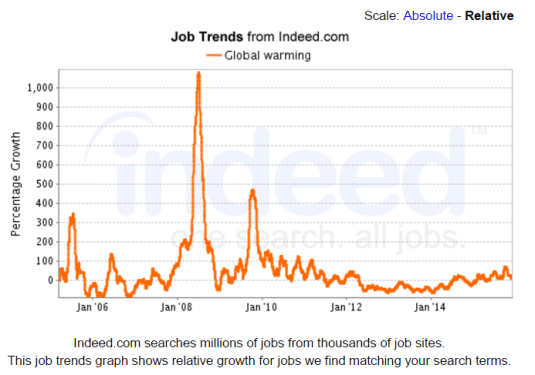
A lot of jobs depend upon action to fight climate change and global warming. Perhaps they should be little bit easier about accusing others of being on the payroll to criticise or advocate for a particular position in those debates.
There has been a recession in the climate change and global warming industry in the last few years. Then there was a bit of a rebound after the Paris climate talks and subsequent agreement to promise to do something but whatever that was is up to you and your domestic political constituencies.

Source: climate change Job Trends | Indeed.com.

Source: climate change Job Trends | Indeed.com.

Source: Global warming Job Trends | Indeed.com.
@GreenpeaceUSA I must photoshop this #TPPANoWay 4 climate treaties
02 Feb 2016 Leave a comment
in environmental economics, global warming, international economic law, international economics, rentseeking

1975: Scientists “almost unanimous” cooling will reduce ag. product. thru 2000
30 Jan 2016 Leave a comment
in environmental economics, global warming
Some birds are more equal than others? @GreenpeaceNZ @GarethMP
28 Jan 2016 Leave a comment
in energy economics, environmental economics, environmentalism
Al Gore and snow on Mount Kilimanjaro
25 Jan 2016 1 Comment
in environmental economics, global warming
Electricity from new #wind 3x more costly than existing #coal @GarethMP
22 Jan 2016 1 Comment
in energy economics, environmental economics, global warming Tags: power prices, wind power
Wind has exceeded 1% of the world’s energy needs in 2015
21 Jan 2016 Leave a comment
in economic history, energy economics, environmental economics Tags: wind power
Area needed to power the Entire World with Solar Power
17 Jan 2016 Leave a comment
in energy economics, environmental economics
IPCC summaries of cost of #globalwarming @greencatherine @GreenpeaceNZ
16 Jan 2016 Leave a comment
in applied welfare economics, energy economics, environmental economics, global warming

SOURCE: Table 10.B.1, IPCC WGII AR5, p. 82 via
Carbon trading, fisheries quotas & deregulatory takings @cjsbishop @franks_lawyer
16 Jan 2016 Leave a comment
in applied price theory, energy economics, environmental economics, law and economics, property rights, Public Choice
 Like carbon trading permits, an individual transferable quota (ITQ) to a fish catch can be construed as a exclusive, perpetual right. An individual transferable quota (ITQ) is an allocated privilege to land a specified portion of the annual fish catch.
Fisheries regulators consider ITQ quota shares not to be property, but to convey a privilege to catch an amount of fish or shellfish in a given year that can be renewed or revoked. ITQs are quota shares may represent a different resource quantity every year as the total allocated catch may vary from year to year. Nonetheless, the ability to sell or lease ITQ shares implies a more enduring, if not permanent, fishing access privilege.
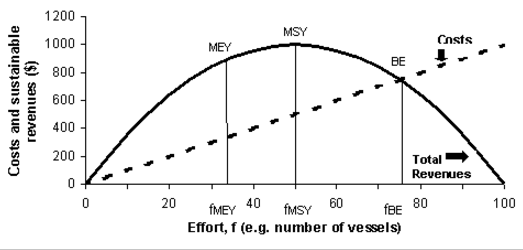
No one has yet successfully argued that the ability to adjust and modify an ITQ program constitutes grounds for a regulatory taking in the USA.
The Australian courts have found that fishing entitlements, although similar in terms of the privileges conferred, are not the common law property right of profit á prendre. They are a statutory entitlement. A profit á prendre is a right to take part of the soil, minerals, natural produce including fish and wild animals. The person does not own the thing gathered whilst it is on the land, but has a right to gather it.
Compensation for modification and extinguishment of these rights depends on whether there is compensation payable under applicable legislation or on whether the plaintiffs can rely on constitutional guarantees of acquisition of property on just terms. The courts have clearly indicated that fishing entitlements are rights created by government as means of regulating the fishing industry and are thus governed by the legislation that created them.

By annulling that legislation, the entitlement no longer exists. By modifying the legislation, the entitlement is redefined. Statutory licences are ‘inherently susceptible’ to modification or extinguishment.
See ‘ITQs and Property Rights A review of Australian case law’ by Sevaly Sen, Barry Kaufmann and Gerry Geen Fisheries Economics, Research and Management Pty. Ltd. Australia
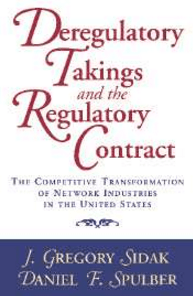
Deregulatory takings is another name for reducing the size of carbon trading permits and individually transferable fisheries quotas. There is a large literature on deregulatory takings and regulatory contracts in the USA.
In electric power generation deregulation, ‘Stranded Costs’ represents the existing investments in infrastructure for the incumbent utility which may become redundant in a competitive environment. Stranded costs can also be defined as any investment that will be less valuable under competition than under regulation. Stranded costs are another name for the transitional gains trap.
Given there are no constitutional protections against regulatory takings, it would be ironic that there were constitutional protections against deregulatory takings.

It would be even more ironic that the viability of carbon trading is undermined by the unwillingness of the environmental movement to accept investor certainty over individually tradable quotas to a fishery catch. High-handed reductions of fisheries quotas set the stage for the same in carbon trading. Given that sovereign risk, the business community and investors will be less willing to support the regime been established in the first place.

I used to write essays about the threats of global cooling in high school
16 Jan 2016 Leave a comment
in economic history, economics of media and culture, energy economics, environmental economics, global warming Tags: climate alarmism, conjecture and refutation, global cooling, global warming, growth of knowledge, rational irrationality
Al Gore and Arctic ice
11 Jan 2016 1 Comment
in environmental economics, global warming Tags: Al Gore, climate alarmism
 Utopia, you are standing in it!
Recent Comments