How to get a tinfoil hat
26 Nov 2015 Leave a comment
in environmental economics, health economics Tags: conspiracy theories, quackery, Quacks
Mitchell And Webb – The soothsayer
25 Nov 2015 Leave a comment
in economics of media and culture, economics of natural disasters, economics of religion, environmental economics Tags: Mitchell and Webb
The payoff from different energy investments
24 Nov 2015 Leave a comment
in energy economics, environmental economics Tags: atomic energy, Big Solar, Big Wind, coal power, nuclear power, solar power, wind power
@GreenpeaceNZ @RusselNorman confuse thuggery with peaceful protest against oil exploration
24 Nov 2015 Leave a comment
in constitutional political economy, energy economics, environmental economics, environmentalism, politics - New Zealand
Greenpeace thugs today climbed aboard a Government science ship that will search for oil. Three Greenpeace activists have locked themselves to the mast with others secured to various areas on deck. They unfurled a banner reading: “Climb it Change” and intend to stay as long as possible.
https://twitter.com/gen_tweets1/status/668891794726256640
Greenpeace are keen to pass laws to save the environment but they’re more than happy to break laws they disagree with. I wonder if they extend that same courtesy to others they regard as less enlightened than them?
Greenpeace expects others to obey the laws for which Greenpeace lobbied. Why does Greenpeace think they can break laws that others secured through lawful, peaceful democratic action? Is some peaceful democratic action more equal than others? Why does Greenpeace think their vote counts more than mine?
The Greenpeace vandals who trespassed at Parliament a few months ago by climbing up to put signs down showed a flagrant disregard of the ample possible options for peaceful protest right outside. In their favour, they showed some sort of fidelity to law by later pleading guilty in court. That showed an acknowledgement that what they did was a criminal offence.
John Rawls makes the point that the purpose of civil disobedience is not to impose your will upon others but through your protest to implore them to reconsider their position and change the law or policy you are disputing.
Rawls argues that civil disobedience is never covert or secretive; it is only ever committed in public, openly, and with fair notice to legal authorities. Openness and publicity, even at the cost of having one’s protest frustrated, offers ways for the protesters to show their willingness to deal fairly with authorities. Rawls argues:
- for a public, non-violent, conscientious yet political act contrary to law being done (usually) with the aim of bringing about a change in the law or policies of the government;
- that appeals to the sense of justice of the majority;
- which may be direct or indirect;
- within the bounds of fidelity to the law;
- whose protesters are willing to accept punishment; and
- although civil disobedience involves breaking the law, it is for moral rather than selfish reasons; the willingness to accept arrest is proof of the integrity of the act.
Rawls argues, and too many forget, that civil disobedience and dissent more generally contribute to the democratic exchange of ideas by forcing the dominant opinion to defend their views.
https://twitter.com/nzheraldvideo/status/668968510060564480
Legitimate non-violent direct action are publicity stunts to gain attention and provoke debate within the democratic framework, where we resolve our differences by trying to persuade each other and elections.
The civil disobedient is attempting to appeal to the “sense of justice” of the majority and a willingness to accept arrest is proof of the integrity of the act says Rawls:
…any interference with the civil liberties of others tends to obscure the civilly disobedient quality of one’s act.
Rawls argues that the use or threat of violence is incompatible with a reasoned appeal to fellow citizens to move them to change a law. The actions are not a means of coercing or frightening others into conforming to one’s wishes. That is a breach of the principles of a just society.
Too many acts of non-violent direct action aim to impose their will on others rather than peaceful protests designed to bring about democratic change in the laws or policies. That ‘might does not make right’ is fundamental to democracy and the rule of law. As United States Supreme Court Justice Antonin Scalia said
The virtue of a democratic system [with a constitutionally guaranteed right to free speech] is that it readily enables the people, over time, to be persuaded that what they took for granted is not so and to change their laws accordingly.
John Rawls’ view that fidelity to law and democratic change through trying to persuade each other is at the heart of civil disobedience reflects the difference between the liberal and the left-wing on democracy and social change as Jonathan Chait observed:
Liberals treat political rights as sacrosanct. The left treats social and economic justice as sacrosanct. The liberal vision of political rights requires being neutral about substance. To the left, this neutrality is a mere guise for maintaining existing privilege; debates about “rights” can only be resolved by defining which side represents the privileged class and which side represents the oppressed… Liberals believe that social justice can be advanced without giving up democratic rights and norms. The ends of social justice do not justify any and all means.
If you want to reform the world, do what we ordinary people have to do: change your vote, write to an MP, protest, donate to or even join a political party, or run for parliament.
https://twitter.com/siana_tweets/status/668927311928954880
The great strength of democracy is a small group of concerned and thoughtful citizens can band together and change things by mounting single issue campaigns or joining a political party and running for office and winning elections or influencing who wins.
Yesterday’s majority of the vote sooner or later and often sooner than they expect will break off into different minorities on the next big issue of the day. These newly formed minorities will use that same ability to band together as a minority to block vote to protect what they think is important and advance agendas they think are to be wider benefit despite the opinion of the current majority to the contrary. All reforms start as a minority viewpoint.
Indeed, it is a strength of democracy – small groups of concerned citizens banding together – is what is holding up legislating in many areas. It is not that minorities are powerless and individuals are voiceless. It is exactly the opposite.
Nothing stirs up the impassioned (and most other people as well) more than depriving them of their right to support or oppose what is important to them through political campaigns and at an election. The losing side, we all end up on the losing side at one time or another, are much more likely to accept an outcome if they had their say and simply lost the vote at the election or in Parliament.
Greenpeace should show fidelity to democracy by obeying the laws supported by others when they were in the majority. Yes, Greenpeace is in despair over oil exploration. Others rejoice in it but that clash of strong opinions is the nature of any important controversy.
Greenpeace wants to do is rob the winners of their honest democratic victory over the balance between oil exploration and other energy options. Greenpeace are also robbing themselves of a fair defeat.
A fair defeat flows from laws and policies secured through normal democratic means knowing that one day you may be in a majority. Only by respecting the will of the majority when you are in the minority do you have any right to expect future minorities to respect your honest democratic victories as the majority of some future day. Democratic majorities of patched together through give-and-take and the reality that even the most important policies may be reversed in the future.
Right now, the thuggery of Greenpeace is poisoning the democratic process. Greenpeace should respect the political process because democracy alone can produce compromises satisfying a sufficient mass of the electorate on deeply felt issues so as to not distort the remainder of the democratic process. Greenpeace owes New Zealand democracy better than what it is doing today
Niagara Falls in 1969 with no water
24 Nov 2015 Leave a comment
in environmental economics, resource economics Tags: Niagara Falls
Niagara Falls in 1969 with no water. The water was diverted so that engineers could strengthen areas & slow erosion. http://t.co/5cOZ3CLWRl—
The World (@World) September 28, 2015
@NZGreens say something sensible on global warming @jamespeshaw @GreenpeaceNZ
23 Nov 2015 Leave a comment
in environmental economics, global warming, politics - New Zealand, Thomas Schelling
It is a stretch to say that New Zealand Greens have accepted that adaptation is the only proper response to the threat of global warming.
Nonetheless, their call for a plan for adaptation is an acceptance that more must be done than hoping for the best that a massively expensive international public good will be provided through a climate change treaty.

It is time for the environmental movement to face up to the fact that there never will be an international treaty to restrain carbon emissions.
The practical way to respond to global warming is healthier is wealthier, richer is safer. Faster economic growth creates more resources for resilience and adaptation to a changing environment.
Tom Schelling has been involved with the global warming debate since chairing a commission on the subject for President Carter in 1980.
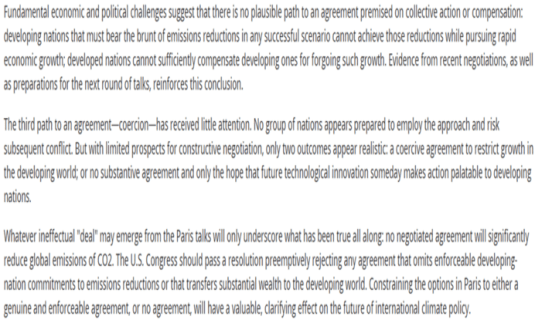
Schelling is an economist who specialises in strategy so he focuses on climate change as a bargaining problem. Schelling drew in his experiences with the negotiation of the Marshall Plan and NATO.

International agreements rarely work if they talk in terms of results. They work better if signatories promise to supply specific inputs – to perform specific actions now. Individual NATO members did not promise to slow the Soviet invasion by 90 minutes if it happened after 1962. NATO members promised to raise and train troops, procure equipment and supplies, and deploy these assets geographically. All of these actions can be observed, estimated and compared quickly.
The Kyoto Protocol commitments were made not about actions but to results that were to be measured after more than a decade and several elections.
Climate treaties should promise to do certain actions now such as invest in R&D and develop carbon taxes that return the revenue as tax cuts. If the carbon tax revenue is fully refunded as tax cuts, less reliable countries, in particular, have an additional incentive to collect the carbon tax properly to keep their budget deficits under control.
As for the chances of a global treaty, Schelling has said:
The Chinese, Indonesians, or Bangladeshis are not going to divert resources from their own development to reduce the greenhouse effect, which is caused by the presence of carbon-based gases in the earth’s atmosphere. This is a prediction, but it is also sound advice. Their best defence against climate change and vulnerability to weather in general is their own development, reducing their reliance on agriculture and other such outdoor livelihoods. Furthermore, they have immediate environmental problems — air and water pollution, poor sanitation, disease — that demand earlier attention.
The costs of global warming to New Zealand are small. For developing countries, their best protection against global warming is rapid economic development through capitalism and freedom.
The latest report from the Intergovernmental Panel on Climate Change’s (IPCC) Working Group II has concluded that global warming of 2.5˚C would cost the equivalent to losing between 0.2-2.0% of annual income.

The truth behind NZ wind power @GreenpeaceNZ @GarethMP @RusselNorman
23 Nov 2015 Leave a comment
in energy economics, environmental economics, politics - New Zealand
Solar and wind in India will remain uncompetitive for the next 25 years
21 Nov 2015 Leave a comment
in development economics, energy economics, environmental economics Tags: India, solar energy, wind power
The inconvenient truths of @AlGore
20 Nov 2015 Leave a comment
in environmental economics, global warming Tags: climate alarmism, expressive voting, political propaganda, rational ignorance, rational irrationality
Unlike @Subway @WalmartToday understands the #DHMO awareness campaign
19 Nov 2015 Leave a comment
in economics of media and culture, economics of regulation, environmental economics, health economics Tags: political satire, precautionary principle, Subway, Walmart
The western environmental movement’s role in China’s one-child policy
19 Nov 2015 Leave a comment
in development economics, environmental economics, environmentalism, growth disasters, growth miracles, health economics, labour economics, labour supply, population economics Tags: China, cranks, doomsday profits, doomsday prophecies, one child policy
Payoff from Paris @COP21 @garethmorgannz @jamespeshaw @greenpeaceNZ @RusselNorman
17 Nov 2015 Leave a comment
in applied welfare economics, environmental economics, global warming
@HelenClarkUNDP @OxfamGB @GreenpeaceUSA support energy poverty in Africa
14 Nov 2015 1 Comment
in development economics, energy economics, environmental economics, growth disasters, growth miracles Tags: Africa, child poverty, energy poverty, extreme hunger, extreme poverty, global hunger, Greenpeace, Oxfam, The Great Escape
 Utopia, you are standing in it!

Recent Comments