Malaria was prevalent in Europe & USA
More in my Visual History of Global Health: OurWorldInData.org/VisualHistoryO… http://t.co/Fm21vXZJkS—
Max Roser (@MaxCRoser) June 08, 2015
Where was malaria once prevalent?
14 Jun 2015 Leave a comment
in development economics, environmental economics, global warming, growth disasters, growth miracles, health economics Tags: endemic diseases, global warming, infectious diseases, malaria, The Great Escape
Can anti-GMOs activists be trekkers?
13 Jun 2015 Leave a comment
in environmental economics, health economics, TV shows Tags: GMOs antiscience left, star trek
Conspiracy theories versus the supply and demand for scientists who are approachable about their findings
11 Jun 2015 5 Comments
in environmental economics, health economics Tags: anti-vaccination movement, bribery and corruption, climate alarmists, conjecture and refutation, conspiracy theories, conspiracy theorists
Formal carbon pricing initiatives around the world
11 Jun 2015 Leave a comment
in environmental economics, global warming Tags: bootleggers and baptists, carbon pricing, carbon tax, expressive voting, global warming, green rent seeking
#Carbonpricing is expanding w/ initiatives now valued at nearly $50 bil: wrld.bg/NBuz0 http://t.co/qELgE97i1p—
World Bank Pubs (@WBPubs) May 29, 2015
Carbon pricing expanded in the last 18 months. New report shows where & how: wrld.bg/Nrhsq http://t.co/D4uQtjl6EZ—
IFC (@IFC_org) May 27, 2015
Solar power versus economic development
11 Jun 2015 Leave a comment
in development economics, energy economics, environmental economics, environmentalism, global warming, growth disasters, growth miracles Tags: renewable energy, solar power

What it would take for the US to run on 100% renewable energy
10 Jun 2015 Leave a comment
in energy economics, environmental economics, global warming, politics - USA Tags: expressive voting, geothermal power, hydroelectric power, rational ignorance, rational irrationality, renewable energy, solar power, tidal power, wind power
/cdn0.vox-cdn.com/uploads/chorus_asset/file/3768834/jacobson-us-renewables-2015.png)
The price, output and acreage effects of a GMO ban
08 Jun 2015 Leave a comment
in development economics, economics of regulation, environmental economics, growth disasters, growth miracles, health economics, politics - Australia, politics - New Zealand, politics - USA, population economics, technological progress Tags: agricultural economics, expressive voting, extreme poverty, global hunger, global poverty, GMOs, Left-wing hypocrisy, rational ignorance, rational irrationality, The Great Fact
Organic farming is a gift….
facebook.com/welovegv http://t.co/iu8Jq0KcHD—
C. S. Prakash (@AgBioWorld) June 05, 2015
Projected increases in corn and soy prices in a world without GMOs
ageconsearch.umn.edu/bitstream/2049… http://t.co/PNydjpl59K—
C. S. Prakash (@AgBioWorld) June 08, 2015
If you outlaw GMOs, be prepared to bring millions of acres of forest land, cropland & pasture under farming http://t.co/H9ftkxhXYe—
C. S. Prakash (@AgBioWorld) June 08, 2015
If GMOs are banned today in the US, what would be the crop yield reduction? http://t.co/pEn73PODcR—
C. S. Prakash (@AgBioWorld) June 08, 2015
How to argue for doing nothing about global warming when arguing for a climate club enforced by green tariffs!
08 Jun 2015 1 Comment
in environmental economics, global warming, politics - Australia, politics - New Zealand, politics - USA, Public Choice Tags: climate treaties, club goods, free-riders, global warming, green tariffs, international public goods
The best case I’ve seen recently for doing nothing about global warming was put by those arguing with the greatest sincerity and considerable technical skill that the next international climate treaty should be built around a climate club of those that comply with its obligations with green tariffs on those who do not join.
I have long argued that green tariffs are the only reason to do anything about climate change. Much better to collect the revenue ourselves than let it go into the pockets of a foreign taxman.
William Nordhaus has proposed climate clubs as a way of overcoming free riding in international climate negotiations. Specifically, the international climate treaty should authorise members to impose green tariffs on non-members to encourage them to impose their own carbon taxes and carbon emission targets. This has been done before with the Montréal protocol on CFCs. To encourage the phase-out of CFCs countries that did not commit to do so simply could not trade in those goods with members of the club.
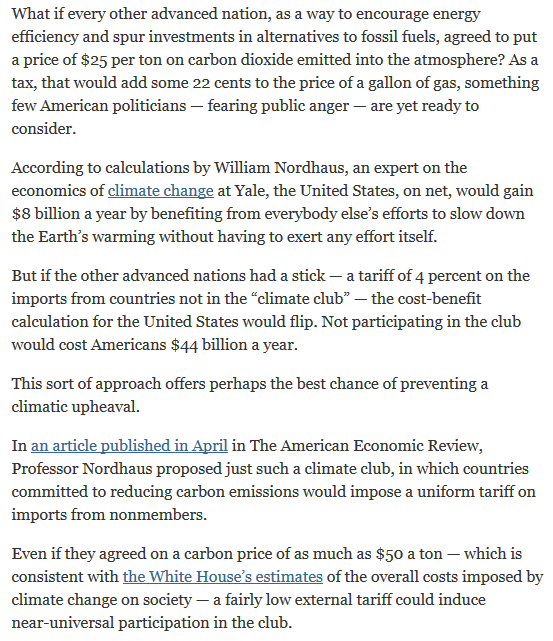
via Climate Deal Badly Needs a Big Stick – NYTimes.com.
4%! A 4% global green tariff is all that is necessary under a climate change treaty that proposes that a carbon price of $50 to apply globally! A 4% green tariff is hardly worth worrying about considering tariffs used to be much much higher than that.
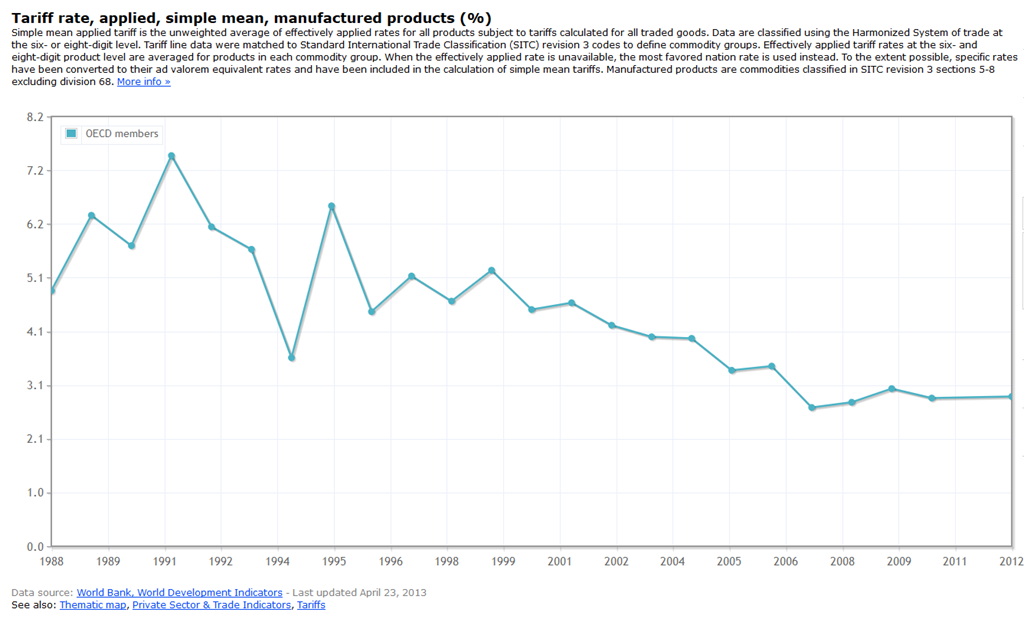
Given all the stories of why woe and doom touted out by the climate alarmists, climate salvation and the keys to environmental heaven should cost much more than 4% tax?! Your sins are forgiven for a 4% green tariff! Big problems such as a climate crisis are not solved with a 4% green tariff.
I think this green tariff of 4% is an own goal. It reinforces the clear message from the economics of climate change that global warming is actually a small economic problem not a large one.
For developed countries, global warming will be at most a minor irritant. For developing countries, their best solution and the solution they have most control over is to develop faster and become a developed country.
Climate change saving hundreds of thousands of lives in Africa
08 Jun 2015 Leave a comment
in development economics, environmental economics, global warming, growth disasters, growth miracles Tags: Africa, agricultural economics, climate alarmism, drought, extreme poverty, famine, global poverty, global warming
Climate change saving hundreds of thousands of lives in Africa
thetimes.co.uk/tto/environmen…
@BarackObama hates that. http://t.co/cneiSS60wT—
Steve Goddard (@SteveSGoddard) June 02, 2015
This would have been blamed on global warming if it happened today
07 Jun 2015 Leave a comment
in environmental economics, global warming Tags: climate alarmism, global warming
Niagara falls without water. 1969 http://t.co/9hNAtiw8rj—
History Pictures (@CombinedHistory) June 05, 2015
The latest update on CMIP5 simulations & global temperature observations
07 Jun 2015 Leave a comment
in environmental economics, global warming Tags: climate alarmism, conjecture and refutation, global warming
The latest update to the comparison of CMIP5 simulations & global temperature observations: climate-lab-book.ac.uk/comparing-cmip… http://t.co/iYXfF3QGC5—
Ed Hawkins (@ed_hawkins) June 05, 2015
"accelerating" global warming is now touted as "no slow down”
06 Jun 2015 Leave a comment
in environmental economics, global warming Tags: climate alarmism, conjecture and refutation, expressive voting, global warming
What once was once touted as "accelerating" #globalwarming is now touted as "no slow down." Science evolves! @CatoCSS http://t.co/KMbnzJFM9p—
Chip Knappenberger (@PCKnappenberger) June 05, 2015
When Will Climate Scientists Say They Were Wrong?
31 May 2015 4 Comments
in environmental economics, global warming Tags: climate alarmism, conjecture and refutation, global warming
This graph shows the remarkable disconnect between predicted global warming & real world data: j.mp/1JZEmn5 http://t.co/6ckYuW5ozA—
Cato Institute (@CatoInstitute) May 30, 2015
via When Will Climate Scientists Say They Were Wrong? | Cato Institute.

 Utopia, you are standing in it!

Recent Comments