Killer green technologies alert – electric cars
25 Feb 2015 Leave a comment
in environmental economics, global warming, health economics Tags: electric cars, killer green technologies
The shifting sources of greenhouse gas emissions
24 Feb 2015 Leave a comment
in development economics, environmental economics, global warming, growth miracles, politics - Australia, politics - New Zealand, politics - USA Tags: China, climate alarmism, free riding, game theory, global public goods, global warming

The sustainability of wind turbines
24 Feb 2015 Leave a comment
in energy economics, environmental economics, global warming Tags: wind welfare
On arguments from authority
22 Feb 2015 Leave a comment
in environmental economics, environmentalism, global warming, liberalism, politics - Australia, politics - New Zealand, politics - USA Tags: climate alarmism, conjecture and refutation, philosophy of science
The real corngate
22 Feb 2015 Leave a comment
in energy economics, environmental economics Tags: ethonol
The smart, green economy, not – electric cars version
20 Feb 2015 Leave a comment
in energy economics, environmental economics, global warming, rentseeking Tags: Big Green, Bjørn Lomborg, electric cars, green rent seeking
Al Gore Buys CA Shoreline Mansion…Awkward
19 Feb 2015 Leave a comment
Al Gore has snapped up an ocean front property in California. Obviously, rising sea levels are not any time soon for him when it comes to putting his money where his mouth is. The only explanation is that Mr. Gore does not actually believe his predictions of doom.


Former Vice President Al Gore and his wife, Tipper, have added a Montecito/ Santa Barbara CA -area property to their real estate holdings, reports the Montecito Journal.
The couple spent $8,875,000 on an ocean-view villa on 1.5 acres with a swimming pool, spa and fountains, a real estate source familiar with the deal confirms. The Italian-style house has six fireplaces, five bedrooms and nine bathrooms.
Some of the most memorable images from Al Gore’s movie, An Inconvenient Truth, are the graphics that show how rising ocean levels will dramatically alter our planet’s coastlines. As Greenland’s ice sheets collapse, Gore predicts that our shores will be flooded and sea-bordering cities will sink beneath the water leaving millions of people homeless. His narration tells the audience that, due to global warming, melting ice could release enough water to cause at 20-foot rise in sea level “in the near future.” Al PT…
View original post 2 more words
Niagara Falls has frozen over
19 Feb 2015 Leave a comment
in environmental economics, global warming Tags: climate alarmism, Niagra Falls

HT: dailymail.co.uk
Who gains from global warming alarmism?
18 Feb 2015 2 Comments
in environmental economics, global warming, Public Choice, rentseeking Tags: activists, climate alarmism, global warming, green rent seeking
Why did environmentalists change her mind about pollution taxes being a ‘licence to pollute’?
18 Feb 2015 Leave a comment
in energy economics, environmental economics, environmentalism, global warming
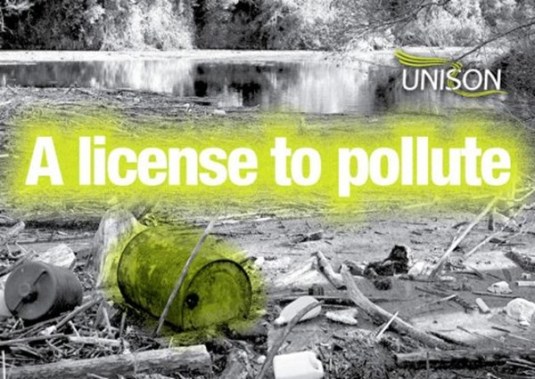
When I was a lad, the environmental movement was dead set against pollution taxes. Robert N. Stavins and Bradley W. Whitehead said in 1992:
…for many years, market-based incentives were characterized by environmentalists, not only as impractical, but also as “licenses to pollute.” Over time, environmental groups have frequently applied a different and more rigorous standard in measuring market-based systems against their command-and-control counterparts, possibly because of their belief that market-based systems legitimize pollution by purporting to sell the right to pollute. This old suspicion likely continues among many rank-and-file environmentalists.
How times have changed. Now the environmental movement of the biggest champions of carbon taxes as well as carbon trading. What gives? Anything more than cynical political opportunism? Concede nothing until the last moment when it is tactically opportune to sideline opposition.
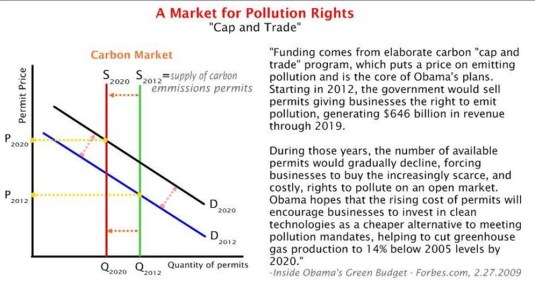
Initially, all environmental regulations were command and control regulations that specified quantities and the technologies to be mandated and gave no role to prices to ensure that the pollution reduction was done by those who could do it cheapest. Robert Crandall noticed the shift in position in his recent essay on pollution controls:
… environmentalists have increasingly realized that markets can work to allocate pollution reduction responsibilities efficiently among firms and across industries. Although the command-and-control approach is still the norm, environmental lobbyists and legislators have, on occasion, considered market-based approaches to pollution control. Most of the proposals for limiting global warming, for example, explicitly include market-based approaches for controlling carbon dioxide emissions.
The reason for the change in tactics by the environmental movement is quite straightforward. The deadweight cost of regulation and taxes that leads to increasing resistance from those subject to existing and proposed environmental regulations.
- The deadweight losses of taxes, transfers and regulation are a constraint on inefficient policies (Becker 1983, 1985; Peltzman 1989).
- The deadweight loss is the difference between winner’s gain less the loser’s losses from a tax or regulation-induced change in output. Changes in behaviour due to taxes and regulation reduce output and investment.
- Policies that significantly cut the total wealth available for distribution by governments are avoided because they reduce the payoff from taxes and regulation relative to the germane counter-factual, which are other even costlier modes of redistribution (Becker 1983, 1985).
The rising deadweight cost of regulation due to technological change, and the dissipation of wealth through these rising costs progressively enfeebled environmental groups lobbying for more regulation. This allowed industry and consumers to win the initiative in resisting more environmental regulation. The cost of reducing carbon emissions is a classic example. Another is the United States acid rain allowance market.
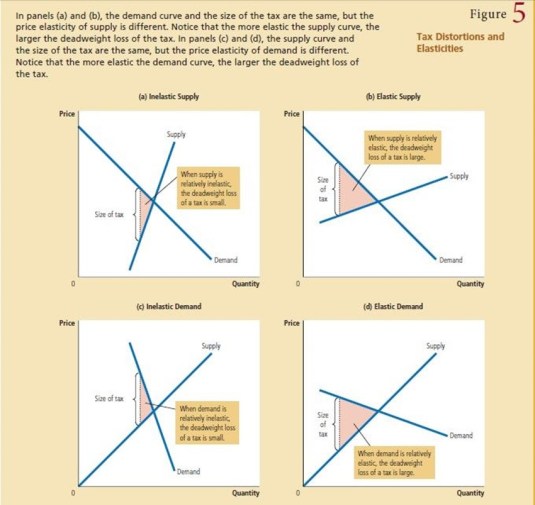
In the case of carbon emissions, the additional political pressure that the winners had to exert to keep the same reduction in carbon emissions had to overcome rising pressure from the losers such as carbon intensive industries and they consist customers to escape their escalating losses of complying with any sort of further carbon emission regulation.
Eventually, the fight was no longer worthwhile relative to the alternatives. Taxed, regulated and subsidised groups can find common ground in wealth enhancing policies and an encompassing interest in mitigating any reduction in wealth from public policies (Becker 1983, 1985; Peltzman 1989).

In the case of global warming, both the environmental movement, and carbon intensive industries, and consumers find common ground in finding a cheaper way of reducing carbon emissions. That is done by agreeing to either carbon trading or carbon taxes. Coalitions of environmentalists and industry also form where carbon emission taxes or trading disadvantage the competition of some industries and some competitors within the same industry.

Carbon trading was a classic example of these dark coalitions. There’s a big difference in their cost to industry depending on whether carbon trading quotas are auctioned or given away to the incumbent firms for free or at a discount price.
It’s not easy to be green: the cost of fossil fuels divestments to the New Zealand superannuation fund
17 Feb 2015 Leave a comment
in economics of bureaucracy, energy economics, environmental economics, environmentalism, financial economics, global warming, Public Choice, rentseeking Tags: efficient market hypothesis, fossil fuel disinvestment, Global disinvestment day, Green Party of New Zealand, index linked investing, privatisation, state ownership
The Green Party of New Zealand wants the New Zealand superannuation fund to sell its $676 million in fossil fuel investments. For those not in the know, this government investment fund is worth about $25 billion and is funded by present taxes to pay for the universal old age pension in New Zealand. Its current investment strategy seems to rely heavily on index linked funds that minimise management and trading costs.
The Government uses the Fund to save now in order to help pay for the future cost of providing universal superannuation.
In this way the Fund helps smooth the cost of superannuation between today’s taxpayers and future generations.
In common with the endowment funds of the American universities, that $676 million is about 2% of the total New Zealand superannuation portfolio of about NZ$25 billion.

Any portfolio manager risks considerable fees if she must monitor the entire portfolio because 2% is of dubious moral stature.

The main cost of divestiture is compliance costs to prevent fossil fuel investments drifting back into the portfolio through the routine day to day investments of other companies within their portfolios as these other firms expand into new businesses or diversified. The entire portfolio must be monitored for this risk.

American universities found that fossil fuels divestment rules out indexed linked funds as a class, along with their low management and trading fees. Ethical investors must move to actively managed investment funds which are perhaps a third more expensive in management fees.

If a move to a fossil fuel free portfolio rules out passive indexed linked funds, that is a major risk to future returns of the New Zealand superannuation fund. Would this fossil fuels disinvestment including selling the recently acquired Z petrol station network by the New Zealand superannuation fund?
Z Energy now owns and manages these businesses, which include:
- a 15.4 per cent stake in Refining NZ who runs New Zealand’s only oil refinery.
- a 25 per cent stake in Loyalty New Zealand who run Fly Buys
- over 200 service stations
- about 90 truck stops
- pipelines, terminals and bulk storage
As usual, in the course of argument for disinvestment by the government investment fund, the Green Party makes an excellent argument for the privatisation not only of state owned enterprises but of the New Zealand superannuation fund.
Rather than have one victory at a time, the Greens want the NZ superannuation fund to use the funds from the disinvestment to reinvest in pet projects of politicians. The green party co-leader said:
Money released from divestment can be reinvested in the rapidly growing renewable energy and energy efficiency sectors, helping to hasten the transition of our economy to a low-carbon future.
This makes government investment funds the playthings of politicians so they can never match the returns of a genuinely privately owned investment fund.
How are the computer predictions of global warming going?
13 Feb 2015 2 Comments
in environmental economics, global warming Tags: climate alarmists, conjecture and refutation

HT: dailymail.co.uk
Deciding science by voting – updated
13 Feb 2015 1 Comment
in economics of religion, environmental economics, global warming, Public Choice, rentseeking Tags: appeal to authority, climate alarmism, conjecture and refutation, global cooling, global warming, JS Mill, logical fallacies, marketing, persuasion
 One of the troubling aspects of climate alarmism is its repeated appeals to authority. Rather odd for a bunch left-wingers trying to overthrow the status quo and the established order.
The most obvious manifestation of this tactics to go on about how there is a consensus of scientists, the science is settled or the debate is over.

These repeated and unimaginative appeals to authority are either to champion the existing scientific views about global warming or to suggest that previous scientific predictions of global cooling in the 1960s and 1970s were only a minority view.

Again, an appeal to authority is an odd communication strategy for the climate alarmists. Their movement is made up more of young people because of the overweening conceit of youth. Many of their recruits are young people.The debate over the causes of global warming and its likelihood must be repeated over and over again, if only to introduce and socialise their new recruits to the arguments and counterarguments.
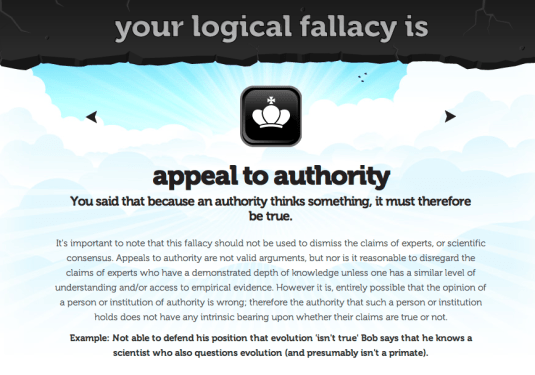
One of the reasons I changed my mind on the economics and politics of climate science is these repeated appeals to authority and general bully boy tactics made me suspicious of the underlying merits of the arguments canvassed.

The only profession I know of which actually does take a vote on what is the truth in a scientific sense is psychiatrists. Their American annual conference has a vote on what to put out their professional diagnostic manual. This science by voting never went well with various psychiatric disorders voted in and out of their professional diagnostic manual on the basis of politics, cultural bias and the medicalisation of human distress.

John Stuart Mill emphasise the value of even completely false arguments in keeping us on our toes. His scenarios involves both parties of opinion, majority and minority, having a portion of the truth but not the whole of it. He regards this as the most common of the three scenarios, and his argument here is very simple. To enlarge its grasp of the truth the majority must encourage the minority to express its partially truthful view.
J.S. Mill pointed out that critics who are totally wrong still add value because they keep you on your toes and sharpened both your argument and the communication of your message.
If the righteous majority silences or ignores its opponents, it will never have to defend its belief and over time will forget the arguments for it. As well as losing its grasp of the arguments for its belief, J.S. Mill adds that the majority will in due course even lose a sense of the real meaning and substance of its belief. What earlier may have been a vital belief will be reduced in time to a series of phrases retained by rote. The belief will be held as a dead dogma rather than as a living truth.
Three scenarios – the majority is wrong, partly wrong, or totally right – exhaust for Mill the possible permutations on the distribution of truth, and he holds that in each case the search for truth is best served by allowing free discussion.
Mill thinks history repeatedly demonstrates this process at work where silencing falsehood led to dogmas rather than living truth. He offered Christianity as an illustrative example. By suppressing opposition to it over the centuries Christians ironically weakened rather than strengthened Christian belief. Mill thinks this explains the decline of Christianity in the modern world. Christians forgot why they were Christians and in the Reformation could not successfully rebut who came up with valid criticisms of their existing profession of faith.
Going on about how climate science is settled and the debate is over is bad tactics for the climate alarmists. Attempts to close the debate this way provokes suspicion among those who expect some attempt to persuade them rather than to instruct them from on high. Presumptuousness is never a good persuasion tactic nor is dismissiveness.
A salesman trying to sell a product would never use any of the persuasion tactics or selling tactics of the climate alarmists. They would quickly go out of business if they did.
 Utopia, you are standing in it!
Recent Comments