Why do @AOC @BernieSanders @SenWarren @GreenpeaceUSA @Greens @NZGreens hate fracking?
26 Feb 2020 Leave a comment
in energy economics, environmental economics, environmentalism, global warming, politics - USA
#climateemergency #globalwarming @AOC @BernieSanders @SenWarren @Greens @NZGreens @jamespeshaw @Greenpeace
26 Feb 2020 Leave a comment
in economics of natural disasters, energy economics, environmental economics, global warming, politics - Australia, politics - New Zealand, politics - USA Tags: 2020 presidential election, climate alarmists, pessimism bias, regressive left

Yet another shortcoming @Greens @NZGreens @jamespeshaw @mfe_news @JulieAnneGenter
24 Feb 2020 Leave a comment
in energy economics, environmental economics, global warming, politics - Australia, transport economics Tags: electric cars

More on anti-science @Greens @GreenpeaceAP #globalwarming #climateemergency #FakeNews
24 Feb 2020 Leave a comment
in economics of natural disasters, energy economics, environmental economics, global warming, politics - Australia Tags: climate alarmists, pessimism bias, rational irrationality, regressive left

Bad news for #globalwarming @Greens #climateemergency #FakeNews
24 Feb 2020 Leave a comment
in economics of education, economics of information, economics of natural disasters, energy economics, environmental economics, global warming, politics - Australia Tags: climate alarmists, expressive voting, pessimism bias, rational irrationality, regressive left

The Myth of the Rational Voter: Why Democracies Choose Bad Policies – Annual Casey-McIlvane Lecture
24 Feb 2020 1 Comment
in comparative institutional analysis, constitutional political economy, economics of bureaucracy, economics of education, economics of information, economics of regulation, environmental economics, financial economics, industrial organisation, international economics, James Buchanan, labour economics, law and economics, macroeconomics, Marxist economics, politics - USA, Public Choice, public economics, rentseeking Tags: rational ignorance, rational irrationality
#climateemergency #globalwarming @GreenpeaceAP @Greens
23 Feb 2020 Leave a comment
in energy economics, environmental economics, global warming, politics - Australia Tags: solar power, wind power

#endcoal #endoil but gas has lower emissions and is far cheaper now because of fracking @Greenpeace @Greens @NZGreens #globalwarming #climateemergency
23 Feb 2020 Leave a comment

#climateemergency #globalwarming @GreenpeaceAP @Greens @NZGreens
23 Feb 2020 Leave a comment
in energy economics, environmental economics, global warming Tags: atomic energy, nuclear energy

When does the pause matter?
22 Feb 2020 Leave a comment
in applied welfare economics, econometerics, energy economics, environmental economics, global financial crisis (GFC)

See https://www.friendsofscience.org/assets/documents/McKitrick2014_ThePause.pdf and https://www.rossmckitrick.com/uploads/4/8/0/8/4808045/model_obs_comp_nov_2019.pdf
The fact that CO2 emissions lead to changes in the atmospheric carbon concentration is not controversial. Nor is the fact that CO2 and other greenhouse gases (GHGs) absorb infrared energy in the atmosphere and contribute to the overall greenhouse effect. Increases in CO2 levels are therefore expected to lead to atmospheric warming, and this is the basis for the current push to enact policies to reduce GHG emissions.
For more than 25 years, climate models have reported a wide span of estimates of the sensitivity of the climate to CO2 emissions, ranging from relatively benign to potentially catastrophic. These continuing uncertainties have direct policy implications. Economic models for analyzing climate policy are calibrated using climate models, not climate data. In a low-sensitivity model, GHG emissions lead only to minor changes in temperature, so the socioeconomic costs associated with the emissions are minimal. In a high-sensitivity model, large temperature changes would occur, so marginal economic damages of CO2 emissions are larger.
The data show that, over the past two decades, warming has actually slowed down to a pace well below most model projections. Depending on the data set used, there has been no statistically significant temperature change for the past 15 to 20 years. Yet atmospheric GHG levels have increased rapidly over this interval, and there is now a widening discrepancy between most climate model projections and observed temperatures.
Since economic models are trained to match climate models, if climate models overstate the effect of CO2 emissions, economic models will overstate the social damages associated with them. Consequently, there is good reason to suppose that economic models too may be subject to revision over the next few years. Hence, it is essential to build into the policy framework clear feedback mechanisms that connect new data about climate sensitivity to the stringency of the emissions control policy. And since important new information about climate sensitivity is expected within a few years, there is value to waiting for this information before making any irreversible climate policy commitments, in order to avoid making costly decisions that are revealed a short time later to have been unnecessary.
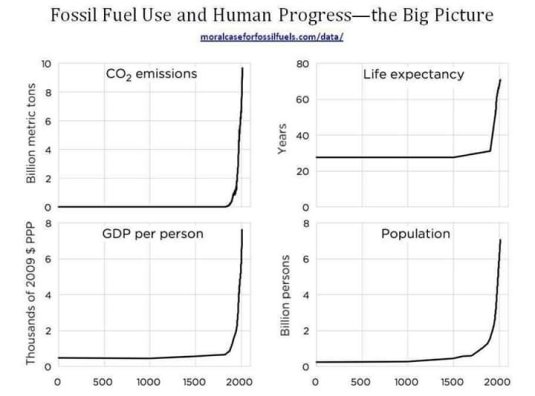
Billions in the developing world have enhanced their lives by using more fossil fuels
22 Feb 2020 Leave a comment
in development economics, energy economics, environmental economics, global warming, growth miracles


Recent Comments