BP’s green pivot has backfired spectacularly, hammering profits and leaving the company vulnerable to a hedge fund siege, writes Jonathan Leake in the Telegraph.
BP Faces “Existential Crisis” After Ruinous Attempt to Go Green
BP Faces “Existential Crisis” After Ruinous Attempt to Go Green
02 Mar 2025 Leave a comment
in applied price theory, economics of climate change, energy economics, entrepreneurship, environmental economics, environmentalism, financial economics, global warming, industrial organisation, politics - USA, survivor principle Tags: 2024 presidential election, climate activists, climate alarmism, efficient markets hypothesis, greenwashing
Mandated Board Diversity Reduces Firm Value
27 Feb 2025 Leave a comment
in applied price theory, discrimination, econometerics, economics of regulation, financial economics, gender, industrial organisation, labour economics, occupational choice, politics - USA Tags: efficient markets hypothesis, sex discrimination
Jon Klick finds that when courts in CA surprisingly invalidated a set of DEI laws, the market value of firms subject to those laws increased: California mandated that firms headquartered in the state include women (SB 826) and underrepresented minorities (AB 979) on their corporate boards. These laws, passed in 2018 and 2020 respectively, were […]
Mandated Board Diversity Reduces Firm Value
The American Rōnin: How Displaced “Disinformation Experts” Are Seeking New Opportunities in Europe and Academia
27 Feb 2025 Leave a comment
in economics of bureaucracy, economics of education, economics of information, economics of media and culture, entrepreneurship, financial economics, industrial organisation, law and economics, liberalism, Marxist economics, politics - USA, property rights, Public Choice, rentseeking Tags: 2024 presidential election, free speech, political correctness, regressive left

Below is my column in the Hill on the new American emigres: “disinformation experts” who are finding themselves unemployed with the restoration of free speech protections. Here is the column:
The American Rōnin: How Displaced “Disinformation Experts” Are Seeking New Opportunities in Europe and Academia
Does the Feldstein-Horioka Puzzle mean National’s Foreign Investment Ambitions Won’t Raise NZ Productivity?
26 Feb 2025 Leave a comment
in applied price theory, econometerics, economic history, financial economics, history of economic thought, international economics, macroeconomics, politics - New Zealand Tags: foreign investment
The NZ Herald’s Editor has declared its journalists will be promoted or fired on the basis of factors like how many clicks they get on their articles. Yes, the Herald is now officially “click bait”. We’re trying to avoid the mistake of writing shallow nonsense at this Blog. So on that note, here’s a somewhat…
Does the Feldstein-Horioka Puzzle mean National’s Foreign Investment Ambitions Won’t Raise NZ Productivity?
Equinor Cut Green Investment In Half
07 Feb 2025 Leave a comment
in economics of climate change, energy economics, environmental economics, environmentalism, financial economics, global warming Tags: greenwashing

By Paul Homewood h/t Ian Cunningham More bad news for the idiot Miliband: Norwegian energy giant Equinor is halving investment in renewable energy over the next two years while increasing oil and gas production.
Equinor Cut Green Investment In Half
Mocking European Statism
04 Feb 2025 1 Comment
in applied price theory, Austrian economics, comparative institutional analysis, economic growth, economics of bureaucracy, economics of regulation, entrepreneurship, environmental economics, financial economics, industrial organisation, international economics, labour economics, labour supply, law and economics, liberalism, macroeconomics, Marxist economics, property rights, Public Choice, public economics, rentseeking, survivor principle, theory of the firm Tags: employment law, European Union
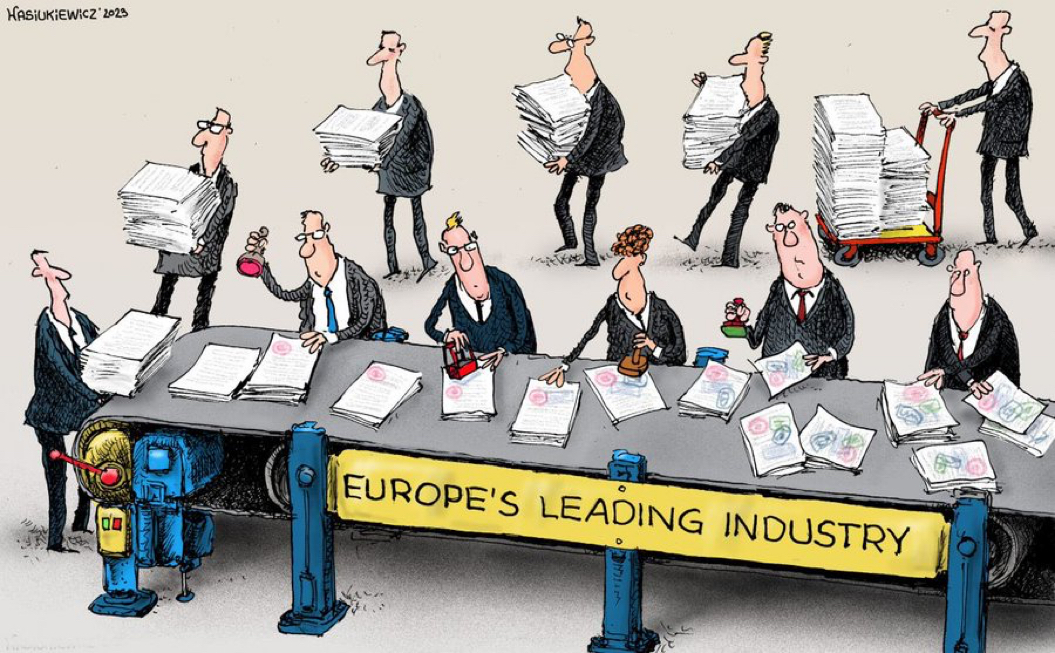
I have a special page for humor involving Europe, but I have not added to it since sharing some Brexit humor in 2016. Let’s being the process of catching up with some amusing cartoons and memes mocking our government-loving cousins on the other side of the Atlantic Ocean. I’ve made the serious point that bureaucrats […]
Mocking European Statism
Can President Trump break the International Corporate Tax Cartel?
01 Feb 2025 Leave a comment
in entrepreneurship, financial economics, fiscal policy, industrial organisation, International law, macroeconomics, politics - USA, Public Choice, public economics Tags: taxation and entrepreneurship, taxation and investment
From the Economist: The international tax system has long suffered from two related problems: firms go to great lengths to book profits in low-tax jurisdictions, and governments thus have strong incentives to compete with each other in cutting levies so as to attract investment [only a dirigiste would consider this a problem]. Hoping to forestall…
Can President Trump break the International Corporate Tax Cartel?
Interview with Eugene Fama: For Whom are Financial Markets Efficient?
28 Jan 2025 Leave a comment
in applied price theory, economics of information, entrepreneurship, financial economics Tags: efficient markets hypothesis, Internet
Joe Walker interviews Eugene Fama (Nobel ’13) with the title “For Whom is the Market Efficient?” (The Joe Walker podcast, December 31, 2024). Here are some bits and pieces of their exchange that caught my eye. Are financial markets efficient? WALKER: Gene, I was talking with a few friends who work in high finance in preparation…
Interview with Eugene Fama: For Whom are Financial Markets Efficient?
The Tennessee-BlackRock Settlement: A Win for Transparency and Investor Interests
24 Jan 2025 Leave a comment
in economics of climate change, economics of regulation, energy economics, environmental economics, environmentalism, financial economics, global warming, law and economics, politics - USA, property rights Tags: active investing, climate activists, climate alarmism, efficient markets hypothesis
While no settlement is perfect, this agreement represents a significant victory for transparency, accountability, and the integrity of financial markets. For Tennessee investors—and indeed, all investors across the country—it’s a step in the right direction.
The Tennessee-BlackRock Settlement: A Win for Transparency and Investor Interests
The Little Book of Common Sense Investing
24 Jan 2025 Leave a comment
in applied price theory, financial economics Tags: active investing, efficient markets hypothesis, passive investing

John Bogle, the founder of Vanguard, wrote a short book in 2006 that explains his investment philosophy. I can sum it up at much less than book length: the best investment advice for almost everyone is to buy and hold a diversified, low-fee fund that tracks an index like the S&P 500. Of course, a […]
The Little Book of Common Sense Investing
Margaret Thatcher, Michael Curley, and the 19th Theorem of Government
16 Jan 2025 Leave a comment
in applied price theory, applied welfare economics, Austrian economics, comparative institutional analysis, constitutional political economy, economic growth, economic history, economics of regulation, energy economics, environmental economics, financial economics, fiscal policy, human capital, income redistribution, international economics, labour economics, labour supply, law and economics, liberalism, libertarianism, macroeconomics, Marxist economics, politics - USA, poverty and inequality, property rights, Public Choice, public economics, regulation, rentseeking
In this 12-second video, Margaret Thatcher is talking about the Labour Party in the United Kingdom, but her warning has universal application. And when I say her warning has universal application, I’m not joking. Politicians generally can’t resist the temptation to buy votes. And I fear that this can and will happen at all levels […]
Margaret Thatcher, Michael Curley, and the 19th Theorem of Government
Will Australia’s Mandatory Climate Reporting make Greenwashing Illegal?
13 Jan 2025 Leave a comment
in economics of climate change, economics of information, economics of regulation, energy economics, entrepreneurship, environmental economics, environmentalism, financial economics, global warming, politics - Australia Tags: climate activists, climate alarmism

Legal penalties for greenwashing could force Aussie companies to declare their total lack of interest in climate action.
Will Australia’s Mandatory Climate Reporting make Greenwashing Illegal?
Is ESG investing illegal? In TX it is.
13 Jan 2025 Leave a comment
in financial economics, politics - USA Tags: efficient markets hypothesis, regressive left
Breaking: …US District Judge Reed O’Connor found that the airline breached its fiduciary duty … by prioritizing ESG considerations over the financial interests of participants. … The court criticized American Airlines for allowing its asset manager, BlackRock, to advance goals unrelated to maximizing returns for plan participants. “ERISA does not permit a fiduciary to pursue…
Is ESG investing illegal? In TX it is.
‘A Huge Win’: Woke ‘Cartel’ Of Financial Giants Dealt Death Blow 11 Days Before Trump Takes Office
13 Jan 2025 Leave a comment
in applied price theory, economics of climate change, energy economics, entrepreneurship, environmental economics, environmentalism, financial economics, global warming, politics - USA, Public Choice, rentseeking Tags: efficient markets hypothesis
“The news of BlackRock’s departure from NZAM should be music to the ears of every American consumer,” Will Hild, executive director of conservative nonprofit Consumers’ Research, told the Daily Caller News Foundation. “NZAM is an illegitimate cartel of asset managers pushing harmful and costly net zero policies across the entire economy. The activities of NZAM and its members raise prices on Americans everywhere from the gas pump to the grocery store.”
‘A Huge Win’: Woke ‘Cartel’ Of Financial Giants Dealt Death Blow 11 Days Before Trump Takes Office
Debanking: Oil companies and the “far right” watch out
12 Jan 2025 Leave a comment
in economics of climate change, energy economics, environmental economics, environmentalism, financial economics, global warming, industrial organisation, politics - New Zealand Tags: climate activists, climate alarmism, competition law enforcement
The decision of the Court of Appeal in the case of BNZ v Gloriavale is here if you want to read it. Gravedodger wrote his views on the topic here. I want to focus on a particular comment in the decision at paragraph [139]. That comment was this one: [139] In particular, we do not […]
Debanking: Oil companies and the “far right” watch out
 Utopia, you are standing in it!
Recent Comments