When rates go low, future profits go high. Everyone wants a cutBy Richard B. McKenzie. Excerpt:”Profits in the future, dollar for dollar, are worth less than current dollars. This is because current profits can earn interest between now and the future, which means that future profits must be discounted by some percentage to make them…
Why the Fed Cut Sent Stocks Soaring
Why the Fed Cut Sent Stocks Soaring
23 Sep 2024 Leave a comment
in applied price theory, entrepreneurship, financial economics, macroeconomics, monetary economics Tags: monetary policy
Failing Banks
11 Sep 2024 Leave a comment
in business cycles, economic history, financial economics, global financial crisis (GFC), great depression, great recession, macroeconomics, monetary economics, politics - USA Tags: bank panics, bank runs
From Sergio Correia, Stephan Luck, and Emil Verner: Why do banks fail? We create a panel covering most commercial banks from 1865 through 2023 to study the history of failing banks in the United States. Failing banks are characterized by rising asset losses, deteriorating solvency, and an increasing reliance on expensive non-core funding. Commonalities across…
Failing Banks
Creative destruction
03 Sep 2024 Leave a comment
in economic history, entrepreneurship, financial economics, industrial organisation, survivor principle Tags: creative destruction

Fiscal and monetary policy
27 Aug 2024 Leave a comment
in budget deficits, business cycles, econometerics, economic growth, economic history, financial economics, fiscal policy, history of economic thought, inflation targeting, macroeconomics, monetary economics, politics - New Zealand Tags: monetary policy

Over the last few years, The Treasury seems to have been toying with bidding for a more significant role for fiscal policy as a countercyclical stabilisation tool It seemed to start when Covid hubris still held sway – didn’t we do well? – and the first we saw of it in public was at a […]
Fiscal and monetary policy
Finally, exchange rate models seem to work pretty well
14 Aug 2024 Leave a comment
in budget deficits, business cycles, econometerics, economic history, financial economics, history of economic thought, inflation targeting, macroeconomics, monetary economics, politics - USA Tags: exchange rates, monetary policy
Exchange-rate models fit very well for the U.S. dollar in the 21st century. A “standard” model that includes real interest rates and a measure of expected inflation for the U.S. and the foreign country, the U.S. comprehensive trade balance, and measures of global risk and liquidity demand is well-supported in the data for the U.S. […]
Finally, exchange rate models seem to work pretty well
Not a good case for a CBDC
27 Jul 2024 Leave a comment
in applied price theory, comparative institutional analysis, financial economics, law and economics, macroeconomics, monetary economics, politics - New Zealand, property rights Tags: digital currency

The Reserve Bank’s latest round of consultation on a possible central bank digital currency (CBDC) closes today. The thick and probably expensive (at least one of the documents was produced jointly with the consultancy firm Accenture) set of consultation documents came up a few months ago. I thought I had run out of time to […]
Not a good case for a CBDC
The Danish Mortgage System Avoids Lock-In
20 Jun 2024 Leave a comment
in applied price theory, financial economics, law and economics, property rights, urban economics Tags: Denmark
Tyler and I have been promoting the Danish mortgage system for years. Recall that in the Danish system each mortgage is backed by a matching bond. As a consequence, mortgage holders have two ways to pay a mortgage: 1) hold the mortgage and pay the monthly payments or 2) buy the matching bond and, in […]
The Danish Mortgage System Avoids Lock-In
Caught out! The NZ Initiative’s Article in the Herald Blaming the RBNZ for our Rip-Off Big Banks is Contradicted by its Own Expert Witness. (Willis Beware).
12 Jun 2024 Leave a comment
in applied price theory, applied welfare economics, business cycles, economic history, economics of bureaucracy, financial economics, macroeconomics, monetary economics, politics - New Zealand, Public Choice
When it comes to the question of how best to avoid a banking collapse and multi-billion dollar bailout that can drag a whole nation into depression, the best solution, according to Chicago-Stanford economist, John Cochrane, is to require banks to set aside a fraction of their own funds as reserves to cover losses they may…
Caught out! The NZ Initiative’s Article in the Herald Blaming the RBNZ for our Rip-Off Big Banks is Contradicted by its Own Expert Witness. (Willis Beware).
Prediction Markets As Investments
04 Jun 2024 Leave a comment
in applied price theory, financial economics Tags: efficient markets hypothesis

Supporters of prediction markets tend to emphasize how they are great tools for aggregating information to produce accurate forecasts. If you want to know e.g. who is likely to win the next election, you can watch every poll and listen to pundits for hours, or you can take ten seconds to check the odds. This […]
Prediction Markets As Investments
Bailouts Forever
02 Jun 2024 Leave a comment
in business cycles, economic history, financial economics, global financial crisis (GFC), macroeconomics, monetary economics, politics - USA Tags: deposit insurance
When interest rates rise, the price of long-term assets falls. Consequently, when the Fed began raising interest rates in 2022, the value of bonds and mortgages dropped, causing significant accounting losses for banks heavily invested in these assets. Silicon Valley Bank went bust, for example, because depositors fled upon realizing it was holding lots of […]
Bailouts Forever
India, Dependency, and the 17th Theorem of Government
28 May 2024 Leave a comment
in applied price theory, development economics, economic history, financial economics, growth disasters, growth miracles, income redistribution, macroeconomics, Public Choice, public economics, rentseeking Tags: India
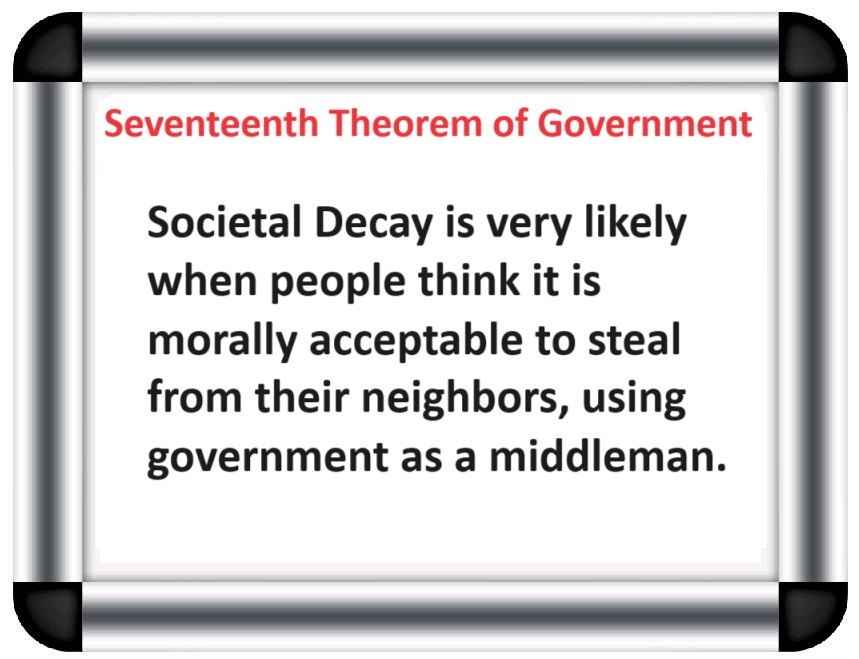
I released my First Theorem of Government in 2015 and today I’m going to unveil the 17th iteration in the series. But I’ll confess upfront that I’m doing a bit of recycling. My latest Theorem is very similar to something I shared back in 2014. I decided to upgrade my 2014 column to a Theorem […]
India, Dependency, and the 17th Theorem of Government
MPS
22 May 2024 Leave a comment
in budget deficits, business cycles, economic growth, financial economics, fiscal policy, inflation targeting, macroeconomics, monetary economics
Why prediction markets are not popular
20 May 2024 Leave a comment
in applied price theory, comparative institutional analysis, economics of information, entrepreneurship, financial economics
By Nick Whitaker and J. Zachary Mazlish, this is the best piece on this question so far. Excerpt, noting I will not double indent: “Rather than regulation, our explanation for the absence of widespread prediction markets is a straightforward demand-side story: there is little natural demand for prediction market contracts, as we observe in practice. […]
Why prediction markets are not popular
Business Freeze: Germany’s Last Solar Panel Manufacturers Finally Crushed
15 May 2024 Leave a comment
in energy economics, entrepreneurship, environmental economics, financial economics, global warming, industrial organisation, survivor principle Tags: Germany, solar power

Germany’s costly and chaotic wind and solar transition has served up plenty of casualties. Large numbers of energy intensive manufacturers have already bailed out – chasing cheap power prices in places like the US and Singapore. Now, in a rather ironic twist, its solar panel manufacturing industry has all but thrown in the towel. Notwithstanding […]
Business Freeze: Germany’s Last Solar Panel Manufacturers Finally Crushed
Still no prudential regulation case around climate change
24 Apr 2024 Leave a comment
in economics of bureaucracy, economics of climate change, environmental economics, environmentalism, financial economics, global warming, industrial organisation, law and economics, macroeconomics, monetary economics, politics - New Zealand, Public Choice, survivor principle Tags: climate alarmism
Eric Crampton writes – The Reserve Bank of New Zealand desperately wants to find reasons to have workstreams in climate change. It makes little sense.
Still no prudential regulation case around climate change
 Utopia, you are standing in it!
Recent Comments