Offsetting behaviour alert: KiwiSaver and the Accumulation of Net Wealth (WP 14/22) — The Treasury
18 Nov 2014 Leave a comment
in applied price theory, applied welfare economics, economics of regulation, financial economics Tags: KiwiSaver, offsetting behaviour

Abstract
The objective of this paper is to analyse the extent to which membership of KiwiSaver has been associated with greater accumulations of net wealth.
The paper utilises two linked sources of data which cover the period 2002 to 2010: Statistics New Zealand’s Survey of Family, Income and Employment and Inland Revenue Department administrative data on KiwiSaver membership.
Two approaches are employed: difference-in-differences (where the outcomes of interest are changes in net wealth) and various panel regression techniques.
Results appear consistent with earlier evaluations of KiwiSaver. Neither approach suggests KiwiSaver membership has been associated with any positive effect on net wealth accumulation.
via KiwiSaver and the Accumulation of Net Wealth (WP 14/22) — The Treasury – New Zealand.
David I. Levine on entrepreneurial alertness and the efficient markets hypothesis
13 Nov 2014 Leave a comment

The share market speaks: the boom in marijuana shares
03 Oct 2014 Leave a comment
in applied price theory, economics of crime, economics of regulation, entrepreneurship, financial economics, industrial organisation Tags: marijuana decriminalisation, marijuana legalisation

Over the past two years, investors bid up penny stocks, which are stocks that trade for less than $5 a share, for marijuana from a $500,000 market to more than $7 billion.
The sale and use of marijuana is now approved for medical purposes in 22 states and the District of Columbia and is legal for recreational sales in Colorado and Washington state.

Among those will have to put their money where their mouth is, their entrepreneurial forecast is marijuana legalisation is only going to spread and the legal marijuana market is going to grow. Florida will vote on legalizing medical marijuana, and recent polls suggest the measure has the support needed to pass.

In February 2014, President Obama signed a law that allows states to experiment with industrial hemp. In response, 17 states have removed barriers to hemp production.
HT: Vox.com/marijuana-legalization-maps-charts-facts and https://twitter.com/business/status/479287579263524864
The reality of green investing
28 Sep 2014 Leave a comment
in environmental economics, environmentalism, financial economics Tags: green investing
How to beat the share market
15 Aug 2014 Leave a comment
in economics of crime, financial economics, Public Choice, rentseeking Tags: insider trading, official corruption
Become a United States senator. Their share portfolios out-perform the best of the best hedge fund managers, and the best hedge fund manager was paid 3 1/2 billion dollars last year; to get on the list for the top hedge fund manager, you make at least $300 million a year. Good things that politicians know how to outperform them on their modest salaries and busy schedules of public engagements and parliamentary sittings.
Using the financial disclosures of politicians, "Abnormal Returns From the Common Stock Investments of Members of the U.S. House of Representatives," built model portfolios and charted their performance. They found that House members outperform the market by 6 percentage points. Senators do even better, the authors say, citing their own earlier research from 2004.
Senate portfolios "show some of the highest excess returns ever recorded over a long period of time, significantly outperforming even hedge fund managers," with gains that are "both economically large and statistically significant."

These results suggest that congressmen and senators have access to non-public information on particular businesses, industries or the economy as a whole and invest on the basis that information. The good returns of Senators and Congressmen last far too long to be no more than luck.
Who Routinely Trounces the U.S. Stock Market? Try 2 Out of 2,862 Funds – NYTimes.com
30 Jul 2014 Leave a comment
in entrepreneurship, financial economics, survivor principle Tags: active investing, efficient markets hypothesis, indexed linked investing, passive investing, stock picking

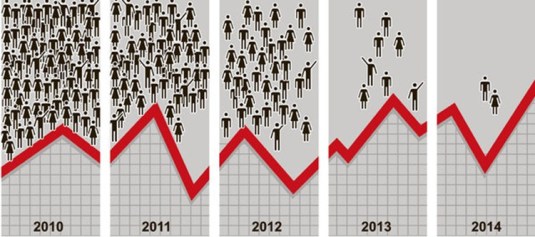
For the three years ended March 2014, 14.10% of large-cap funds, 16.32% of mid-cap funds and 25.00% of small-cap funds maintained a top-half ranking over three consecutive 12-month periods. Random expectations would suggest a rate of 25%.
After five years, two funds are still beating the market in each of the last five years.The rest of fallen by the wayside.
via Who Routinely Trounces the Stock Market? Try 2 Out of 2,862 Funds – NYTimes.com
Mutual fund facts and a question: Why are so many investors so willing to throw so much of their money away? | AEIdeas
23 Jul 2014 Leave a comment

The average expense ratio of actively managed equity mutual funds was 0.89% in 2013, which was more than seven times higher than the 0.12% average expense ratio for index equity funds. Some index mutual funds like the Vanguard S&P 500 Index have expense ratios as low as 0.05%.
The advantages of passive investing or indexed linked investing: the impact of costs and fees
23 Jul 2014 Leave a comment
in entrepreneurship, financial economics Tags: index linked investing
Figure 1: Impact of costs on returns

Half of all invested assets will outperform the market return before costs. After costs, a much smaller portion outperforms the market return.
The indexing concept makes no judgment as to market efficiency, size, or style, nor does it need efficient markets to be effective: Every market will always have an average return, whether the market is deemed efficient or otherwise. Indexing works because
whether markets are efficient or inefficient, investors as a group must fall short of the market return by the amount of the costs they incur
Active investors in strategies are exposed to commissions, management fees, bid-ask spreads, administrative costs, taxes, liquidity constraints, and other costs. In 2008, French in “The Cost of Active Investing” analysed the total cost to investors who have hired active managers to be more than $100 billion:
Professor French notes that while the total cost of trying to beat the market has grown over the years, the percentage of individuals who bear this cost has declined — precisely because of the growing popularity of index funds.
From 1986 to 2006, according to his calculations, the proportion of the aggregate market cap that is invested in index funds more than doubled, to 17.9 percent. As a result, the negative-sum game played by active investors has grown ever more negative.
The bottom line is this: The best course for the average investor is to buy and hold an index fund for the long term. Even if you think you have compelling reasons to believe a particular trade could beat the market, the odds are still probably against you.
Figure 2: Percentage of active funds underperforming low-cost index funds, For the ten years ended December 31, 2013

HT: vanguard.com
.
Paul Krugman was a consultant to Enron
14 Jul 2014 Leave a comment
in financial economics Tags: Enron, Paul Krugman

In 1999, Paul Krugman was paid $50,000 by Enron to act as a consultant and hold seminars. Krugman wrote a glowing article about Enron for Fortune magazine. After the collapse of Enron, he was a stern critic of that company.
In his columns, Krugman worked hard to link Enron to the Bush administration, and in one blamed Enron’s consultants for the company’s collapse. Krugman neglected to mention that he had been an Enron consultant:
Enron sold lots of things, but above all it sold itself: it crafted a self-portrait that business gurus loved. Like a schematic diagram from The McKinsey Quarterly or The Harvard Business Review, Enron’s business plan made a perfect PowerPoint presentation.
Other companies hired business gurus as consultants; Enron, in effect, put the gurus in charge. (Jeff Skilling, who made Enron what it is today, is a former McKinsey consultant.) What they created was a company so trendy that investors were dazzled. And that let executives get away with financial murder.
Eugene Fama on share market bubbles
03 Jul 2014 Leave a comment
in economics, entrepreneurship, financial economics Tags: efficient markets hypothesis, Eugene Fama

Q: I guess most people would define a bubble as an extended period during which asset prices depart quite significantly from economic fundamentals.
A: That’s what I would think it is, but that means that somebody must have made a lot of money betting on that, if you could identify it. It’s easy to say prices went down, it must have been a bubble, after the fact.
I think most bubbles are twenty-twenty hindsight. Now after the fact you always find people who said before the fact that prices are too high.
People are always saying that prices are too high. When they turn out to be right, we anoint them. When they turn out to be wrong, we ignore them.
They are typically right and wrong about half the time…
I want people to use the term in a consistent way. For example, I didn’t renew my subscription to The Economist because they use the world bubble three times on every page. Any time prices went up and down—I guess that is what they call a bubble. People have become entirely sloppy.
People have jumped on the bandwagon of blaming financial markets. I can tell a story very easily in which the financial markets were a casualty of the recession, not a cause of it.


Recent Comments