Tyler and I have been promoting the Danish mortgage system for years. Recall that in the Danish system each mortgage is backed by a matching bond. As a consequence, mortgage holders have two ways to pay a mortgage: 1) hold the mortgage and pay the monthly payments or 2) buy the matching bond and, in […]
The Danish Mortgage System Avoids Lock-In
The Danish Mortgage System Avoids Lock-In
20 Jun 2024 Leave a comment
in applied price theory, financial economics, law and economics, property rights, urban economics Tags: Denmark
Caught out! The NZ Initiative’s Article in the Herald Blaming the RBNZ for our Rip-Off Big Banks is Contradicted by its Own Expert Witness. (Willis Beware).
12 Jun 2024 Leave a comment
in applied price theory, applied welfare economics, business cycles, economic history, economics of bureaucracy, financial economics, macroeconomics, monetary economics, politics - New Zealand, Public Choice
When it comes to the question of how best to avoid a banking collapse and multi-billion dollar bailout that can drag a whole nation into depression, the best solution, according to Chicago-Stanford economist, John Cochrane, is to require banks to set aside a fraction of their own funds as reserves to cover losses they may…
Caught out! The NZ Initiative’s Article in the Herald Blaming the RBNZ for our Rip-Off Big Banks is Contradicted by its Own Expert Witness. (Willis Beware).
Prediction Markets As Investments
04 Jun 2024 Leave a comment
in applied price theory, financial economics Tags: efficient markets hypothesis

Supporters of prediction markets tend to emphasize how they are great tools for aggregating information to produce accurate forecasts. If you want to know e.g. who is likely to win the next election, you can watch every poll and listen to pundits for hours, or you can take ten seconds to check the odds. This […]
Prediction Markets As Investments
Bailouts Forever
02 Jun 2024 Leave a comment
in business cycles, economic history, financial economics, global financial crisis (GFC), macroeconomics, monetary economics, politics - USA Tags: deposit insurance
When interest rates rise, the price of long-term assets falls. Consequently, when the Fed began raising interest rates in 2022, the value of bonds and mortgages dropped, causing significant accounting losses for banks heavily invested in these assets. Silicon Valley Bank went bust, for example, because depositors fled upon realizing it was holding lots of […]
Bailouts Forever
India, Dependency, and the 17th Theorem of Government
28 May 2024 Leave a comment
in applied price theory, development economics, economic history, financial economics, growth disasters, growth miracles, income redistribution, macroeconomics, Public Choice, public economics, rentseeking Tags: India
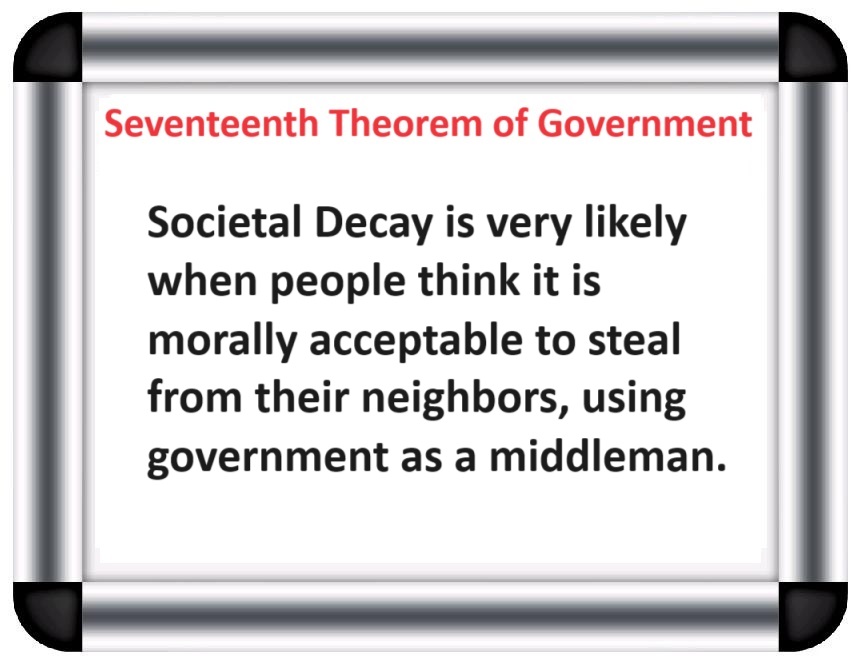
I released my First Theorem of Government in 2015 and today I’m going to unveil the 17th iteration in the series. But I’ll confess upfront that I’m doing a bit of recycling. My latest Theorem is very similar to something I shared back in 2014. I decided to upgrade my 2014 column to a Theorem […]
India, Dependency, and the 17th Theorem of Government
MPS
22 May 2024 Leave a comment
in budget deficits, business cycles, economic growth, financial economics, fiscal policy, inflation targeting, macroeconomics, monetary economics
Why prediction markets are not popular
20 May 2024 Leave a comment
in applied price theory, comparative institutional analysis, economics of information, entrepreneurship, financial economics
By Nick Whitaker and J. Zachary Mazlish, this is the best piece on this question so far. Excerpt, noting I will not double indent: “Rather than regulation, our explanation for the absence of widespread prediction markets is a straightforward demand-side story: there is little natural demand for prediction market contracts, as we observe in practice. […]
Why prediction markets are not popular
Business Freeze: Germany’s Last Solar Panel Manufacturers Finally Crushed
15 May 2024 Leave a comment
in energy economics, entrepreneurship, environmental economics, financial economics, global warming, industrial organisation, survivor principle Tags: Germany, solar power

Germany’s costly and chaotic wind and solar transition has served up plenty of casualties. Large numbers of energy intensive manufacturers have already bailed out – chasing cheap power prices in places like the US and Singapore. Now, in a rather ironic twist, its solar panel manufacturing industry has all but thrown in the towel. Notwithstanding […]
Business Freeze: Germany’s Last Solar Panel Manufacturers Finally Crushed
Still no prudential regulation case around climate change
24 Apr 2024 Leave a comment
in economics of bureaucracy, economics of climate change, environmental economics, environmentalism, financial economics, global warming, industrial organisation, law and economics, macroeconomics, monetary economics, politics - New Zealand, Public Choice, survivor principle Tags: climate alarmism
Eric Crampton writes – The Reserve Bank of New Zealand desperately wants to find reasons to have workstreams in climate change. It makes little sense.
Still no prudential regulation case around climate change
Fun’s Over: America’s ‘Green’ Investors Ditch Climate Action Zealotry
15 Apr 2024 1 Comment
in energy economics, entrepreneurship, environmental economics, financial economics, global warming, politics - USA Tags: climate alarmism

The climate cult thought the serious money was all in, forever. Til now, weather zealots could call on Wall Street to bankroll the climate industrial complex; there was no end to the amount of money available for harebrained, uneconomic wind and solar projects; no end to the unhinged war on hydrocarbons. These days, not so […]
Fun’s Over: America’s ‘Green’ Investors Ditch Climate Action Zealotry
DON BRASH: BANKS AND CLIMATE CHANGE: THE LAW IS AN ASS
30 Mar 2024 Leave a comment
in energy economics, entrepreneurship, environmental economics, financial economics, global warming Tags: climate alarmism, efficient markets hypothesis
As everybody who is not blind and deaf is aware, there is a huge political preoccupation with climate change at the moment, a widespread (though by no means unanimous) belief that global temperatures are rising mainly as a result of the greenhouse gases created by humankind, and a strong view that all countries have a…
DON BRASH: BANKS AND CLIMATE CHANGE: THE LAW IS AN ASS
How credible is the Milei plan?
24 Mar 2024 Leave a comment
in applied price theory, budget deficits, business cycles, development economics, economic growth, financial economics, fiscal policy, growth disasters, income redistribution, international economics, macroeconomics, monetary economics, Public Choice, public economics Tags: Argentina
Here is a good Substack essay by Nicolas Cachanosky, excerpt: Inflation expectations depend on what is expected to happen to the budget in the months to come. It is natural, then, to ask whether the observed surpluses are sustainable in the months ahead. Answering this question requires looking at two things. First, how was the fiscal […]
How credible is the Milei plan?
Aussie Renewable Investment Slumped 80% in 2023
20 Mar 2024 Leave a comment
in energy economics, entrepreneurship, environmental economics, financial economics, global warming, politics - Australia Tags: wind power
Rooftop solar / battery installations were the exception. Perhaps Aussie households are preparing for the coming grid failure?
Aussie Renewable Investment Slumped 80% in 2023
One Year Since the Meltdown at Silicon Valley Bank: Commercial Real Estate and Ongoing Threats
13 Mar 2024 Leave a comment
in applied price theory, economics of information, economics of regulation, financial economics, macroeconomics, monetary economics, politics - USA Tags: banking panics

One year ago in March 2023, Silicon Valley Bank melted down, quickly followed by similar meltdowns at Signature Bank and First Republic Bank. Measured by the nominal size of bank assets, these were three of the biggest four US bank failures in history. (The failure of Washington Mutual Bank in 2008 remains the largest.) Was…
One Year Since the Meltdown at Silicon Valley Bank: Commercial Real Estate and Ongoing Threats


Recent Comments