What Do Entrepreneurs Actually Do?
05 Dec 2019 Leave a comment
in economic history, economics of information, entrepreneurship, fisheries economics, human capital, income redistribution, industrial organisation, labour economics, labour supply, managerial economics, Marxist economics, occupational choice, organisational economics, personnel economics, politics - USA, poverty and inequality, property rights, Public Choice, public economics, survivor principle Tags: creative destruction, entrepreneurial alertness, superstar wages, superstars, top 1%
Free Market Environmentalism with Terry Anderson: Perspectives on Policy
27 Jun 2019 Leave a comment
in applied price theory, applied welfare economics, Austrian economics, comparative institutional analysis, economic history, economics of bureaucracy, energy economics, entrepreneurship, environmental economics, fisheries economics, global warming, income redistribution, industrial organisation, law and economics, property rights, Public Choice, rentseeking, survivor principle Tags: common property, tragedy of the commons
Economics of climate change innovation | @BjornLomborg
09 Apr 2019 Leave a comment
in applied price theory, development economics, economic history, energy economics, entrepreneurship, environmental economics, fisheries economics, global warming, politics - New Zealand, politics - USA, Public Choice Tags: climate alarmism
Why are GMOs Bad? @SciShow
25 Feb 2019 Leave a comment
in development economics, economics of education, economics of information, economics of regulation, environmental economics, fisheries economics, health economics, law and economics, politics - Australia, politics - New Zealand, politics - USA, property rights, Public Choice, rentseeking Tags: anti-GMO movement, Anti-Science left, pessimism bias
Does Eating Breakfast Really Help You Lose Weight?
04 Sep 2018 Leave a comment
in fisheries economics, health economics Tags: economics of obesity
What if plastic was never invented @GreenpeaceNZ @GarethMP
20 Aug 2018 Leave a comment
in applied price theory, economic history, energy economics, environmental economics, fisheries economics, health economics Tags: meddlesome preferences, The Great Enrichment
When will @AnnPettifor found a hedge fund to profit from putting other’s money where her mouth is rather than just her own retirement savings portfolio, which I am sure she did
23 Apr 2018 Leave a comment
in applied price theory, economics of information, entrepreneurship, fisheries economics, global financial crisis (GFC), macroeconomics, Marxist economics, monetary economics Tags: efficient markets hypothesis, entrepreneurial alertness, monetary cranks

Creative destruction in the 5 largest companies
24 Oct 2016 Leave a comment
in economic history, entrepreneurship, fisheries economics Tags: Apple, creative destruction, Microsoft

Has the Vice Fund ever not outperformed the share market?
28 Jul 2016 3 Comments
in fisheries economics Tags: active investing, efficient markets hypothesis, entrepreneurial alertness, ethical investing, passive investing
The Vice Fund is a mutual fund investing in companies that have significant involvement in, or derive a substantial portion of their revenues from the tobacco, gambling, defense/weapons, and alcohol industries. A primary focus of stock selection is the ability to pay and grow dividends.

Source: VICEX USA Mutuals Barrier Investor Fund VICEX Quote Price News.
Paul Samuelson on everything you need to know about the efficient markets hypothesis
31 May 2016 Leave a comment
in applied price theory, fisheries economics Tags: active investing, efficient markets hypothesis, entrepreneurial alertness, passive investing, Paul Samuelson


Saving Ocean Fisheries with Property Rights
17 May 2016 Leave a comment
in applied price theory, comparative institutional analysis, economics of regulation, environmental economics, fisheries economics, industrial organisation, international economics, law and economics, privatisation, property rights Tags: common property, economics of fisheries, individual transferable quotas, tragedy of the commons
How much do you get paid if you can pick winners? @JulieAnneGenter @simonjbridges
05 May 2016 Leave a comment
in applied price theory, comparative institutional analysis, entrepreneurship, fisheries economics, politics - New Zealand Tags: entrepreneurial alertness, hedge fund managers, industry policy, picking winners, superstar wages, superstars
Electric cars have joined the long list of mendicant mendicant businesses that have been backed by the New Zealand government of late. Picking winners again.
The payrolls of entire government departments in New Zealand are not enough to hire a single successful hedge fund manager to pick winners for their political masters. To get on the list of the top 25 hedge fund managers, you need to earn at least $300 million a year.
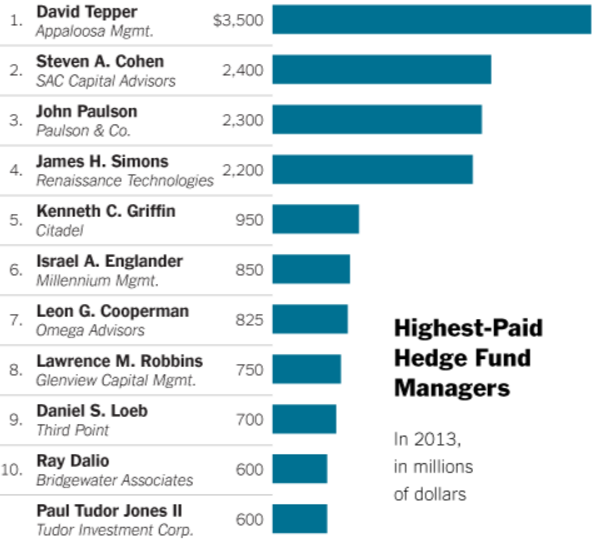
The 25 highest-earning hedge fund managers and traders made a combined $12 billion in 2015, slightly less than the $12.5 billion the 25 top-earning hedge fund managers together made in 2014.
Why do investment advisors sell and often give away their sage advice? If their insights were any good, they could trade on the share market before others caught on and make a killing!
I will give a personal example based on the skills of bureaucracies in picking winners. The test of my hypothesis is based on the transferability of human capital across jobs.
My graduate school professors in Japan included many retired bureaucrats from the Ministry of Finance and MITI. These agencies were heralded by Joe Stiglitz and others for picking winners and guiding Japanese companies to choose the right technologies and what to export.
The skills that my graduate school professors learned at picking winners over their careers with the Ministry of Finance and MITI in the high-growth years in the 1970s would now be available to them in their retirements to trade on their own account.
Page 32 of "An Illustrated Guide to Income" more economic #dataviz at: bit.ly/12SEI9p http://t.co/HYm0II2UNI—
Catherine Mulbrandon (@VisualEcon) May 08, 2013
My graduate school professors should quickly become very rich after retiring because of the skills they learned in picking winners while at the Ministry of Finance and MITI, which should cross over into their private share portfolios. The rich lists world-wide should be full of retired industry and finance ministry bureaucrats.
Instead, my graduate school professors took the train and bus to work and their families lived off their salaries in standard sized Japanese government apartments. All looked forward to their annual bonus of 5.15 months salary.
If governments are any good at picking winners, people should be willing to pay big time to get jobs at ministries of finance and ministries of international trade and industry to get access to their unique and highly secret skills they learn therein on how to pick winners.
I am still waiting for that tell-all book by an insider on these skills. Why is there no Picking Winners for Dummies on Amazon kindle as yet?
How profitable are the tech giants?
03 Apr 2016 Leave a comment
in fisheries economics, industrial organisation, survivor principle Tags: Apple, creative destruction, Facebook, Microsoft, Twitter
I did not know Yahoo was still in business.

Share market losses during previous financial crises in the USA and UK
31 Jan 2016 Leave a comment
in business cycles, economic history, fisheries economics, global financial crisis (GFC), great depression, great recession, macroeconomics Tags: banking crises, financial crises, sovereign debt crises, sovereign defaults
 Utopia, you are standing in it!
Recent Comments