George Orwell had it right 80 years ago… #sugartax pic.twitter.com/8PwEICSTAd
— Dominic Utton (@DomUtton) March 16, 2016
George Orwell had it right 80 years ago on the #sugartax
21 Mar 2016 Leave a comment
in health economics, liberalism Tags: George Orwell, meddlesome preferences, nanny state, sugar tax, The fatal conceit
@mattyglesias on why greedy drug companies are heroes
20 Mar 2016 Leave a comment
in economics of regulation, health economics, law and economics, politics - New Zealand, politics - USA, property rights Tags: avoiding difficult choices, drug lags, generic drugs, intellectual monopolies, invisible graveyard, patents and copyrights

#EarthHour 10 great public health achievements of 20th century #HAH2016
19 Mar 2016 Leave a comment
in applied welfare economics, economic history, health economics Tags: economics of smoking, fluoridation, public health, The Great Escape, vaccines
#HAH2016 Life expectancy is rising in the world’s four most populous countries
19 Mar 2016 Leave a comment
in development economics, health economics Tags: China, India, Indonesia, life expectancies, The Great Escape
The share market speaks on the UK #sugartax @JulieAnneGenter @GreenCatherine
18 Mar 2016 Leave a comment
in economics of regulation, financial economics, health economics Tags: British economy, libertarian paternalism, meddlesome preferences, nanny state, sugar tax


The biggest drop was in a company that sold its sugar interests in 2009 so that was a rather within the day affair once traders realised their error.

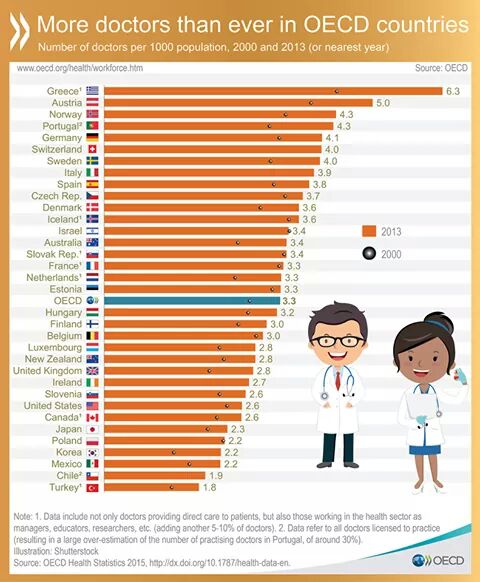
Still no obese Japanese
14 Mar 2016 Leave a comment
in health economics Tags: economics of obesity, nanny state
The discovery void in antibiotic drugs
13 Mar 2016 Leave a comment
in economic history, entrepreneurship, health economics Tags: creative destruction, entrepreneurial alertness, intellectual monopolies, patents and copyrights, research prizes, The Great Escape
No new classes of antibiotics has been discovered since 1987. They are looked upon as a poor investment by pharmaceutical entrepreneurs because there are so many generic competitors. To make it even more complicated, any new antibiotic that might be invented would have to be held in reserve for a major case of an antibiotic resistant infection.

Wealth and Health of Nations
13 Mar 2016 Leave a comment
in economic history, health economics Tags: life expectancies, The Great Escape
Fruits and vegetables, wild vs. domesticated
12 Mar 2016 Leave a comment
in economic history, economics of information, economics of media and culture, economics of regulation, environmental economics, health economics Tags: agricultural economics, antiscience left, food snobs, GMOs, organic food
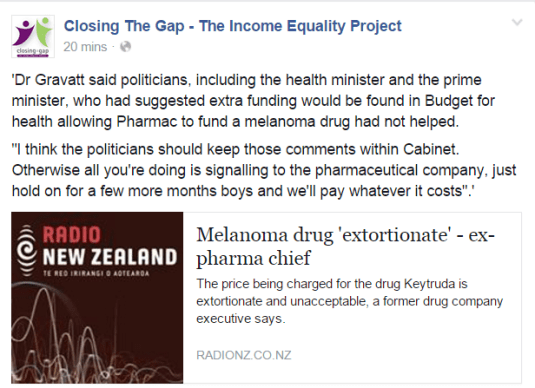
@Income_Equality this mostly criticises @annetterongotai @AndrewLittleMP
11 Mar 2016 Leave a comment
in applied welfare economics, health economics, politics - New Zealand
Solution aversion and the anti-science Left
11 Mar 2016 1 Comment
in applied price theory, applied welfare economics, comparative institutional analysis, constitutional political economy, economics of regulation, energy economics, environmental economics, global warming, health economics, law and economics, politics - Australia, politics - New Zealand, politics - USA, property rights, Public Choice Tags: antiscience left, climate alarmism, geo-engineering, GMOs, growth of knowledge, gun control, motivated reasoning, nuclear power, political persuasion, solar power, solution aversion, wind power
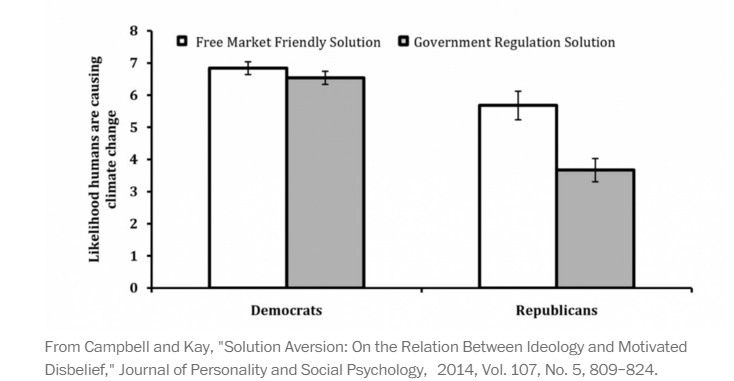
Climate science is the latest manifestation of solution aversion: denying a problem because it has a costly solution. The Right does this on climate science, the Left does it on gun control, GMOs, and plenty more. Cass Sunstein explains:
It is often said that people who don’t want to solve the problem of climate change reject the underlying science, and hence don’t think there’s any problem to solve.
But consider a different possibility: Because they reject the proposed solution, they dismiss the science. If this is right, our whole picture of the politics of climate change is off.
Some psychologists wasted grant money on lab experiments to show that people that think the solution to a problem is costly tend to rubbish every aspect of the argument. Any politician will tell you you do not concede anything. Sunstein again:
Campbell and Kay asked the participants whether they agreed with the IPCC. And in both, about 80 percent of Democrats did agree; the policy solutions made no difference.
Republicans, in contrast, were far more likely to agree with the IPCC when the proposed solution didn’t involve regulatory restrictions…
Here, then, is powerful evidence that many people (of course not all) who purport to be skeptical about climate science are motivated by their hostility to costly regulation.
The Left is equally prone to motivated readings. For example, it was found that those on the left are much more concerned about home invasions when gun control can reduce them rather than increase them.

The Left picks and chooses which scientific consensus as it accepts. The overwhelming consensus among researchers is biotech crops are safe for humans and the environment. This is a conclusion that is rejected by the very environmentalist organisations that loudly insist on the policy relevance of the scientific consensus on global warming.
Previously the precautionary principle was used to introduce doubt when there was no doubt. But when climate science turned in their favour, environmentalists wanted public policy to be based on the latest science.
The Right is welcoming of the science of nuclear energy or geo-engineering. The Left rejects it point-blank. Their refusal to consider nuclear energy as a solution to global warming is a classic example of solution aversion. Let he who is without sin cast the first stone.
90% of English drink in moderation – the Welsh and Scots have a few more
11 Mar 2016 Leave a comment



Recent Comments