The decline and decline of the rentier class in the USA
24 May 2016 Leave a comment
in economic history, entrepreneurship, human capital, industrial organisation, labour economics, labour supply, occupational choice, politics - USA, poverty and inequality Tags: entrepreneurial alertness, superstar wages, superstars, top 1%, top incomes
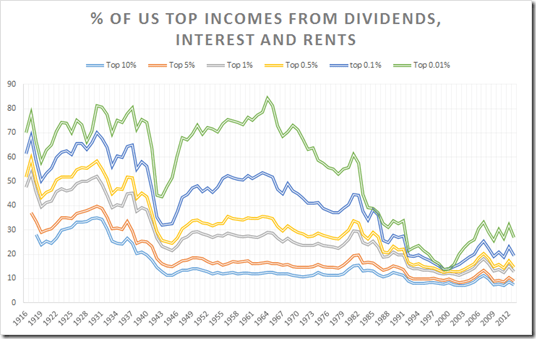
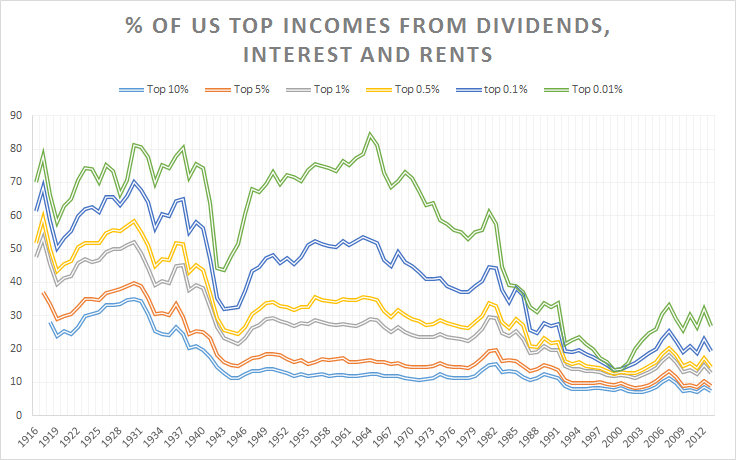
Looks like the Reagan Revolution coincided with the American rich going out to work for a living. They started earning most of their incomes from wages, salaries and pensions or from entrepreneurial income. The American rich are now working rich; top wage earners, not top income earners.
Source: The World Wealth and Income Database.
@JulieAnneGenter only 21% of freight is contestable by rail
24 May 2016 Leave a comment
in environmental economics, industrial organisation, politics - New Zealand, survivor principle, transport economics Tags: celebrity technologies, New Zealand Greens

Source: International freight transport services | Productivity Commission of New Zealand.

Source: International freight transport services | Productivity Commission of New Zealand.

@jamespeshaw only 8% of freight is contestable by coastal shipping
24 May 2016 Leave a comment
in industrial organisation, politics - New Zealand, survivor principle, transport economics Tags: celebrity technologies, New Zealand Greens
Shipping offers only a tiny bit of competition the rail freight but barely any with road freight

Source: International freight transport services | Productivity Commission of New Zealand.
% of top incomes from wages, salaries and pensions
23 May 2016 Leave a comment
in applied price theory, applied welfare economics, economic history, entrepreneurship, human capital, industrial organisation, labour economics, labour supply, occupational choice, poverty and inequality, survivor principle Tags: entrepreneurial alertness, envy, superstar wages, superstars, top 1%, top incomes
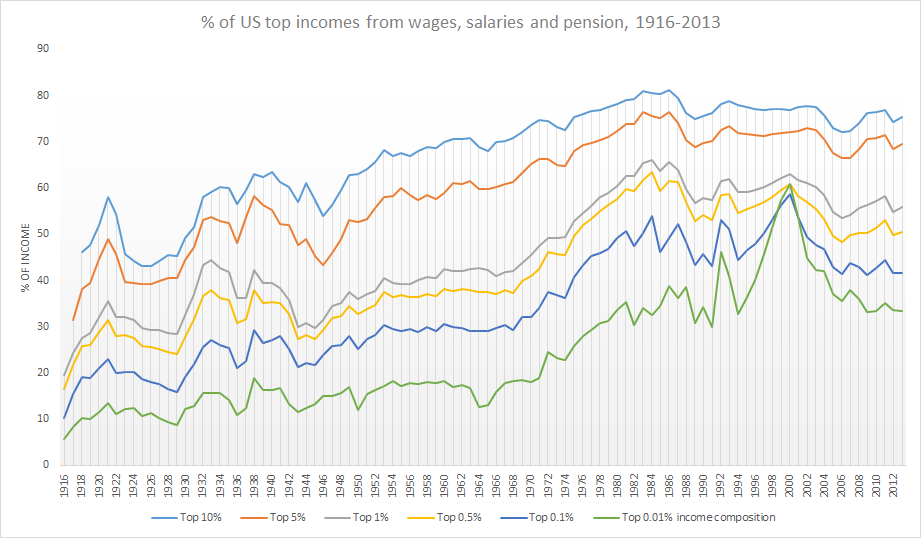
Everybody from the top 10% to the top 0.01% have to work for their living these days with much of their income coming from wages.
Source: The World Wealth and Income Database.
Bryan Bruce’s boy’s own memories of pre-neoliberal #NewZealand @Child_PovertyNZ
23 May 2016 Leave a comment
in applied welfare economics, comparative institutional analysis, economic history, economics of regulation, income redistribution, industrial organisation, politics - New Zealand, poverty and inequality, Public Choice, rentseeking Tags: child poverty, conspiracy theories, expressive voting, family poverty, Leftover Left, living standards, neoliberalism, Old Left, pessimism bias, rational irrationality, reactionary left, top 1%
New work by Chris Ball and John Creedy shows substantial *declines* in NZ inequality.
initiativeblog.com/2015/06/24/ine… http://t.co/f94fw4Bhae—
Eric Crampton (@EricCrampton) June 24, 2015
You really are still fighting the 1990 New Zealand general election if Max Rashbrooke makes more sense than you on the good old days before the virus of neoliberalism beset New Zealand from 1984 onwards.
Source: Mind the Gap: Why most of us are poor | Stuff.co.nz.
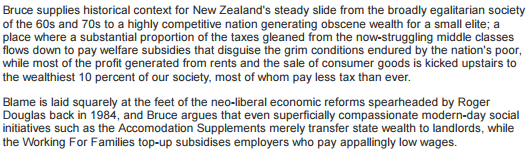
Bryan Bruce in the caption looks upon the New Zealand of the 1960s and 70s as “broadly egalitarian”. Even Max Rashbrooke had to admit that was not so if you were Maori or female.
The present rate of technology adoption is nearly a vertical line —@blackrock https://t.co/3oS3YAI4ld—
Vala Afshar (@ValaAfshar) January 22, 2016
Maybe 65% of the population of those good old days before the virus of neoliberalism. were missing out on that broadly egalitarian society championed by Bryan Bruce.
As is typical for the embittered left, the reactionary left, gender analysis and the sociology of race is not for their memories of their good old days. New Zealand has the smallest gender wage gap of any of the industrialised countries.
The 20 years of wage stagnation that proceeded the passage of the Employment Contracts Act and the wages boom also goes down the reactionary left memory hole.
That wage stagnation in New Zealand in the 1970s and early 80s coincided with a decline in the incomes of the top 10%. When their income share started growing again, so did the wages of everybody after 20 years of stagnation. The top 10% in New Zealand managed to restore their income share of the early 1970s and indeed the 1960s. That it is hardly the rich getting richer.
Do Immigrants Steal Our Jobs?
23 May 2016 Leave a comment
in applied price theory, economic history, industrial organisation, labour economics, labour supply, unemployment Tags: economics of immigration
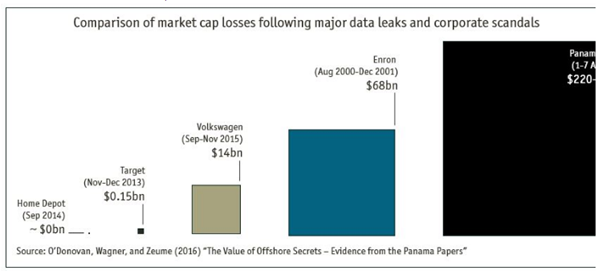
The sharemarket speaks: The Value of Offshore Secrets – Evidence from the #PanamaPapers
21 May 2016 Leave a comment
in financial economics, industrial organisation, public economics Tags: Panama papers, tax savings
Rothbard on Insider Trading
20 May 2016 Leave a comment
in economics, financial economics, industrial organisation Tags: insider trading
Dr Mark Pennington – ‘Robust Political Economy’
20 May 2016 Leave a comment
in applied price theory, applied welfare economics, comparative institutional analysis, constitutional political economy, economics of media and culture, economics of regulation, entrepreneurship, environmental economics, industrial organisation, liberalism Tags: offsetting behaviour, The fatal conceit, The pretence to knowledge
Privatizing local bus services could save $5.7 billion
19 May 2016 Leave a comment
in industrial organisation, politics - New Zealand, politics - USA, privatisation, survivor principle, theory of the firm, transport economics, urban economics Tags: privatisation, state owned enterprises
Solutions to Moral Hazard
18 May 2016 Leave a comment
in economics of information, industrial organisation Tags: moral hazard
Is it merchandising that drives gender bias in Hollywood casting?
17 May 2016 Leave a comment
in discrimination, economics of media and culture, gender, industrial organisation, labour economics, labour supply, occupational choice, survivor principle Tags: entrepreneurial alertness, gender gap, gender wage gap, Hollywood economics

Iron Man 3 changed the gender of the film’s villain from female to male after pressure from the production company Marvel, which feared toy merchandise would not sell as well.
This is a rather frank admission of what drives gender bias in Hollywood casting decisions. Its customer preferences – customer discrimination. It was not nasty producers and directors choosing not to hire women.
It was producers and directors casting a movie that might sell at the box office given what the box office wants. The great majority of box office sales is outside of the USA and US cultural values, interests and concepts of humour.

Hollywood is a cutthroat market where producers and directors do do whatever it takes to make their movie sell at the box office. But would not last very long if they indulge their personal preferences at the expense of the box office.
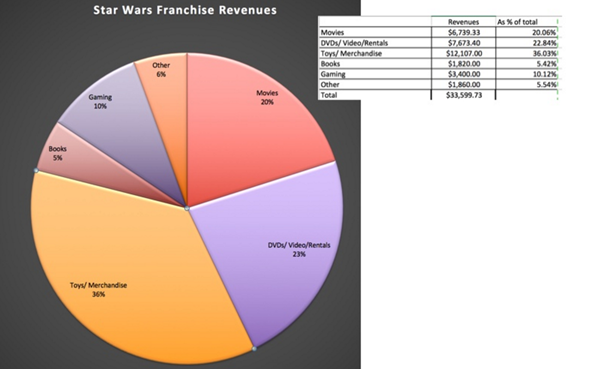
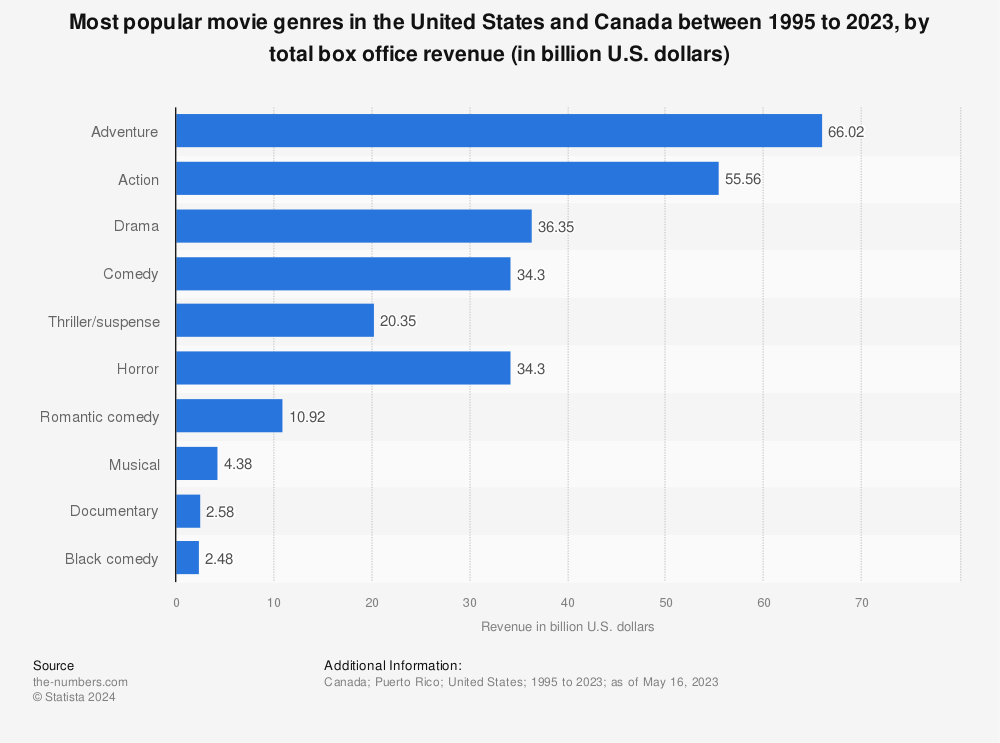
Not every movie has the merchandising potential of action films but they still have to pay careful attention to what audiences want to avoid having produced a run of flops and never get financing again.
That is not made any easier by the first law of Hollywood economics, which is nobody knows nothing. Audiences have a constant demand for novelty but they do not know what they want delay see it.

 Utopia, you are standing in it!
Recent Comments