Top incomes and the decline of unions in Canada, France and Italy

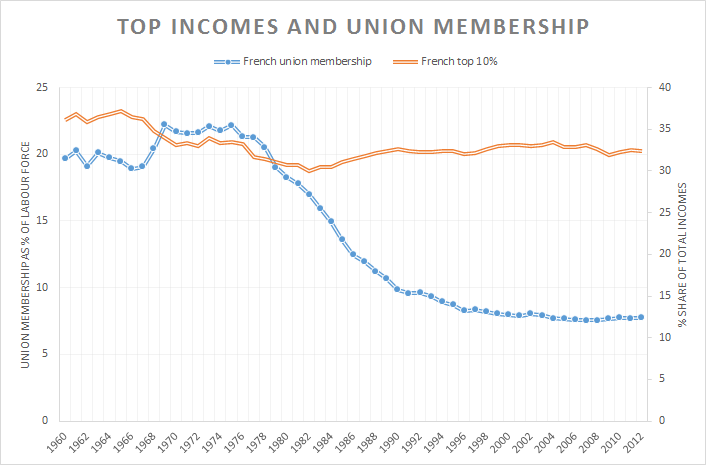
The French ruling class is as lazy as their transnational co-conspirators down under. French union membership is in serious decline albeit from a low base. An opportunity lost for the French ruling class. It has not lifted a finger to extract additional labour surplus from the downtrodden French proletariat now stripped of their only line of collective defence against capitalist exploitation.
image

Source: OECD Stat and Top Incomes Database.

The top 10% and top 1% in France are no better off than two generations ago despite the decline of French unions. The French Left must be most disappointed. No kicking in the rotten door of the permanent revolution anytime soon after the immiserised French proletariat rises up because it has nothing to lose but its chains. The 21st century version of the Marxist call to the barricades would be a proletariat stirred to revolution with nothing to lose but their suburban home, motorcar, IPad and air points

image

Source: OECD Stat and Top Incomes Database.

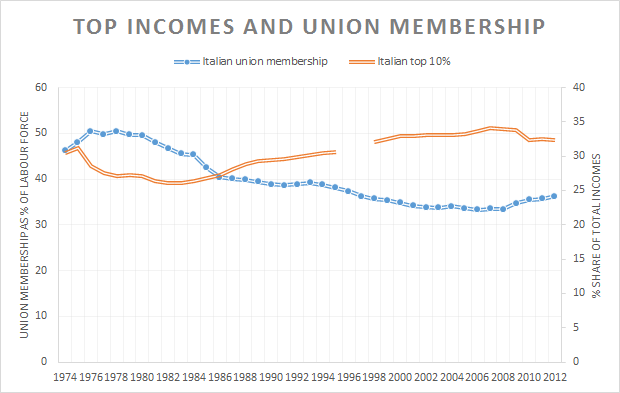
The Italian ruling class has had little success in bringing Italian unions down. The top 10% in Italy is earning no more now than back when the Red Brigades were gunning for them.
image

Source: OECD Stat and Top Incomes Database.

The top 1% in Italy is doing a little bit better than when the Red Brigade was gunning for them, but not much more. Unions don’t figure in explaining that small rise in Italian top 1% incomes over the last 40 years. Italian unions are pretty much a strong as they were 40 years ago in membership. Italian employment protection laws are pretty much as strong as they used to be too.

image

Source: OECD Stat and Top Incomes Database.

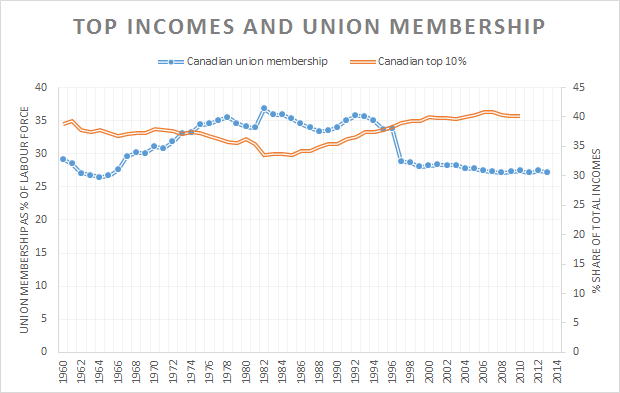
The Canadian ruling classes even more incompetent than their transnational co-conspirators over in Italy. There appears to have been next to no decline in union membership in Canada. The Canadian top 10% is not earning any more than back in the 60s.
image

Source: OECD Stat and Top Incomes Database.

The Canadian top 1% is doing a little bit better than 25 years ago also but not off the back of unions which are almost as strong as in the past. The Canadian Left will have to look for a different hypothesis than the ravages of the top 1%.

image

Source: OECD Stat and Top Incomes Database.

All in all, the Economic Policy Institute simply got lucky with a spurious correlation between top incomes and union membership in the USA.

10 years ago today some kid dropped out of Harvard to work on some website

Did the New Zealand film industry just eat our lunch? By Jason Potts

James Cameron is going to film the next three instalments of the Avatar franchise in New Zealand. He promises to spend at least NZ$500 million, employ thousands of Kiwis, host at least one red-carpet event, include a NZ promotional featurette in the Avatar DVDs, and will personally serve on a bunch of Film NZ committees, and probably even bring scones, all in return for a 25% rebate on any spending he and his team do in the country (up from a 20% baseline to international film-makers) that is being offered by the New Zealand Government.

The implication that many media reports are running with is that this is a loss to the Australian film industry, that we should be fighting angry, and that we should hit back at this brilliantly cunning move by the Kiwi’s by increasing our film industry rebates, which currently are about 16.5% (these include the producer and location offsets, and the post, digital and visual effects offset) to at very least 30%. These rebates cost tax-payers A$204 million in 2012, which hardly even buys you a car industry these days.

So what are the economics of this sort of industry assistance? Is this something we should be doing a whole lot more of? Was the NZ move to up the rebate especially brilliant? First, note that James Cameron has substantial property interests in New Zealand already, so this probably wasn’t as up for grabs as we might think. But if that’s how the New Zealand taxpayers want to spend their money, that’s up to them. The issue is should we follow suit?

The basic economics of this sort of give-away is the concept of a multiplier “”), which is the theory that an initial amount of exogenous spending becomes someone else’s income, which then gets spent again, creating more income, and so on, creating jobs and exports and all sorts of “economic benefits” along the way.

People who believe in the efficacy of Keynesian fiscal stimulus also believe in the existence of (>1) multipliers. Consultancy-based “economic impact” reports do their magic by assuming greater-than-one multipliers (or equivalently, a high marginal propensity to consume coupled with lots of dense sectoral linkages). With a multiplier greater than one, all government spending is magically transformed into “investment in Australian jobs”.

So the real question is: are multipliers actually greater-than-one? That’s an empirical question, and the answer is mostly no. (And if you don’t believe my neoliberal bluster, the progressive stylings of Ben Eltham over at Crikey more or less make the same point.)

But to get this you have to do the economics properly, and not just count the positive multipliers, but also account for the loss of investment in other sectors that didn’t take place because it was artificially re-directed into the film sector, which no commissioned impact study ever does.

This is why economists have a very low opinion of economic impact studies, which are to economics what astrology is to physics.

What does make for a good domestic film industry then? Look again at New Zealand, and look beyond the great Weta Studios in Wellington, for Australia and Canada both have world-class production studios and post-production facilities. Look beyond New Zealand’s natural scenery, for Vancouver is an easy match for New Zealand and Australia pretty much defines spectacular.

No, the simple comparison is that New Zealand is about 20% cheaper than Australia and 30% cheaper than Canada. New Zealand has lower taxes, easy employment conditions and relatively light regulations (particularly around insurance and health and safety). It’s just easier to get things done there.

If Australia really wants to boost its film industry, it might look more closely at labour market restrictions (including minimum wages) and regulatory burden and worry less about picking taxpayer pockets and bribing foreigners.

This article was originally published on The Conversation in December 2013. Read the original article. Republished under the a Creative Commons Attribution No Derivatives licence.

Did government pick the Internet as a winner? @stevenljoyce @dpfdpf

Mises on Nazi socialism

No Matter How You Slice the Data, Senator Sanders and other Leftists Are Wrong to Think Nations like Sweden and Denmark Are More Prosperous than America

Dan Mitchell's avatarInternational Liberty

I periodically make comparisons of the United States and Europe that are not very flattering for our cousins across the Atlantic.

Though this isn’t because of any animus toward Europe. Indeed, I always enjoy my visits. And some of America’s best (albeit eroding) features, such as rule of law and dignity of the individual, are a cultural inheritance from that continent.

Nor am I trying to overstate America’s competitiveness, which actually has eroded considerably during this century.

Instead, I’m simply trying to make the narrow point that too much government is already causing serious problems in Europe, and I’m worried those problems are spreading to the United States.

Yet some of our statist friends, most notably Senator Bernie Sanders, think America should deliberately choose to be more like Europe.

They have this halcyon vision that the average European is more prosperous and they exclaim that this is proof that…

View original post 1,133 more words

The Dutch have taken delivery of the first self-driving shuttle for use on public roads.

Why does Housing New Zealand pay dividends? @chrishipkins @metiria

The current controversy over payment of dividends by Housing New Zealand is misplaced because of the subtle connections between payment of dividends and greater value for money.

By paying dividends, the investment priorities of Housing New Zealand are subject to additional ministerial scrutiny. Its capital program is scrutinised in greater detail by the Cabinet because ministers must fund it against competing bids across the entire budget and parliamentary scrutiny process.

Each budget bid is championed by a minister, each of whom must make their case every year against all-comers. This annual competition for a central pool of capital filters out lower value investment bids.

If dividends were not paid but were instead retained as free cash flows in the agency, there would be less ministerial scrutiny of Housing New Zealand because it would have a smaller role in annual budget rounds. Ministers and the Parliament sit up and pay attention when money is to be spent, as they should, and the larger is the sum in the budget, the more attention is paid to value for the money sought. Funding projects with retained dividends may reduce ministerial and parliamentary scrutiny.

Payment of dividends does not reduce the ability of Housing New Zealand to engage in new capital spending. If the dividends were not paid, the amount of new capital spending from budget appropriations would be reduced dollar for dollar.

Private police reduce crime by more

https://twitter.com/bswud/status/562992743941931008

Creative destruction in technology acquisitions

Creative destruction in newspapers

Creative destruction in Twitter

Milton Friedman on the social responsibility of business

Image

Mises on prosperity and inequality

Image

Map of cables laid internationally

Previous Older Entries Next Newer Entries

Bassett, Brash & Hide

Celebrating humanity's flourishing through the spread of capitalism and the rule of law

Truth on the Market

Scholarly commentary on law, economics, and more

The Undercover Historian

Beatrice Cherrier's blog

Matua Kahurangi

Celebrating humanity's flourishing through the spread of capitalism and the rule of law

Temple of Sociology

Celebrating humanity's flourishing through the spread of capitalism and the rule of law

Velvet Glove, Iron Fist

Celebrating humanity's flourishing through the spread of capitalism and the rule of law

Why Evolution Is True

Why Evolution is True is a blog written by Jerry Coyne, centered on evolution and biology but also dealing with diverse topics like politics, culture, and cats.

Down to Earth Kiwi

Celebrating humanity's flourishing through the spread of capitalism and the rule of law

NoTricksZone

Celebrating humanity's flourishing through the spread of capitalism and the rule of law

Homepaddock

A rural perspective with a blue tint by Ele Ludemann

Kiwiblog

DPF's Kiwiblog - Fomenting Happy Mischief since 2003

The Dangerous Economist

Celebrating humanity's flourishing through the spread of capitalism and the rule of law

Watts Up With That?

The world's most viewed site on global warming and climate change

The Logical Place

Tim Harding's writings on rationality, informal logic and skepticism

Doc's Books

A window into Doc Freiberger's library

The Risk-Monger

Let's examine hard decisions!

Uneasy Money

Commentary on monetary policy in the spirit of R. G. Hawtrey

Barrie Saunders

Thoughts on public policy and the media

Liberty Scott

Celebrating humanity's flourishing through the spread of capitalism and the rule of law

Point of Order

Politics and the economy

James Bowden's Blog

A blog (primarily) on Canadian and Commonwealth political history and institutions

Science Matters

Reading between the lines, and underneath the hype.

Peter Winsley

Economics, and such stuff as dreams are made on

A Venerable Puzzle

"The British constitution has always been puzzling, and always will be." --Queen Elizabeth II

The Antiplanner

Celebrating humanity's flourishing through the spread of capitalism and the rule of law

Bet On It

Celebrating humanity's flourishing through the spread of capitalism and the rule of law

History of Sorts

WORLD WAR II, MUSIC, HISTORY, HOLOCAUST

Roger Pielke Jr.

Undisciplined scholar, recovering academic

Offsetting Behaviour

Celebrating humanity's flourishing through the spread of capitalism and the rule of law

JONATHAN TURLEY

Res ipsa loquitur - The thing itself speaks

Conversable Economist

In Hume’s spirit, I will attempt to serve as an ambassador from my world of economics, and help in “finding topics of conversation fit for the entertainment of rational creatures.”

The Victorian Commons

Researching the House of Commons, 1832-1868

The History of Parliament

Articles and research from the History of Parliament Trust

Books & Boots

Reflections on books and art

Legal History Miscellany

Posts on the History of Law, Crime, and Justice

Sex, Drugs and Economics

Celebrating humanity's flourishing through the spread of capitalism and the rule of law

European Royal History

Exploring the Monarchs of Europe

Tallbloke's Talkshop

Cutting edge science you can dice with

Marginal REVOLUTION

Small Steps Toward A Much Better World

NOT A LOT OF PEOPLE KNOW THAT

“We do not believe any group of men adequate enough or wise enough to operate without scrutiny or without criticism. We know that the only way to avoid error is to detect it, that the only way to detect it is to be free to inquire. We know that in secrecy error undetected will flourish and subvert”. - J Robert Oppenheimer.

STOP THESE THINGS

The truth about the great wind power fraud - we're not here to debate the wind industry, we're here to destroy it.

Lindsay Mitchell

Celebrating humanity's flourishing through the spread of capitalism and the rule of law

Alt-M

Celebrating humanity's flourishing through the spread of capitalism and the rule of law

croaking cassandra

Economics, public policy, monetary policy, financial regulation, with a New Zealand perspective

The Grumpy Economist

Celebrating humanity's flourishing through the spread of capitalism and the rule of law

International Liberty

Restraining Government in America and Around the World