OK, Nordic billionaire population sizes might be small, but plenty more billionaires make their own money in neoliberal USA than in Bernie Sanders’ Utopia

Celebrating humanity's flourishing through the spread of capitalism and the rule of law
25 Feb 2016 Leave a comment
in economic history, entrepreneurship, industrial organisation, politics - USA, survivor principle Tags: 2016 presidential election, billionaires, Denmark, entrepreneurial alertness, Finland, inherited wealth, Norway, superstar wages, superstars, Sweden
OK, Nordic billionaire population sizes might be small, but plenty more billionaires make their own money in neoliberal USA than in Bernie Sanders’ Utopia
24 Feb 2016 Leave a comment
in development economics, economic history, entrepreneurship, financial economics, growth miracles, industrial organisation, rentseeking, survivor principle Tags: billionaires, China, entrepreneurial alertness, Hong Kong, Japan, superstar wages, superstars, Taiwan
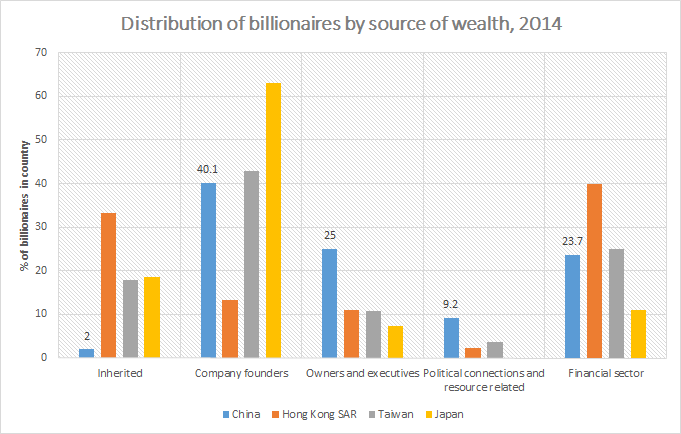
Surprisingly few billionaires in any of the 4 countries obtained their wealth through political connections. Founding a company seems to be still the path of great wealth even in Japan these days. Hong Kong is a financial centre so the large number of billionaires in its financial sector is no surprise.
24 Feb 2016 Leave a comment
in applied price theory, comparative institutional analysis, economics of bureaucracy, industrial organisation, politics - New Zealand, Public Choice, public economics Tags: anti-market bias, New Zealand Greens, privatisation, rational irrationality, state owned enterprises

Green MP Gareth Hughes today nailed the case as to why governments should never run businesses. Too many MPs simply do not understand what dividends represent and what the profits from asset sales represent.
Hughes was reported today saying that taxpayers lost nearly $1 billion in dividends since the recent privatisations of power companies. He is the Green party spokesman on state owned enterprises.

Source: Asset sales cost hits $1 billion | Green Party of Aotearoa New Zealand.
Does the Green Party understand that an asset sells for a price equal to its risk-adjusted discounted net present value of the stream of dividends. When you sell a financial asset, you cash out the net present value of the stream of dividends that might have come from those assets.
The Greens, who are prissy about government transparency and dishonesty of their opponents, did not mention the $4.7 billion in revenue from the asset sale. Taxpayers now receiving more in dividends as a part owner of the privatised power companies than they did as a full owner.
Hughes had the cheek to complain about the politicisation of those privatisations such as favourable terms for small share buyers. That inability of governments to even sell an asset competently is a strong reason why governments should never run businesses in the first place.
If an asset cannot be sold in the full light of day – a major issue in an election campaign and a referendum – without the sale price that is politicised, what is the chance of good management of any state-owned enterprise when it is not the central focus of opposition scrutiny?
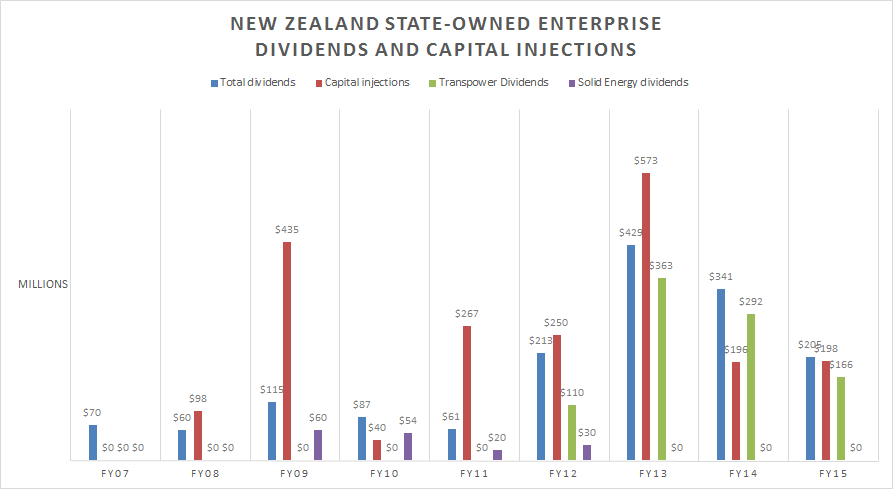
It is been many years since dividends from the state-owned enterprise portfolio has been a net positive cash flow for the taxpayer, as the chart below shows.
Source: New Zealand Treasury – data released under the Official Information Act.
KiwiRail and Solid Energy gobbled up whatever dividends came out of the power companies. Aside from power companies, state-owned enterprises not really offer much in the way of dividends to the taxpayer as the chart again shows.
24 Feb 2016 Leave a comment
in industrial organisation, labour economics, labour supply, population economics, technological progress Tags: creative destruction, robots
20 Feb 2016 Leave a comment
in fiscal policy, industrial organisation, politics - New Zealand, public economics Tags: government ownership, privatisation, state owned enterprises
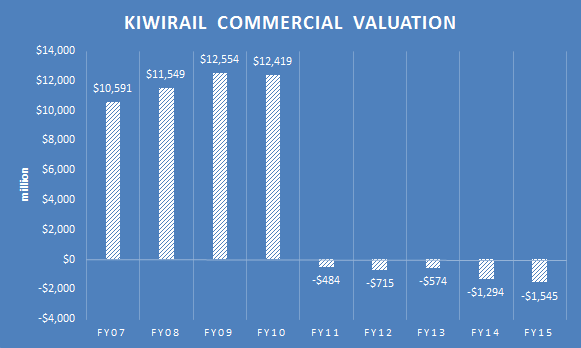
Two dogs of an investment propped up a $20 billion portfolio that a few years later was worth less than 1/5 of that. Both of these stalwarts are now worth not even one dollar.

Source:New Zealand Treasury – information released under the Official Information Act, January 2016.
18 Feb 2016 Leave a comment
in economic history, industrial organisation, politics - New Zealand, public economics Tags: government ownership, KiwiRail, New Zealand Greens, New Zealand Labor Party, privatisation, rational irrationality, state owned enterprises
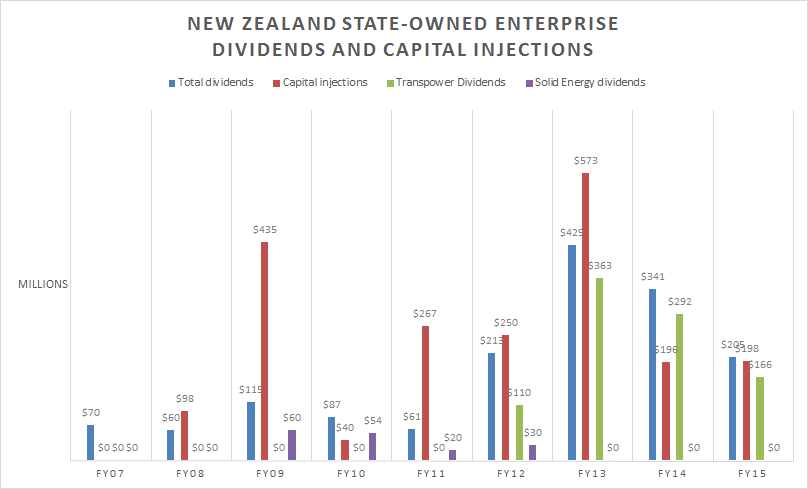
With a straight face, the Labour Party and the Greens claim that state-owned enterprises should not be sold because taxpayers give up the future dividend stream.
Source: New Zealand Treasury – data released under the Official Information Act.
Leaving to one side what the sale price is the net present value of, for as far back as I could obtain data from the Treasury, it is a rare year in which the taxpayers does not pour more money into state-owned enterprises than they get back in dividends.
Transpower is carrying the entire state-owned enterprise portfolio. Earlier on, Solid Energy – a now bankrupt coal mining company– was carrying the portfolio in terms of cash flow to the taxpayer.
18 Feb 2016 Leave a comment
in industrial organisation, politics - USA, public economics Tags: KiwiRail, privatisation, state owned enterprises
Source: New Zealand Treasury – data released under the Official Information Act.
18 Feb 2016 1 Comment
in applied welfare economics, economic history, entrepreneurship, financial economics, industrial organisation Tags: billionaires, entrepreneurial alertness, Philippines, superstars, top 1%
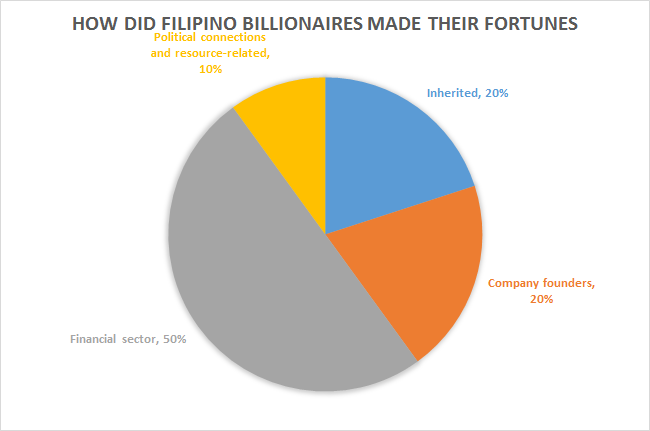
A surprisingly large number of Filipino billionaires are in the financial sector.
17 Feb 2016 Leave a comment
in applied welfare economics, development economics, economic history, economics of regulation, entrepreneurship, growth disasters, growth miracles, industrial organisation Tags: billionaires, entrepreneurial alertness, India, superstars, top 1%
A decent number of India’s billionaires founded a company.

16 Feb 2016 Leave a comment
in applied welfare economics, economic history, economics of regulation, entrepreneurship, financial economics, human capital, industrial organisation, labour economics, poverty and inequality, survivor principle Tags: billionaires, British economy, entrepreneurial alertness, superstars, top 1%

Inheriting wealth is not what it used to be in Britain. There are all these upstarts running businesses or working in the City.

15 Feb 2016 Leave a comment
in applied price theory, development economics, economic history, entrepreneurship, growth miracles, human capital, industrial organisation, labour economics Tags: billionaires, China, entrepreneurial alertness, superstars, top 1%
14 Feb 2016 Leave a comment
in applied price theory, history of economic thought, industrial organisation, international economics Tags: division of labour, spontaneous order
13 Feb 2016 Leave a comment
in economics of bureaucracy, economics of regulation, energy economics, entrepreneurship, industrial organisation, poverty and inequality, privatisation, rentseeking, resource economics
The 1826 Billionaires in the Forbes 2015 list are classified as rich through political connections if they made their money through past political positions, close relatives or friends in government, or questionable licenses, privatisations or resource extraction industries.
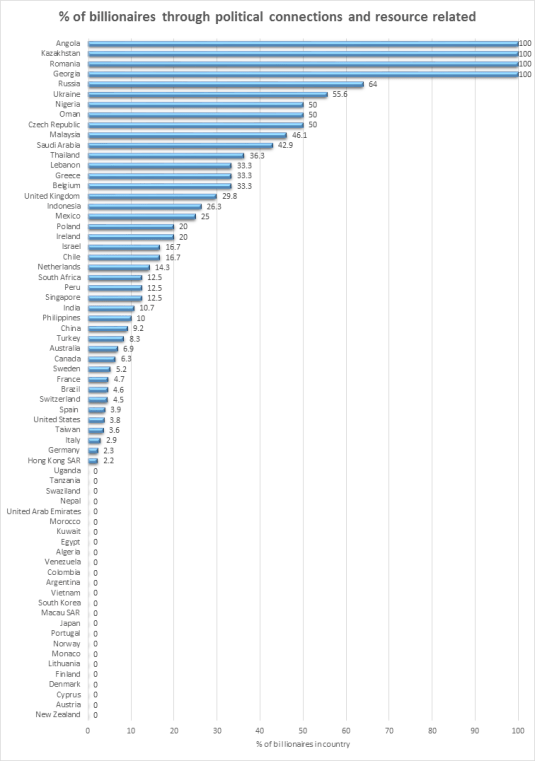
All privatizations were included in the politically-connected/resource-related category despite my data source acknowledging the possibility that the new owners may have transformed the company. Resource billionaires were all deemed to be lucky or cronies by my data source rather than diligent as some most certainly were. This is something of a slur by my data source given the industriousness of some resource billionaires some of whom were even geologists.
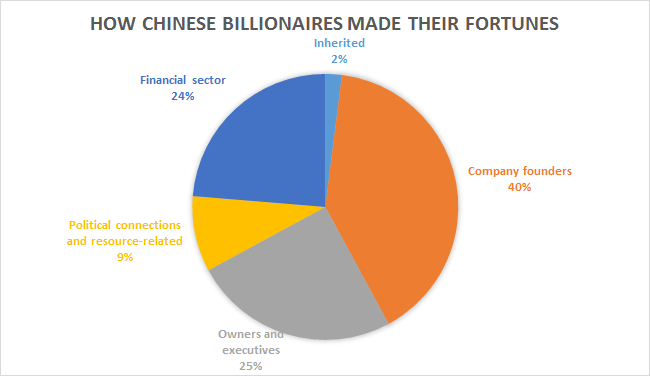
Political cronyism is a path to billionaire wealth mainly in the developing countries. Less than 10% of Chinese billionaires made their money through political connections, which is surprising.
Celebrating humanity's flourishing through the spread of capitalism and the rule of law
Celebrating humanity's flourishing through the spread of capitalism and the rule of law
Celebrating humanity's flourishing through the spread of capitalism and the rule of law
Celebrating humanity's flourishing through the spread of capitalism and the rule of law
Celebrating humanity's flourishing through the spread of capitalism and the rule of law
Celebrating humanity's flourishing through the spread of capitalism and the rule of law
Celebrating humanity's flourishing through the spread of capitalism and the rule of law
Celebrating humanity's flourishing through the spread of capitalism and the rule of law
A History of the Alt-Right
Econ Prof at George Mason University, Economic Historian, Québécois
Celebrating humanity's flourishing through the spread of capitalism and the rule of law
Scholarly commentary on law, economics, and more
Beatrice Cherrier's blog
Celebrating humanity's flourishing through the spread of capitalism and the rule of law
Celebrating humanity's flourishing through the spread of capitalism and the rule of law
Celebrating humanity's flourishing through the spread of capitalism and the rule of law
Why Evolution is True is a blog written by Jerry Coyne, centered on evolution and biology but also dealing with diverse topics like politics, culture, and cats.
Celebrating humanity's flourishing through the spread of capitalism and the rule of law
A rural perspective with a blue tint by Ele Ludemann
DPF's Kiwiblog - Fomenting Happy Mischief since 2003
Celebrating humanity's flourishing through the spread of capitalism and the rule of law
The world's most viewed site on global warming and climate change
Tim Harding's writings on rationality, informal logic and skepticism
A window into Doc Freiberger's library
Let's examine hard decisions!
Commentary on monetary policy in the spirit of R. G. Hawtrey
Thoughts on public policy and the media
Celebrating humanity's flourishing through the spread of capitalism and the rule of law
Politics and the economy
A blog (primarily) on Canadian and Commonwealth political history and institutions
Reading between the lines, and underneath the hype.
Economics, and such stuff as dreams are made on
"The British constitution has always been puzzling, and always will be." --Queen Elizabeth II
Celebrating humanity's flourishing through the spread of capitalism and the rule of law
Celebrating humanity's flourishing through the spread of capitalism and the rule of law
WORLD WAR II, MUSIC, HISTORY, HOLOCAUST
Undisciplined scholar, recovering academic
Celebrating humanity's flourishing through the spread of capitalism and the rule of law
Res ipsa loquitur - The thing itself speaks
In Hume’s spirit, I will attempt to serve as an ambassador from my world of economics, and help in “finding topics of conversation fit for the entertainment of rational creatures.”
Researching the House of Commons, 1832-1868
Articles and research from the History of Parliament Trust
Reflections on books and art
Posts on the History of Law, Crime, and Justice
Celebrating humanity's flourishing through the spread of capitalism and the rule of law
Exploring the Monarchs of Europe


Recent Comments