NewstalkZb reports: The derelict Reading Cinema complex on Wellington’s Courtenay Place has finally been sold, with a local developer snapping up the 1.5-hectare plot. The property was at the centre of a controversial deal between Wellington City Council and Reading International last year, after the council tried to buy the land under the quake-prone building […]
A Reading deal that doesn’t cost ratepayers
A Reading deal that doesn’t cost ratepayers
08 Jan 2025 Leave a comment
in economics of bureaucracy, entrepreneurship, industrial organisation, law and economics, politics - New Zealand, property rights, Public Choice, rentseeking, survivor principle
Some Links
06 Jan 2025 Leave a comment
in applied price theory, economics of bureaucracy, economics of regulation, entrepreneurship, income redistribution, industrial organisation, politics - USA, Public Choice, rentseeking, survivor principle
TweetScott Lincicome decries Biden’s abuse of national security to block Nippon Steel’s acquisition of U.S. Steel. Two slices: Today, President Joe Biden blocked Nippon Steel’s proposed acquisition of US Steel on the grounds that “there is credible evidence” the Japanese steelmaker “might take action that threatens to impair the national security of the United States.” What…
Some Links
Some Links
03 Jan 2025 1 Comment
in applied price theory, comparative institutional analysis, constitutional political economy, defence economics, economic history, economics of crime, economics of regulation, industrial organisation, international economics, International law, law and economics, politics - USA, war and peace
TweetArnold Kling ponders producers versus parasites. A slice: What I notice is that the elites on the Republican side tend to earn a living as producers. They make things that other people want or need. In contrast, elites on the Democratic side include many people one may think of as parasites. They depend on producers…
Some Links
Te Pati Maori promise retrospective legislation
02 Jan 2025 Leave a comment
in comparative institutional analysis, constitutional political economy, economics of regulation, industrial organisation, law and economics, politics - New Zealand, property rights Tags: constitutional law
Te Pati Maori have written to organisations saying that if they are part of a Labour-led Government, they will pass retrospective legislation to punish organisations for actions that were entirely legal. You wonder how much more they need to do, to have media hold them to the same account as any other political party. They […]
Te Pati Maori promise retrospective legislation
Some Links
02 Jan 2025 Leave a comment
in applied price theory, economics of regulation, history of economic thought, industrial organisation, politics - USA
TweetMike Munger explains that “the only way to gain jobs is to lose jobs.” Two slices: Politicians want to create jobs, “good-paying union jobs,” in existing industries. But that’s not what markets do. The “destructive” part of creative destruction eliminates jobs in existing industries. In a dynamic economy, innovations indivision of labor can create good-paying…
Some Links
Palagashvili and Stossel on How Vile Labor Unions Can Be
20 Dec 2024 Leave a comment
in applied price theory, industrial organisation, labour economics, labour supply, survivor principle, unions
TweetIn this video, GMU Econ alum – and my Mercatus Center colleague – Liya Palagashvili talks with John Stossel about the economic destructiveness of labor unions. The post Palagashvili and Stossel on How Vile Labor Unions Can Be appeared first on Cafe Hayek.
Palagashvili and Stossel on How Vile Labor Unions Can Be
Some Simple Economics of the Google Antitrust Case
17 Dec 2024 1 Comment
in applied price theory, economics of information, entrepreneurship, industrial organisation, law and economics, politics - USA, Public Choice, survivor principle, theory of the firm Tags: competition law
The case is straightforward: Google pays firms like Apple billions of dollars to make its search engine the default. (N.B. I would rephrase this as Apple charges Google billions of dollars to make its search engine the default–a phrasing which matters if you want to understand what is really going on. But set that aside […]
Some Simple Economics of the Google Antitrust Case
Health insurance companies are not the main villain
16 Dec 2024 1 Comment
in applied price theory, health economics, industrial organisation, survivor principle Tags: health insurance
First of all, insurance companies just don’t make that much profit. UnitedHealth Group, the company of which Brian Thompson’s UnitedHealthcare is a subsidiary, is the most valuable private health insurer in the country in terms of market capitalization, and the one with the largest market share. Its net profit margin is just 6.11%… That’s only about half of […]
Health insurance companies are not the main villain
#OTD a monopoly was born!?
15 Dec 2024 Leave a comment
in economic history, entrepreneurship, industrial organisation, survivor principle Tags: competition law, creative destruction, merger law enforcement
“This is Not the Time for Balance”: LA Times Columnist Resigns in Protest . . . Over Balanced Commentary
13 Dec 2024 Leave a comment
in entrepreneurship, financial economics, industrial organisation, law and economics, politics - USA, property rights, survivor principle Tags: media bias

When now President-Elect Donald Trump was convicted, the thrill-kill atmosphere around the courthouse and the country was explosive, but no one was more ecstatic than liberal columnist and former prosecutor Harry Litman. The then L.A. Times columnist told MSNBC’s Nicolle Wallace that it was a “majestic day” and “a day to celebrate.” A lawfare advocate, […]
“This is Not the Time for Balance”: LA Times Columnist Resigns in Protest . . . Over Balanced Commentary
More on Business Dynamism
11 Dec 2024 Leave a comment
in applied price theory, economic history, economics of bureaucracy, economics of regulation, entrepreneurship, financial economics, income redistribution, industrial organisation, labour economics, labour supply, managerial economics, organisational economics, personnel economics, Public Choice, rentseeking, survivor principle, theory of the firm Tags: creative destruction, employment law
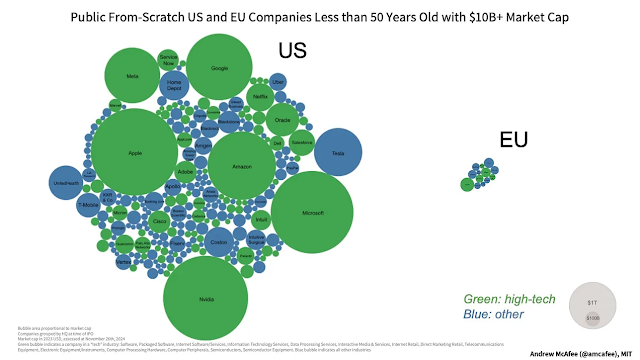
Over at the Geek Way, Andrew McAfee has created a startling visualization related to entrepreneurship in the US and EU. The Draghi Report on EU competitiveness is generating a small buzz among economists. One startling claim is thatthere is no EU company with a market capitalisation over EUR 100 billion that has been set up…
More on Business Dynamism
Nobody Wants To Build Wind Farms In The North Sea
10 Dec 2024 1 Comment
in economics of climate change, energy economics, entrepreneurship, environmental economics, environmentalism, global warming, industrial organisation, resource economics, survivor principle Tags: wind power

By Paul Homewood h/t Hugh Sharman If wind power was so cheap, you would think they would be queuing up to build them: The Danish Energy Agency has not received a single bid for any of the three offshore wind farms in the North Sea, the agency said in a […]
Nobody Wants To Build Wind Farms In The North Sea
Mexican Cartels Lure Chemistry Students to Make Fentanyl
10 Dec 2024 Leave a comment
in development economics, economics of crime, growth disasters, human capital, industrial organisation, labour economics, labour supply, law and economics, occupational choice Tags: Mexico
Criminals turn college campuses into recruitment hubs, recruiting chemistry students in Mexico with big paydays.By Natalie Kitroeff and Paulina Villegas of The NY Times. Excerpts:”In their quest to build fentanyl empires, Mexican criminal groups are turning to an unusual talent pool: not hit men or corrupt police officers, but chemistry students studying at Mexican universities.People…
Mexican Cartels Lure Chemistry Students to Make Fentanyl
Reality Forces Reason into Power Choices
09 Dec 2024 2 Comments
in energy economics, entrepreneurship, industrial organisation, politics - USA Tags: nuclear energy, solar power, wind power
Amazon executives realized their very profitable data centers would fail if they kept posturing with renewable energy.
Reality Forces Reason into Power Choices
How is the Russian war economy doing?
08 Dec 2024 1 Comment
in applied price theory, defence economics, development economics, economic growth, economics of regulation, entrepreneurship, fiscal policy, growth disasters, income redistribution, industrial organisation, international economics, law and economics, macroeconomics, monetary economics, property rights, Public Choice, war and peace Tags: Russia, Ukraine
Here is a gloomy account from Vladimir Mirov: Ruble depreciation will contribute to inflation even further, as Russia is continued to be heavily reliant on imports – this is a kind of self-sustaining spiral. I also strongly disagree with those who say that cheaper ruble is “good” for exporters and the budget. Exporters have yet […]
How is the Russian war economy doing?
 Utopia, you are standing in it!
Recent Comments