
https://www.facebook.com/share/p/Y8JA1saUGwwCNr5Z/?mibextid=xfxF2i
Celebrating humanity's flourishing through the spread of capitalism and the rule of law
30 Jun 2024 Leave a comment
in economic history, entrepreneurship, industrial organisation, survivor principle
26 Jun 2024 Leave a comment
in applied price theory, entrepreneurship, history of economic thought, industrial organisation, law and economics, Ronald Coase Tags: competition law
Nobel Laureate Ronald Coase once quipped that he left antitrust because “When prices go up, its monopolization, when prices fall it’s predation, and when they stay the same it’s collusion.” As if to illustrate this idea, the FTC’s Chair is reversing herself to bring a case against Amazon. On one hand, booksellers argue that Amazon…
When life imitates comedy: FTC’s Amazon Flip Flop
06 Jun 2024 Leave a comment
in applied price theory, health economics, industrial organisation
Among the hundreds of medicines now in short supply are popular drugs used for weight loss such as OzempicBy Liz Essley Whyte and Peter Loftus of The WSJ. I liked that this article mentions that price increases are part of the solution, something that usually does get mentioned. A shortage means that current price is below…
Drug Shortages in America Reach a Record High
06 Jun 2024 Leave a comment
in applied price theory, global financial crisis (GFC), great recession, industrial organisation, law and economics, macroeconomics, monetary economics, politics - New Zealand Tags: competition law
When it comes to the question of how best to avoid a banking collapse and multi-billion dollar bailout that can drag a whole nation into depression, the best solution, according to Chicago-Stanford economist, John Cochrane, is to require banks to set aside a fraction of their own funds as reserves to cover losses they may…
Caught out! The NZ Initiative’s Article in the Herald Blaming the RBNZ for our Rip-Off Big Banks is Contradicted by its Own Expert Witness. (Willis Beware).
24 May 2024 Leave a comment
in applied price theory, economic history, economics of education, history of economic thought, human capital, industrial organisation, labour economics, labour supply, occupational choice

Previously, we could observe a higher proportion of men than women in, say, steel fabrication and suspect that men have “some sort” of physical or mental comparative advantage related to steel fabrication. But what does that mean?
Almost Observable Human Capital
24 May 2024 Leave a comment
in applied price theory, econometerics, industrial organisation, law and economics Tags: competition law, merger law enforcement
DETERRENCE IN MERGER REVIEW: LIKELY EFFECTS OF RECENT U.S. POLICY CHANGESBy Luke M. Froeb, Steven T. Tschantz & Gregory J. WerdenWe model likely effects of Biden Administration changes in merger enforcement on five discrete decisions in the review process. We find that the policy changes can be expected to stop many bad mergers but only at the cost…
New article by some middling economists about Biden Admin. merger policy
21 May 2024 Leave a comment
in applied price theory, comparative institutional analysis, development economics, economics of regulation, entrepreneurship, growth miracles, industrial organisation, managerial economics, organisational economics, public economics, survivor principle Tags: taxation and entrepreneurship, taxation and investment
QUESTION TO CLAUDE 3: The EU and China lag behind the US in economic dynamism, measured by start-up activity, number of unicorns, age of unicorns (younger indicates more rapid innovation), and in productivity growth. Can you document this and tell me why?ANSWER: Here is the data to document the economic dynamism gap between the US,…
Claude 3 on why the US leads China and the EU in economic dynamism
19 May 2024 Leave a comment
in applied price theory, economic history, economics of education, entrepreneurship, human capital, income redistribution, industrial organisation, labour economics, labour supply, occupational choice, politics - USA, poverty and inequality, Public Choice Tags: taxation and entrepreneurship, taxation and investment

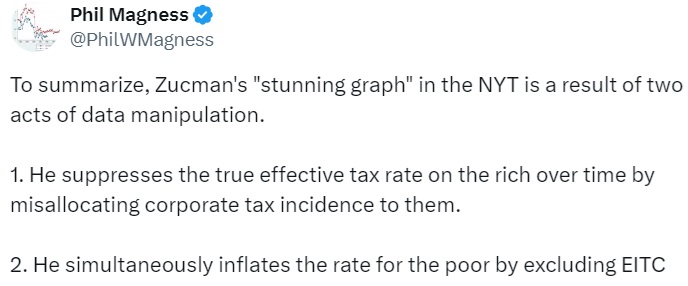
Like Thomas Piketty, Gabriel Zucman is a French economist who promotes economically destructive class-warfare tax policy. He’s also infamous for dodgy data manipulation, as Phil Magness explains in this Reason discussion. The interview lasts for 64 minutes, and I recommend the entire discussion. Yes, that’s a lot of time, but Phil has encyclopedic knowledge and […]
Debunking Bad Class Warfare and Debunking Nonsensical Class Warfare
17 May 2024 Leave a comment
in applied price theory, economics of bureaucracy, industrial organisation, law and economics, managerial economics, politics - New Zealand, privatisation, property rights, Public Choice, survivor principle, theory of the firm, transport economics
The Herald reports: KiwiRail’s seemingly endless requests for more money is damning. At one point, KiwiRail assured Robertson when he was the Finance Minister that the worst-case scenario would be an extra $300 million before requesting $1.2 billion a few months later. Not what most people regard as worst case. It’s no wonder Ministry of Transport officials […]
Is it time to take the Interislander away from Kiwirail?
15 May 2024 Leave a comment
in energy economics, entrepreneurship, environmental economics, financial economics, global warming, industrial organisation, survivor principle Tags: Germany, solar power

Germany’s costly and chaotic wind and solar transition has served up plenty of casualties. Large numbers of energy intensive manufacturers have already bailed out – chasing cheap power prices in places like the US and Singapore. Now, in a rather ironic twist, its solar panel manufacturing industry has all but thrown in the towel. Notwithstanding […]
Business Freeze: Germany’s Last Solar Panel Manufacturers Finally Crushed
14 May 2024 Leave a comment
in energy economics, environmental economics, global warming, industrial organisation, politics - USA, survivor principle Tags: wind power

America’s offshore wind industry is collapsing, both figuratively and literally. Offshore turbines have grown in capacity and size to the point where they simply collapse into the ocean. As do the financial prospects of those seeking to profit from them. One of the key players offshore – GE’s renewables division – backed up a solid […]
Full-blown Financial Meltdown: Offshore Wind Industry’s Collapse Accelerates
09 May 2024 Leave a comment
in applied price theory, comparative institutional analysis, constitutional political economy, development economics, economic history, growth disasters, growth miracles, history of economic thought, income redistribution, industrial organisation, law and economics, property rights, Public Choice, public economics, rentseeking

Mancur Olson’s The Rise and Decline of Nations is one of my favorite books and a classic of public choice. Olson may well have won the Nobel prize had he not died young. He summarized his book in nine implications of which I will present four: 2. Stable societies with unchanged boundaries tend to accumulate […]
The Rise and Decline and Rise Again of Mancur Olson
07 May 2024 Leave a comment
in applied price theory, economic growth, economic history, entrepreneurship, human capital, income redistribution, industrial organisation, labour economics, labour supply, macroeconomics, Marxist economics, politics - USA, Public Choice, public economics Tags: taxation and entrepreneurship, taxation and investment, wealth tax
Everything you need to know about wealth taxation can be summarized in two sentences. The biggest problem with most tax systems is the pervasive tax bias against income that is saved and invested, which discourages the accumulation of capital that helps to finance future growth. Wealth taxes would dramatically increase the tax bias against saving […]
Dishonest Pimping for a Global Wealth-Tax Cartel
01 May 2024 Leave a comment
in applied price theory, economic history, industrial organisation, labour economics, labour supply Tags: asymmetric information, moral hazard, tipping
Why leave a tip? You have already received whatever food or service you are going to receive. Maybe if you are a very regular customer, tipping could lead to better service in the future. But most people who leave tips do so even if they are stopping off at, say, a restaurant in a city…
Some Economics of Tipping
28 Apr 2024 Leave a comment
in applied price theory, Austrian economics, history of economic thought, industrial organisation, law and economics Tags: competition law
Tweet… is from page 422 of Robert Bork’s masterful 1978 book, The Antitrust Paradox: Competition in open markets reflects the ideal of equality of opportunity, while antitrust’s longstanding and growing concern for the small and less efficient reflects a preference for equality of outcome. Outcomes are not equal in open competition, hence the pressure for…
Quotation of the Day…
Celebrating humanity's flourishing through the spread of capitalism and the rule of law
Celebrating humanity's flourishing through the spread of capitalism and the rule of law
Celebrating humanity's flourishing through the spread of capitalism and the rule of law
Celebrating humanity's flourishing through the spread of capitalism and the rule of law
Celebrating humanity's flourishing through the spread of capitalism and the rule of law
Celebrating humanity's flourishing through the spread of capitalism and the rule of law
Celebrating humanity's flourishing through the spread of capitalism and the rule of law
A History of the Alt-Right
Econ Prof at George Mason University, Economic Historian, Québécois
Celebrating humanity's flourishing through the spread of capitalism and the rule of law
Scholarly commentary on law, economics, and more
Beatrice Cherrier's blog
Celebrating humanity's flourishing through the spread of capitalism and the rule of law
Celebrating humanity's flourishing through the spread of capitalism and the rule of law
Celebrating humanity's flourishing through the spread of capitalism and the rule of law
Why Evolution is True is a blog written by Jerry Coyne, centered on evolution and biology but also dealing with diverse topics like politics, culture, and cats.
Celebrating humanity's flourishing through the spread of capitalism and the rule of law
A rural perspective with a blue tint by Ele Ludemann
DPF's Kiwiblog - Fomenting Happy Mischief since 2003
Celebrating humanity's flourishing through the spread of capitalism and the rule of law
The world's most viewed site on global warming and climate change
Tim Harding's writings on rationality, informal logic and skepticism
A window into Doc Freiberger's library
Let's examine hard decisions!
Commentary on monetary policy in the spirit of R. G. Hawtrey
Thoughts on public policy and the media
Celebrating humanity's flourishing through the spread of capitalism and the rule of law
Politics and the economy
A blog (primarily) on Canadian and Commonwealth political history and institutions
Reading between the lines, and underneath the hype.
Economics, and such stuff as dreams are made on
"The British constitution has always been puzzling, and always will be." --Queen Elizabeth II
Celebrating humanity's flourishing through the spread of capitalism and the rule of law
Celebrating humanity's flourishing through the spread of capitalism and the rule of law
WORLD WAR II, MUSIC, HISTORY, HOLOCAUST
Undisciplined scholar, recovering academic
Celebrating humanity's flourishing through the spread of capitalism and the rule of law
Res ipsa loquitur - The thing itself speaks
In Hume’s spirit, I will attempt to serve as an ambassador from my world of economics, and help in “finding topics of conversation fit for the entertainment of rational creatures.”
Researching the House of Commons, 1832-1868
Articles and research from the History of Parliament Trust
Reflections on books and art
Posts on the History of Law, Crime, and Justice
Celebrating humanity's flourishing through the spread of capitalism and the rule of law
Exploring the Monarchs of Europe
Cutting edge science you can dice with


Recent Comments