Trust in media chart, by ideology https://t.co/n9UrakFbaN pic.twitter.com/mFQD71tNZL
— Sara Kehaulani Goo (@sarakgoo) October 29, 2015
Trust in media by ideology
15 Nov 2015 Leave a comment
in economics of information, economics of media and culture, industrial organisation, politics - USA, Public Choice, survivor principle Tags: expressive voting, media bias, rational ignorance, rational irrationality, The meaning of competition
Creative destruction in British manufacturing employment
13 Nov 2015 Leave a comment
in applied price theory, applied welfare economics, economic history, industrial organisation, labour economics, labour supply, survivor principle Tags: British economy, British history, creative destruction, endogenous growth theory, labour reallocation, technological unemployment
@dsmitheconomics @thesundaytimes In mid-60s, about a third of workers were employed in manufacturing. Now 8%! http://t.co/ipmr7XvIme—
Andrew Sentance (@asentance) July 12, 2015
Do the European welfare states free ride off American entrepreneurship and innovation?
12 Nov 2015 1 Comment
in applied price theory, applied welfare economics, comparative institutional analysis, constitutional political economy, economic history, economics of regulation, entrepreneurship, industrial organisation, politics - USA, public economics, survivor principle, taxation, technological progress Tags: creative destruction, Daron Acemoglu, Denmark, entrepreneurial alertness, Eurosclerosis, international technology diffusion, taxation and entrepreneurship, taxation and innovation, taxation and investment, taxation and labour supply, technology followers, welfare state
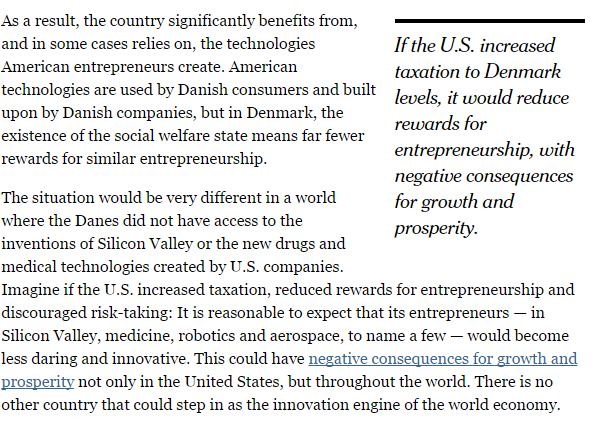
Source: Daron Acemoglu A Scandinavian U.S. Would Be a Problem for the Global Economy – NYTimes.com.
The diffusion rates of household appliances in the 20th century
06 Nov 2015 Leave a comment
in economic history, gender, industrial organisation, labour economics, survivor principle Tags: creative destruction, engines of liberation, household production, international technology diffusion, marital division of labour, technology diffusion
Why household appliances are the 20th century’s most disruptive technologies bit.ly/1LsZEJC
at @wef https://t.co/qwI3FpXhwz—
Max Roser (@MaxCRoser) October 24, 2015

Why are so many Silicon Valley start-up founders libertarian Democrats?
03 Nov 2015 Leave a comment
in economics of media and culture, entrepreneurship, income redistribution, industrial organisation, politics - USA, Public Choice, rentseeking, survivor principle Tags: creative destruction, entrepreneurial alertness, expressive voting, rational ignorance, Silicon Valley, start-ups, voter demographics
10 years ago today some kid dropped out of Harvard to work on some website
02 Nov 2015 Leave a comment
in economic history, economics of media and culture, entrepreneurship, industrial organisation, survivor principle Tags: creative destruction, entrepreneurial alertness, Facebook
Did the New Zealand film industry just eat our lunch? By Jason Potts
01 Nov 2015 Leave a comment
in applied price theory, economics of media and culture, fiscal policy, industrial organisation, job search and matching, labour economics, labour supply, macroeconomics, politics - Australia, politics - New Zealand, Public Choice, rentseeking, survivor principle Tags: film subsidies, Hollywood economics, industry policy, offsetting behaviour, The fatal conceit, The pretense to knowledge, unintended consequences

James Cameron is going to film the next three instalments of the Avatar franchise in New Zealand. He promises to spend at least NZ$500 million, employ thousands of Kiwis, host at least one red-carpet event, include a NZ promotional featurette in the Avatar DVDs, and will personally serve on a bunch of Film NZ committees, and probably even bring scones, all in return for a 25% rebate on any spending he and his team do in the country (up from a 20% baseline to international film-makers) that is being offered by the New Zealand Government.
The implication that many media reports are running with is that this is a loss to the Australian film industry, that we should be fighting angry, and that we should hit back at this brilliantly cunning move by the Kiwi’s by increasing our film industry rebates, which currently are about 16.5% (these include the producer and location offsets, and the post, digital and visual effects offset) to at very least 30%. These rebates cost tax-payers A$204 million in 2012, which hardly even buys you a car industry these days.
So what are the economics of this sort of industry assistance? Is this something we should be doing a whole lot more of? Was the NZ move to up the rebate especially brilliant? First, note that James Cameron has substantial property interests in New Zealand already, so this probably wasn’t as up for grabs as we might think. But if that’s how the New Zealand taxpayers want to spend their money, that’s up to them. The issue is should we follow suit?
The basic economics of this sort of give-away is the concept of a multiplier “”), which is the theory that an initial amount of exogenous spending becomes someone else’s income, which then gets spent again, creating more income, and so on, creating jobs and exports and all sorts of “economic benefits” along the way.
People who believe in the efficacy of Keynesian fiscal stimulus also believe in the existence of (>1) multipliers. Consultancy-based “economic impact” reports do their magic by assuming greater-than-one multipliers (or equivalently, a high marginal propensity to consume coupled with lots of dense sectoral linkages). With a multiplier greater than one, all government spending is magically transformed into “investment in Australian jobs”.
So the real question is: are multipliers actually greater-than-one? That’s an empirical question, and the answer is mostly no. (And if you don’t believe my neoliberal bluster, the progressive stylings of Ben Eltham over at Crikey more or less make the same point.)
But to get this you have to do the economics properly, and not just count the positive multipliers, but also account for the loss of investment in other sectors that didn’t take place because it was artificially re-directed into the film sector, which no commissioned impact study ever does.
This is why economists have a very low opinion of economic impact studies, which are to economics what astrology is to physics.
What does make for a good domestic film industry then? Look again at New Zealand, and look beyond the great Weta Studios in Wellington, for Australia and Canada both have world-class production studios and post-production facilities. Look beyond New Zealand’s natural scenery, for Vancouver is an easy match for New Zealand and Australia pretty much defines spectacular.
No, the simple comparison is that New Zealand is about 20% cheaper than Australia and 30% cheaper than Canada. New Zealand has lower taxes, easy employment conditions and relatively light regulations (particularly around insurance and health and safety). It’s just easier to get things done there.
If Australia really wants to boost its film industry, it might look more closely at labour market restrictions (including minimum wages) and regulatory burden and worry less about picking taxpayer pockets and bribing foreigners.
This article was originally published on The Conversation in December 2013. Read the original article. Republished under the a Creative Commons Attribution No Derivatives licence.
Did government pick the Internet as a winner? @stevenljoyce @dpfdpf
31 Oct 2015 Leave a comment
in applied price theory, Austrian economics, comparative institutional analysis, economic history, economics of bureaucracy, economics of media and culture, industrial organisation, Public Choice, survivor principle Tags: creative destruction, entrepreneurial alertness, industry policy, Internet, picking losers, picking winners, The fatal conceit, The meaning of competition, The pretense to knowledge
Mises on Nazi socialism
31 Oct 2015 Leave a comment
in applied price theory, Austrian economics, comparative institutional analysis, constitutional political economy, defence economics, economics of bureaucracy, economics of regulation, industrial organisation, labour economics, Ludwig von Mises, Public Choice, survivor principle Tags: Nazi Germany
#TBT Ludwig von Mises' 1942 Letter to the Editor in the @nytimes on Nazi socialism. http://t.co/kv7TFekY8J—
Mises Institute (@mises) October 15, 2015
Creative destruction in technology acquisitions
19 Oct 2015 Leave a comment
in economic history, entrepreneurship, industrial organisation, survivor principle Tags: creative destruction, entrepreneurial alertness, market for corporate control, mergers and takeovers
The 12 biggest #technology acquisitions of all time wef.ch/1QrO2b5 http://t.co/Dx0YTm8NpA—
World Economic Forum (@wef) October 15, 2015
Creative destruction in newspapers
17 Oct 2015 Leave a comment
in economic history, economics of media and culture, entrepreneurship, industrial organisation, survivor principle Tags: creative destruction, entrepreneurial alertness
Creative destruction in Twitter
17 Oct 2015 Leave a comment
in economic history, economics of media and culture, entrepreneurship, industrial organisation, survivor principle Tags: creative destruction, entrepreneurial alertness, Twitter
2015 has not been a particularly good year for Twitter. Will share prices go further down? econ.st/1PfOAmW http://t.co/ME1RbnlmNE—
The Economist (@TheEconomist) October 14, 2015
Our interactive chart explains why Twitter remains a minnow in the tech industry econ.st/1LkhVqi http://t.co/sCQWStMEC3—
The Economist (@TheEconomist) October 14, 2015


 Utopia, you are standing in it!
Recent Comments