CHART: Asians Make 15% More Than Whites, Is That Because of 'Asian Privilege' or Discrimination Against Whites? http://t.co/9YnkDDrcbO—
Mark J. Perry (@Mark_J_Perry) March 19, 2015
A long-standing anomaly about racial discrimination in the labour market
19 Apr 2015 Leave a comment
in discrimination, human capital, labour economics, labour supply, occupational choice Tags: co-worker discrimination, customer discrimination, employer discrimination, labour market discrimination, racial discrimination
50% more R&D since the 60s, but still no growth dividend?
18 Apr 2015 1 Comment
in applied price theory, economic growth, economics of education, entrepreneurship, history of economic thought, human capital, industrial organisation, macroeconomics, occupational choice, survivor principle Tags: Ben Jones, Chad Jones, creative destruction, endogenous growth theory, innovation, R&D
Spending on intellectual property products has risen in the USA from 1% in 1950 to 5% now. Public R&D spending in the USA has been pretty static for 60 years. Intellectual property products in the chart below includes traditional research and development, spending on computer software, and spending on entertainment such as movies, TV shows, books, and music. Spending on software and entertainment was only recently measured in the US national accounts. This inclusion of intangible capital investments will radically change the story of economic growth and the business cycle in the 20th century.
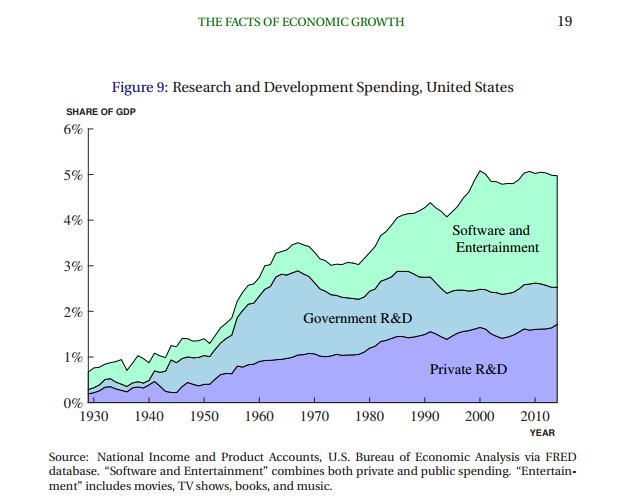
Source: Chad Jones (2015).
The growth rate in the USA hasn’t changed much despite this massive increase in intellectual property property product production. Is innovation getting harder? R&D is supposed to boost the growth rate, if you are to believe politicians bearing subsidies for it wherever they find it.
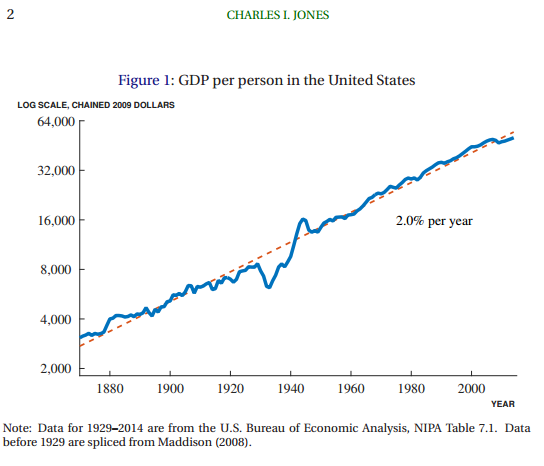
Source: Chad Jones (2015).
Ben Jones in The Burden of Knowledge and the Death of the Renaissance Man: Is Innovation Getting Harder? found that as knowledge accumulates as technology advances, successive generations of innovators may face an increasing educational burden. Innovators can compensate through lengthening their time in education and narrowing expertise, but these responses come at the cost of reducing individual innovative capacities. This has implications for the organization of innovative activity – a greater reliance on teamwork – and has negative implications for economic growth.
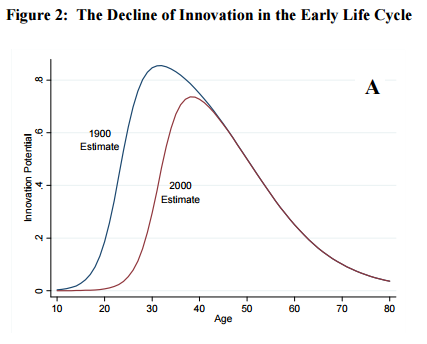
This longer period of education and initial study is not compensated by inventors innovating for longer spans of their lifestyle. This rising burden of knowledge is cutting into their best years of their lives. Jones found a broad and dramatic declines in early life-cycle productivity among great minds and ordinary inventors, and a close relationship of these trends with increased training duration.
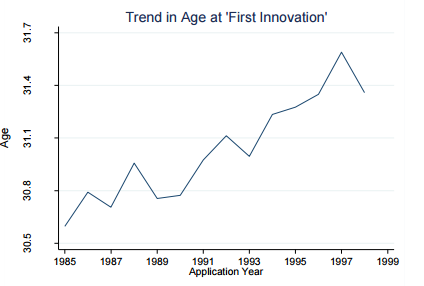
Jones found that the age at first invention, specialisation, and teamwork increased over time in a large micro-data set of inventors. Upward trends in academic collaboration and lengthening doctorates can also be explained in his framework of innovation getting harder because of a rising burden of knowledge. Co-authorship in academic literature has increased, including physics, biology, chemistry, mathematics, psychology, and economics. This measure of teamwork has increased 17% per decade.
Using data on Nobel Prize winners, Jones found that the mean age at which the innovations are produced to win the Prize has increased by 6 years over the 20th Century.
- Before 1901, two-thirds of the Nobel laureates did their prize-winning work before the age of 40 and 20 per cent did it before age of 30.
- By 2000, however, great achievements seldom occurred before the age of 40.
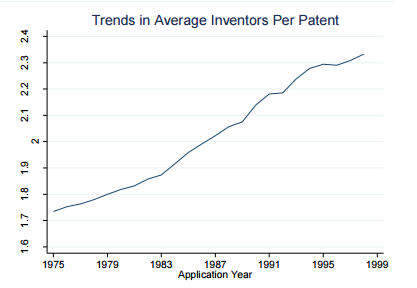
It’s now taking longer for scientists to get their basic training and start their careers. There is simply more to learn because knowledge in all fields has grown by quantum leaps in the past century. Nobels are being handed out for different types of work than a century ago.
- There has been a trend away from awarding prizes for abstract, theoretical ideas.
- Now more honours are being bestowed on people who have made discoveries through painstaking lab work and experimentation – which takes a lot of time to do.
Jones’ theory provides an explanation for why productivity growth rates did not accelerate through the 20th century despite an enormous expansion in collective research effort and levels of education and many more graduates. Innovation is getting harder?
There are big differences in educational attainment across Europe
16 Apr 2015 Leave a comment
in economics of education, human capital, labour economics, occupational choice Tags: educational attainment, Eurosclerosis
Ireland has the highest share of highly qualified 30-34 year olds in the EU http://t.co/LhZMvYcgj5—
Guardian Data (@GuardianData) September 26, 2014
Thomas Sowell – Gender Bias and Income Disparity: A Myth?
15 Apr 2015 Leave a comment
in discrimination, gender, human capital, labour economics, labour supply, occupational choice Tags: gender wage gap, Thomas Sowell
The raw gender wage gap conceals more than it reveals
15 Apr 2015 Leave a comment
in discrimination, gender, human capital, labour economics, labour supply, occupational choice Tags: gender wage gap, reversing gender gap
FACTS #EqualPayDay http://t.co/KoWZeiIShQ—
Meninist (@MeninistTweet) April 14, 2015
Why aren’t the trends in this chart celebrated on Equal Pay Day?
15 Apr 2015 Leave a comment
in discrimination, gender, human capital, labour economics, labour supply, occupational choice Tags: gender wage gap
Some #EqualPayDay statistics: gender wage gap is narrowest for the young, gets wider with age blogs.wsj.com/economics/2015… http://t.co/rpiWdfOyp2—
Josh Zumbrun (@JoshZumbrun) April 14, 2015
What does the raw gender wage gap mean if it is not this?
15 Apr 2015 Leave a comment
in discrimination, gender, human capital, labour economics, labour supply, occupational choice Tags: Equal Pay Day, gender wage gap
Tomorrow is feminists' make-believe, bogus Equal Pay Day. Look for statistical fraud, best illustrated by this coupon http://t.co/agg2o8n8yU—
Mark J. Perry (@Mark_J_Perry) April 13, 2015
New Zealand spends a lot in education for a pretty average education premium in return
15 Apr 2015 Leave a comment
in economics of education, human capital, labour economics Tags: College premium, education premium, graduate premium
#Education makes up 12.9% of public #spending in OECD area; how does your country compare? bit.ly/1ang3Rj http://t.co/cUgf7fnj8F—
(@OECD) April 13, 2015

@OECD More college grads nationally= a smaller wage premium for young workers bit.ly/1rJ8bz9 #highereducation http://t.co/IWjetA6znw—
Dr. Eugene Kowch (@ekowch) September 17, 2014

Finishing year 10 of high school was a very much a mid-20th century phenomenon
09 Apr 2015 Leave a comment
in economic history, economics of education, human capital, labour economics, occupational choice, politics - USA Tags: educational attainment
Difference in PISA scores of 15-year-old female and male students on reading literacy: 2012
06 Apr 2015 Leave a comment
in discrimination, economics of education, gender, human capital, labour economics, occupational choice Tags: reversing gender gap

via nces.ed.gov
I am pretty sure I am not a super-taster given my narrow food preferences
05 Apr 2015 Leave a comment
in human capital, occupational choice Tags: economics of personality traits, economics of physiology
Claudia Goldin on Gender Equality in the Labor Market
02 Apr 2015 Leave a comment
in discrimination, gender, human capital, labour economics, managerial economics, occupational choice, organisational economics, personnel economics Tags: Claudia Goldin, gender wage gap, wage gaps
The rising educational attainment of the poor
01 Apr 2015 Leave a comment
in economics of education, human capital, labour economics, labour supply, poverty and inequality, welfare reform Tags: educational attainment
@mattyglesias poverty trends a good example of why americanprogress.org/issues/poverty… http://t.co/tgn7RzBKzw—
Shawn Fremstad (@inclusionist) March 28, 2015


Recent Comments