
Data extracted on 10 Mar 2016 22:02 UTC (GMT) from OECD.Stat and The Conference Board. 2015. The Conference Board Total Economy Database™, May 2015, http://www.conference-board.org/data/economydatabase/
Celebrating humanity's flourishing through the spread of capitalism and the rule of law
14 Mar 2016 Leave a comment
in economic history, labour economics, labour supply Tags: British economy, France, hours worked, taxation and labour supply
Data extracted on 10 Mar 2016 22:02 UTC (GMT) from OECD.Stat and The Conference Board. 2015. The Conference Board Total Economy Database™, May 2015, http://www.conference-board.org/data/economydatabase/
13 Mar 2016 Leave a comment
in applied price theory, labour economics, labour supply, personnel economics, survivor principle

It comes as a surprise to living wage advocates that entrepreneurs are so alert to the impact of downsizing and firm closures on employee morale that they keep these a secret to the last possible minute.
Entrepreneurs are not fools. They profit from alertness to the effects of changes in the fortunes of the firm on labour productivity. There is a vast literature on how to motivate workers towards more effort and diligence and honesty.

I worked at a Japanese private university whose financial survival was always in question. We spent a lot of time gossiping about the security of our jobs.
I refer to one year at one employer as the year of doing nothing because management was so consumed with restructuring and downsizing. They were too busy to sign out the output of their staff.
I have come across an estimate the effect of downsizing announcement on productivity at a German bakery chain of 193 shops.

The study found that announcements of a sale to a new owner and closure reduced sales by six and 21 percent, respectively. This negative effect increased with the share of workers on a permanent contract, even though these workers faced a much lower unemployment risk. Fewer customers were served per unit of time because of less employee effort at the bakery chain.
Going back to my year of doing nothing, which dragged out through worker consultations sought by the unions under the collective agreement, I remember chatting to a mate whose father was in the downsizing consulting business. He told me that private businesses get downsizing over as quickly as possible because of the impact on morale and productivity. Entrepreneurs are perfectly aware that uncertainty promotes office gossip and valuable staff moving on.
12 Mar 2016 Leave a comment
in gender, labour economics, labour supply Tags: 40 hour week, female labour force participation, hours worked, maternal labour force participation, part-time work, social insurance, taxation and labour supply
12 Mar 2016 Leave a comment
in economic history, labour economics, labour supply Tags: France, hours worked, social insurance, taxation and labour supply
American workers are working fewer hours per year but more labour has been supplied by the working age population especially in the 1980s and 1990s. In France, there has been a steady decline of hours worked per worker and, up until 1985, hours worked per working age French.

Data extracted on 10 Mar 2016 22:34 UTC (GMT) from OECD.Stat, Data extracted on 10 Mar 2016 22:02 UTC (GMT) from OECD.Stat, and The Conference Board. 2015. The Conference Board Total Economy Database™, May 2015, http://www.conference-board.org/data/economydatabase/
12 Mar 2016 Leave a comment
in labour economics, labour supply Tags: 35 hour week, 40 hour week, hours worked
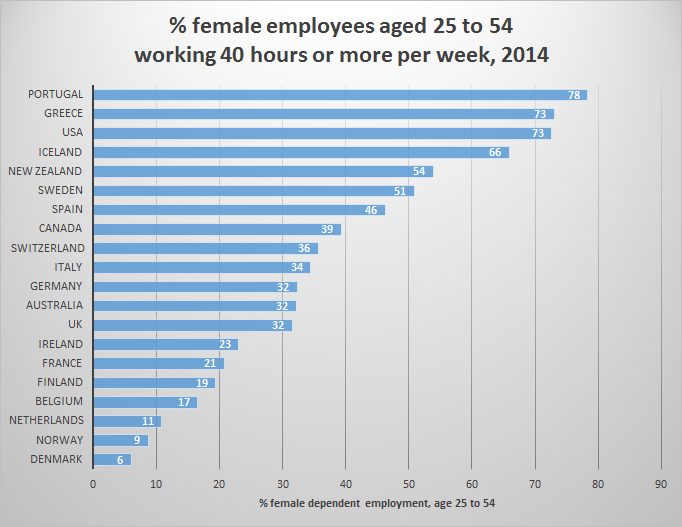
The 40 hour week is rather rare in some parts of Western Europe.
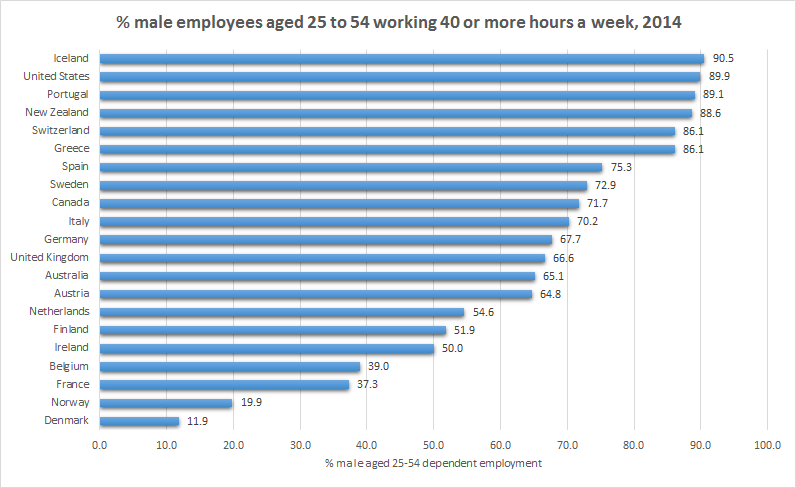
Data extracted on 11 Mar 2016 13:44 UTC (GMT) from OECD.Stat
10 Mar 2016 Leave a comment
in economic history, job search and matching, labour economics, labour supply, macroeconomics, unemployment

Source: How Sweden’s Unemployment Became More Like Europe’s, Lars Ljungqvist, Thomas J. Sargent 2010.
10 Mar 2016 Leave a comment
in labour economics, labour supply Tags: Australia, British economy, Canada, Denmark, France, Germany, Japan, Sweden, taxation and labour supply, working hours
Them Continentals certainly are a bit work-shy especially the Nordics. All of them are pretty much afraid to put in a long week. Then again they do face rather high taxes on labour so what would you expect? The Japanese are still working themselves to death.
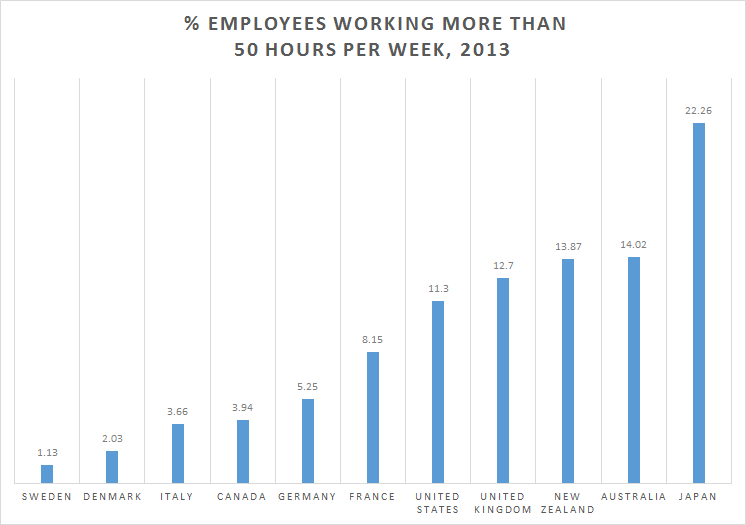
Data extracted on 09 Mar 2016 22:25 UTC (GMT) from OECD.Stat – OECD Better Life Index 2015.
10 Mar 2016 Leave a comment
in discrimination, economics of education, gender, human capital, labour economics, labour supply, occupational choice Tags: compensating differentials, education premium, female labour force participation, gender wage gap, graduate premium, maternal labour force participation
The USA, the gender pay gap gets worse if you go to college. By contrast, in Sweden and especially Canada the gender pay gap is much less for graduates than for those with a high school education.
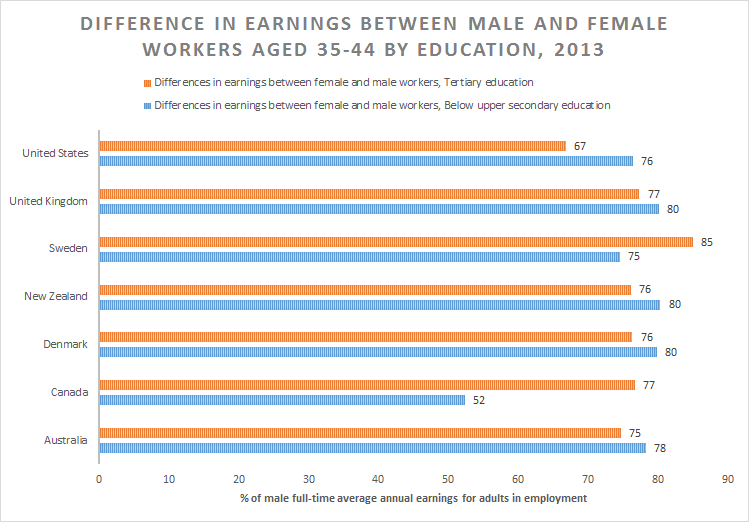
Data extracted on 09 Mar 2016 22:28 UTC (GMT) from OECD.Stat.
In most countries in the chart above, going on to university and graduating does not reduce the gender pay gap by the time you reach your late 30s and early 40s. Best explanation for that is that part of the graduate wage premium is traded for work-life balance.
05 Mar 2016 Leave a comment
in economics of love and marriage, fiscal policy, gender, labour economics, labour supply, law and economics, politics - Australia, politics - New Zealand, politics - USA, public economics Tags: Australia, British economy, Canada, Denmark, effective marginal tax rates, family tax benefits, family tax credits, France, Germany, in-work tax credits, Italy, poverty traps, rational irrationality, social insurance, Sweden, taxation and labour supply
Some countries including New Zealand and Australia do not give ordinary families much of an incentive to earn more. Effective marginal tax rates on low income families is one of the few times that the Left discovers supply-side economics.
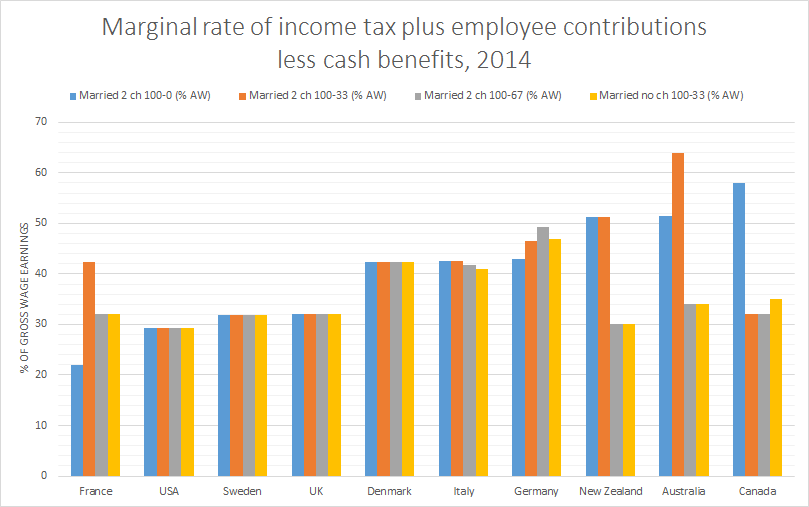
Source: Taxing Wages 2015 – OECD 2015.
05 Mar 2016 Leave a comment
in economics, gender, labour economics, labour supply, politics - USA Tags: maternity leave
04 Mar 2016 Leave a comment
in economics of media and culture, labour supply, occupational choice
01 Mar 2016 Leave a comment
in labour economics, labour supply Tags: hours worked
Celebrating humanity's flourishing through the spread of capitalism and the rule of law
Scholarly commentary on law, economics, and more
Beatrice Cherrier's blog
Celebrating humanity's flourishing through the spread of capitalism and the rule of law
Celebrating humanity's flourishing through the spread of capitalism and the rule of law
Celebrating humanity's flourishing through the spread of capitalism and the rule of law
Why Evolution is True is a blog written by Jerry Coyne, centered on evolution and biology but also dealing with diverse topics like politics, culture, and cats.
Celebrating humanity's flourishing through the spread of capitalism and the rule of law
Celebrating humanity's flourishing through the spread of capitalism and the rule of law
A rural perspective with a blue tint by Ele Ludemann
DPF's Kiwiblog - Fomenting Happy Mischief since 2003
Celebrating humanity's flourishing through the spread of capitalism and the rule of law
The world's most viewed site on global warming and climate change
Tim Harding's writings on rationality, informal logic and skepticism
A window into Doc Freiberger's library
Let's examine hard decisions!
Commentary on monetary policy in the spirit of R. G. Hawtrey
Thoughts on public policy and the media
Celebrating humanity's flourishing through the spread of capitalism and the rule of law
Politics and the economy
A blog (primarily) on Canadian and Commonwealth political history and institutions
Reading between the lines, and underneath the hype.
Economics, and such stuff as dreams are made on
"The British constitution has always been puzzling, and always will be." --Queen Elizabeth II
Celebrating humanity's flourishing through the spread of capitalism and the rule of law
Celebrating humanity's flourishing through the spread of capitalism and the rule of law
WORLD WAR II, MUSIC, HISTORY, HOLOCAUST
Undisciplined scholar, recovering academic
Celebrating humanity's flourishing through the spread of capitalism and the rule of law
Res ipsa loquitur - The thing itself speaks
Celebrating humanity's flourishing through the spread of capitalism and the rule of law
Researching the House of Commons, 1832-1868
Articles and research from the History of Parliament Trust
Reflections on books and art
Posts on the History of Law, Crime, and Justice
Celebrating humanity's flourishing through the spread of capitalism and the rule of law
Exploring the Monarchs of Europe
Cutting edge science you can dice with
Small Steps Toward A Much Better World
“We do not believe any group of men adequate enough or wise enough to operate without scrutiny or without criticism. We know that the only way to avoid error is to detect it, that the only way to detect it is to be free to inquire. We know that in secrecy error undetected will flourish and subvert”. - J Robert Oppenheimer.
The truth about the great wind power fraud - we're not here to debate the wind industry, we're here to destroy it.
Celebrating humanity's flourishing through the spread of capitalism and the rule of law
Celebrating humanity's flourishing through the spread of capitalism and the rule of law
Economics, public policy, monetary policy, financial regulation, with a New Zealand perspective
Celebrating humanity's flourishing through the spread of capitalism and the rule of law
Restraining Government in America and Around the World


 Utopia, you are standing in it!
Recent Comments