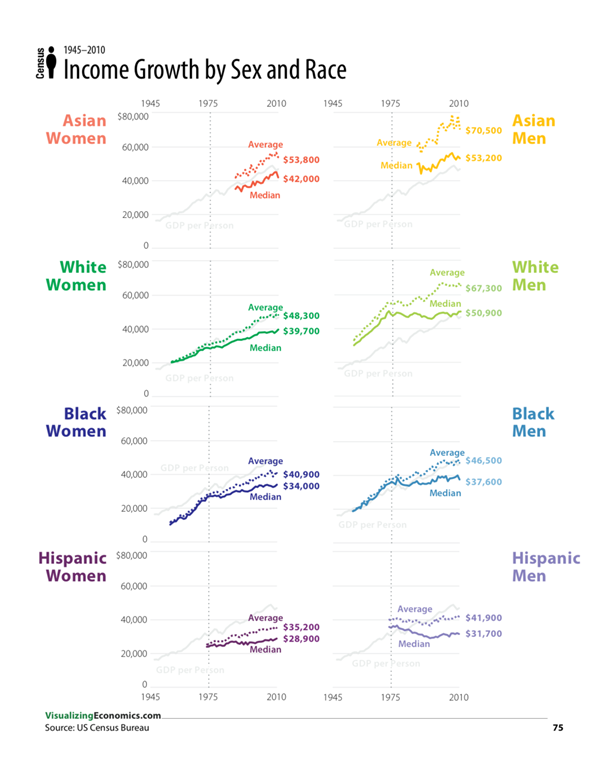
Source: Read Online — Visualizing Economics.
Celebrating humanity's flourishing through the spread of capitalism and the rule of law
23 May 2016 Leave a comment
in discrimination, economic history, economics of media and culture, gender, human capital, labour economics, labour supply, occupational choice, poverty and inequality Tags: gender wage gap, middle class stagnation, reversing gender gap, wage stagnation
Source: Read Online — Visualizing Economics.
23 May 2016 Leave a comment
in applied price theory, applied welfare economics, economic history, entrepreneurship, human capital, industrial organisation, labour economics, labour supply, occupational choice, poverty and inequality, survivor principle Tags: entrepreneurial alertness, envy, superstar wages, superstars, top 1%, top incomes
Everybody from the top 10% to the top 0.01% have to work for their living these days with much of their income coming from wages.
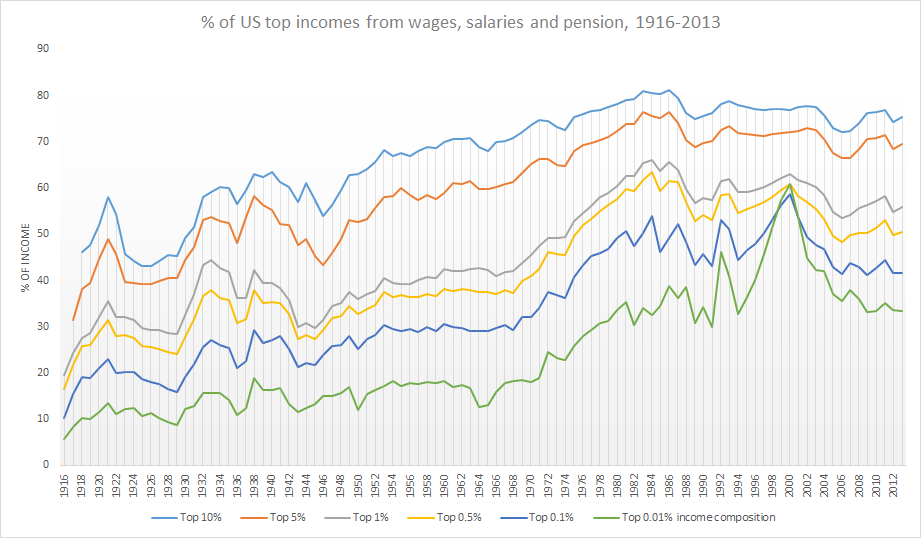
Source: The World Wealth and Income Database.
23 May 2016 Leave a comment
in applied price theory, economic history, industrial organisation, labour economics, labour supply, unemployment Tags: economics of immigration
23 May 2016 Leave a comment
in labour economics, labour supply, population economics Tags: economics of immigration
17 May 2016 Leave a comment
in discrimination, economics of media and culture, gender, industrial organisation, labour economics, labour supply, occupational choice, survivor principle Tags: entrepreneurial alertness, gender gap, gender wage gap, Hollywood economics

Iron Man 3 changed the gender of the film’s villain from female to male after pressure from the production company Marvel, which feared toy merchandise would not sell as well.
This is a rather frank admission of what drives gender bias in Hollywood casting decisions. Its customer preferences – customer discrimination. It was not nasty producers and directors choosing not to hire women.
It was producers and directors casting a movie that might sell at the box office given what the box office wants. The great majority of box office sales is outside of the USA and US cultural values, interests and concepts of humour.

Hollywood is a cutthroat market where producers and directors do do whatever it takes to make their movie sell at the box office. But would not last very long if they indulge their personal preferences at the expense of the box office.
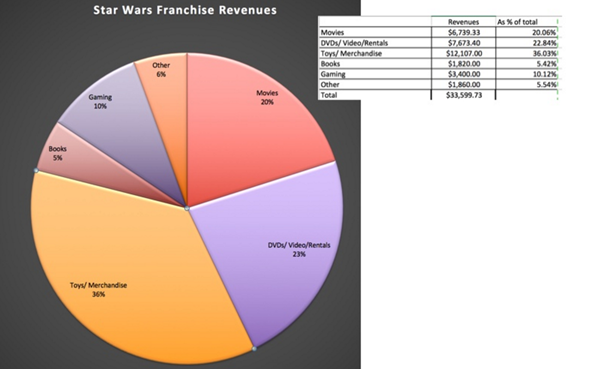
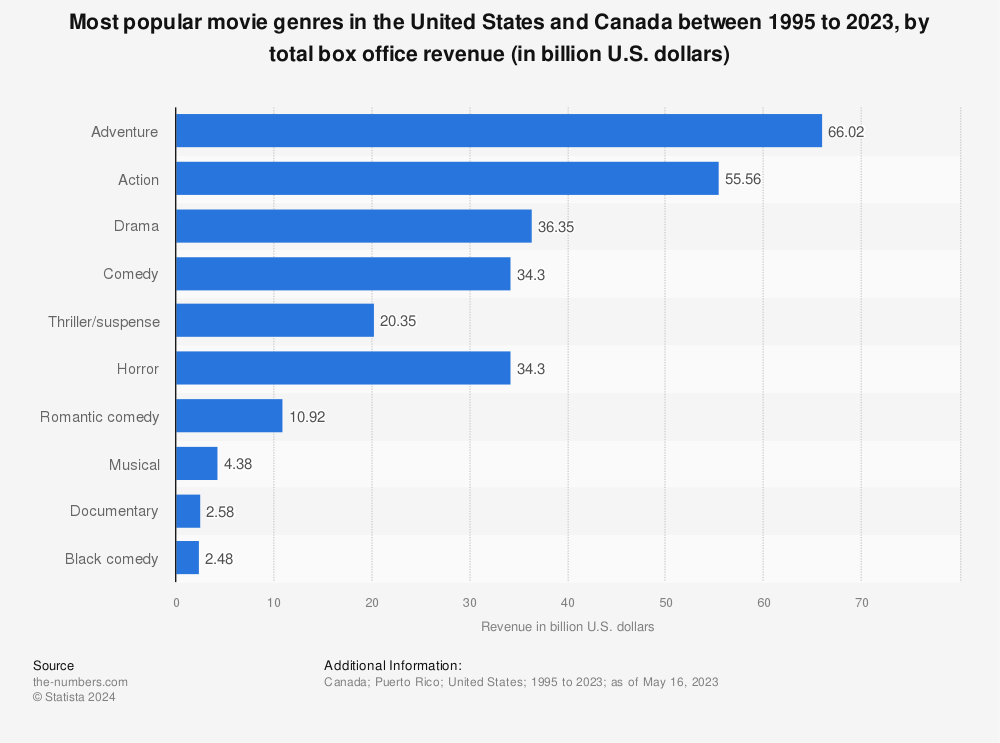
Not every movie has the merchandising potential of action films but they still have to pay careful attention to what audiences want to avoid having produced a run of flops and never get financing again.
That is not made any easier by the first law of Hollywood economics, which is nobody knows nothing. Audiences have a constant demand for novelty but they do not know what they want delay see it.
17 May 2016 1 Comment
in industrial organisation, labour economics, labour supply, survivor principle Tags: agricultural economics, creative destruction
16 May 2016 Leave a comment
in labour economics, labour supply, managerial economics, minimum wage, occupational regulation, organisational economics, personnel economics, politics - USA, theory of the firm Tags: Edward Lazear, performance pay, tipping

Joe’s Crab Shack tested a no-tip model in 18 of its 130 restaurants. A 12-15% service charge replaced tips. Joe’s Crab capture is the first major restaurant chain to experiment with a tipping policy to experiment with abolishing it. The tipping minimum wage is far less than the federal, state and local minimum wages.

Joe’s Crab Shack had high hopes. The aims were customers would pay less, get a greater value experience, reduce labour costs and increase profits. The reactionary left represented by Salon and Huffington Post have quite strong views on tipping. Salon says
Tipping is a repugnant custom. It’s bad for consumers and terrible for workers. It perpetuates racism. Tipping isn’t even good for restaurants, because the legal morass surrounding gratuities results in scores of expensive lawsuits.
Tipping does not incentivize hard work. The factors that correlate most strongly to tip size have virtually nothing to do with the quality of service. Credit card tips are larger than cash tips. Large parties with sizable bills leave disproportionately small tips.
We tip servers more if they tell us their names, touch us on the arm, or draw smiley faces on our checks. Quality of service has a laughably small impact on tip size.
According to a 2000 study, a customer’s assessment of the server’s work only accounts for between 1 and 5 percent of the variation in tips at a restaurant.
Salon adds that federal and state law requires restaurants to ensure that tips bring employees up to minimum wage, but few diners know that.

Huffington Post managed to marshal 9 reasons why tipping should be abolished arguing that it was in no one’s interests either employers, employees or customers. The old efficiency at wage argument was rolled out arguing that employers gain in terms of diligent motivate employees by paying a straight wage rather than leaving it up to customer judgements of the services tended.
Not surprisingly this sounded like a business opportunity to Joe’s Crab Shack. Better customer service, better motivated employees and lower labour costs were promised by abolishing tips. You wonder why tipping survived in competition against alternative forms of restaurant service formats for all these decades?

Well, Joe’s Crab Shack got more than it bargained for when it abolished tipping. The pilot restaurants lost an average of 8-10% of customers during the test run.
The restaurant’s research showed that around 60% of customers disliked the policy because it took away an incentive for good service and that they don’t necessarily trust that management is passing along the money to workers.
The no tipping structure worked at four restaurants and will continue to work out why it succeeded there but failed at 14 other places.
What is even more interesting that the abolition of tipping lead to some workers quitting. This outcome at Joe’s Crab Shack is inconsistent with the notion that tipping is a by-product of the inequality of bargaining power between workers and employees. Turnover is supposed to reduce when tipping is abolished rather than increase with the employer losing their best workers.

Lazear found in data for Safelite Glass that average productivity will rise and the firm will attract a more able workforce will rise when it shifts to piece rates. The 44% increase in output per worker suggested the firm previously had a suboptimal compensation system. Half of the increase in labour productivity came from workers quitting when piece rates are introduced and being replaced by workers motivated to apply by the lure of piece rates. The average worker received a 10% increase in pay as a result of the switch to piece rates.
The only economic analysis of any value on tipping was written in 1985 by David Sisk at the Federal Trade Commission. He wrote a paper about both tipping and commissions. Sisk approached tipping not as a motivational device but a form of contracting.
Sisk points out that tipping takes the place of reputation as a way of guaranteeing good services are at a restaurant. Many do not plan to return to a restaurant so an alternative form of contracting emerges to ensure good service because the threat of taking future custom elsewhere does not work.
In the case of a tip, the buyer (or customer) is provided with a final means of automatic redress which serves to prevent unsatisfactory performance on the part of the seller.
The possibility of unsatisfactory performance arises when the brand-name, repeat purchase mechanism is not effective or because employees of the seller are too costly to monitor.
An example is tourists. They are protected from inferior service relative to the locals because they pay tips too and are well able to judge good and bad service.

Sisk argues that once a customer sits down at a restaurant, the customer commits ever increasing amounts of time and the restaurant commits ever increasing amounts of physical resources. As one commits more irrevocable resources, the greater is the incentive of the other to renege on the contract.
A tip allows the customer to withhold a portion of the price without further negotiation. The tip serves to protect the customer from bad service and to protect the restaurant from bad service by an errant employee
The system of tipping provides the motivation for the waiter to properly identify and accommodate the individual desires of customers subject to the profit maximizing constraint of the restaurant owner…
The tip protects the buyer from exploitation by a seller (when the brand-name mechanism is insufficient) or from exploitation by the shirking employees of the seller
The worst tippers are single males; the best are couples and groups. The biggest tippers are single males on a date.
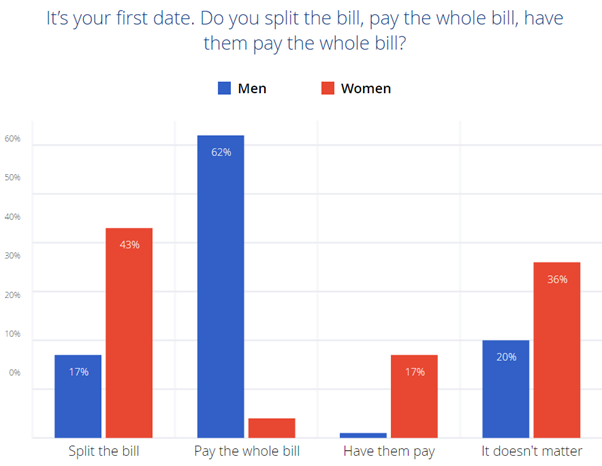
Source: OkCupid, A woman’s advantage.
14 May 2016 Leave a comment
in economic history, gender, health economics, labour economics, labour supply Tags: maternal health, maternal labour force participation, The Great Escape
Medical progress contributed more than people realise to women’s liberation. The key area of progress was far fewer deaths in childbirth as the chart below for Australia shows. Deaths from childbirth disappeared from mortality statistics in the 1940s and 1950s.
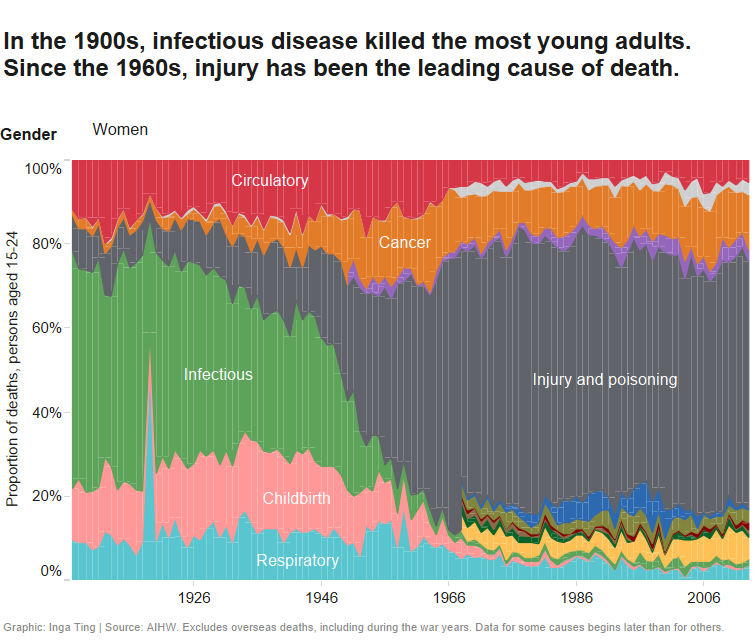
Source: Australian Institute of Health and Welfare via Sydney Morning Herald This chart shows how you will probably die, and it’s changed a lot in 100 years.
The next key area of medical progress was fewer disabling injuries subsequent because of childbirth that kept women out of the workforce for several years if not permanently. In Gender Roles and Medical Progress, Stefania Albanesi and Claudia Olivetti say
Consider a typical woman born around 1900. She married at 21 and gave birth to more than three live children between age 23 and 33. The high fetal mortality rate implied an even greater number of pregnancies, so that she would be pregnant for 36% of this time.
Health risks in connection to pregnancy and childbirth were severe. Septicemia, toxaemia, hemorrhages and obstructed labour could lead to prolonged physical disability and, in the extreme, death. In 1920 one mother died for each 125 living births. At a rate of 3.6 pregnancies per woman, the compounded risk of death from maternal causes was 2.9%.
For every death, twenty times as many mothers were estimated to suffer different degrees of disablement annually. Many maternal conditions had very long lasting or chronic effects on health, hindering women’s ability to work beyond their childbearing years.
Death in childbirth and serious complications from childbirth been forgotten in modern memory. So much so that there can be an entire year in New Zealand when no child nor mother dies in childbirth. When that does happen, there is a coroner’s enquiry.
The implications of medical progress around childbirth for female life expectancy has been equally forgotten as Albanesi and Olivetti explain
The development of bacteriology, the introduction of sulfominydes and antibiotics, and the diffusion of blood banks dramatically decreased the death rate from sepsis and hemorrhage. More specific interventions, such as the standardization of obstetric practices and the increased availability of pre-natal care, reduced the incidence of hypertensive disorders of pregnancy and obstructed labour, a causal factor for many forms of post-partum disability.
These developments lead to a stark decline in maternal mortality and a rise in the female-male differential in life expectancy at age 20 from 1.5 years in 1920 to 6 years in 1960.
At the beginning of the last century, the burden of childbirth and breastfeeding simply made it impossible for married women to work in any significant number as Albanesi and Olivetti explain
In addition, due to the lack of reliable alternatives, most infants were exclusively breast fed. Women would then be nursing for approximately a third of the time between age 23 and 33.
Since the average time required to feed one child ranges between 14 and 17 hours per week, with a 40 hour workweek, mothers would be nursing for 35%-43% of their potential working time in childbearing years.
Not surprisingly given this burden, few married women worked. Only 5.4% of married women aged 25 to 34 were in the labour force in 1900.
There was an extraordinary reduction in the number of years lost in disablement after childbirth in the early and mid-20th century as Albanese in Olivetti’s explain
…the years lost to disabilities associated with maternal conditions declined from 2.31 per pregnancy in 1920 to just 0.17 in 1960.
Medical progress around childbirth is the most important force driving the rise in the participation of married women during childbearing years and post-childbearing between 1935 and 1965. The health burden of giving birth is now measured in weeks rather than years.
09 May 2016 Leave a comment
in energy economics, environmental economics, global warming, labour economics, labour supply, occupational choice Tags: Big Wind, green rent seeking, renewable energy, wind power
Doubling from 4,400 to 9,000 does not exactly strike me as an explosion in wind technician employment.
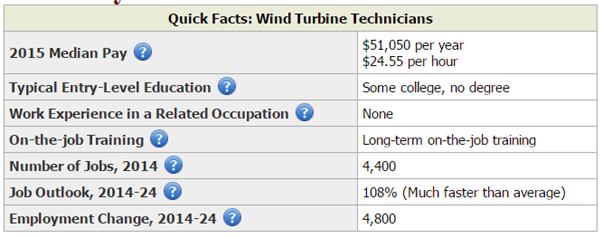
Source: Wind Turbine Technicians : Occupational Outlook Handbook: : U.S. Bureau of Labor Statistics.
Yet still this occupation is expected to be the fastest-growing occupation in the USA in the next 10 years.
07 May 2016 Leave a comment
in applied price theory, economics of crime, labour economics, labour supply, law and economics, occupational choice Tags: crime and punishment, criminal deterrence, law and order, police
07 May 2016 Leave a comment
in applied welfare economics, discrimination, economic history, gender, labour economics, labour supply Tags: Canada, gender wage gap, middle class stagnation, reversing gender gap, top 1%, wage stagnation
06 May 2016 Leave a comment
in discrimination, gender, labour economics, labour supply, occupational choice Tags: gender wage gap, reversing gender gap
05 May 2016 Leave a comment
in human capital, industrial organisation, labour economics, labour supply, occupational choice, survivor principle Tags: Apple, CEO pay, creative destruction, entrepreneurial alertness, Facebook, Google, Microsoft, superstar wages, superstars, top 1%, Twitter, Uber, Yahoo
I am surprised to see that Yahoo is in business much less competing for top talent. Microsoft is in decline too. Apple does not pay people as much as everybody else.
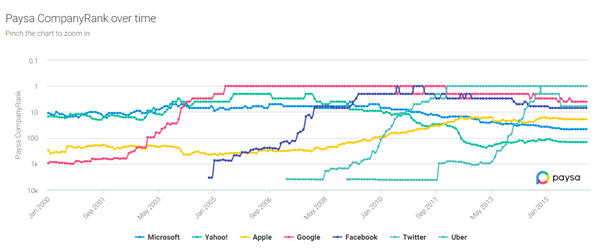
Source: Paysa Company Rank | Paysa.
Some other colours seem to duplicate so you will have to work out which is which by when they exploded in hiring top talent.
Celebrating humanity's flourishing through the spread of capitalism and the rule of law
Celebrating humanity's flourishing through the spread of capitalism and the rule of law
Celebrating humanity's flourishing through the spread of capitalism and the rule of law
Celebrating humanity's flourishing through the spread of capitalism and the rule of law
Celebrating humanity's flourishing through the spread of capitalism and the rule of law
A History of the Alt-Right
Econ Prof at George Mason University, Economic Historian, Québécois
Celebrating humanity's flourishing through the spread of capitalism and the rule of law
Scholarly commentary on law, economics, and more
Beatrice Cherrier's blog
Celebrating humanity's flourishing through the spread of capitalism and the rule of law
Celebrating humanity's flourishing through the spread of capitalism and the rule of law
Celebrating humanity's flourishing through the spread of capitalism and the rule of law
Why Evolution is True is a blog written by Jerry Coyne, centered on evolution and biology but also dealing with diverse topics like politics, culture, and cats.
Celebrating humanity's flourishing through the spread of capitalism and the rule of law
A rural perspective with a blue tint by Ele Ludemann
DPF's Kiwiblog - Fomenting Happy Mischief since 2003
Celebrating humanity's flourishing through the spread of capitalism and the rule of law
The world's most viewed site on global warming and climate change
Tim Harding's writings on rationality, informal logic and skepticism
A window into Doc Freiberger's library
Let's examine hard decisions!
Commentary on monetary policy in the spirit of R. G. Hawtrey
Thoughts on public policy and the media
Celebrating humanity's flourishing through the spread of capitalism and the rule of law
Politics and the economy
A blog (primarily) on Canadian and Commonwealth political history and institutions
Reading between the lines, and underneath the hype.
Economics, and such stuff as dreams are made on
"The British constitution has always been puzzling, and always will be." --Queen Elizabeth II
Celebrating humanity's flourishing through the spread of capitalism and the rule of law
Celebrating humanity's flourishing through the spread of capitalism and the rule of law
WORLD WAR II, MUSIC, HISTORY, HOLOCAUST
Undisciplined scholar, recovering academic
Celebrating humanity's flourishing through the spread of capitalism and the rule of law
Res ipsa loquitur - The thing itself speaks
In Hume’s spirit, I will attempt to serve as an ambassador from my world of economics, and help in “finding topics of conversation fit for the entertainment of rational creatures.”
Researching the House of Commons, 1832-1868
Articles and research from the History of Parliament Trust
Reflections on books and art
Posts on the History of Law, Crime, and Justice
Celebrating humanity's flourishing through the spread of capitalism and the rule of law
Exploring the Monarchs of Europe
Cutting edge science you can dice with
Small Steps Toward A Much Better World
“We do not believe any group of men adequate enough or wise enough to operate without scrutiny or without criticism. We know that the only way to avoid error is to detect it, that the only way to detect it is to be free to inquire. We know that in secrecy error undetected will flourish and subvert”. - J Robert Oppenheimer.



Recent Comments