What is a Luddite?
14 Jun 2016 Leave a comment
in applied price theory, economic history, industrial organisation, labour economics, labour supply Tags: Luddites, pessimism bias, technological unemployment
Does Child Labor Help Children in Poverty?
12 Jun 2016 Leave a comment
in development economics, economic history, growth disasters, growth miracles, industrial organisation, labour economics, labour supply Tags: child labour
Child poverty, @jacindaardern and what higher wages cannot buy
10 Jun 2016 Leave a comment
in labour economics, labour supply, minimum wage, politics - New Zealand, poverty and inequality, public economics Tags: child poverty, family poverty, female labour force participation, living wage, New Zealand Labour Party, single mothers, single parents, social insurance
The Left thinks the solution to poverty is giving the poor more money because poverty is caused by the poor not having enough money.
Labour MP Jacinda Ardern introduced the exception in an op-ed in the Sunday Star Times. People are poor because they do not have enough money unless that is because of a lack of money because you are not married or not living with the father of the child.
Ardern was raging against a report by Lindsey Mitchell arguing that a major driver of child poverty is the breakdown of the family and the rise of single parent households. Ardern said that
I’ve spent the better part of six years reading and researching the issue of child poverty, and what we need to do to resolve this complex problem in New Zealand.
And yet here it was, the silver bullet we have all been looking for. Marriage. Getting hitched. Tying the knot. It turns out that we didn’t need an Expert Advisory Group on child poverty, or any OECD analysis for that matter – apparently all we really need is a pastor and a party
Ardern preferred to attribute the increase in child poverty to welfare benefit cuts in the early 1990s.
There is an exception within this exception for the living wage as Ardern says
But the other factors Family First was so quick to dismiss – low wages and staggering housing costs – mean we have 305,000 children in poverty. And this is the stuff that needs to change. It’s time we faced reality.
A living wage increase can solved family poverty. Actually getting a job and earning a wage does not reduce poverty among single-parent households but living wage increases do for families.

Source: Jacinda Ardern: Govt must improve the lot of our children – National – NZ Herald News.
You cannot have it both ways. That low wages cause family poverty but no wages does not.
The best solution to child poverty is to move their parents into a job. Simon Chapple is quite clear in his book last year with Jonathan Boston that.
Sustained full-time employment of sole parents and the fulltime and part-time employment of two parents, even at low wages, are sufficient to pull the majority of children above most poverty lines, given the various existing tax credits and family supports.
Creative destruction in mass media employment since 1990
09 Jun 2016 Leave a comment
in economic history, economics of media and culture, entrepreneurship, industrial organisation, labour economics, labour supply, occupational choice, survivor principle Tags: entrepreneurial alertness, legacy media, mass media, radio, social media
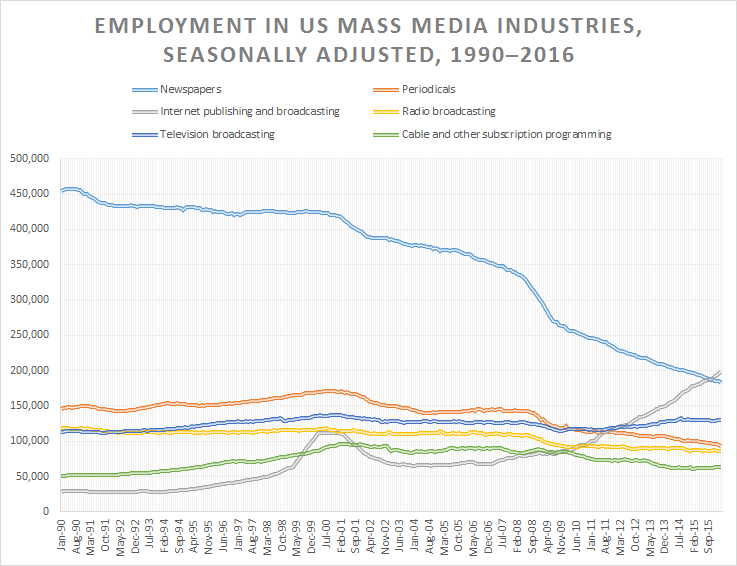
The Bureau of Labour Statistics chart included books which I took it out along with a few others to confine the information to newspapers and other competitors in the mass media. People still study journalism but more and more go to public relations jobs in government and business.
..
The asymmetric marriage premium and the motherhood penalty in the UK
09 Jun 2016 Leave a comment
in discrimination, gender, labour supply, law and economics

Source: Trades Union Congress – The Pregnancy Test: Ending Discrimination at Work for New Mothers (2016).
Gender differences in jobs and occupations since 1960
07 Jun 2016 Leave a comment
in economic history, economics, gender, human capital, labour economics, labour supply, occupational choice Tags: gender wage gap
Hayek on what determines market incomes
05 Jun 2016 Leave a comment
in applied price theory, entrepreneurship, F.A. Hayek, human capital, industrial organisation, labour economics, labour supply, occupational choice, poverty and inequality, survivor principle Tags: distributive justice, social justice

NZ #UBI can be only $4,700 @JordNZ @GrantRobertson1 @GeoffSimmonz
04 Jun 2016 Leave a comment
in labour economics, labour supply, politics - New Zealand, poverty and inequality Tags: expressive voting, growth of government, New Zealand Labor Party, rational irrationality, size of government, social insurance, universal basic income, welfare state
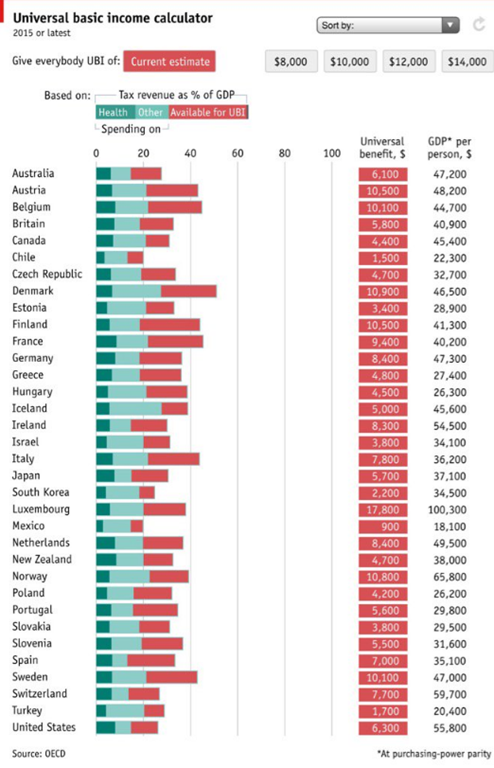
A universal basic income in New Zealand will have to be financed by a great big new tax because the existing ones are not enough according to the Economist calculations below.
HT: Paul Kerby.
The Prevalence of Marxism in Academia
02 Jun 2016 Leave a comment
in economics of education, labour economics, labour supply, occupational choice Tags: academic bias
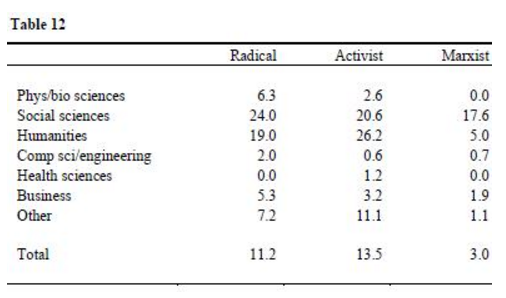
Source: The Prevalence of Marxism in Academia, Bryan Caplan | EconLog | Library of Economics and Liberty.
Equilibrium unemployment rate: USA, UK, France, Germany, Canada & Australia, 1985-2017
02 Jun 2016 Leave a comment
in business cycles, economic growth, economic history, global financial crisis (GFC), great recession, labour economics, labour supply, unemployment Tags: British economy, Canada, equilibrium unemployment rate, France, Germany, natural unemployment rate
I do admire the way in which the USA has been able to have a steadily falling equilibrium unemployment rate since 1984 through thick and thin. The Great Recession had no impact on the US equilibrium unemployment rate. Not only has the largest member been able to do this, the OECD host country (red squares) has had a pretty steady natural unemployment rate too all things considered.
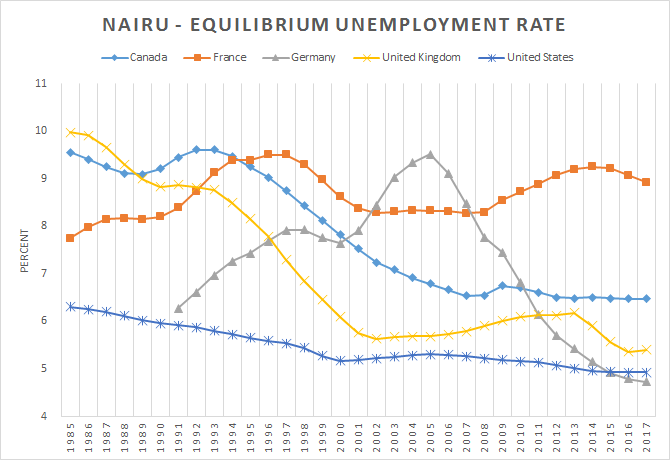
Source: OECD Economic Outlook June 2016 Data extracted on 01 Jun 2016 12:40 UTC (GMT) from OECD.Stat
New Zealand population trends, 1950-2100
30 May 2016 Leave a comment
in labour economics, labour supply, population economics Tags: ageing society, demographic crisis, labour demographics, population bomb, Population demographics

Gap in GDP per Australian, Canadian, French, German, Japanese, New Zealander and British hour worked with the USA
28 May 2016 Leave a comment
in economic growth, economic history, labour economics, labour supply, macroeconomics, politics - Australia, politics - New Zealand, politics - USA, public economics Tags: Australia, British economy, Canada, Eurosclerosis, France, Germany, Japan, labour productivity, measurement error, taxation and labour supply
This data tells more of a story than I expected. Firstly, New Zealand has not been catching up with the USA. Japan stopped catching up with the USA in 1990. Canada has been drifting away from the USA for a good 30 years now in labour productivity.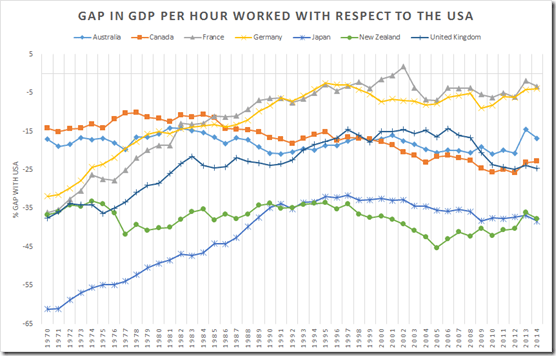
Data extracted on 28 May 2016 05:15 UTC (GMT) from OECD.Stat from OECD Compendium of Productivity Indicators 2016 – en – OECD.
Australia has not been catching up with the USA much at all since 1970. It has maintained a pretty consistent gap with New Zealand despite all the talk of a resource boom in the Australia; you cannot spot it in this date are here.
Germany and France caught up pretty much with the USA by 1990. Oddly, Eurosclerosis applied from then on terms of growth in income per capita.
European labour productivity data is hard to assess because their high taxes lead to a smaller services sector where the services can be do-it-yourself. This pumps up European labour productivity because of smaller sectors with low productivity growth.
The minimum wage and teenage age labour force participation
25 May 2016 Leave a comment
in economic history, economics, labour economics, labour supply, minimum wage Tags: living wage, teenage unemployment
The decline and decline of the rentier class in the USA
24 May 2016 Leave a comment
in economic history, entrepreneurship, human capital, industrial organisation, labour economics, labour supply, occupational choice, politics - USA, poverty and inequality Tags: entrepreneurial alertness, superstar wages, superstars, top 1%, top incomes
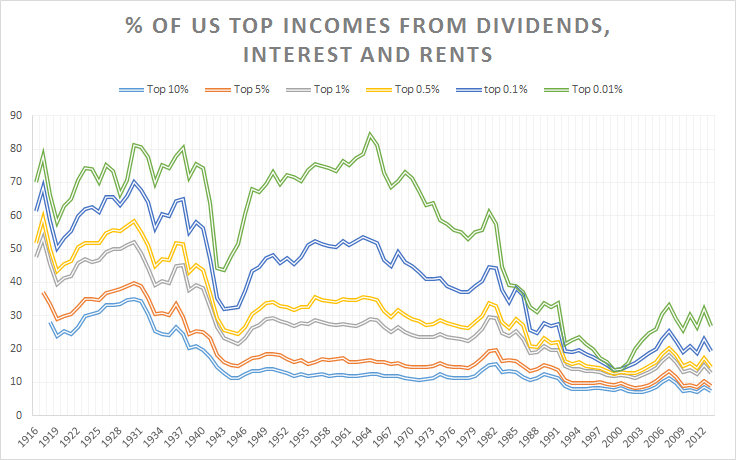
Looks like the Reagan Revolution coincided with the American rich going out to work for a living. They started earning most of their incomes from wages, salaries and pensions or from entrepreneurial income. The American rich are now working rich; top wage earners, not top income earners.
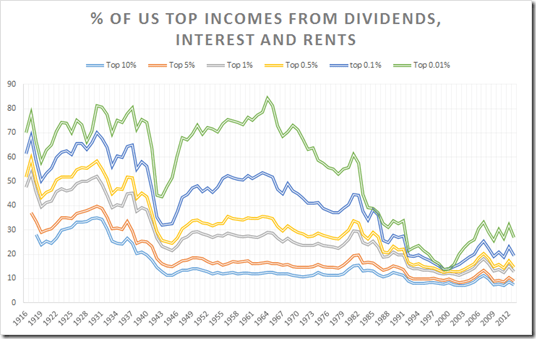
Source: The World Wealth and Income Database.


Recent Comments