Does “Fair Trade” Help?
29 Apr 2016 Leave a comment
in applied price theory, development economics, economics, gender, growth disasters, growth miracles, labour economics, labour supply Tags: fair trade
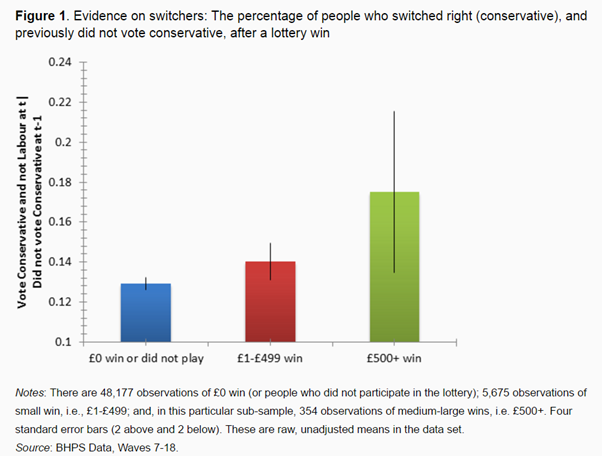
Winning the lottery makes you into right-wingers
29 Apr 2016 Leave a comment
in labour economics, labour supply, Public Choice Tags: lottery winners, voter demographics
@Economicpolicy shows that most minimum wage workers are adults who do not have children to support
28 Apr 2016 Leave a comment

@The_TUC confirm that motherhood penalty has nothing to do with employer discrimination @CHSommers
28 Apr 2016 1 Comment
in discrimination, gender, human capital, labour economics, labour supply, occupational choice Tags: asymmetric information, asymmetric marriage premium, British economy, employer discrimination, family wage gap, gender wage gap, marriage and divorce, marriage bar, motherhood penalty
Source: Trades Union Congress – The Motherhood Pay Penalty.
The British Trades Union Congress (TUC) has released the preliminary findings of research into the 1970 Birth Cohort Study. The union research into the gender wage gap finds that
The overall gender pay gap of 34 per cent for this cohort of full-time workers who were born in 1970. This gap is largely due to the impact of parenthood on earnings – the women earning less and the men earning more after having children.
Mothers in the 1970 Birth Cohort Study who are in full-time work earn 11 per cent less than full-time women without children at age 42. When factors such as education, region and occupational social class are taken into account, this motherhood pay penalty in full-work falls to 7 per cent.
This finding by the union research into the 1970 birth cohort is no surprise. For 40 years at least now it has been known that having children and and spacing those children over a longer period carries a career penalty for women.
Recent work finds that the motherhood penalty is larger for those women pursuing careers where long hours or rigid hours is required and if they wish to combine careers and motherhood. Much of that research is led by Claudia Goldin.
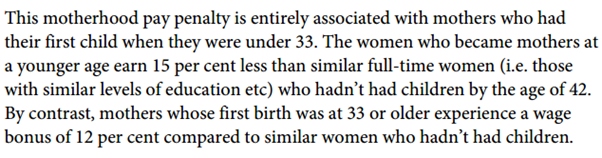
It is difficult for employers to discriminate against women if the gender wage gap is not only driven by motherhood but also by having their first child past the age of 33. Male chauvinistic employers simply do not have the necessary information about whether women are mothers and and whether they had their first child before or after the age of 33.
For employer discrimination to drive the gender wage gap, these male chauvinist employers must know:
- whether female applicants are mothers, and
- the age of female applicants who are mothers when they had their first child.
This information on the age of first motherhood is essential for employer discrimination to be driving the gender wage gap. This information about the age of first motherhood must be in the hands of the employer so that they do not shortlist and do not promote women who are mothers before age 33.
Of 534 occupations tracked by BLS, ONLY 7 pay women more than men ampr.gs/1oJzOrh http://t.co/XRunQkiav8—
American Progress (@amprog) January 29, 2015
It would be handy to know why why these male chauvinistic employers have such strong prejudices against women who are mothers before the age of 33 but have few prejudices against women who are mothers after age 33.
Another piece of useful information is how do male chauvinist employers get their hands on the partnership status of mothers when they had their first child. As the Trades Union Congress found
There is a bonus of 12 per cent for being in a couple when women had their first child.
If the gender wage gap is due to employer discrimination rather than the choices by women about motherhood, there seems to be a 12% wage bonus for single mothers who can successfully lie to male chauvinist employers about whether they are in a stable relationship when they had their first child.
Keeping up appearances for the sake of the children has a whole new meaning if there is 12% wage bonus in it if male chauvinist employers can be fooled. There is a wage bonus of several times that if mothers can keep their children secret from their discriminating employer.
When there is a marriage bar in the Australian Public Service, there were instances where women kept their children or marriages secret to avoid being sacked. One woman had four children before she decided to make an honest man of the father. She lost her job.
@The_TUC confirms motherhood penalty is nothing to do with discrimination @CHSommers
28 Apr 2016 Leave a comment
in discrimination, gender, human capital, labour economics, labour supply, occupational choice Tags: asymmetric information, asymmetric marriage premium, British economy, employer discrimination, family wage gap, gender wage gap, marriage and divorce, marriage bar, motherhood penalty
Source: Trades Union Congress – The Motherhood Pay Penalty.
The British Trades Union Congress (TUC) has released the preliminary findings of research into the 1970 Birth Cohort Study. The union research into the gender wage gap finds that
The overall gender pay gap of 34 per cent for this cohort of full-time workers who were born in 1970. This gap is largely due to the impact of parenthood on earnings – the women earning less and the men earning more after having children.
Mothers in the 1970 Birth Cohort Study who are in full-time work earn 11 per cent less than full-time women without children at age 42. When factors such as education, region and occupation are taken into account, this motherhood pay penalty in full-work falls to 7 per cent.
This finding by the union research into the 1970 birth cohort is no surprise. For 40 years at least now it has been known that having children and and spacing those children over a longer period carries a career penalty for women.
More recent work has emphasised the motherhood penalty is larger for those women pursuing careers where long hours or rigid hours is required and if they wish to combine careers and motherhood. Much of that research is led by Claudia Goldin.
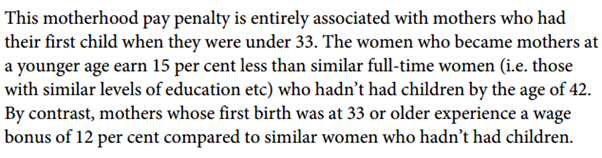
It is difficult for employers to discriminate against women if the gender wage gap is not only driven by motherhood but also by having their first child past the age of 33. Male chauvinistic employers simply do not have the necessary information about whether women are mothers and and whether they had their first child before or after the age of 33.
For employer discrimination to drive the gender wage gap, rather than women’s choices about balancing career and motherhood, these male chauvinist employers must know:
- whether female applicants are mothers, and
- the age of female applicants who are mothers when they had their first child.
This information on the age of first motherhood is essential for employer discrimination to be driving the gender wage gap. This information about the age of first motherhood must be in the hands of the employer so that they do not shortlist, do not promote and do not hire women who are mothers before the age of 33.
Of 534 occupations tracked by BLS, ONLY 7 pay women more than men ampr.gs/1oJzOrh http://t.co/XRunQkiav8—
American Progress (@amprog) January 29, 2015
It would be handy to know why why these male chauvinistic employers have such strong prejudices against women who are mothers before the age of 33 but have no prejudices against women who are mothers after the age of 33. It would
Another piece of you useful information is how do male chauvinist employers get their hands on the partnership status of mothers when they had their first child. As the Trades Union Congress found
There is a bonus of 12 per cent for being in a couple when women had their first child.
Why are the prejudices of male chauvinist employers dampened when the mother is married or in a stable relationship when they had their first child? Why are these male chauvinist employers so prejudiced against in mothers?
There seems to be a 12% wage bonus for single mothers who can successfully lie to male chauvinist employers about whether they are in a stable relationship back when they had the first child.
Keeping up appearances for the sake of the children has a whole new meaning if there is a 12% wage bonus in it if male chauvinist employers can be fooled. There is a wage bonus of several times that if mothers can keep their children secret from their discriminating employer.
When there is a marriage bar in the Australian Public Service, there were instances where women kept their children or marriages secret to avoid being sacked. One woman had four children before she decided to make an honest man of the father. She lost her job.
Are gender roles a marker of true equality?
27 Apr 2016 Leave a comment
in discrimination, economics, gender, human capital, labour economics, labour supply Tags: gender gap
@Economicpolicy shows that top CEO pay has been a miserable rollercoaster for 15 years
25 Apr 2016 Leave a comment
What % of each occupation needs a license or certificate in the USA?
23 Apr 2016 1 Comment
in applied price theory, applied welfare economics, economics of regulation, labour economics, labour supply, occupational choice, occupational regulation, Public Choice, rentseeking Tags: adverse selection, barriers to entry, moral hazard, occupational licensing, occupational regulation
The 2015 Current Population Survey in the USA added a question about whether you needed a licence or a certificate to practice your occupation. One in 4 Americans say they need a licence or certificate. 22.4% need a license and 3.1% need a certificate among employed over the age of 16 in the USA.
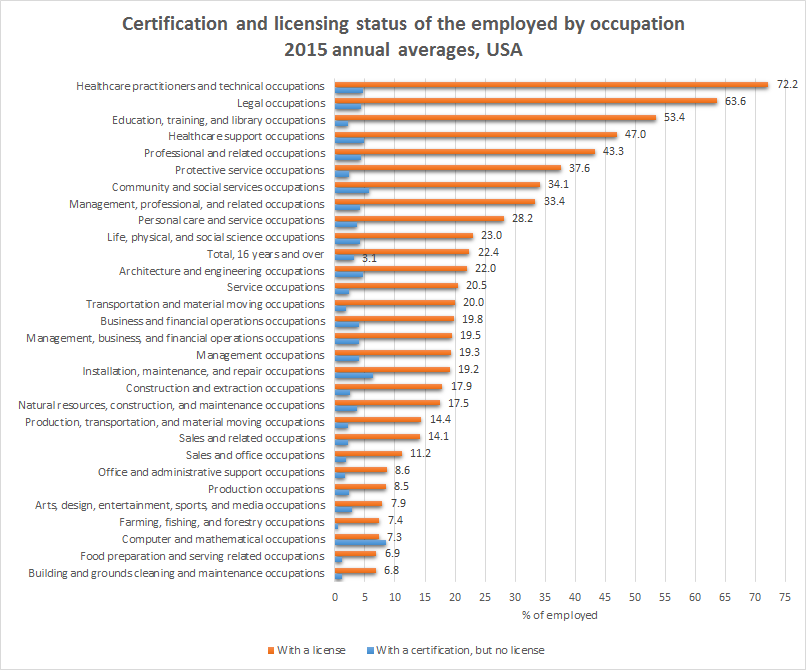
Source: Bureau of Labour Statistics, Labor Force Statistics from the Current Population Survey (2015), Certification and licensing status of the employed by occupation Table 5.
This estimate of 25% is less than the 30% estimated by Kleiner and Vorotnikov (2015) using a Harris Poll. Kleiner and Vorotnikov (2015) also found that some American states regulate twice as many occupations as others. This diversity in federalism strains any public interest explanation of occupational regulation.
Occupational regulation is more likely to be an issue for those who finished further education. It would have been better if the estimate by the Bureau of Labour Statistics was for adults and not have included teenagers.
The purpose of occupational regulation is to protect buyers from quacks and lemons – to overcome asymmetric information about the quality of the provider of the service.
The main issue with quacks in the labour market is whether there is a large cost of less than average quality service, and is there a sub-market who will buy less than average quality products in the presence of competing sellers competing on the basis of quality assurance. This demand for assurance creates opportunities for entrepreneurs to profit by providing assurance of quality.
Mostly disciplinary investigations and deregistrations under the auspices of occupational regulation are for gross misconduct and criminal convictions rather than the shading of quality.
The share of women who have earned a college degree
23 Apr 2016 Leave a comment
in economic history, economics of education, economics of media and culture, gender, human capital, labour economics, labour supply, occupational choice Tags: gender gap, gender wage gap, reversing gender gap
NZ top of world in quality of working environment @fairnessNZ @suemoroney
22 Apr 2016 Leave a comment
in labour economics, labour supply Tags: compensating differentials

Earth Day flashback
21 Apr 2016 Leave a comment
in environmental economics, environmentalism, labour economics, labour supply, population economics Tags: doomsday prophecies, Earth Day, Paul Ehrlich

McDonald’s Workers Just Lovin’ Their #ZeroHoursContracts @suemoroney @IainLG @FairnessNZ
19 Apr 2016 Leave a comment
in labour economics, labour supply, managerial economics, market efficiency, organisational economics, personnel economics, politics - New Zealand Tags: British economy, British politics, employment law, employment regulation, fixed costs of working, part-time work, The fatal conceit, The pretense to knowledge, zero hours contracts
Revealed preference rules. Not only do about half of unemployed turned down offers of zero hour contract jobs, those that switch from a zero hours contract to minimum hours are not much different from the number of people in these type of jobs who would be quitting to another job anyway.
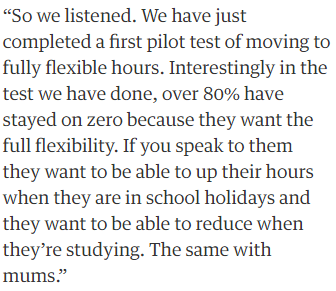
Source: McDonald’s Workers Are Just Lovin’ Their Zero Hours Contracts – Forbes and McDonald’s offer staff the chance to get off zero-hours contracts | UK news | The Guardian.
Did the rise of welfare state cause more inequality in wealth?
18 Apr 2016 Leave a comment
in fiscal policy, labour economics, labour supply, macroeconomics, poverty and inequality, public economics Tags: growth of government, income inequality, measurement error, Ricardian theory of budget deficits, Social Security, top 1%, wealth inequality
Markus Poschke and Barış Kaymak have just put out a paper arguing that increased social spending is a major driver of wealth inequality:
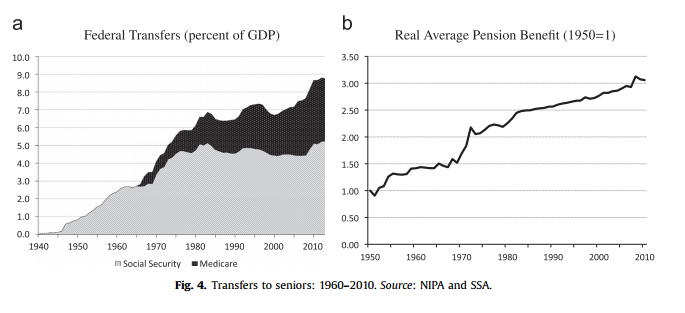
Another important and often overlooked third factor is the rise in the generosity of government transfers since 1960, mostly due to the expansion of public pensions (social security) and the introduction of public health insurance for the elderly (Medicare).
Combined spending on these two programs accounted for almost 9% of US GDP in 2010, up from less than 3% in 1960…
These government programmes tend to curb the need to rely on personal savings for retirement, especially among low and middle-income households, and might thus explain why their share in total wealth has declined.
This makes a good to good degree of sense. I have previously argued that using the arguments of Edward Prescott that it is not wise for people on ordinary income to save for their retirement when they can go down to the local Social Security office and claim an old age pension.
51% of nonretirees doubt they will receive Social Security… on.gallup.com/1NcwzEa #GallupDaily http://t.co/ZhKnHYtr1X—
(@GallupNews) August 13, 2015
It is even less wise to save that for retirement if those savings reduce your eligibility for an old age pension. Far better just to invest in a nicer house and pass it on to your children. Poschke and Kaymak note that measures of private wealth inequality miss these claims to old age pensions:
… statistics on wealth inequality that do not capture households’ claims on the public sector are incomplete and overstate top wealth shares.
This is not a new argument. Back when the Ricardian theories of budget deficits came to prominence and before that in debates on theories of the public debt, the more Keynesian sides of those arguments did argue that people were irrational for not including their old age pension entitlements under social security schemes in their calculations of their wealth.
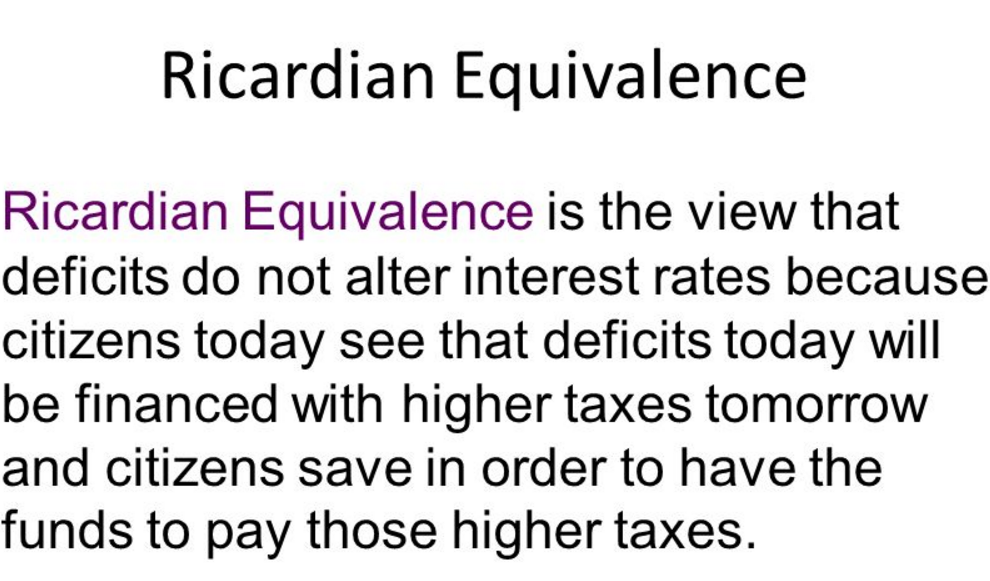
Some of their taxes were paying for their future old age pension and were another form of wealth rather than a tax. As such, taxpayers should regard this part of their taxes as investments and not cutting back their labour supply in response as they do to other taxes.
How much of the rise in wealth inequality is due to this failure to measure Social Security wealth as represented by old age pension entitlements? Their estimate is about 25%:
…technological factors play a dominant role not only for changes in income inequality, as is well known, but also for wealth inequality. As high-earning households save part of their additional income, their share of wealth also rises.
This channel accounts for about half of the total increase in wealth inequality. Tax cuts and the expansion of transfers each account for about half of the remainder…
While tax cuts encourage saving, larger transfers reduce saving incentives for retirement, in particular for low and middle income groups. This implies that these groups’ share of private wealth declines.
Note though that this is partly due to the fact that measures of private wealth inequality, like those compiled by Saez and Zucman, do not include claims to future government transfers, like social security, which constitute wealth for their owners.
Walter Block defends multinational corporations in developing countries
18 Apr 2016 Leave a comment
in development economics, growth disasters, growth miracles, industrial organisation, international economics, labour economics, labour supply Tags: foreign direct investment, foreign investment, multinational corporations, Walter Bloch


Recent Comments