
Why the Gender Pay Gap is a Myth
29 Oct 2014 Leave a comment
in discrimination, gender, health and safety, human capital, labour economics, labour supply, occupational choice Tags: employment discrimination, gender wage gap, labour economics, sex discrimination
Men are far more likely to choose careers that are more dangerous, so they naturally pay more under the principle of compensating differences. Top 10 most dangerous jobs: Fishers, loggers, aircraft pilots, farmers and ranchers, roofers, iron and steel workers, refuse and recyclable material collectors, industrial machinery installation and repair, truck drivers, construction labourers. They are male-dominated jobs.
Men are far more likely to enter higher-paying fields and occupations (by choice). Men are far more likely to take work in uncomfortable, isolated, and undesirable locations that pay more. Men work longer hours than women do. The average fulltime working man works 6 hours per week or 15 percent longer than the average fulltime working woman.

Women tend to work in fields dominated by women because these fields best satisfy women’s’ dual careers as workers and household managers. This can include less stressful work environments (noise, strenuous activity, etc.), more flexible policies regarding time off, and a number of other factors.

Men work longer hours than women do. The average fulltime working man works 6 hours per week or 15 percent longer than the average fulltime working woman. Even within the same career category, men are more likely to pursue high-stress and higher-paid areas of specialisation.

Despite all of the above, unmarried women who’ve never had a child actually earn more than unmarried men. In 2008, single, childless women between ages 22 and 30 were earning more than their male counterparts in most U.S. cities, with incomes that were 8% greater on average.
Women business owners make less than half of what male business owners make, which, since they have no boss, means it’s independent of discrimination. The reason for the disparity is money is the primary motivator for 76% of men versus only 29% of women. Women place a higher premium on shorter work weeks, proximity to home, fulfillment, autonomy, and safety.
Women lean toward jobs with fewer risks, more comfortable conditions, regular hours, more personal fulfillment and greater flexibility. Many women are willing to trade higher pay for other desirable job characteristics.
Men often take on jobs that involve physical labour, outdoor work, overnight shifts and dangerous conditions (which is why men suffer the overwhelming majority of injuries and deaths at the workplace). They choose to put up with unpleasant factors because they can earn more.
An Analysis of Reasons for the Disparity in Wages Between Men and Women for the U.S. Department of Labor in 2009 concluded that:
This study leads to the unambiguous conclusion that the differences in the compensation of men and women are the result of a multitude of factors and that the raw wage gap should not be used as the basis to justify corrective action.
Indeed, there may be nothing to correct. The differences in raw wages may be almost entirely the result of the individual choices being made by both male and female workers.
Pop stars should get hazard pay
29 Oct 2014 Leave a comment
in health and safety, labour supply, occupational choice Tags: compensating differentials, hazard pay
The 27 club is a myth, but rock stars do die younger on.wsj.com/1teyte8 http://t.co/XvoLy56KNr—
Wall Street Journal (@WSJ) October 28, 2014


The impact of street capital on the labour market prospects of inner-city youth
15 Oct 2014 Leave a comment
in human capital, labour economics, labour supply Tags: code of the street, human capital, labour economics, sociology
Dionissi Aliprantis wrote a superb paper on how the social skills developed to survive in the inner cities of America are not the skills that help you graduate from high school and get a job.
In the NLSY97, 26% of black inner-city youth report seeing someone shot by age 12, and 43% of black inner-city youth report the same by age 18.

The code of the street, the street smarted skills that inner-city black youth learn as teenagers to stay alive, do not pay off in regular society:
growing up in the ’hood means learning to some degree the code of the streets, the prescriptions and proscriptions of public behaviour. He must be able to handle himself in public, and his parents, no matter how decent they are, may strongly encourage him to learn the rules
The behaviours that do not help you survive in the street of the poor inner cities of America include include doing well in school, being civil to others, and speaking Standard English.
These skills that are the antithesis of the code of the street are exactly the skills valued by employers, especially employers of low paid workers. Employers of the low paid essentially want to recruit people who are friendly and reliable.
Dionissi Aliprantis found that exposure to street violence during childhood explains 20-35% of the high school dropout rate of inner-city youth.
Robots will take my job alert: when musicians campaigned against the introduction of canned music into cinemas
28 Sep 2014 Leave a comment
in economics of media and culture, human capital, industrial organisation, labour economics, labour supply, survivor principle, technological progress Tags: automation, creative destruction, mechanisation, technological unemployment, The Great Enrichment


Managerial Econ: Why are wages decreasing and employment increasing in Great Britain?
19 Sep 2014 1 Comment
in applied price theory, labour economics, labour supply, welfare reform Tags: British economy, wage flexibility, welfare reform
The simplest explanation is that supply is increasing: as supply increases output increases real prices fall and output increases.
The Financial Times shows the data and puts forward several explanations:
(1) welfare reforms are pushing people off the dole and into the labor force;
(2) older workers are choosing to retire at a later age.
Both explanations would imply an increase in supply.
via Managerial Econ: Why are wages decreasing and employment increasing in Great Britain?.
Too few good men – rational behaviour and the causes of teen pregnancies
21 Aug 2014 Leave a comment
in applied price theory, applied welfare economics, economics of love and marriage, labour economics, labour supply, population economics Tags: teen pregnancies
Teenage pregnancy rates have been cut in half in the past 20 years. buff.ly/1PnIpdN http://t.co/1SIJeTeZjj—
HumanProgress.org (@humanprogress) August 14, 2015
The causes of teen pregnancies are well described in Kathryn Edin and Maria Kefalas’s Promises I Can Keep: Why Poor Women Put Motherhood Before Marriage and Jason DeParle’s American Dream: Three Women, Ten Kids, and a Nation’s Drive to End Welfare. See Amy Wax’s superb book review Too few good men.

Women on a low social trajectory see no reason to wait before having a baby and they look down upon those women that wait.
People now regard marriage as a luxury good rather than as a necessity. They refuse to tie the knot unless they have first achieved economic success. A house, a well-paying job, and enough money for a nice wedding are now needed before considering a trip to the altar.
These young women put motherhood first and have no intention of marrying the layabouts that often father their children, most of all, because of repeated and open infidelity.
The women do not complain of men’s failure to earn enough, but rather of their unwillingness to grasp opportunities, work steadily, and spend wisely. The objection is not to modest earning power, but to financial profligacy, defiant attitudes, and lack of work discipline…
The most vociferous complaints are reserved for men’s chronic criminal behaviour, drug use, violence, and, above all, repeated and flagrant sexual infidelity.
Most men made no effort to hide their frequent liaisons, which were often carried on simultaneously. More often than not, those relationships produced babies
Having a baby changes these young women from extras on the stage of life to a mother and all the community respect and social standing that commands.
Babies need not await the achievement of an elevated position in life, because childbearing is a fundamental hallmark of female adulthood that is central to poor women’s dignity and identity.
In the authors’ words, “women rely on their children to bring validation, purpose, companionship, and order to their often chaotic lives — things they find hard to come by in other ways.” In a perverse inversion of old values, these woman have come to regard lone motherhood as the ultimate heroic act, the proving ground of their responsible devotion to others.
These new mothers try and clean up their act. They stop drinking and taking drugs. For the first time in their lives they have a purpose, which is to raise a child.

Far too many social commentators see a teen pregnancy through their own lens as a middle class parent and the despair they would fell because their daughter will not go to university and all that brings including a better class of husband.

University educated couples are not called power couples for nothing – their earning power is this stunning compared to going it on your own. The emergence of power couples means that less educated women may prefer to stay single and raise children on their own rather than marry what is left in the marriage pool.
The importance of Baumol’s cost disease in school cost trends
16 Aug 2014 Leave a comment
in applied price theory, economics of education, human capital, labour economics, labour supply, occupational choice Tags: Baumol's disease

Baumol’s cost disease is a phenomenon described by William J. Baumol in the 1960s. It involves a rise of wages in jobs that have experienced no increase of labour productivity in response to rising wages in other jobs which did experience such labour productivity growth.
The rise of wages in jobs without productivity gains is required to compete for employees with jobs that did experience gains and can naturally pay higher wages.
The original study was conducted for the performing arts. Baumol pointed out that the same number of musicians is needed to play a Beethoven string quartet today as was needed in the 19th century: the productivity of classical music performance has not increased, but real wages of musicians (as well as in all other professions) have increased greatly since the 19th century.
In labour-intensive sectors that rely heavily on human interaction such as nursing, education, or the performing arts, there is little or no growth in productivity over time. These sectors must pay more to stay competitive in the labour market. These jobs will survive as long as consumers are willing to pay these wage increases. Entrepreneurs react to Baumol’s disease in several ways:
- Decrease quantity/supply
- Decrease quality
- Increase price
- Increase total factor productivity
Baumol’s cost disease in the education sector would be reinforced by reductions in class sizes, more specialised teaching, and the increase in the higher education premium throughout the economy.
All of these effects would require the schooling sector to pay because would be teachers have many more options than in the past. In days gone by, outside of the professions, teaching was one of the few jobs available to a university graduate. Indeed, in days gone by, many teachers were either teachers college graduates such is the case with the sister or they learnt on-the-job as my mother was going to do.
Recall and waiting unemployment
04 Aug 2014 Leave a comment
in business cycles, job search and matching, labour economics, labour supply, macroeconomics, occupational choice, unemployment Tags: recall unemployment, rest unemployment, temporary layoffs, waiting unemployment, work for the dole

Time use surveys in a range of countries show that the unemployed spend maybe a few hours per week looking for a new job. Krueger and Mueller (2008) found that:
…average search time is highest in the U.S.A., at 32.3 minutes per day, closely followed by Canada.
Europeans search much less, but there is considerable variation across countries.
In France the unemployed search around 21 minutes a day compared with 3 minutes in Finland
A small amount of job search per week is rational for many of the unemployed because a major form of job search doesn’t involve any job search any time soon. Instead, they are waiting for a call.
Also, Anglo-Saxon labour market are much more dynamic with many more vacancies opening every month as compared with the Eurosclerosis dual labour markets. In the European Union’s dual labour markets, it is not rational to search for vacancies that will never be there.
Job searches is an entrepreneurial venture that can involve a considerable amount of biding your time. Job seekers must choose between wider job search that may involve switching to a new industry or new occupation and investing in availability for suitable vacancies in their local labour markets or a recall to employment by old employers.
A spell of unemployment followed by a rehire by an old employer is known as recall unemployment or a temporary layoff.

Demand is less stable and more seasonal in industries such as construction, manufacturing and agriculture. When demand rebounds, recalling an old employee is a faster and cheaper hiring process than screening unfamiliar applicants of uncertain quality and training recruits.
Recall is not certain. Temporary layoffs will forecast their chances of recall and review these forecasts as they discover more about the length of drop in local labour demand and the general state of the rest of the labour market. the majority of unemployed who regard themselves as temporary layoffs are indeed recalled to their old job by their old employer after most downturns.
Better prospects of recall by old employers will reduce the intensity of job searches of temporary layoffs and increase their asking wages for other jobs. Workers with considerable industry and firm-specific human capital are likely to risk waiting longer for recall. Workers will search more intensively for other jobs as their forecasts of their chances of recall to old jobs become less encouraging.
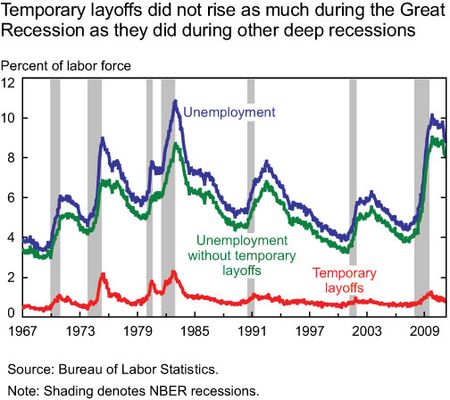
There are more temporary layoffs in milder recessions because the lull in demand is expected to be short and there are fewer business closures. The higher levels of recall unemployment will reduce downward pressure on asking wages and slow the filling of vacancies because many well qualified job applicants are waiting for recall to their old jobs rather than applying more widely for new jobs.
Dixon and Crichton (2006) found that 58% of New Zealand benefit-to-work transitions involved starting with a new employer, 30% continued with an employer for whom they worked part-time in the benefit spell and 12% returned to an employer they had worked for in the past 2 years. The prospect of a recall by an old employer has been important for unemployed workers in countries such as the US, Canada, Demark, Sweden, Austria and Norway.
In the context of work-for-the-dole schemes and activation programmes that involve intensive monitoring of job search by the unemployed on unemployment benefits, requiring workers who are temporarily laid off to search for jobs is in many ways counter-productive.
Developing a screening mechanism to find these temporary layoffs and distinguishing them from permanent layoffs would be quite challenging. Countries which have unemployment insurance premiums spend a lot of try trying to adjust those premiums for temporary layoffs. This is so employers and employees do not take advantage of unemployment insurance to have a week or two off work in slack periods at the expense of the unemployment insurance system and top up their wages in the interim.
A cousin of recall unemployment is rest unemployment or waiting unemployment – job seekers who are waiting for conditions in a depressed sector to improve (Hamilton 1988; Alvarez and Shimer 2008).

Some job seekers may wait for local labour market conditions to improve, rather than search for jobs in other industries and new occupations. A job seeker’s old industry may offer better wage and job finding prospects than other industries If the newly unemployed worker waits a while.
Rest unemployment or waiting unemployment strives to salvage as much of the occupation and industry-specific human capital of the newly unemployed worker as possible.
A significant share of job seekers have been found to be waiting for local labour market conditions to improve rather than searching further afield in different industries or new occupations (Alvarez and Shimer 2008).
Again, rest unemployment or waiting unemployment is a type of job search that cannot be well handled by work-for-the-dole schemes and intensive monitoring of the job search of unemployed workers.
Job finding rates under work for the dole when there is involuntary unemployment
03 Aug 2014 6 Comments
in business cycles, job search and matching, labour economics, labour supply, macroeconomics, welfare reform Tags: Active labour market programs, Jeff Borland, mandatory work requirements, search and matching, welfare reform, work for the dole
Jeff Borland is a critic of work for the dole. He points out that they do not improve the job finding rates of participants and in fact reduce the amount of job search because work for the Dole participants are busy undertaking work for the dole requirements:
The main reason is that participation in the program diverts participants from job seeking activity towards Work for the Dole activity. Research on similar programs internationally has come up with comparable findings.
This made me wonder. If unemployment is caused by deficient aggregate demand, and otherwise is involuntary, how can work for the dole increase unemployment or reduce the rate at which people exit unemployment?
‘Involuntary’ unemployment occurs when all those willing and able to work at the given real wage but no job is available, i.e. the economy is below full employment. A worker is ‘involuntary’ unemployment if he or she would accept a job at the given real wage. Keynesians believe money wages are slow to adjust (e.g. due to money illusion, fixed contracts or because employers and employees want long run money wage stability), and so the real wage may no adjust to clear the labour market: there can be ‘involuntary’ unemployment.

Under the deficient aggregate demand theory of unemployment, people have no control over why they are unemployed – that’s why their unemployment is involuntary.
Sticky wages are no less sticky when work for the dole is introduced and people search more intensively for jobs. Deficient demand unemployment is no less deficient when there is an increase in job search intensity.

Work for the dole must be carefully defined, of course, to differentiate it from the failed active labour market programs of the past that attempted to improve the employability of the unemployed. By work for the dole, I simply mean mandatory work requirements simply make it more of an ordeal to be on unemployment and thereby encourage people to find a job.
Mandatory work requirements simply tax leisure. By taxing leisure, mandatory work requirements change the work leisure trade-off between unemployment and seeking a job with greater zeal and a lower asking wage more attractive option. More applicants asking for lower wages will mean employers can fill jobs faster and at lower wages, which means our create more jobs in the first place.
The probability of finding a job for an unemployed worker depends on how hard this individual searches and how many jobs are available: Chance of Finding Job = Search Effort x Job Availability
Both the search effort of the unemployed and job creation decisions by employers are potentially affected by unemployment benefit generosity and mandatory work for welfare benefits requirements.
Modern theory of the labour market, based on Mortensen and Pissarides provides that more generous unemployment benefits put upward pressure on wages the unemployed seek. If wages go up, holding worker productivity constant, the amount left to cover the cost of job creation by firms declines, leading to a decline in job creation.
Everything else equal under the labour macroeconomics workhorse search and matching model of the labour market, reducing the rewards of being unemployed exerts downward pressure on the equilibrium wage. This fall in asking wages increases the profits employers receive from filled jobs, leading to more vacancy creation. More vacancies imply a higher finding rate for workers, which leads to less unemployment. The vacancy creation decision is based on comparing the cost of creating a job to the profits the firm expects to obtain from hiring the worker.
When unemployment benefits are less generous or more onerous work requirements are attached, some of the unemployed will become less choosey about the jobs they seek in the wages they will accept. a number of people at the margin between working or not. An example is commuting distance to jobs. A number of people turn down a job because is just that little too far to commute. A small change in the cost of accepting that job would have resulted in them moving from being unemployed to fully employed.
Unemployment is easy to explain in modern labour macroeconomics: it takes time for a job seeker to find a suitable job with a firm that wishes to hire him or her; it takes time for a firm to fill a vacancy. Search is required on both sides of the labour market – there are always would-be workers searching for jobs, and firms searching for workers to fill vacancies.
In a recession, a large number of jobs are destroyed at the same time. It takes time for these unemployed workers to be reallocated new jobs. It takes time for firms to find where it is profitable to create new jobs and find workers suitable to fill these new jobs.
Recessions are reorganisations. Unemployed workers look for jobs, and firms open vacancies to maximize their profits. Matching unemployed workers with new firms firms is a time-consuming and costly process.
The demand for labour is a derived demand
03 Aug 2014 Leave a comment
in human capital, labour economics, labour supply, occupational choice Tags: demand for labour, derived demand for labour, in reputation the, marginal revenue product of labour

The willingness to pay of buyers is the fundamental constraint on wages, conditions, and job amenities including reduced hours of work. Entrepreneurs will not pay no more for inputs – be it labour, land, machinery, or raw materials – than they expect to recoup later on from the sale of their final product (Hicks 1932; Hamermesh 1996).
Wages reflect the value the employee adds to the sales of the firm. The value of what an employee adds is set by the consumers who buy or abstain from buying the output of the firm.
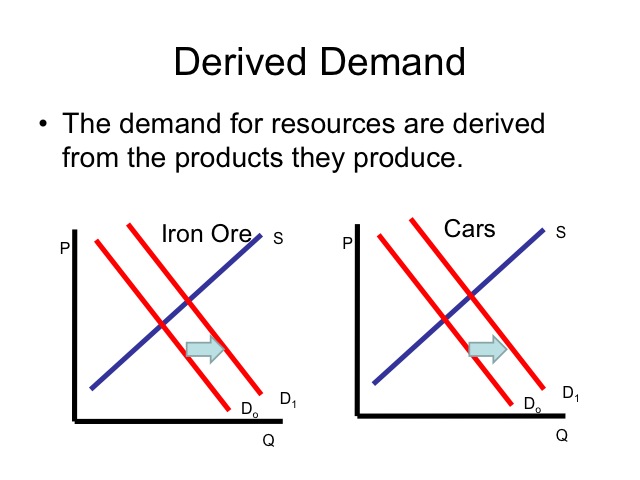
The prices that the final consumer will pay or refuse to pay for products assigns to each kind of labour used in its production a maximum profitable wage. An employer cannot pay higher wages or provide more generous working conditions if buyers are not willing to pay more to cover the extra cost of this (Hicks 1932; Stigler 1987). A profit minded employer cannot grant favours to employees at the expense of customers.

Employers compete for the services of workers who are seeking a range of jobs in industry and occupational labour markets in the areas in which they live. An employer who offers wages, working hours and conditions below what others are paying for the extra value added by a worker will experience higher staff turnover as employees quit to more rewarded jobs elsewhere (Stigler 1987).
These less alert employers will also struggle to recruit and retain the types of workers that are the most profitable for that firm to employ unless they pay the going rate. Rivalry with other sellers sets the maximum on what an employer can profitably pay in wages and survive.
Competition from other employers sets a minimum in wages, hours, working conditions and job amenities to recruit and retain a profitable workforce. Wages are demarked both by what consumers are willing to pay for what the firm produces and by what wages that rival employers are offering in comparable jobs (Stigler 1987).
Calmfor’s Iron Law of Active Labour Market Policy.
31 Jul 2014 Leave a comment
in applied price theory, fiscal policy, job search and matching, labour economics, labour supply, macroeconomics, welfare reform Tags: Active labour market programs, Lars Calmfors, welfare reform, work for the dole, workfare

Lars Calmfors is a Swedish economist whose main interest is labour makets.
His iron law of Active Labour Market Policy (ALMP) refers to a characteristic of make work schemes, like the WPA that operated in the United States in the 1930s.
The characteristic or problem with these schemes is that if people are attracted to these schemes by generous pay or conditions, their motive to search for regular work is necessarily reduced.
Assuming unemployment is anywhere near NAIRU, the effect of this reduced aggregate labour supply will be inflationary, which means that demand will have to be reduced, which in turn means that the jobs created by the make work scheme will be, at least to some extent, at the expense of regular jobs.
Alternatively, if people are coerced into joining make work schemes because of what might be called a “workfare” sanction, their job search efforts are not reduced, thus the jobs created by the make work scheme have a better chance of not being at the expense of normal jobs.
via RALPHONOMICS: Calmfor’s Iron Law of Active Labour Market Policy..
The politics of ethnicity-based research in New Zealand
30 Jul 2014 Leave a comment
in applied price theory, discrimination, human capital, income redistribution, labour economics, labour supply, politics - New Zealand, population economics, Public Choice, rentseeking Tags: employment discrimination, inequality, Maori economic development, poverty, Simon Chapple, The Great Enrichment, The Great Fact
When Simon Chapple in 2000 wrote “Māori Socio-Economic Disparity”, which showed that disadvantage in New Zealand is more closely tied to age, marital status, education, skills, and geographic location than it is to ethnicity, broadly conceived, such as Māori ethnicity:
- He was summoned before the Māori Affairs Committee of parliament to defend his paper! His chief executive at the Ministry of Social Policy went along with him to defend what he wrote while employed as a senior analyst at the Department of Labour. Staff at his new ministry launched a petition to have Simon fired.
- The head of the Māori Affairs Ministry accused Simon of breaching the public service code of conduct.
Chapple also found that there are important differences in socio economic development by Māori self-identity. Those who identified only as Māori did worse than those that are identified as Māori and another ethnicity. Identifying only as Māori also correlated with living in rural New Zealand.
In terms of employment discrimination, employers would not know whether a Māori job applicant identified as only as Māori or also with another ethnicity, so discrimination is not a good explanation of Māori disadvantage because of this counterfactual. A major driver of Māori disadvantage, which is identifying on the Census form solely as Maori, is simply unknown to discriminating employers as a basis for discrimination in hiring and promotion.
There were editorials in the Dominion Post, which I cannot find online, and in the New Zealand Herald. The latter said:
The Government is being prodded to recognise that Maori deprivation has more to do with socio-economic factors than ethnicity.
This was the conclusion of a report by the Labour Department’s senior research analyst, Simon Chapple. Helen Clark might well have had that finding partly in mind when she referred to a lot of water having gone under the bridge since the Government first formulated legislation.
Mr Chapple said, in essence, that place of residence, age, education and skills had more to do with poverty than race. In areas such as South Auckland, Northland and the central North Island, there were poor Maori, but there were also poor Pākehā and poor Pasifika.
The Minister attacked him and the paper as well for contradicting the Minister’s claim during the election campaign that everything got worse for Maori in the 1990s.

Real equivalised median household income rose 47% from 1994 to 2010; for Māori, this rise was 68%; for Pasifika, 77% (Perry July 2014)
See Karen Baehler’s Ethnicity-based research and politics: snapshots from the United States and New Zealand for more information and a comparison with the similar response to Daniel Patrick Moynihan’s The Negro Family: A Case for National Action in 1965.
About a quarter of Negro families are headed by women. The divorce rate is about 2 1/2 times what it is [compared with whites],” Moynihan said. “The number of fatherless children keeps growing. And all these things keep getting worse, not better, over recent years.”
Moynihan, now retired from the United States Senate, was a senior official in LBJ’s Labor Department in 1965. He wrote his report on a typewriter over a few weeks and had the publications office in the basement of the Labor Department print 100 of them, marked “For Official Use Only.”
- He warned about the breakdown of the African-American family where deprivation and disorganisation had formed their own vicious circle.
- Many civil rights leaders had labelled Moynihan’s report a subtle form of racism because of its unflattering portrayal of the black family (Wilson 1987).
- These accusations of racism helped make the breakdown of the family a taboo subject in social policy in the USA
see The Moynihan Report Revisited: Lessons and Reflections after Four Decades for a review by the best and the brightest in American economics and sociology on Daniel Patrick Moynihan’s prophetic warnings. Holzer says, for example:
Moynihan was extremely insightful and even prescient in arguing that the employment situation of young black men was a “crisis . . . that would only grow worse.”
He understood that these trends involve both limits on labour market opportunities that these young men face as well as skill deficits of and behavioural responses by the young men themselves.
More children are growing-up without a working father living in the home and glean the awareness that work is a central expectation of adult life (Wilson 1987, 1996).
Single-parent households increased from 13 per cent of all Māori households in 1981 to 24.4 per cent in the 2006 Census. In the 2006 Census, 70 per cent of Māori single parent households were on a low income compared to 15 per cent of other Māori one family households (Kiro, Randow and Sporle 2010).
Most of the skill gaps that are present at the age of 18 – skill gaps which substantially explain gaps in adult earnings and employment in all groups – are also present at the age of five (Cunha and Heckman 2007). There is much evidence to show that disadvantaged children have lower levels of soft skills (non-cognitive skills): motivation, persistence, self-discipline, the ability to work with others, the ability to defer gratification and plan ahead, etc. (Heckman 2008). Most of the skills that are acquired at school build on these soft skills that are moulded and reinforced within whānau.
When I started working on labour economics in 2007 I found that the labour economics of Māori was very narrowly written and stayed well clear of the minefield that Simon braved about how ethnicity does not matter that much to Māori social disadvantage.
 Utopia, you are standing in it!
Recent Comments