Coalition Celebrating Equal Pay Case Outcome

I wonder who will pay for this? Caregiver wages are funded out of a fixed budget allocated by the government.

A higher wage will change the type of worker that the caregiving sector will seek to recruit, as happened after increases in the teenage went minimum wage.

When the teenage minimum wage went up in New Zealand, employment of 17 and 18-year-olds fell, while the employment of 18 to 19-year-olds increased because the latter were more mature and reliable than the younger contemporaries.

Eileen Brown's avatarPay Equity Challenge Coalition

Media release: Pay Equity Challenge Coalition

28 October 2014

Coalition Celebrating Equal Pay Case Outcome

“The Court of Appeal’s decision declining the employers’ appeal in the Kristine Bartlett case is a huge victory for women workers” said Pay Equity Coalition Challenge spokesperson Angela McLeod.

“The Courts’ decision that equal pay may be determined across industries in female-dominated occupations revitalises the Equal Pay Act 1972 and will be a major factor in closing New Zealand’s stubborn 14 percent gender pay gap”.

The judgement by the Court of Appeal upholding the Employment Court decision again validates the work of caregivers and that they are underpaid, she said.

“We commend the Service and Food Workers Union Nga Ringa Tota in taking this case and exposing the underpayment and undervaluation of aged care workers. And the decision is a victory for all the women’s organisations who have never given up fighting for equal pay,”…

View original post 92 more words

Not too long ago, the left promoted the pointlessness of minimum wage – Whale Oil Beef Hooked


via Not too long ago, the left promoted the pointlessness of minimum wage – Whale Oil Beef Hooked | Whaleoil Media.

Henry Hazlitt on the living wage

Image

Paul Krugman (1998) on the fiscal politics of the minimum wage/living wage movement

Image

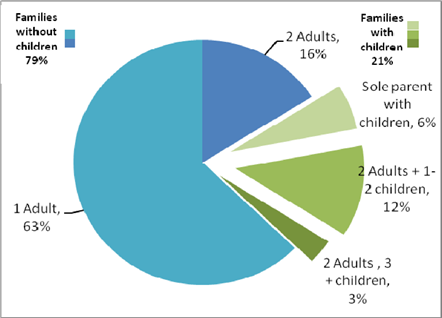
The labour demographics of a NZ living wage

Distribution of families earning below the Living Wage

image

Source: Taxwell

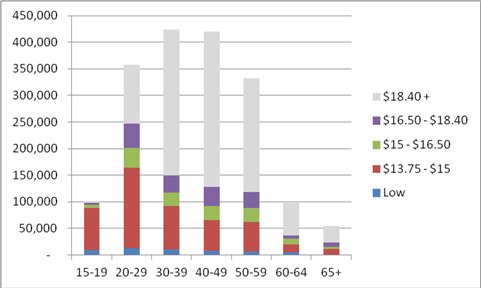
The wage rates of people of different ages

image

Source: Taxwell

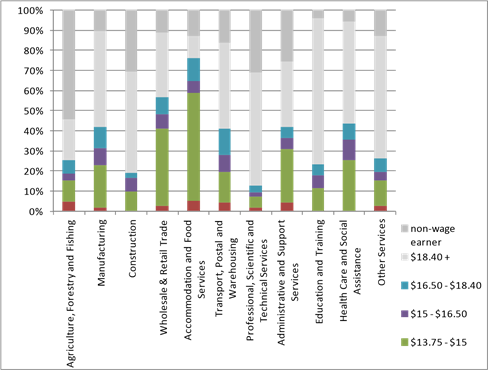
The distribution of wages by industry

image

Non-wage earners is mainly self employed. Source: Taxwell

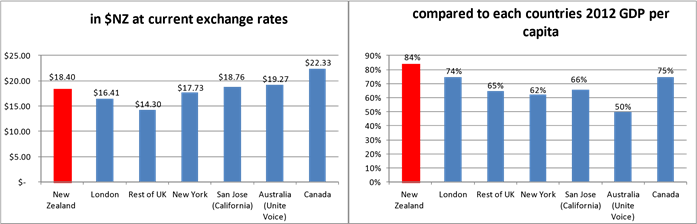
NZ’s proposed Living Wage compared to other Living Wage proposals

image

Source: Living Wage campaign websites, and exchange rates as at 20 September 2013

  1. The Living Wage proposal is an ineffective way to help families with low incomes, because:
      • Many low income earners are people below the age of 30 who are single or part of a childless couple;
      • The extra earnings by parents would result in reduced tax credits or benefit payments (as they abate with higher income).
      1. If adopted as a minimum wage, New Zealand would be out of line with other countries, and it is likely to reduce employment, particularly of younger people trying to enter the labour market.
      2. The overall impact on poverty levels is likely to be small, but it would represent a change of focus from supporting families with children towards supporting young, single people.

      General source: The Treasury Living Wage Information Release

      @arindube Paul Krugman on the minimum/living wage in 1998

      via Paul Krugman on the minimum/living wage: 1998 vs. 2014 | AEIdeas.

      Hayek on social justice in the labour market

      Image

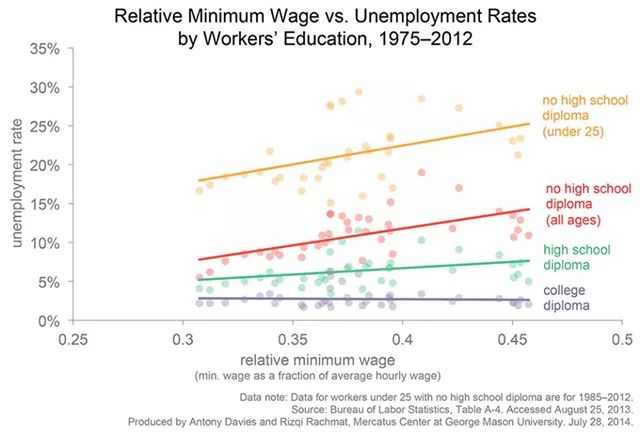
      Minimum wage rates and unemployment

      image

      Image

      A response to Judith Sloan on monopsony

      In the monopsony view view, search frictions in the labour market generate upward sloping labour supply curves to individual firms even when firms are small relative to the labour market.

      Peter Kuhn in a great review of monopsony in motion pointed out the correct title was search fictions with wage posting and random matching in motion.This precision is important because, as Kuhn goes on to say:

      “Manning clearly recognizes this weakness of search-based monopsony models, and does his best to address it in his discussion of ‘random’ vs. ‘balanced’ matching on pages 284–96. Manning’s basic general-equilibrium monopsony model, set out in chapter 2, assumes ‘random matching’, which means that, regardless of its size, every firm—from the local bakery to Microsoft—receives the same absolute number of job applications per period. The only way for a firm to expand its scale of operations in this model is to offer a higher wage… it is absolutely critical to the search-based monopsony model at the core of this book that there be diminishing returns to scale in the technology for recruiting new workers. In other words, for the theory to apply, firms must find it harder to recruit a single new worker the larger the absolute number of workers they currently employ.”

      The evidence in favour of the monopoly view of minimum wage is is not as good as people think.

      Under this monopsony view of minimum wages – an upward sloping supply curve of labour – an increase in the minimum wage increases both wages and employment.

      That is, there is a very specific joint hypothesis of both more employment and more wages and as there are more workers in the workplace, higher output which the employer can only sell by cutting their prices.

      David Henderson made very good points along this line when he reviewed David Card’s book back in 1994:

      Interestingly, Card’s and Krueger’s own data on price contradict one of the implications of monopsony. If monopsony is present, a minimum wage can increase employment. These added employees produce more output. For a given demand, therefore, a minimum wage should reduce the price of the output. But Card and Krueger find the opposite. They write: ‘[P]retax prices rose 4 percent faster as a result of the minimum-wage increase in New Jersey…’ (p. 54). If their data on price are to be believed, they have presented evidenceagainst the existence of monopsony. David R. Henderson, “Rush to Judgment,”MANAGERIAL AND DECISION ECONOMICS, VOL. 17, 339-344 (1996)

      Henry Hazlitt on the mythology of the minimum wage

      Image

      Minimum Wage Hikes Hurt Job-Keepers

      HT: idiosyncraticwhisk.blogspot

      Idiosyncratic Whisk: Teen Employment and the Minimum Wage, 60 years of experience

      Is there any other issue where the data conforms so strongly to basic economic intuition, and yet is widely written off as a coincidence?

      via Idiosyncratic Whisk: Teen Employment and the Minimum Wage, 60 years of experience.

      Is the minimum wage an important tool in fighting pov­erty?

      Image

      The minimum wage raises prices and reduces hiring

      branco min wage cartoon

      Image

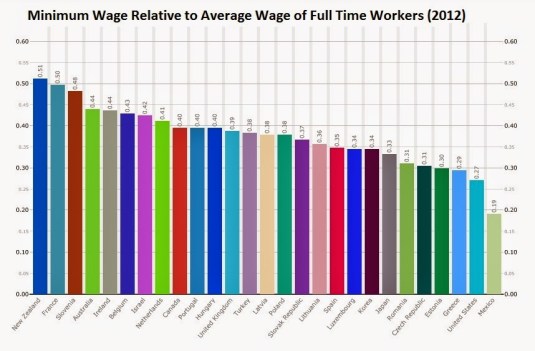
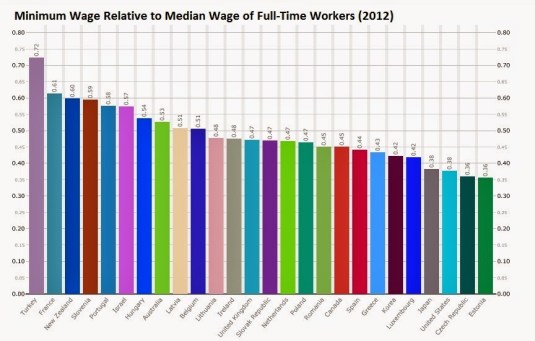
      New Zealand has the highest minimum wage in the world

      John Schmitt  lists 11 margins along which  a minimum wage  might  cause changes:

      1. Reduction in hours worked (because firms faced with a higher minimum wage trim back on the hours they want)
      2. Reduction in non-wage benefits (to offset the higher costs of the minimum wage)
      3. Reduction in money spent on training (again, to offset the higher costs of the minimum wage)
      4. Change in composition of the workforce (that is, hiring additional workers with middle or higher skill levels, and fewer of those minimum wage workers with lower skill levels)
      5. Higher prices (passing the cost of the higher minimum wage on to consumers)
      6. Improvements in efficient use of labour (in a model where employers are not always at the peak level of efficiency, a higher cost of labour might give them a push to be more efficient)
      7. “Efficiency wage” responses from workers (when workers are paid more, they have a greater incentive to keep their jobs, and thus may work harder and shirk less)
      8. Wage compression (minimum wage workers get more, but those above them on the wage scale may not get as much as they otherwise would)
      9. Reduction in profits (higher costs of minimum wage workers reduces profits)
      10. Increase in demand (a higher minimum wage boosts buying power in overall economy)
      11. Reduced turnover (a higher minimum wage makes a stronger bond between employer and workers, and gives employers more reason to train and hold on to workers)

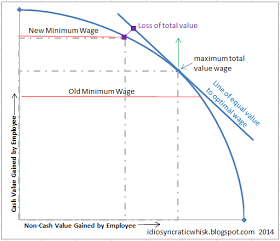
       Richard McKenzie argues that the biggest impact  of a minimum wage increase is reductions to paid and unpaid benefits for minimum wage workers, including  health insurance, store discounts, free food, flexible scheduling, and job security resulting from higher-skilled workers drawn to the higher minimum wage jobs:

      • Masanori Hashimot found that under the 1967 minimum-wage hike, workers gained 32 cents in money income but lost 41 cents per hour in training—a net loss of 9 cents an hour in full-income compensation. Several other researchers in independently completed studies found more evidence that a hike in the minimum wage undercuts on-the-job training and undermines covered workers’ long-term income growth.
      • Walter Wessels found that the minimum wage caused retail establishments in New York to increase work demands by cutting back on the number of workers and giving workers fewer hours to do the same work.
      • Belton Fleisher, L. F. Dunn, and William Alpert found that minimum-wage increases lead to large reductions in fringe benefits and to worsening working conditions.
      • Mindy Marks found that workers covered by the federal minimum-wage law were also more likely to work part time, given that part-time workers can be excluded from employer-provided health insurance plans.

      McKenzie also argued that if the minimum wage does not cause employers to make substantial reductions in fringe benefits and increases in work demands, then an increased minimum should cause

      (1) an increase in the labour-force-participation rates of covered workers (because workers would be moving up their supply of labour curves),

      (2) a reduction in the rate at which covered workers quit their jobs (because their jobs would then be more attractive), and

      (3) a significant increase in prices of production processes heavily dependent on covered minimum-wage workers.

      Wessels found that minimum-wage increases had exactly the opposite effect:

      (1) participation rates went down,

      (2) quit rates went up, and

      (3) prices did not rise appreciably—which are findings consistent only with the view that minimum-wage increases make workers worse off.

      McKenzie was the first economist to argue that a minimum wage increase may actually reduce the labour supply  of menial workers. Employment in menial jobs may go down slightly in the face of minimum-wage increases not so much because the employers don’t want to offer the jobs, but because fewer workers want these menial jobs that are offered.

      The repackaging of monetary and non-monetary benefits, greater work intensities and fewer training opportunities make these jobs less attractive relative to their other options. This  reduction in labour supply by low skilled workers is why the voluntary quit rate among low-wage workers goes up, not down, after a minimum wage increase. As McKenzie explains

      Economists almost uniformly argue that minimum wage laws benefit some workers at the expense of other workers.

      This argument is implicitly founded on the assumption that money wages are the only form of labour compensation.

      Based on the more realistic assumption that labour is paid in many different ways, the analysis of this paper demonstrates that all labourers within a perfectly competitive labour market are adversely affected by minimum wages.

      Although employment opportunities are reduced by such laws, affected labour markets clear. Conventional analysis of the effect of minimum wages on monopsony markets is also upset by the model developed.

      McKenzie argues that not accounting for offsetting behaviour led to a fundamental misinterpretation in the empirical literature on the minimum wage. That literature shows that small increases in the minimum wages does not seem to affect employment and unemployment by that much.

      …. wage income is not the only form of compensation with which employers pay their workers. Also in the mix are fringe benefits, relaxed work demands, workplace ambiance, respect, schedule flexibility, job security and hours of work.

      Employers compete with one another to reduce their labour costs for unskilled workers, while unskilled workers compete for the available unskilled jobs — with an eye on the total value of the compensation package. With a minimum-wage increase, employers will move to cut labour costs by reducing fringe benefits and increasing work demands…

      Proponents and opponents of minimum-wage hikes do not seem to realize that the tiny employment effects consistently found across numerous studies provide the strongest evidence available that increases in the minimum wage have been largely neutralized by cost savings on fringe benefits and increased work demands and the cost savings from the more obscure and hard-to-measure cuts in nonmoney compensation.

      McKenzie is correct in arguing that the empirical literature on the minimum wage is dewy-eyed. The first assumption about any regulation is the market will offset it significantly. In the course of undoing the direct effects  of the regulation, there will be unintended consequences such as the remixing of wage and nonwage components of  remuneration packages of low skilled workers covered by the minimum wage.

      HT:  conversableeconomist

      Previous Older Entries Next Newer Entries

      David Andolfatto

      Celebrating humanity's flourishing through the spread of capitalism and the rule of law

      Monetary Non-Neutrality

      Celebrating humanity's flourishing through the spread of capitalism and the rule of law

      Reason Magazine

      Celebrating humanity's flourishing through the spread of capitalism and the rule of law

      Coyote Blog

      Celebrating humanity's flourishing through the spread of capitalism and the rule of law

      Thoughts from the North

      Celebrating humanity's flourishing through the spread of capitalism and the rule of law

      Fardels Bear

      A History of the Alt-Right

      Vincent Geloso

      Econ Prof at George Mason University, Economic Historian, Québécois

      Bassett, Brash & Hide

      Celebrating humanity's flourishing through the spread of capitalism and the rule of law

      Truth on the Market

      Scholarly commentary on law, economics, and more

      The Undercover Historian

      Beatrice Cherrier's blog

      Matua Kahurangi

      Celebrating humanity's flourishing through the spread of capitalism and the rule of law

      Temple of Sociology

      Celebrating humanity's flourishing through the spread of capitalism and the rule of law

      Velvet Glove, Iron Fist

      Celebrating humanity's flourishing through the spread of capitalism and the rule of law

      Why Evolution Is True

      Why Evolution is True is a blog written by Jerry Coyne, centered on evolution and biology but also dealing with diverse topics like politics, culture, and cats.

      NoTricksZone

      Celebrating humanity's flourishing through the spread of capitalism and the rule of law

      Homepaddock

      A rural perspective with a blue tint by Ele Ludemann

      Kiwiblog

      DPF's Kiwiblog - Fomenting Happy Mischief since 2003

      The Dangerous Economist

      Celebrating humanity's flourishing through the spread of capitalism and the rule of law

      Watts Up With That?

      The world's most viewed site on global warming and climate change

      The Logical Place

      Tim Harding's writings on rationality, informal logic and skepticism

      Doc's Books

      A window into Doc Freiberger's library

      The Risk-Monger

      Let's examine hard decisions!

      Uneasy Money

      Commentary on monetary policy in the spirit of R. G. Hawtrey

      Barrie Saunders

      Thoughts on public policy and the media

      Liberty Scott

      Celebrating humanity's flourishing through the spread of capitalism and the rule of law

      Point of Order

      Politics and the economy

      James Bowden's Blog

      A blog (primarily) on Canadian and Commonwealth political history and institutions

      Science Matters

      Reading between the lines, and underneath the hype.

      Peter Winsley

      Economics, and such stuff as dreams are made on

      A Venerable Puzzle

      "The British constitution has always been puzzling, and always will be." --Queen Elizabeth II

      The Antiplanner

      Celebrating humanity's flourishing through the spread of capitalism and the rule of law

      Bet On It

      Celebrating humanity's flourishing through the spread of capitalism and the rule of law

      History of Sorts

      WORLD WAR II, MUSIC, HISTORY, HOLOCAUST

      Roger Pielke Jr.

      Undisciplined scholar, recovering academic

      Offsetting Behaviour

      Celebrating humanity's flourishing through the spread of capitalism and the rule of law

      JONATHAN TURLEY

      Res ipsa loquitur - The thing itself speaks

      Conversable Economist

      In Hume’s spirit, I will attempt to serve as an ambassador from my world of economics, and help in “finding topics of conversation fit for the entertainment of rational creatures.”

      The Victorian Commons

      Researching the House of Commons, 1832-1868

      The History of Parliament

      Articles and research from the History of Parliament Trust

      Books & Boots

      Reflections on books and art

      Legal History Miscellany

      Posts on the History of Law, Crime, and Justice

      Sex, Drugs and Economics

      Celebrating humanity's flourishing through the spread of capitalism and the rule of law

      European Royal History

      Exploring the Monarchs of Europe

      Tallbloke's Talkshop

      Cutting edge science you can dice with

      Marginal REVOLUTION

      Small Steps Toward A Much Better World

      NOT A LOT OF PEOPLE KNOW THAT

      “We do not believe any group of men adequate enough or wise enough to operate without scrutiny or without criticism. We know that the only way to avoid error is to detect it, that the only way to detect it is to be free to inquire. We know that in secrecy error undetected will flourish and subvert”. - J Robert Oppenheimer.