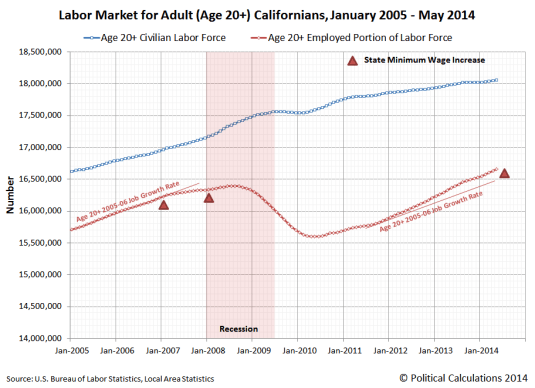
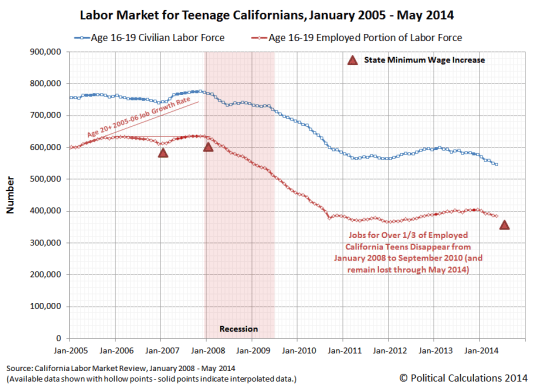
In every episode, except 1996 (which is the smallest hike relative to average wages), there was a distinct decline in the trend of teen employment in the few months before the initial hike until a few months after the follow-up hike. This led Kevin Erdmann to ask:
Is there any other issue where the data conforms so strongly to basic economic intuition, and yet is widely written off as a coincidence?
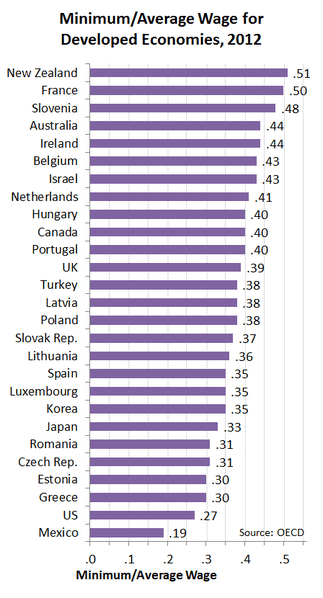
Auckland University of Technology Associate Professor Gail Pacheco is not quoted as often she should be in the politics of the minimum wage in New Zealand. Her research repeatedly finds that the increases in the minimum wage over the last 10 to 15 years in New Zealand reduced employment, increased unemployment, and reduced skill acquisition among teenagers:
Tim Maloney and Gail Pacheco (2012) found that the real minimum wages increased by nearly 33% for adults and 123% for teenagers in New Zealand between 1999 and 2008. Where fewer than 2% of workers were being paid a minimum wage in 1999, more than 8% of adult workers and 60% of teenage workers are receiving hourly earnings close to the minimum wage. They estimated that a 10% increase in minimum wages, even without any offsetting reduction in earnings due to a loss in employment or hours of work, would lower the relative poverty rate by less than one-tenth of a percentage point!
Gail Pacheco (2011) review the impact of rising minimum wages on employment in New Zealand over the time period 1986–2004. She found significant negative employment effects of a higher minimum wage.
Pacheco and Cruickshank (2007) found the youth minimum wage increases resulted in some age groups undergoing a 91% rise in their real minimum wage over the last 10 years. They found that for 16–19 year olds, minimum wage rises have a statistically significant negative effect on educational enrollment levels. But the introduction of the minimum wage appears to have had a significantly positive impact on teenagers’ enrollment levels. This is a possible indication of the ineffective level the minimum wage was set at, in terms of reservation wages of youth in New Zealand.
Gail Pacheco & Vic Naiker (2006) reviewed the consequences of where in March 2001, the eligibility for adult minimum wage rates was lowered from 20 to 18 years while the youth minimum wage for 16–17 year olds was also increased from 60 to 70% of the adult minimum wage. Most minimum wage workers in New Zealand work in the four sectors: (1) Retail, (2) Textile and apparel, (3) Accommodation, cafes and restaurants, and (4) Agriculture, forestry, and fishing. Using an event study methodology we examine the economic impact of the substantial increase in youth minimum wage rates on employers in industries with high concentrations of minimum wage workers. All conclusions point to there being an insignificant impact on profit expectations for low wage employers by investors.
In summary, increases in the youth minimum wage in New Zealand reduced employment, increased unemployment but did not reduce the profits of employers.
If the minimum wage is operating off the monopsony power of employers, investors should have anticipated that the profits of these employers will fall, but they did not. Investors anticipated that most of the consequences of the minimum wage increases would fall upon low paid workers themselves in terms of loss of employment, greater intensity of work effort and reduce training opportunities.
The minimum wage is an inefficient way of tackling poverty because many minimum-wage earners are actually teenagers or second earners in wealthy households in New Zealand and in all other countries that have a minimum wage. As soon as one person is unemployed as a result of the minimum wage increase or otherwise disadvantaged, applied welfare economics comes into play with concepts like Pareto improvement. How do you trade-off the losses for one with another’s gains.
Most are those who support the minimum wage shift gears their applied welfare economics in all other social context to emphasise how the losers should be given priority and greater weight when adding up the social gains and social losses of economic change.
The social cost of the minimum wage is not discussed in this way: how many jobs are lost and that these job losses are much more important than any gains to society. All that is done is the number of jobs lost is compared with some other social metrics such as how much the wages go up for those that still have a job and that is enough to conclude that there is a socially beneficial change from a minimum wage increase.
Any low paid workers affected by the minimum wage increase are just reduced to numbers and added and subtracted with great ease and few moral compunctions about interpersonal comparisons of utility
A minimum wage increase is not free if one worker loses their job. The Paretian Criterion states that welfare is said to increase or decrease if at least one person is made better off or worse off with no change in the positions of others.
As Rawls pointed out, a general problem that throws utilitarianism into question is some people’s interests, or even lives, can be sacrificed if doing so will maximize total satisfaction. As Rawls says:
[ utilitarianism] adopt[s] for society as a whole the principle of choice for one man… there is a sense in which classical utilitarianism fails to take seriously the distinction between persons.
Minimum wage advocates fail to take seriously that low paid workers who lose their jobs because of minimum wage increases are real living people who suffer when their interests are traded off for the greater good of their fellow low paid workers, some of whom come from much wealthier households.
If the Left want to improve the lot of the poor, they would be doing better by either promoting an institutional framework that promotes general wage growth and by simply increasing the earned income tax credit.
The minimum wage law is most properly described as a law saying that employers must discriminate against people who have low skills. That’s what the law says.
The law says that here’s a man who has a skill that would justify a wage of $5 or $6 per hour (adjusted for today), but you may not employ him, it’s illegal, because if you employ him you must pay him $9 per hour.
So what’s the result? To employ him at $9 per hour is to engage in charity. There’s nothing wrong with charity. But most employers are not in the position to engage in that kind of charity.
Thus, the consequences of minimum wage laws have been almost wholly bad. We have increased unemployment and increased poverty.
When we adjust a national minimum wage of $10.10 for regional differences, these are the amounts you’d need to have the same buying power: $11.94 in Washington, D.C., and $11.40 in California, but only $8.90 in Alabama and $9.08 in Kansas.
And of course, prices vary within states as well. In the New York City area, it would take $12.34 to meet the national buying power of $10.10; upstate around Buffalo, you’d need only $9.47. In the Los Angeles area, it would take $11.94; go up north a bit to Bakersfield, where prices are closer to the national average, and it’s $9.83.
To repeat what George Stigler said on the unsuitability of a nation-wide minimum wage in 1946 when there was monopsony, and therefore a small minimum wage increase is less likely to result in a reduction in employment:
If an employer has a significant degree of control over the wage rate he pays for a given quality of labour, a skilfully-set minimum wage may increase his employment and wage rate and, because the wage is brought closer to the value of the marginal product, at the same time increase aggregate output…
This arithmetic is quite valid but it is not very relevant to the question of a national minimum wage. The minimum wage which achieves these desirable ends has several requisites:
1. It must be chosen correctly… the optimum minimum wage can be set only if the demand and supply schedules are known over a considerable range…
2. The optimum wage varies with occupation (and, within an occupation, with the quality of worker).
3. The optimum wage varies among firms (and plants).
4. The optimum wage varies, often rapidly, through time.
A uniform national minimum wage, infrequently changed, is wholly unsuited to these diversities of conditions
A smarter federal minimum wage is a federal minimum wage of zero. Let each state and city set a minimum wage in accordance with its own economic conditions and the blackboard economics of monopsony and competition in the labour market.
As soon as you concede that there is not one single national labour market, other concessions must be made. This slippery slope includes that the monopsony power of employers might vary from state to state, city to city, and local labour market from local labour market.
Even a state or city minimum wage regulator would have to pretend to know an immense amount of information about the labour market with most of this information in a tacit form that cannot be summarised in statistics or other decision aids for regulators. As Hayek reminded in his classic in 1945 on The Use of Knowledge in Society:
the fact that the sort of knowledge with which I have been concerned is knowledge of the kind which by its nature cannot enter into statistics and therefore cannot be conveyed to any central authority in statistical form.
The statistics which such a central authority would have to use would have to be arrived at precisely by abstracting from minor differences between the things, by lumping together, as resources of one kind, items which differ as regards location, quality, and other particulars, in a way which may be very significant for the specific decision.
It follows from this that central planning based on statistical information by its nature cannot take direct account of these circumstances of time and place and that the central planner will have to find some way or other in which the decisions depending on them can be left to the "man on the spot."
Germany, Denmark, Italy, Austria, Finland, Sweden, Iceland, Norway and Switzerland do not have a statutory minimum wage. Capitalist hell-holes all.
A common feature of this group of countries is the high coverage rate of union agreed minimum wages, generally laid down in sectoral agreements by employers associations with unions.
The percentage of employees covered by union agreed minimum wages ranges from approximately 70% in Germany and Norway to almost 100% in Austria and Italy (though excluding irregular workers, who make up a relatively large share of the Italian labour market). Italy has a huge underground economy.
In Denmark, the percentage of employees covered by union agreed wages is estimated at between 81% and 90%, while in Finland and Sweden, this figure is 90%.
Scandinavia is a capitalist hell-hole that every true blue social democrat must denounce without reservation. Their so called left-wing parties as traitors to the working class and to the least powerful of all workers – the low-paid and unskilled.
The poor should not have to rely on scraps from the tables of the middle-class unions. They have been deserted by their so called social democratic governments.
Whether the low-paid and low-skilled get a fair consideration from unions in collective bargaining given these unions will be driven by majority rule – by the median voter/union member who is older, senior and of high job tenure – is a question worth exploring.
The evidence is not good. In the Finnish depression in the early 1990s, the unions refused to agree to nominal wage cuts despite 20% unemployment – the worst since the 1930s. They protect those that still had a job.
Most European labour markets are dual labour markets. Unions and employment protection laws ensure that they are made up of two-tier systems with ultra-secure permanent jobs with the rest on temporary contracts.
“Jobs” are deals between workers and employers, and so “creating” them out of unwilling parties is impossible. The state, though, can outlaw deals, and has.
So: eliminate the minimum wage for people younger than 25. The resulting boom in jobs for young people will amaze.
Maybe it will inspire voters to get the state out of the job-outlawing business. Probably not, so sure are we that the state “protects” by stopping deals between willing parties.
All demand curves are falling, and the demand for hiring labour is no exception. Hence, laws that prohibit employment at any wage that is relevant to the market (a minimum wage of 10 cents an hour would have little or no impact) must result in outlawing employment and hence causing unemployment…
Since the demand curve for any sort of labour (as for any factor of production) is set by the perceived marginal productivity of that labour, this means that the people who will be disemployed and devastated by this prohibition will be precisely the "marginal" (lowest wage) workers, e.g. blacks and teenagers, the very workers whom the advocates of the minimum wage are claiming to foster and protect.
The advocates of the minimum wage and its periodic boosting reply that all this is scare talk and that minimum wage rates do not and never have caused any unemployment.
The proper riposte is to raise them one better; all right, if the minimum wage is such a wonderful anti-poverty measure, and can have no unemployment-raising effects, why are you such pikers?
Why you are helping the working poor by such piddling amounts? Why stop at $4.55 an hour? Why not $10 an hour? $100? $1,000?…
It is conventional among economists to be polite, to assume that economic fallacy is solely the result of intellectual error.
But there are times when decorousness is seriously misleading, or, as Oscar Wilde once wrote, "when speaking one’s mind becomes more than a duty; it becomes a positive pleasure."
Our findings suggest that the efficiency aspects of a modest rise in the minimum wage are overstated….
[W]e find no evidence for a large negative employment effect of higher minimum wages. Even in the earlier literature, however, the magnitude of the predicted employment losses from a much higher minimum wage would be small: the evidence at hand is relevant only for a moderate range of minimum wages, such as those that prevailed in the U.S. labour market during the past few decades.
Within this range, however, there is little reason to believe that increases in the minimum wage will generate large employment losses.
David Card and Alan B. Krueger, Myth and Measurement: The New Economics of the Minimum Wage, (Princeton: Princeton University Press, 1995, p. 393).
Raising the minimum wage by a substantial amount would price working poor people out of the job market.
A far better way to help them would be to subsidize their wages or – better yet – help them acquire the skills needed to earn more on their own…
Raise the legal minimum price of labour above the productivity of the least skilled workers and fewer will be hired.
If a higher minimum means fewer jobs, why does it remain on the agenda of some liberals?
A higher minimum would undoubtedly raise the living standard of the majority of low-wage workers who could keep their jobs. That gain, it is argued, would justify the sacrifice of the minority who became unemployable.
The argument isn’t convincing. Those at greatest risk from a higher minimum would be young, poor workers, who already face formidable barriers to getting and keeping jobs. Indeed, President Reagan has proposed a lower minimum wage just to improve their chances of finding work.
The minimum wage is specifically intended to take aim at the inherent imbalance in power between employers and low-wage workers that can push wages down to poverty levels.…
The weight of the evidence shows that increases in the minimum wage have lifted pay without hurting employment
Both the White House and the New York Times are not the best of Bayesian updaters because the author of the one study on which they are very much hang their hats for their policy conclusions about no job losses from a minimum wage increase interprets his results with very much less zeal than they do:
I think careful research on the topic has found that for this range of minimum wage increase, the almost unmistakable conclusion is that there will be little in the way of job losses, while the wages of low-end workers will get a boost (his underlining).
The claims of the White House and the New York Times that the minimum wage can be lifted without hurting employment are a long bow from what Andrajit Dube said about small changes in the minimum wage having small adverse effects on unemployment:
What Andrajit Dube said s not much different from everyone else on the minimum wage – Nuemark is an example:
a 10 per cent increase in the minimum wage could reduce young adult employment by up to 2 per cent
David Card was always very careful amount about how his pioneering research was about how small increases in the minimum wage not reducing employment in the presence of search and matching costs:
From the perspective of a search paradigm, these policies make sense, but they also mean that each employer has a tiny bit of monopoly power over his or her workforce.
As a result, if you raise the minimum wage a little—not a huge amount, but a little—you won’t necessarily cause a big employment reduction. In some cases you could get an employment increase.
There is always offsetting behaviour: Barry Hirsch found that when the federal minimum wage went up in 2007, businesses just made their employees work harder to justify the expense.
I am always surprised that people might think that the minimum wage will have anywhere near its intended effects after market participants have had time to act to counter its effects as Peltzman explains:
Regulation creates incentives for behaviour to offset some or even all of the intended effect of the regulation…
Regulation seldom changes the forces that produces the particular results the regulators seek to change. So we need to ask whether the regulation really changes result or only the form in which the market forces assert themselves.
Is a minimum wage increase a Pareto improvement – a policy action done in an economy that harms no one and helps at least one person?
Obviously there are winners and losers from a minimum wage increase and these wins and loses must be summed up in some way as they are for all public policy changes.
When there are winners and losers from deregulation, the only thing seems to matter to many of those who support a minimum wage increase are the losses to the incumbent industry and its often well-paid workers rather than the gains to consumers, rich or poor.
For there to be a Marshall improvement, the sum of all of the gains and losses must sum to a positive.
A Marshall improvement from a minimum wage or any other change is measured by adding utilities as if everyone receives the same utility from a dollar. A dollar is a dollar to everyone as David Friedman explains:
A net improvement in the sense used by Marshall–what I have elsewhere called a Marshall improvement–is a change whose net value is positive, meaning that the total value to those who benefit, measured as the sum of the number of dollars they would each, if necessary, pay to get the change, is larger than the total cost to those who lose, measured similarly.
The advantage of the Marshall improvement criterion is we commonly observe people’s values of different things by seeing how much they are willing to pay for it.
Alfred Marshall was aware that treating people as if they all had the same utility for a dollar was a stretch but this was considered less relevant for policy changes that affect large and diverse groups of people. Individual differences could be expected to cancel out over a broad suite of policies in a well-functioning democracy so that most people gain in net terms through time. David Friedman explains:
I prefer to use the Marshallian approach, which makes the interpersonal comparison explicit, instead of hiding it in the ‘could be made but isn’t’ compensating payment…
a change that benefits a millionaire by $10 and costs a pauper $9 is a potential Pareto improvement, since if combined with a payment of $9.50 from the millionaire to the pauper it would benefit both. If the payment is not made, however, the change is not an actual Pareto improvement.
The ‘potential Paretian’ approach reaches the same conclusion as the Marshallian approach and has the same faults; it simply hides them better. That is why I prefer Marshall…
It is worth noting that although a Marshall improvement is usually not a Pareto improvement, the adoption of a general policy of ‘Wherever possible, make Marshall improvements’ may come very close to being a Pareto improvement…
Add up all the effects and, unless one individual or group is consistently on the losing side, everyone, or almost everyone, is likely to benefit.
This is the latest review of the minimum wage research from David Neumark:
The potential benefits of higher minimum wages come from the higher wages for affected workers, some of whom are in poor or low-income families.
The potential downside is that a higher minimum wage may discourage employers from using the low-wage, low-skill workers that minimum wages are intended to help.
If minimum wages reduce employment of low-skill workers, then minimum wages are not a “free lunch” with which to help poor and low-income families, but instead pose a trade-off of benefits for some versus costs for others.
Research findings are not unanimous, but evidence from many countries suggests that minimum wages reduce the jobs available to low-skill workers.
George Stigler set-out the conditions for a minimum wage to achieve its purported objectives in 1946, which have not been bettered:
If an employer has a significant degree of control over the wage rate he pays for a given quality of labour, a skilfully-set minimum wage may increase his employment and wage rate and, because the wage is brought closer to the value of the marginal product, at the same time increase aggregate output…
This arithmetic is quite valid but it is not very relevant to the question of a national minimum wage. The minimum wage which achieves these desirable ends has several requisites:
1. It must be chosen correctly… the optimum minimum wage can be set only if the demand and supply schedules are known over a considerable range…
2. The optimum wage varies with occupation (and, within an occupation, with the quality of worker).
3. The optimum wage varies among firms (and plants).
4. The optimum wage varies, often rapidly, through time.
A uniform national minimum wage, infrequently changed, is wholly unsuited to these diversities of conditions.
The case for a minimum wage was therefore hung, drawn and quartered in 1946 by Stigler. Not every cause and effect is open to policy manipulation because of the lack of the necessary knowledge about the relationship and insufficiently deft policy tools to exploit that knowledge in a timely fashion and as circumstances change. This information and organisational burden is such that the process of setting minimum wage increases is an example of public policy making that is groping about in the dark. Success can be neither appraised in advance nor later retrospectively determined.
Why Evolution is True is a blog written by Jerry Coyne, centered on evolution and biology but also dealing with diverse topics like politics, culture, and cats.
“We do not believe any group of men adequate enough or wise enough to operate without scrutiny or without criticism. We know that the only way to avoid error is to detect it, that the only way to detect it is to be free to inquire. We know that in secrecy error undetected will flourish and subvert”. - J Robert Oppenheimer.


 Auckland University of Technology Associate Professor Gail Pacheco is not quoted as often she should be in the politics of the minimum wage in New Zealand. Her research repeatedly finds that the increases in the minimum wage over the last 10 to 15 years in New Zealand reduced employment, increased unemployment, and reduced skill acquisition among teenagers:




 Utopia, you are standing in it!
Recent Comments