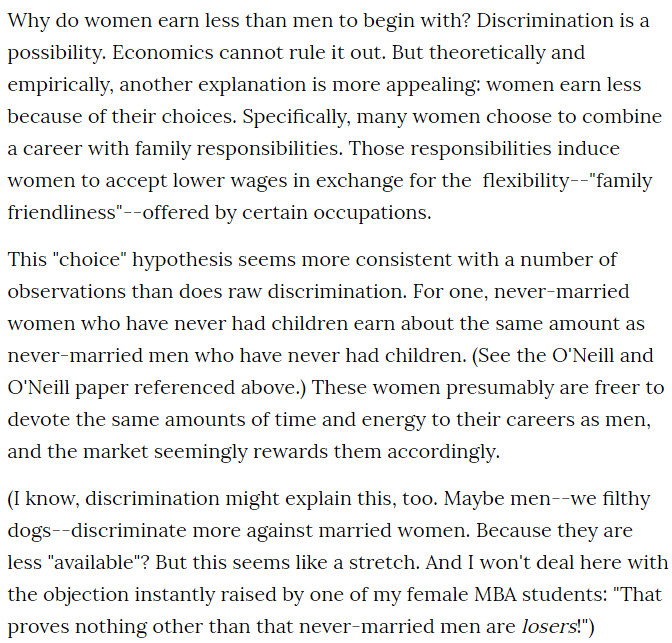
Source: Newmark’s Door: Some notes on comparable worth.
Celebrating humanity's flourishing through the spread of capitalism and the rule of law
19 Apr 2017 Leave a comment
in discrimination, economics of love and marriage, gender, human capital, labour economics, labour supply, occupational choice, television Tags: asymmetric marriage premium, comparable worth, dating markets, gender, marriage and divorce, Seinfeld, signalling
18 Apr 2017 Leave a comment
in applied price theory, human capital, labour economics, labour supply, occupational choice, television Tags: Homer Simpson
24 Mar 2017 Leave a comment
in discrimination, economics of education, gender, human capital, labour economics, labour supply, occupational choice, urban economics Tags: College premium, gender way, graduate premium, reversing gender gap, urban wage premium
08 Mar 2017 2 Comments
in applied price theory, economic history, human capital, labour economics, labour supply, occupational choice, politics - New Zealand Tags: Claudia Goldin, gender wage gap
Dear Deputy Prime Minister,
Earlier this week in your capacity as Minister of Women’s Affairs you sponsored research on the causes of the gender wage gap in New Zealand.
That just published research was seriously incomplete. The Ministry of Women’s Affairs advised today that they were aware of the work of Claudia Goldin but did not reference it.
MWA ignored the research of the world’s top female labour economist Claudia Goldin. Her research shows that the causes of the gender wage gap are completely different to what you have suggested in the research you launched earlier this week and calls for novel policy solutions that are in a completely different ballpark to those that you have raised this week.
When education and accumulated job experience faded away as the statistical explanation of the causes of the gender wage gap, which the research you launched confirmed, Goldin explored how the organisation of work drove what remains. She called this the last chapter of the gender wage gap.
She found that jobs where the willingness to work very long hours, very specific hours and/or maintain continuous contact with co-workers or clients are highly prized and disproportionately rewarded was central to explaining the gender wage gap for well-paid workers.
Both her research and that you sponsored this week shows that the gender wage gap is close to zero for the bottom half of the wage distribution but the wage gap is 20% or more for professionals in the top 10% of wage earners.
Rather than hypothesise that employers suddenly develop an unconscious bias against successful career professionals because they are female, Goldin looked deeply into how the organisation of work and design of jobs affected how workers were paid and how women made choices about their careers and what they majored in at university in anticipation of these demanding or rat race jobs.
Goldin referred to pharmacy as the most family friendly occupation in America because pharmacists are completely interchangeable and in America the great majority of them are employed by Walmart and other big companies. Few are self-employed. The only advantage of working long hours in the pharmacy profession is you are very tired at the end of the week.
Goldin contrasted that with law or finance sector jobs which are rat race jobs.
Rat race jobs such as these disproportionately reward people who are willing to work very long hours, work very rigid hours and/or show up whenever the client wants them anywhere in the world. These jobs also severely penalise even the shortest interruption in your career track. You come back reporting to the people you hired 12-24 months ago!
After starting on the same pay, large gender wage gaps in high-powered professional occupations emerge after 5-10 years into a career as successful professionals power up to become partners or highflyers.
Importantly, Goldin found one counterfactual to this large wage gap for high-powered professionals. If your husband earns less, there is no wage gap with your MBA classmates at Harvard but you do work fewer hours per week.
Goldin’s study of the Harvard and Beyond longitudinal study was corroborated by a study she did of the top 100 occupations in the American Community Survey. The gender wage gap is limited to rat race jobs.
Goldin argued that the last chapter of the gender wage gap dependents on changing the way in which we organise work.
That is a profoundly ambitious agenda because much of the way in which high-powered professionals must work long hours and be always on call for clients is from the demands of their clients. For example, you want your lawyer to show up in court on time every time and always be available to you when you are in trouble. The legal system does not work in any other way because of the possibility of urgent applications to court etc.
Women anticipate this because, as an example, female surgeons tend to specialise in areas where they can schedule operations in advance rather than having to rush in to perform emergency surgery.
I suggest to you that you should think more deeply about the quality of advice you have just received from the causes of the gender wage gap in New Zealand.
That advice to you is profoundly at odds with the latest thinking in modern labour economics on what the causes are and what the solutions must now be for the last chapter of the gender wage gap.
A postscript has the key publications of Claudia Goldin to show why she is the world’s leading female labour economist without a doubt. You were not advised of her findings.
Cheers,
Jim Rose
Selected publications of Claudia Goldin on the labour economics of gender
07 Mar 2017 Leave a comment
in economics, economics of love and marriage, human capital, labour economics, labour supply, occupational choice Tags: assortative mating
07 Mar 2017 Leave a comment
in discrimination, economics, gender, human capital, labour economics, managerial economics, occupational choice, organisational economics, personnel economics
24 Feb 2017 Leave a comment
in discrimination, gender, human capital, labour economics, occupational choice, transport economics Tags: gender wage gap
20 Feb 2017 Leave a comment
in applied price theory, discrimination, entrepreneurship, gender, industrial organisation, labour economics, labour supply, managerial economics, occupational choice, organisational economics, personnel economics Tags: gender wage gap
17 Feb 2017 Leave a comment
in applied price theory, discrimination, economics, gender, health and safety, human capital, labour economics, labour supply, occupational choice, poverty and inequality Tags: gender wage gap, occupational segregation
NZ has a gender wage gap of 6% according to the OECD and 12% according to the Ministry of Women’s Affairs, with 30% of that explained by occupational segregation. That is 2 to 4 percentage points.

You have to explain occupational segregation. Men are represented more in occupations that are riskier. They are paid more for that. There are systematic differences in the occupational choices of married parents, single parents and single mothers regarding the risks of injury. Again, that feeds into wages.
Occupational segregation explains 2 to 4 percentage points of wages. Given that risk premiums – danger money – and trading lower wages for greater flexibility in a job can easily reduce wages or increase them by 2-4%, occupational segregation is simply a proxy for measurement error.
Still more of wage premiums has to be poured into this 2-4% of wages such as occupational segregation in unsocial work hours. Many more women than men work 9 to 5 during the week. Men would then have a wage premium for working nights and weekends. A hell a lot has to be explained away by just 2 to 4% wages.
What does undervalued work mean? Does it mean it is very profitable to employ women in certain occupations such as caring. That implies that high profits will lead new firms to enter these industries bidding up wages and equalising them with other competing jobs.
Celebrating humanity's flourishing through the spread of capitalism and the rule of law
Scholarly commentary on law, economics, and more
Beatrice Cherrier's blog
Celebrating humanity's flourishing through the spread of capitalism and the rule of law
Celebrating humanity's flourishing through the spread of capitalism and the rule of law
Celebrating humanity's flourishing through the spread of capitalism and the rule of law
Why Evolution is True is a blog written by Jerry Coyne, centered on evolution and biology but also dealing with diverse topics like politics, culture, and cats.
Celebrating humanity's flourishing through the spread of capitalism and the rule of law
Celebrating humanity's flourishing through the spread of capitalism and the rule of law
A rural perspective with a blue tint by Ele Ludemann
DPF's Kiwiblog - Fomenting Happy Mischief since 2003
Celebrating humanity's flourishing through the spread of capitalism and the rule of law
The world's most viewed site on global warming and climate change
Tim Harding's writings on rationality, informal logic and skepticism
A window into Doc Freiberger's library
Let's examine hard decisions!
Commentary on monetary policy in the spirit of R. G. Hawtrey
Thoughts on public policy and the media
Celebrating humanity's flourishing through the spread of capitalism and the rule of law
Politics and the economy
A blog (primarily) on Canadian and Commonwealth political history and institutions
Reading between the lines, and underneath the hype.
Economics, and such stuff as dreams are made on
"The British constitution has always been puzzling, and always will be." --Queen Elizabeth II
Celebrating humanity's flourishing through the spread of capitalism and the rule of law
Celebrating humanity's flourishing through the spread of capitalism and the rule of law
WORLD WAR II, MUSIC, HISTORY, HOLOCAUST
Undisciplined scholar, recovering academic
Celebrating humanity's flourishing through the spread of capitalism and the rule of law
Res ipsa loquitur - The thing itself speaks
Celebrating humanity's flourishing through the spread of capitalism and the rule of law
Researching the House of Commons, 1832-1868
Articles and research from the History of Parliament Trust
Reflections on books and art
Posts on the History of Law, Crime, and Justice
Celebrating humanity's flourishing through the spread of capitalism and the rule of law
Exploring the Monarchs of Europe
Cutting edge science you can dice with
Small Steps Toward A Much Better World
“We do not believe any group of men adequate enough or wise enough to operate without scrutiny or without criticism. We know that the only way to avoid error is to detect it, that the only way to detect it is to be free to inquire. We know that in secrecy error undetected will flourish and subvert”. - J Robert Oppenheimer.
The truth about the great wind power fraud - we're not here to debate the wind industry, we're here to destroy it.
Celebrating humanity's flourishing through the spread of capitalism and the rule of law
Celebrating humanity's flourishing through the spread of capitalism and the rule of law
Economics, public policy, monetary policy, financial regulation, with a New Zealand perspective
Celebrating humanity's flourishing through the spread of capitalism and the rule of law
Restraining Government in America and Around the World



 Utopia, you are standing in it!
Recent Comments