Australia has had a working rich for a long time now. Australian top income earners are top wage earners. They are athletes, celebrities, business executives and in the professions.
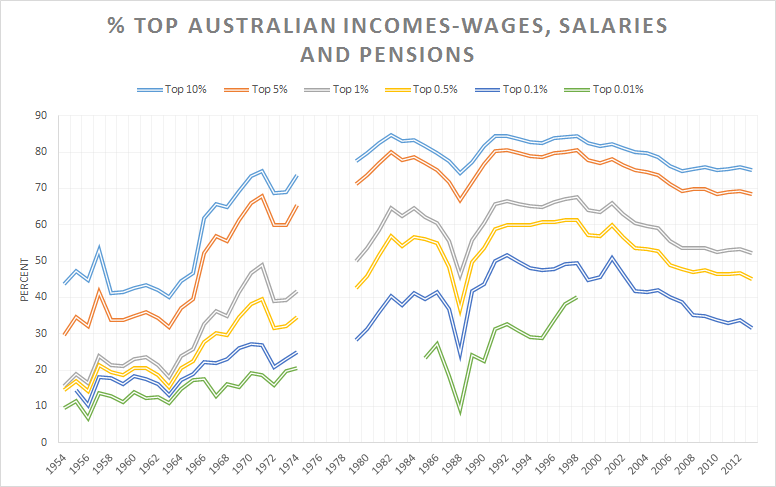
Source: The World Wealth and Income Database.
Celebrating humanity's flourishing through the spread of capitalism and the rule of law
19 Jul 2016 Leave a comment
in economic history, human capital, industrial organisation, labour economics, occupational choice, politics - Australia, poverty and inequality Tags: Australia, CEO pay, superstar wages, superstars, top 1%, top incomes
Australia has had a working rich for a long time now. Australian top income earners are top wage earners. They are athletes, celebrities, business executives and in the professions.
Source: The World Wealth and Income Database.
18 Jul 2016 Leave a comment
in applied welfare economics, economic history, human capital, industrial organisation, labour economics, occupational choice, politics - USA, poverty and inequality, survivor principle Tags: CEO pay, entrepreneurial alertness, superstar wages, superstars, top 1%, top incomes
The rich in the USA long ago became a working rich; most top incomes are from wages and salaries.
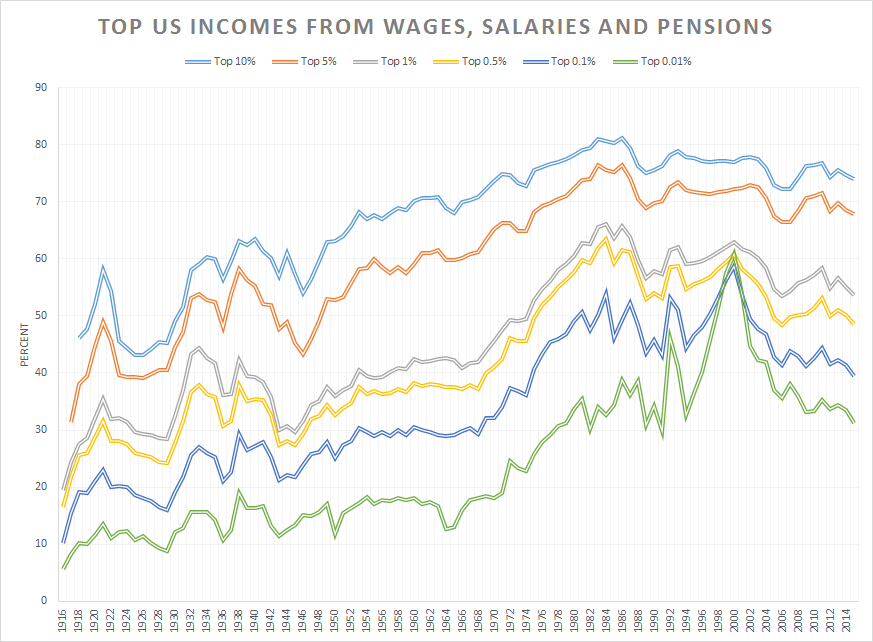
Source: The World Wealth and Income Database.
17 Jul 2016 Leave a comment
in economic history, human capital, labour economics, occupational choice, politics - New Zealand, poverty and inequality Tags: Leftover Left, pessimism bias, top 1%, top incomes, Twitter left
Max Rashbrooke was good enough to remind us that the 2013 update of New Zealand top income shares came online a few days ago.
As is well known to everyone except those obsessed with top income shares, New Zealand top income shares have not changed much since the late 1980s. They are now no higher than in the good old days when New Zealand was an egalitarian paradise in their eyes.

Source: The World Wealth and Income Database.
05 Jul 2016 Leave a comment
in human capital, labour economics, labour supply, occupational choice, poverty and inequality Tags: creative destruction, entrepreneurial alertness, top 1%
The average top income in New Zealand is that of a professional, executive or entrepreneur.
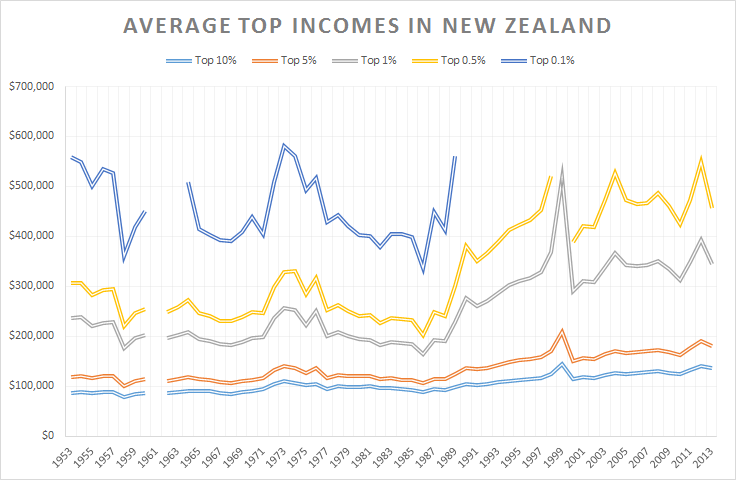
Source: The World Wealth and Income Database.
04 Jul 2016 Leave a comment
in defence economics, labour economics, occupational choice
ISIS foreign fighters are not driven by economic deprivation or inequality. In What Explains the Flow of Foreign Fighters to ISIS? (NBER Working Paper No. 22190),Efraim Benmelech
and Esteban F. Klor found that many foreign fighters come from countries with high levels of economic development, low income inequality, and highly developed political institutions.
Foreign ISIS recruits come largely from prosperous, ethnically and linguistically homogeneous countries. As Alan Krueger explains in a discussion of terrorism is an occupational choice:
One of the conclusions from the work of Laurence Iannaccone—whose paper, “The Market for Martyrs,” is supported by my own research—is that it is very difficult to effect change on the supply side.
People who are willing to sacrifice themselves for a cause have diverse motivations. Some are motivated by nationalism, some by religious fanaticism, some by historical grievances, and so on. If we address one motivation and thus reduce one source on the supply side, there remain other motivations that will incite other people to terror.
Malcontents join the jihadists today for the same reasons they joined the Red Brigade, the Japanese Red Army Faction and Baader-Meinhof gang in the 1970s and 1980s. Plenty of young people were attracted to communism in previous generations as a way of sticking it to the man.
Now as then economic conditions were good as were political freedoms. Italy, Japan and Germany were all at the peak of recoveries from war. Japanese incomes are doubled in the previous decade. Germany and Italy were rich countries. As Alan Krueger explains:
Despite these pronouncements, however, the available evidence is nearly unanimous in rejecting either material deprivation or inadequate education as important causes of support for terrorism or participation in terrorist activities. Such explanations have been embraced almost entirely on faith, not scientific evidence.
Each generation has its defining oppositional identity. Radical Islam is the oppositional identity of choice for today’s angry young men and women. Mind you, they have to buy Islam for dummies to understand what they’re signing up for.
In previous generations, it was communism, weird Christian sects, eco-terrorism, animal liberationist terrorism and a variety of domestic terrorists of the left and right with conspiratorial motivations. Look at the level of diversity of the angry young men and women on the domestic terrorists list of the FBI.
One jihadists when interviewed said that 30 years ago he would probably have become a Communist as his vehicle for venting his frustrations.
03 Jul 2016 Leave a comment
in discrimination, economics of education, gender, human capital, labour economics, labour supply, occupational choice, politics - USA Tags: employer discrimination, ethnic wage gap, gender wage gap, racial discrimination, racial wage gap
30 Jun 2016 Leave a comment
in discrimination, gender, occupational choice
29 Jun 2016 Leave a comment
in economics of education, economics of love and marriage, human capital, labour economics, occupational choice, poverty and inequality Tags: power couples, student loans
Those of European ethnicity had a median net worth of $114,000, compared with $23,000 for Māori , $12,000 for Pasifika and $33,000 for Asians according to the latest Statistics New Zealand data just released.
The Tertiary Education Union made great play about how much of the low net worth of young people and others is due to student loans
Young people (aged 15–24) had the lowest individual median net worth of any age group – just $1,000. The most common debt for young people is education loans.
The union then goes on to say that
Median education loan liabilities are only one-tenth of Pākehā people’s median assets, but they are a quarter of Māori people’s assets and over a third of Pacific people’s assets (table 7.01).
The data shows that the households with the smallest median net worth have the largest median education loans (table 2.02). These loans make up nearly a quarter of their total debt (table 2.03).
Over a third of households within the poorest quintile of net worth have education loans, whereas less than a tenth of households in the wealthiest quintile have education debt (table 2.04).
In a nutshell, not enough people are going to university because of the prospect of repaying student loans and more would go if it were cheaper and that would reducing inequality. The explosion in tertiary educational attendance over the last generation, an increase of about 150% for the adult population aged 25 to 64 was not good enough to reduce inequality.
Free tuition at University is a hand-out to those already had a good start in life. It will be paid for by those who will never go because they do not have an above average IQ.
How much more will you earn by going to university? It depends hugely on which country you're from http://t.co/7RMnUTM8nj—
paulkirby (@paul1kirby) September 11, 2015
Low-cost student loans were supposed to be away to reduce inequality. Instead, they give a flying start to those of already above-average talents. If social justice is to mean anything, it does not involve giving freebies to those who already have a head start in life.
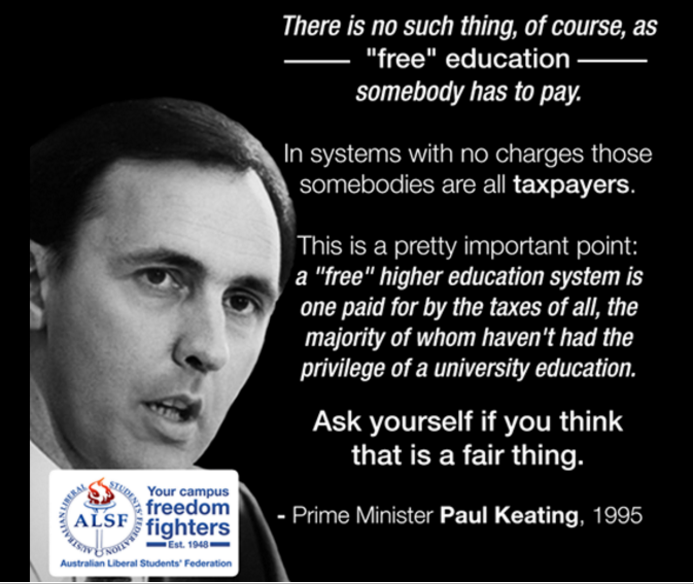
The average student loan debt is about $14,000 while the lifetime earnings premium from university education is about $1/2 million in New Zealand.
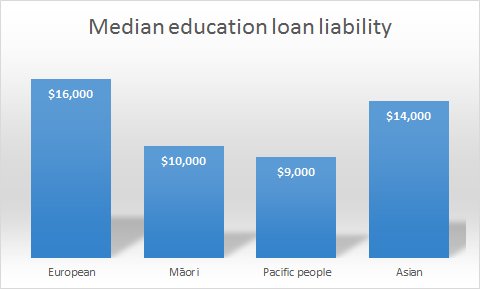
Source: Statistics New Zealand, Household net worth statistics: Year ended 30 June 2015.
Lowering university tuition fees and easing the terms of student loans simply means that those who do well at university will not have to pay back as much to the government. People who succeed at university already have above average IQs so they already had a good head start in life.
Charles Murray points out that succeeded at college requires an IQ of at least 115 but 84% of the population don’t have this:
Historically, an IQ of 115 or higher was deemed to make someone “prime college material.” That range comprises about 16 per cent of the population. Since 28 per cent of all adults have BAs, the IQ required to get a degree these days is obviously a lot lower than 115.
Cheaper higher education does not help the not so smart secure a qualification they lack the innate talent to earn with decent marks and increases the chance of smart men and women marrying. This increases the inequality between power couples and the rest.
25 Jun 2016 Leave a comment
in discrimination, gender, human capital, labour economics, labour supply, occupational choice
Differences in raw gender wage gaps may be almost entirely the result of the individual choices made by both male and female workers.

13 Jun 2016 Leave a comment
in economic history, economics of crime, labour economics, law and economics, occupational choice Tags: age of empires, economics of prisons
09 Jun 2016 Leave a comment
in economic history, economics of media and culture, entrepreneurship, industrial organisation, labour economics, labour supply, occupational choice, survivor principle Tags: entrepreneurial alertness, legacy media, mass media, radio, social media
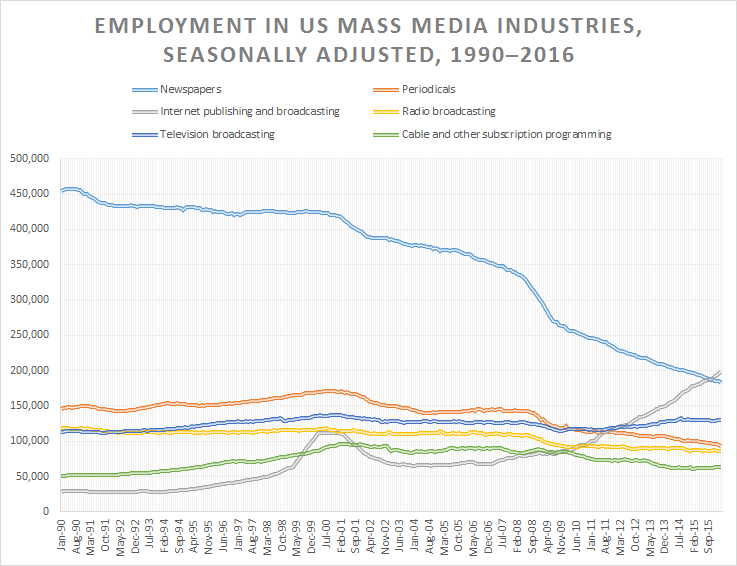
The Bureau of Labour Statistics chart included books which I took it out along with a few others to confine the information to newspapers and other competitors in the mass media. People still study journalism but more and more go to public relations jobs in government and business.
..
07 Jun 2016 Leave a comment
in economic history, economics, gender, human capital, labour economics, labour supply, occupational choice Tags: gender wage gap
05 Jun 2016 Leave a comment
in applied price theory, applied welfare economics, comparative institutional analysis, constitutional political economy, development economics, economic history, economics, economics of regulation, entrepreneurship, growth disasters, growth miracles, income redistribution, industrial organisation, labour economics, macroeconomics, Milton Friedman, minimum wage, occupational choice, politics - USA, Public Choice, public economics Tags: 2016 presidential election, Leftover Left
05 Jun 2016 Leave a comment
in applied price theory, entrepreneurship, F.A. Hayek, human capital, industrial organisation, labour economics, labour supply, occupational choice, poverty and inequality, survivor principle Tags: distributive justice, social justice
Celebrating humanity's flourishing through the spread of capitalism and the rule of law
Scholarly commentary on law, economics, and more
Beatrice Cherrier's blog
Celebrating humanity's flourishing through the spread of capitalism and the rule of law
Celebrating humanity's flourishing through the spread of capitalism and the rule of law
Celebrating humanity's flourishing through the spread of capitalism and the rule of law
Why Evolution is True is a blog written by Jerry Coyne, centered on evolution and biology but also dealing with diverse topics like politics, culture, and cats.
Celebrating humanity's flourishing through the spread of capitalism and the rule of law
Celebrating humanity's flourishing through the spread of capitalism and the rule of law
A rural perspective with a blue tint by Ele Ludemann
DPF's Kiwiblog - Fomenting Happy Mischief since 2003
Celebrating humanity's flourishing through the spread of capitalism and the rule of law
The world's most viewed site on global warming and climate change
Tim Harding's writings on rationality, informal logic and skepticism
A window into Doc Freiberger's library
Let's examine hard decisions!
Commentary on monetary policy in the spirit of R. G. Hawtrey
Thoughts on public policy and the media
Celebrating humanity's flourishing through the spread of capitalism and the rule of law
Politics and the economy
A blog (primarily) on Canadian and Commonwealth political history and institutions
Reading between the lines, and underneath the hype.
Economics, and such stuff as dreams are made on
"The British constitution has always been puzzling, and always will be." --Queen Elizabeth II
Celebrating humanity's flourishing through the spread of capitalism and the rule of law
Celebrating humanity's flourishing through the spread of capitalism and the rule of law
WORLD WAR II, MUSIC, HISTORY, HOLOCAUST
Undisciplined scholar, recovering academic
Celebrating humanity's flourishing through the spread of capitalism and the rule of law
Res ipsa loquitur - The thing itself speaks
Celebrating humanity's flourishing through the spread of capitalism and the rule of law
Researching the House of Commons, 1832-1868
Articles and research from the History of Parliament Trust
Reflections on books and art
Posts on the History of Law, Crime, and Justice
Celebrating humanity's flourishing through the spread of capitalism and the rule of law
Exploring the Monarchs of Europe
Cutting edge science you can dice with
Small Steps Toward A Much Better World
“We do not believe any group of men adequate enough or wise enough to operate without scrutiny or without criticism. We know that the only way to avoid error is to detect it, that the only way to detect it is to be free to inquire. We know that in secrecy error undetected will flourish and subvert”. - J Robert Oppenheimer.
The truth about the great wind power fraud - we're not here to debate the wind industry, we're here to destroy it.
Celebrating humanity's flourishing through the spread of capitalism and the rule of law
Celebrating humanity's flourishing through the spread of capitalism and the rule of law
Economics, public policy, monetary policy, financial regulation, with a New Zealand perspective
Celebrating humanity's flourishing through the spread of capitalism and the rule of law
Restraining Government in America and Around the World


 Utopia, you are standing in it!
Recent Comments