
What are the biggest workplace time wasters?
16 Mar 2015 Leave a comment
in industrial organisation, labour economics, labour supply, managerial economics, occupational choice, organisational economics, personnel economics, survivor principle Tags: cyber loafing
An International Look at the Single-Parent Family–where is New Zealand?
16 Mar 2015 1 Comment
in discrimination, economics of love and marriage, gender, labour economics, labour supply, law and economics, occupational choice, welfare reform Tags: economics of fertility, family demographics, labour demographics, single parents

The policy world and academia offer widely different opportunities for early career researchers
15 Mar 2015 Leave a comment
in applied price theory, applied welfare economics, economics of bureaucracy, economics of education, occupational choice, organisational economics, politics, Public Choice
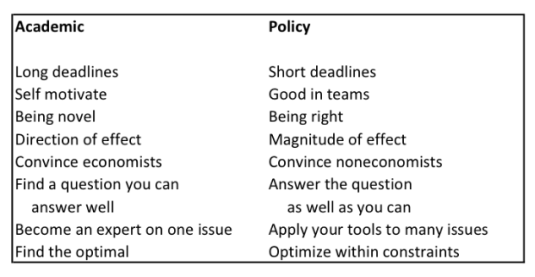
Academia rewards findings that are different and unexpected. In policy it is more important to be right than novel—after all, millions of lives may be impacted by a policy decision. In academia, people argue a lot about the direction of an effect but very little about the magnitude: in policy it’s the reverse…
The Workplace Is Even More Sexist In Movies Than In Reality | FiveThirtyEight
12 Mar 2015 Leave a comment

Unemployment by education
11 Mar 2015 Leave a comment
in business cycles, great recession, human capital, job search and matching, labour economics, labour supply, occupational choice, politics - USA, unemployment Tags: labour demographics

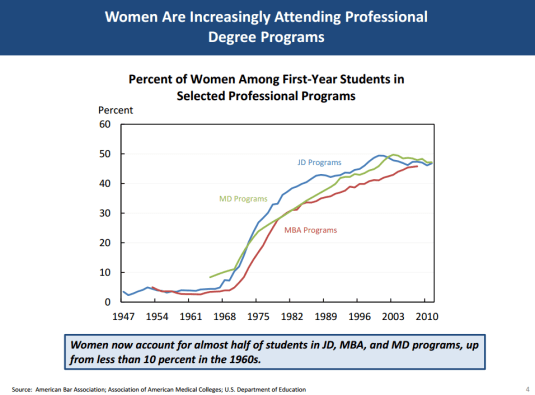
The explosion in women’s professional education just after the pill became widely available
07 Mar 2015 Leave a comment
in discrimination, economic history, economics of education, gender, labour economics, labour supply, occupational choice, politics - USA Tags: economics of fertility, engines of liberation, female labour supply, gender wage gap, reversing gender gap, The Pill
Source: whitehouse.gov

Are women just too smart to be computer scientists?
02 Mar 2015 1 Comment
in discrimination, economics of education, gender, human capital, labour economics, occupational choice Tags: gender wage gap, reversing gender gap
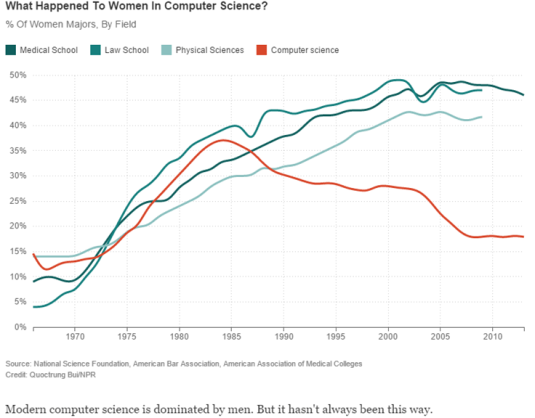
Women started drifting away from computer science in the mid-1980s. The interpretation put forward by the professional grievance industry, that is, by National Public Radio in the USA is:
The share of women in computer science started falling at roughly the same moment when personal computers started showing up in U.S. homes in significant numbers.
These early personal computers weren’t much more than toys. You could play pong or simple shooting games, maybe do some word processing.
And these toys were marketed almost entirely to men and boys. This idea that computers are for boys became a narrative. It became the story we told ourselves about the computing revolution. It helped define who geeks were, and it created techie culture.
Source: NPR
Another interpretation is there are systematic differences between teenage boys and teenage girls in verbal and written skills. Young women moved away from enrolling in computer science because they could make better use of their superior written and verbal skills in medicine and law. Computer science is for those with inferior social skills, on average.

As for computers in the early days been marketed to men and boys, people with inferior verbal and reading skills would be attracted to sitting in front of the computer playing games because of their inferior social skills. Computers were expensive back in the 80s so marketing them to people with fewer social skills is sensible as they were more willing to spend money to fill the extra time they spend on their own.
The difference in reading and verbal skills between girls and boys at the age of 15 is equal to 6-months extra schooling. Six months schooling explains a lot of the wage gaps on ethnic, racial and gender lines. Not surprisingly, fewer women do computer science because their superior reading and verbal skills qualify them for medicine and law where they can take greater advantage of their mix of talents.
It is all about being the best you can be. As many women as men ending up in STEM occupations does not necessarily mean people are making the choices that help them be the best they can be because some women may not be taking advantage of their superior reading skills.
What is the return on higher education?
26 Feb 2015 Leave a comment
in economics of education, human capital, labour supply, occupational choice Tags: age-earnings profile


Zero hours contracts prevalence, the class struggle and the gales of creative destruction
26 Feb 2015 1 Comment
in labour economics, labour supply, managerial economics, occupational choice, organisational economics, personnel economics Tags: class struggle, Class war, creative destruction, false consciousness, inherent inequality of bargaining power between workers and employers, job satisfaction, preference formation, work life balance, zero hours contracts

Source: Use of zero hours contracts rises to record levels | City A.M.
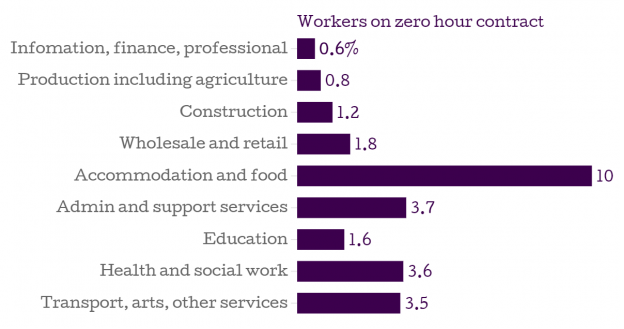
The number of workers on zero hours contracts has certainly exploded in the UK, going from about 100,000 to 700,000 in about five years. The UK data also suggests that most of these contracts will be in the accommodation and food services sector.
Source: Use of zero hours contracts rises to record levels | City A.M.
Zero hours contracts is creative destruction at work in the labour market, sweeping away obsolete working time arrangements, mostly in the retail services sector.

Zero hours contracts is creative destruction at work in the labour market, sweeping away obsolete working arrangements mostly in the retail services sector.
New Zealand data is hard to come by on zero hours contracts. Data on working hours arrangements is in the Survey of Working Life which is conducted every couple of years. This survey doesn’t give any data directly on the prevalence of zero hours contracts, but it does tell you how many people are temporary employees and among these, who is a casual and seasonal employee and whether they have regular hours.
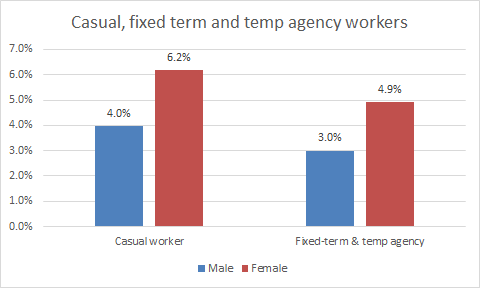
Source: Survey of Working Life December Quarter 2012, Statistics New Zealand.
The first thing can be said about the prevalence of zero hours contracts in New Zealand is two years ago the number of workers both male and female who were casual, fixed term and temp agency workers was relatively small. Less than one in 20 male workers was a casual worker; 3% of male workers was on a fixed term or temp agency worker. For women, 6% were casual workers and 4.9% were either fixed term or temp agency workers.
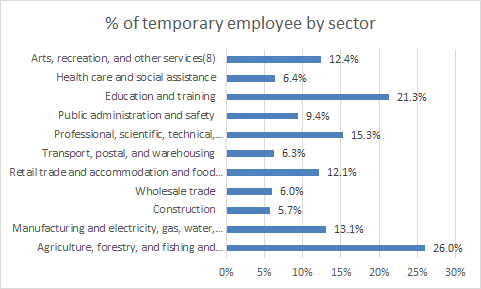
Source: Survey of Working Life December Quarter 2012, Statistics New Zealand.
Temporary employment is most common In the agriculture, forestry and fishery sectors, which is no surprise because of the prevalence seasonal workers in that sector.The retail trade accommodation and food sectors is not the next cab off the rank for temporary employment. Temporary employment is rather common in the education and professional science sectors.
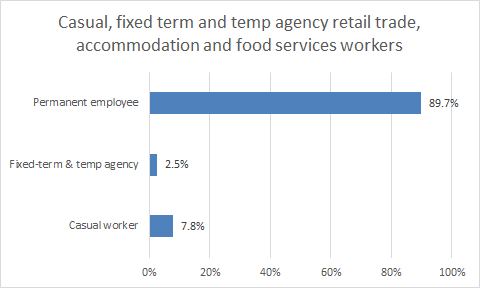
Source: Survey of Working Life December Quarter 2012, Statistics New Zealand.
In the retail trade commendation and food services worker, 90% of all employees are still permanent. There are about 32,000 workers in the retail trade, accommodation and food services sectors.
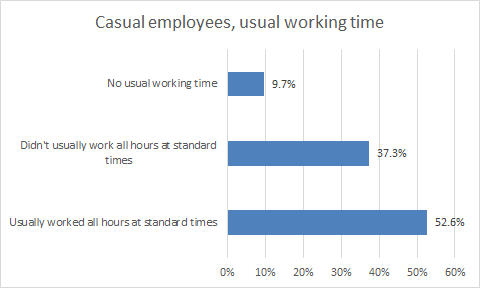
Source: Survey of Working Life December Quarter 2012, Statistics New Zealand.
Among all casual employees across all sectors, 50% work standard hours and about 10% have no usual working time. That is, out of the 92,000 casual employees in New Zealand, about 9000 of them have no usual working times, which is the equivalent of a zero hours contract. No data was published by Statistics New Zealand on fixed term and temp agency workers because the sample sizes were too small so the data was suppressed confidentiality reasons.
Source: Survey of Working Life December Quarter 2012, Statistics New Zealand.
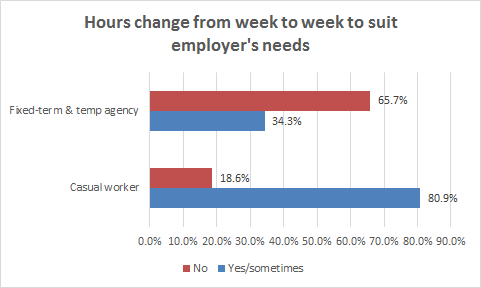
For casual, fixed term and temp agency employees, it is commonplace for them to change their hours from week to week to suit the needs of their employees. The equivalent of zero hours contracts Is commonplace among employees who do not have permanent employment status. It goes with the territory. Those who want fixed hours seek permanent employment.
For zero hours employment to become common, this form of contract in over working time arrangements will have to be come more common among permanent employees. If that is so, such a trend will make the notion of a permanent employee somewhat vague considering these employees, although permanent, are not guaranteed regular hours.
Source: Survey of Working Life December Quarter 2012, Statistics New Zealand.
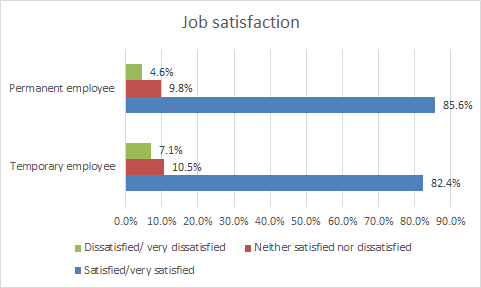
They are a happy lot are temporary employees. Pretty much enjoy their jobs as much as permanent employees do when it comes to their job and, by implication, that perennial left-wing bugbear, the inherent inequality of bargaining power between the bosses and the workers and the violence inherent in the capitalist system. All is not well for the class war.
Source: Survey of Working Life December Quarter 2012, Statistics New Zealand.
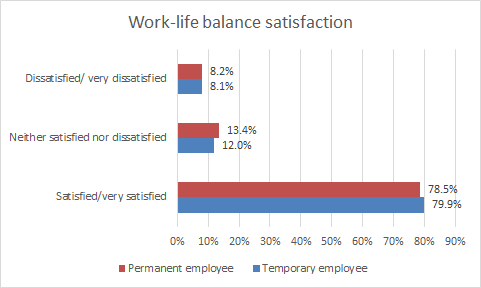
What is worse for the future of the class struggle is that these temporary employees are rather happy lot when it comes to work life balance. Just as happy as permanent employees. Indeed, temporary or permanent employment status has no effect on job satisfaction and work life balance.
Source: Survey of Working Life December Quarter 2012, Statistics New Zealand.
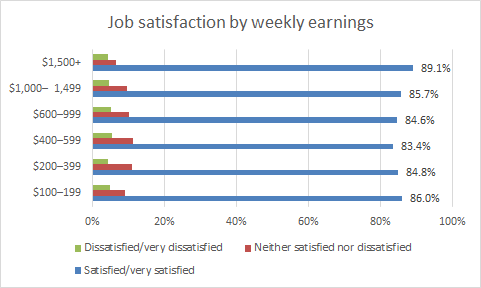
Rise up ye workers, rise up for you have nothing to lose but your zero hours contracts may have to be put on hold as the next battle cry of the class war in New Zealand. Indeed, a lot of consciousness-raising will be in store for our friends on the Left because the working class seem a rather happy lot in their jobs, slightly less grumpy than the middle class, and almost as happy as the ruling class.

Kicking in the rotted door of capitalism to bring on the permanent revolution has never been easy. Zero hours contracts just does not seem to be the new straw that will break the capitalists’ back any time soon. Workers seem to be rather happy with them or their equivalent that has been around for a long time in the labour market.

Critics overplay their hand if they suggest that somehow workers a very much disadvantaged and employers are holding all the cards. Job turnover and recruitment problems are a serious cost to a business. Workers will not sign contracts, such as zero hours contracts or casual work contracts if they are not to their advantage.
Richard Posner on libertarian scepticism about law as an engine of women’s liberation
25 Feb 2015 Leave a comment

The power of the asymmetric marriage premium
25 Feb 2015 Leave a comment
in discrimination, gender, human capital, labour economics, labour supply, occupational choice Tags: asymmetric marriage premium, gender wage gap


How are women doing in the US when it comes to political & business leadership positions
23 Feb 2015 Leave a comment
in discrimination, economic history, economics of marriage, gender, labour economics, law and economics, occupational choice, politics - USA Tags: engines of liberation, gender wage gap


Recent Comments