30 Jan 2015
by Jim Rose
in applied price theory, economics of crime, labour economics, labour supply, law and economics, occupational choice
Tags: crime and punishment, death penalty, deterrence, occupational hazards, prison conditions, punishment
– Updated
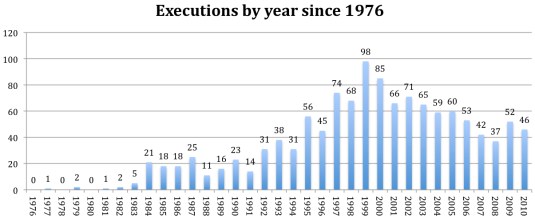
Many a data shyster will make hay with the above chart on the simple correlation between executions and the drop in the US murder rate.

The reality is there are so few executions and they are so infrequent with the exception of Texas that any purported correlation between the death penalty and murder rates requires careful study.

Indeed, for some condemned prisoners, gang bangers are an example, their life expectancy may be increased by the long time they spend on death row versus been murdered by a business associated or a business rival on the streets. As Levitt noted:
no rational criminal should be deterred by the death penalty, since the punishment is too distant and too unlikely to merit much attention.
As such, economists who argue that the death penalty works are put in the uncomfortable position of having to argue that criminals are irrationally overreacting when they are deterred by it.
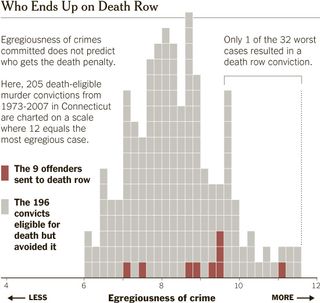
The occupational hazard of been murdered by business rival for gang bangers is higher than the chance of them been arrested, tried , convicted, and condemned to death and then executed after a long appeals process. Not surprisingly, Levitt argued that:
…the quality of life in prison is likely to have a greater impact on criminal behaviour than the death penalty.
Using state-level panel data covering the period 1950–90, we demonstrate that the death rate among prisoners (the best available proxy for prison conditions) is negatively correlated with crime rates, consistent with deterrence. This finding is shown to be quite robust.
In contrast, there is little systematic evidence that the execution rate influences crime rates in this time period.
29 Jan 2015
by Jim Rose
in occupational choice, personnel economics, politics - Australia, politics - New Zealand, politics - USA
Tags: activists, Greens, Inner-city Left, Leftover Left


Minorities represent nearly 40 percent of Americans, yet account for fewer than 16 percent of workers at the government agencies, nongovernmental organizations called NGOs and foundations that were studied.
…Taylor wrote that an “unconscious bias” exists within the liberal and progressive culture of the groups, preserving a racially homogenous workplace. “Recruitment for new staff frequently occurs through word-of-mouth and informal networks,” the study said. “This makes it difficult for ethnic minorities, the working class, or anyone outside of traditional environmental networks to find out about job openings and apply for those jobs.”
HT: http://wapo.st/VdOjqT
27 Jan 2015
by Jim Rose
in occupational choice, Public Choice
Tags: activists, do gooders, fascism of good intentions

Activist: A person who believes so strongly that a problem needs to be remedied that she dedicates substantial time to … getting other people to fix the problem. It used to be that activists sought voluntary help for their pet problem, and thus retained some semblance of honor.
However, our self-styled elite became frustrated at some point in the past that despite their Ivy League masters degrees in sociology, other people did not seem to respect their ideas nor were they particularly interested in the activist’s pet issues.
So activists sought out the double shortcut of spending their time not solving the problem themselves, and not convincing other people to help, but convincing the government it should compel others to fix the supposed problem.
This fascism of good intentions usually consists of government taking money from the populace to throw at the activist’s issue, but can also take the form of government-compelled labor and/or government limitations on choice.
via Definition of an Activist | Coyote Blog.
27 Jan 2015
by Jim Rose
in discrimination, economics of media and culture, gender, industrial organisation, movies, occupational choice, survivor principle
Tags: co-worker discrimination, consumer sovereignty, customer discrimination, employer discrimination, Hollywood economics, sex discrimination, The meaning of competition
/cdn0.vox-cdn.com/uploads/chorus_asset/file/3332436/hickey-bechdel-11.0.png)
Hollywood is a slave to the box office on the most cutthroat industry there is. Film producers and screenwriters will portray men and women in whatever roles and whatever extent sells tickets.
How women are represented in the movies is determined solely by the preferences of the audiences willing to buy tickets. It’s a buyers market out there. Film producers would do whatever it takes to finance films that sell tickets, as even Five Thirty-Eight realised:
“Movies that are female-driven do not travel,” said Krista Smith, West Coast editor of Vanity Fair, describing the broader sentiment in Hollywood. There are almost no women who have sales value in multiple international territories, maybe with the exception of Sandra Bullock, she said.
Times change, and film producers change with the times. Consumers are both sovereign and change their minds, and in the case of movie audiences, constantly demand novelty and surprises, as even Five Thirty-Eight picked up on:
Hollywood is the business of making money. Since our data demonstrates that films containing meaningful interactions between women do better at the box office than movies that don’t, it may be only a matter of time before the data of dollars and cents overcomes the rumours and prejudices defining the budgeting process of films for, by and about women.
This moral panic over gender wage gaps between millionaire actresses and actresses dare not say that for want of offending the audience that is actually the main driver of any gender gap in movies.

Hollywood activists complaining about the gender wage are to business minded to dare insult the audiences that pay their wages.
25 Jan 2015
by Jim Rose
in labour economics, labour supply, occupational choice, welfare reform
Tags: David Autor, disability insurance, social insurance, welfare reform
/cdn0.vox-cdn.com/uploads/chorus_asset/file/3329592/DI_Chartbook_Section_Three-04.0.png)
David Autor found that the effective replacement rate of Social Security disability insurance payments for labour earnings with SSDI benefits has also risen in recent decades due both to the rising value of in-kind Medicare benefits and to a subtle interaction between the benefits formula and rising income inequality in the U.S.
This interaction causes the effective generosity for low-wage workers to rise and encourages older workers with limited education to go on the disability benefit because its income replacement rate for what they can earn in the workforce can be as high as 80% when Medicare is included. As Autor and Duggan explain:
The rapid expansion of the beneficiary population has three main causes.
First, a set of congressional reforms in 1984 to Disability Insurance screening led to rapid growth in the share of recipients suffering from back pain and mental illness. Because these disorders have comparatively low mortality, the average duration of disability spells—and hence the size of the recipient population—has increased.
Second, a rise in the after-tax DI income replacement rate—that is, the ratio of disability income to former labour earnings—strengthened the incentives for workers to seek benefits.
Third, a rapid increase in female labour force participation expanded the pool of insured workers. The aging of the baby boom generation has contributed little to the rise of receipt of disability benefits, while improvements in population health have likely reduced the incidence of disabling medical disorders.
24 Jan 2015
by Jim Rose
in economics of media and culture, environmental economics, global warming, occupational choice, personnel economics
Tags: academic bias, activists, climate alarmism, expressive 13, rational ignorance, rational irrationality

If the public knew the truth, I expect two effects:
- The public would consider scientists to be less authoritative as a neutral source on policy questions, and
- Since scientists are respected, the public would become less conservative and more liberal.
via Overcoming Bias : Exposing Scientist Liberality.
23 Jan 2015
by Jim Rose
in applied price theory, economics of crime, labour economics, law and economics, occupational choice
Tags: Alexander Tabarrok, crime waves, revolutions, riots
In ‘A simple model of crime waves, riots, and revolutions’, Alexander Tabarrok puts forward a model of crime waves that applies not only to crime but also to phenomena like riots, strikes, and revolutions.
- In each of these cases, the probability of being punished is a decreasing function of the total amount of the activity.
- The probability that a rioter is apprehended falls the more rioters there are.
- The probability that a striker or a revolutionary is punished is less the greater the number of strikers and revolutionaries. This is true even if the revolution or strike fails.
The standard model of crime analyses a criminal’s decisions as if they were unrelated to the decisions of other criminals.

The game-theoretic approach examines the entire system of criminal decisions exploring the implications of interdependence.

As crime increases, police resources become strained at the margin and the probability of punishment falls, causing other criminals to increase their criminal activities.
As others turn to crime, the probability of punishment falls even further, giving each individual an additional reason to increase his criminal activities.
Joining into a revolution or a riot has the same calculus of independence. You are less likely to be caught and punished if you will face in the crowd.
This interdependence in the probability of detection, arrest and punishment lowers the cost of participation. Not surprisingly, judges of been aware of this for some time and have hand out severe punishments such as after the 2011 London riots. These riots fell away sharply once these penalties were handed out and more police were on the streets to catch rioters.
Previous Older Entries Next Newer Entries
Recent Comments