Celebrating humanity's flourishing through the spread of capitalism and the rule of law
20 Jul 2016 Leave a comment
in economics, industrial organisation, Joseph Schumpeter, labour economics, politics - USA, population economics, technological progress Tags: creative destruction
19 Jul 2016 Leave a comment
in economic history, human capital, industrial organisation, labour economics, occupational choice, politics - Australia, poverty and inequality Tags: Australia, CEO pay, superstar wages, superstars, top 1%, top incomes
Australia has had a working rich for a long time now. Australian top income earners are top wage earners. They are athletes, celebrities, business executives and in the professions.
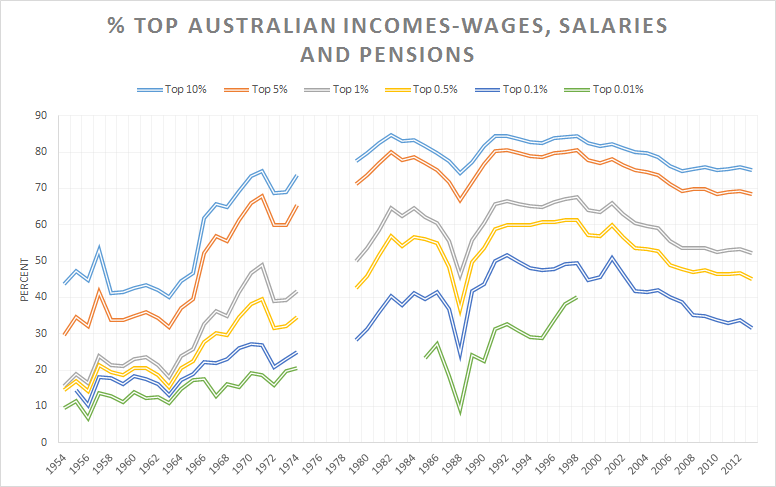
Source: The World Wealth and Income Database.
18 Jul 2016 Leave a comment
in applied welfare economics, economic history, human capital, industrial organisation, labour economics, occupational choice, politics - USA, poverty and inequality, survivor principle Tags: CEO pay, entrepreneurial alertness, superstar wages, superstars, top 1%, top incomes
The rich in the USA long ago became a working rich; most top incomes are from wages and salaries.
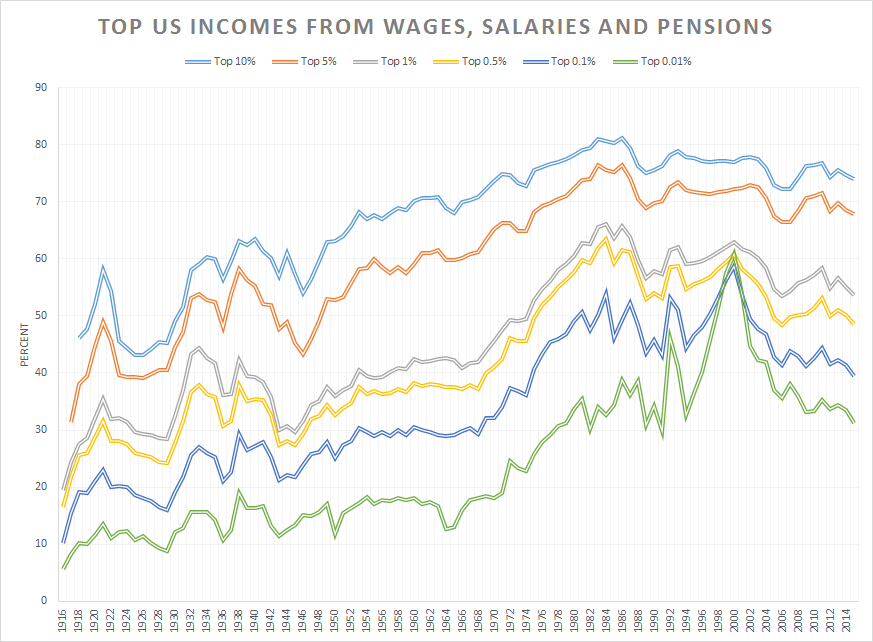
Source: The World Wealth and Income Database.
17 Jul 2016 Leave a comment
in economic history, human capital, labour economics, occupational choice, politics - New Zealand, poverty and inequality Tags: Leftover Left, pessimism bias, top 1%, top incomes, Twitter left
Max Rashbrooke was good enough to remind us that the 2013 update of New Zealand top income shares came online a few days ago.
As is well known to everyone except those obsessed with top income shares, New Zealand top income shares have not changed much since the late 1980s. They are now no higher than in the good old days when New Zealand was an egalitarian paradise in their eyes.

Source: The World Wealth and Income Database.
11 Jul 2016 Leave a comment
in gender, labour economics, labour supply Tags: female labour force participation, female labour supply, part-time work, social insurance, taxation and labour supply
To account for full-time work being 35 hours per week in some countries but 40 hours others I have included both in the chart below. Not many Dutch women work full-time.
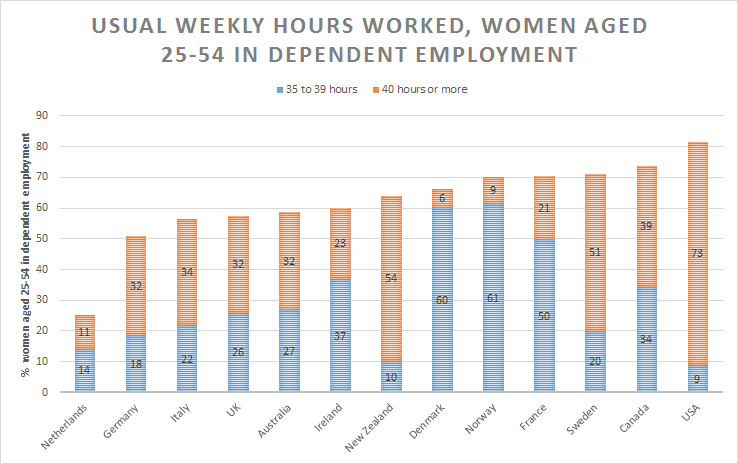
Data extracted on 11 Mar 2016 14:08 UTC (GMT) from OECD.Stat.
11 Jul 2016 Leave a comment
in Alfred Marshall, Gary Becker, history of economic thought, human capital, labour economics

..
10 Jul 2016 Leave a comment
in applied welfare economics, economic history, economics, politics - New Zealand, poverty and inequality Tags: The Great Enrichment, The Great Escape
06 Jul 2016 Leave a comment
in economic growth, economics of education, human capital, labour economics, macroeconomics Tags: endogenous growth theory, graduate premium
Some countries have experienced large increases in the number of young people graduating from University when compared to their parents. Germany and the USA aside, all countries have experienced a noticeable increase in young adults with tertiary degrees.
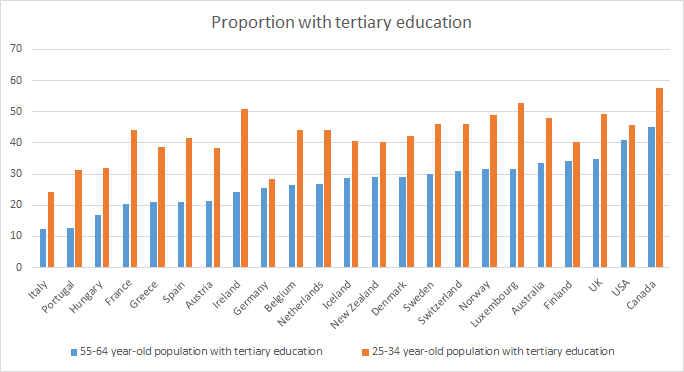
Source: Education at a Glance 2015 – © OECD 01-01-2015.
If human capital is such a major driver of economic growth, should not these countries with large increases in tertiary educated workers be anticipating a growth spurt? The gaps in tertiary attainment across the OECD are much less than they used to be for young adults. Ireland’s burst in tertiary educated workers was after the Celtic Tiger years, not before or during.
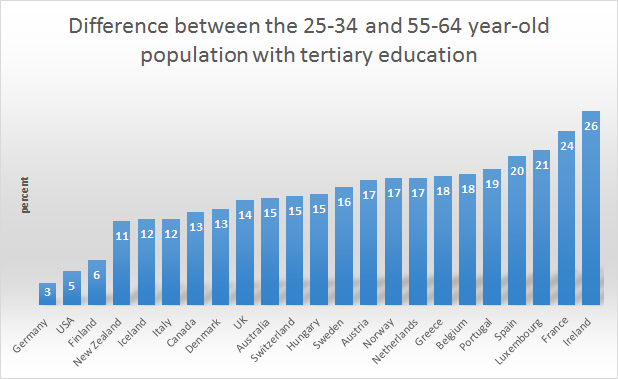
Source: Education at a Glance 2015 – © OECD 01-01-2015.
06 Jul 2016 Leave a comment
in economics of love and marriage, labour economics, labour supply, poverty and inequality, welfare reform Tags: child poverty, family poverty, single mothers, single parents
Looks like the greed of the top 1% was targeted exclusively as single parents since the 1980s. Child poverty in two-parent families has not risen much at all. These households often have jobs and will presumably be under the jackboot of neoliberalism stripping away their bargaining power through the decimation of unions and the introduction of the Employment Contracts Act. Despite these horrors, family poverty did not increase much if there are two parents in the house.
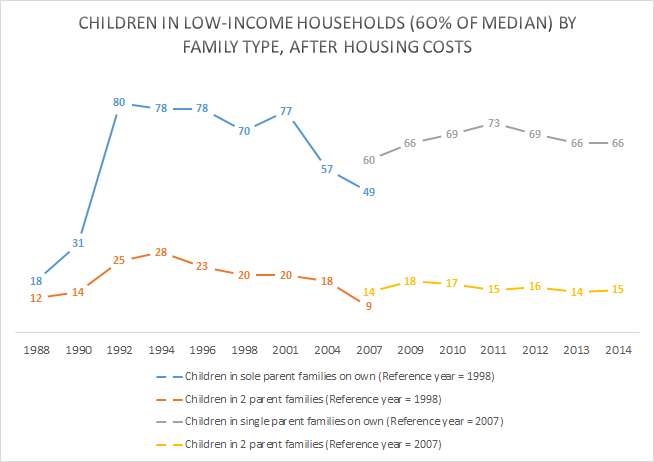
Source: Bryan Perry, Household Incomes in New Zealand: trends in indicators of inequality and hardship 1982 to 2014 – Ministry of Social Development, Wellington (August 2015), Table H.4.
Bryan Caplan argues that there is an undeserving poor if they fail to follow the following reasonable steps to avoid poverty and hardship:
05 Jul 2016 Leave a comment
in human capital, labour economics, labour supply, occupational choice, poverty and inequality Tags: creative destruction, entrepreneurial alertness, top 1%
The average top income in New Zealand is that of a professional, executive or entrepreneur.
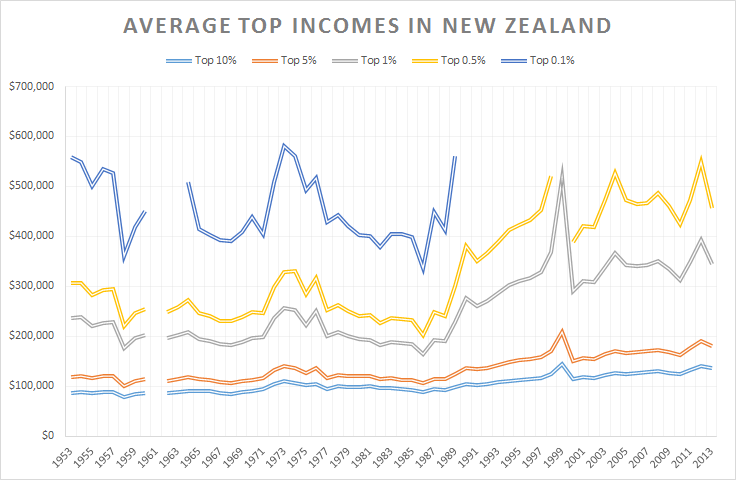
Source: The World Wealth and Income Database.
04 Jul 2016 Leave a comment
in defence economics, labour economics, occupational choice
ISIS foreign fighters are not driven by economic deprivation or inequality. In What Explains the Flow of Foreign Fighters to ISIS? (NBER Working Paper No. 22190),Efraim Benmelech
and Esteban F. Klor found that many foreign fighters come from countries with high levels of economic development, low income inequality, and highly developed political institutions.
Foreign ISIS recruits come largely from prosperous, ethnically and linguistically homogeneous countries. As Alan Krueger explains in a discussion of terrorism is an occupational choice:
One of the conclusions from the work of Laurence Iannaccone—whose paper, “The Market for Martyrs,” is supported by my own research—is that it is very difficult to effect change on the supply side.
People who are willing to sacrifice themselves for a cause have diverse motivations. Some are motivated by nationalism, some by religious fanaticism, some by historical grievances, and so on. If we address one motivation and thus reduce one source on the supply side, there remain other motivations that will incite other people to terror.
Malcontents join the jihadists today for the same reasons they joined the Red Brigade, the Japanese Red Army Faction and Baader-Meinhof gang in the 1970s and 1980s. Plenty of young people were attracted to communism in previous generations as a way of sticking it to the man.
Now as then economic conditions were good as were political freedoms. Italy, Japan and Germany were all at the peak of recoveries from war. Japanese incomes are doubled in the previous decade. Germany and Italy were rich countries. As Alan Krueger explains:
Despite these pronouncements, however, the available evidence is nearly unanimous in rejecting either material deprivation or inadequate education as important causes of support for terrorism or participation in terrorist activities. Such explanations have been embraced almost entirely on faith, not scientific evidence.
Each generation has its defining oppositional identity. Radical Islam is the oppositional identity of choice for today’s angry young men and women. Mind you, they have to buy Islam for dummies to understand what they’re signing up for.
In previous generations, it was communism, weird Christian sects, eco-terrorism, animal liberationist terrorism and a variety of domestic terrorists of the left and right with conspiratorial motivations. Look at the level of diversity of the angry young men and women on the domestic terrorists list of the FBI.
One jihadists when interviewed said that 30 years ago he would probably have become a Communist as his vehicle for venting his frustrations.
03 Jul 2016 Leave a comment
in applied welfare economics, politics - New Zealand, poverty and inequality, Public Choice, public economics
Rashbrooke in the snap-shot quote describes the massive new taxes to fund a universal basic income as a policy shift for which middle New Zealand must be prepared properly over many years. But the purpose of these great big new taxes is to ensure that those with whom the modern welfare state was designed to protect our left no worse off, not better off, just as good as they were under the previous regime of social insurance. Why take that journey when you can target their poverty directly to the current welfare state?
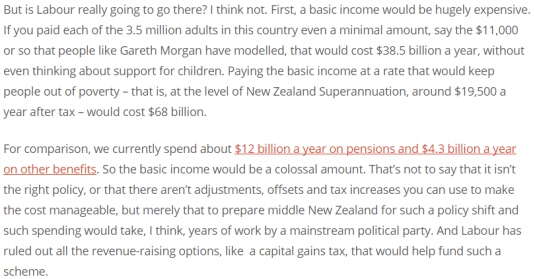
Source: Is Labour really going to deliver a UBI? – Inequality: A New Zealand Conversation.
03 Jul 2016 Leave a comment
in discrimination, economics of education, gender, human capital, labour economics, labour supply, occupational choice, politics - USA Tags: employer discrimination, ethnic wage gap, gender wage gap, racial discrimination, racial wage gap
Celebrating humanity's flourishing through the spread of capitalism and the rule of law
Celebrating humanity's flourishing through the spread of capitalism and the rule of law
Celebrating humanity's flourishing through the spread of capitalism and the rule of law
Celebrating humanity's flourishing through the spread of capitalism and the rule of law
Celebrating humanity's flourishing through the spread of capitalism and the rule of law
A History of the Alt-Right
Econ Prof at George Mason University, Economic Historian, Québécois
Celebrating humanity's flourishing through the spread of capitalism and the rule of law
Scholarly commentary on law, economics, and more
Beatrice Cherrier's blog
Celebrating humanity's flourishing through the spread of capitalism and the rule of law
Celebrating humanity's flourishing through the spread of capitalism and the rule of law
Celebrating humanity's flourishing through the spread of capitalism and the rule of law
Why Evolution is True is a blog written by Jerry Coyne, centered on evolution and biology but also dealing with diverse topics like politics, culture, and cats.
Celebrating humanity's flourishing through the spread of capitalism and the rule of law
A rural perspective with a blue tint by Ele Ludemann
DPF's Kiwiblog - Fomenting Happy Mischief since 2003
Celebrating humanity's flourishing through the spread of capitalism and the rule of law
The world's most viewed site on global warming and climate change
Tim Harding's writings on rationality, informal logic and skepticism
A window into Doc Freiberger's library
Let's examine hard decisions!
Commentary on monetary policy in the spirit of R. G. Hawtrey
Thoughts on public policy and the media
Celebrating humanity's flourishing through the spread of capitalism and the rule of law
Politics and the economy
A blog (primarily) on Canadian and Commonwealth political history and institutions
Reading between the lines, and underneath the hype.
Economics, and such stuff as dreams are made on
"The British constitution has always been puzzling, and always will be." --Queen Elizabeth II
Celebrating humanity's flourishing through the spread of capitalism and the rule of law
Celebrating humanity's flourishing through the spread of capitalism and the rule of law
WORLD WAR II, MUSIC, HISTORY, HOLOCAUST
Undisciplined scholar, recovering academic
Celebrating humanity's flourishing through the spread of capitalism and the rule of law
Res ipsa loquitur - The thing itself speaks
In Hume’s spirit, I will attempt to serve as an ambassador from my world of economics, and help in “finding topics of conversation fit for the entertainment of rational creatures.”
Researching the House of Commons, 1832-1868
Articles and research from the History of Parliament Trust
Reflections on books and art
Posts on the History of Law, Crime, and Justice
Celebrating humanity's flourishing through the spread of capitalism and the rule of law
Exploring the Monarchs of Europe
Cutting edge science you can dice with
Small Steps Toward A Much Better World
“We do not believe any group of men adequate enough or wise enough to operate without scrutiny or without criticism. We know that the only way to avoid error is to detect it, that the only way to detect it is to be free to inquire. We know that in secrecy error undetected will flourish and subvert”. - J Robert Oppenheimer.


Recent Comments