A lion riding in the sidecar of a go-kart at a wall of death, Massachusetts, c. 1929. http://t.co/Dlo7XcdhNC—
ClassicPics (@History_Pics) April 27, 2015
The Lion must be drugged
27 Apr 2015 Leave a comment
in cats, health and safety, labour economics, occupational choice Tags: daredevils
A lot of people test positive to something
27 Apr 2015 Leave a comment
in economics of crime, health and safety, labour economics, law and economics Tags: workplace drug testing
The marriage squeeze in India and China
27 Apr 2015 Leave a comment
The marriage squeeze in India and China is taking a third of humanity into uncharted territory econ.st/1IN2wyw http://t.co/GbjVDDqJ5h—
The Economist (@EconBizFin) April 26, 2015
Why is the rapid closing of the gender wage gap in New Zealand not celebrated more?
27 Apr 2015 1 Comment
in discrimination, gender, human capital, labour economics, labour supply, occupational choice, politics - New Zealand Tags: activists, do gooders, gender wage gap, Left-wing hypocrisy, Leftover Left
With the rapid closure in the raw female male wage gap in New Zealand over the last 15 or so years, the lack of celebration of this achievement among equal pay activists is puzzling.
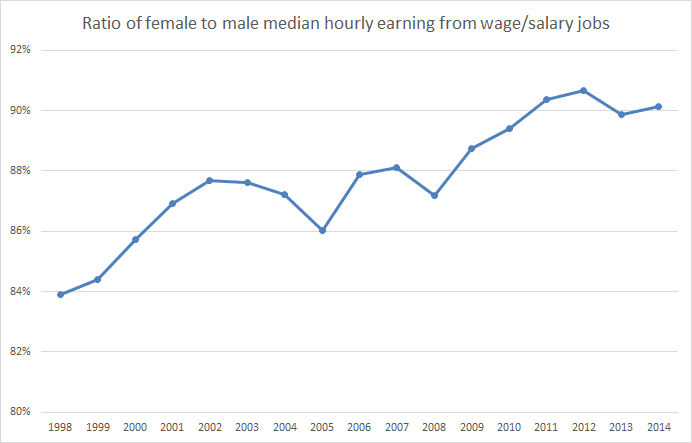
Source: Statistics New Zealand, New Zealand Social indicators, Median hourly earnings.
Gender differences in celebrity charity causes
27 Apr 2015 Leave a comment
in economics of media and culture, gender Tags: Celebrities, charities, expressive politics, expressive voting
Gender differences in celebrity charity causes, visualized f-st.co/V1NMVE6 http://t.co/czkuRlWzKF—
Co.Design (@FastCoDesign) January 20, 2015
Japanese population has peaked and is now in rapid decline to 2050
27 Apr 2015 Leave a comment
in labour economics, labour supply, population economics Tags: ageing society, economics of fertility, Japan, labour demographics
Japan's projected population through 2050. #dataviz
Source: washingtonpost.com/blogs/worldvie… http://t.co/79DKF0mQTs—
Randy Olson (@randal_olson) January 06, 2015
Fact checking Gwyneth Paltrow on $29 of food stamps for a week
26 Apr 2015 Leave a comment
in labour economics, politics - USA, welfare reform Tags: food stamps, Gwyneth Paltrow, Left-wing hypocrisy, welfare state
Tony Atkinson’s ‘Inequality – What Can Be Done?’
24 Apr 2015 Leave a comment
in applied welfare economics, labour economics, minimum wage, Public Choice, Rawls and Nozick, welfare reform Tags: guaranteed minimum income, Leftover Left
I find proposal number 3 to target reducing unemployment rather perplexing because Atkinson in proposal number 5 wants to increase the minimum wage to the living wage, which will increase unemployment. He proposes a guaranteed child income, but he doesn’t appear to make proposals for a guaranteed family minimum income. A guaranteed family minimum income or an increase in the earned income tax credit, to use the American terminology, would increase the incomes of the low paid without threatening their job through a minimum wage increase.
Out Today: Tony Atkinson's new book 'Inequality – What Can Be Done?'
Here are his 14 proposals to reduce inequality: http://t.co/RPXmEBBFCR—
Max Roser (@MaxCRoser) April 23, 2015
Unions have been on the way out just about everywhere since 1980
24 Apr 2015 Leave a comment
in labour economics, unions Tags: union power, union wage premium, Withering away of the proletariat
*53* years of trade #union trends: compare your country among OECD/G7 bit.ly/1rS3hOS (scroll down for Excel) http://t.co/9NHj1YV7sL—
(@OECD) April 06, 2015
The changing American family
24 Apr 2015 3 Comments
in economics of love and marriage, gender, labour economics, labour supply, poverty and inequality, welfare reform Tags: family demographics, single parents


via Was Moynihan Right? What happens to the children of unmarried mothers : Education Next
The role of new taxes in the Great Recession
24 Apr 2015 Leave a comment
in economic growth, fiscal policy, great recession, labour economics, labour supply, macroeconomics, politics - USA Tags: great recession, obama, Obamacare, taxation and entrepreneurship, taxation and investment, taxation and labour supply


.
The war on poverty at age 50: What US social programs worked and which failed? – Chris Blattman
23 Apr 2015 Leave a comment
in economic history, labour economics, labour supply, poverty and inequality, welfare reform
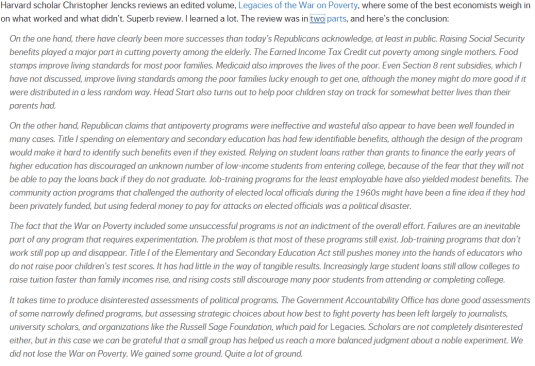
Via The war on poverty at age 50: What US social programs worked and which failed? – Chris Blattman.
The economic and educational psychology case against making Te reo Māori compulsory in NZ schools
23 Apr 2015 1 Comment
in discrimination, economics of education, human capital, labour economics, politics - USA, poverty and inequality Tags: do gooders, economics of languages, Maori economic development, network economics, Te reo Māori
The Race Relations Commissioner Dame Susan Davoy has called for Te Reo Māori to be compulsory in New Zealand schools. She said being bilingual would be “a real added advantage” to young Kiwis and more people knowing Te reo Māori would help race relations.
Learning another language is not a priority for the Pākehā children or Māori mokupuna when you consider the poor literacy rates among Māori, Pasifika and Pākehā. The priority for children in an English speaking country is to master English. Too many children leave school with inadequate reading and writing skills.
Figure 1: Prose literacy by ethnicity, 2011
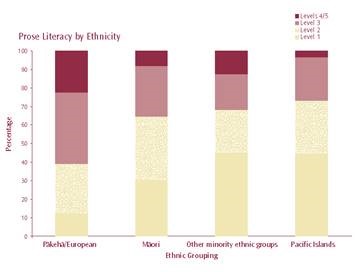
Source: Literacy skills of young adult New Zealanders | Education Counts.
Lower levels of literacy and numerously are much higher among Māori and Pasifika children. Pākehā consistently having a larger proportion in the higher levels of prose literacy.
Figure 2: Prose literacy rates by ethnicity, 1996 and 2006
Source: Indicator 9: Literacy rates — Office of the Auditor-General New Zealand.
60%of Pākehā are above the minimum level of competence to meet the prose literacy requirements of a knowledge society. This contrasts with the majority of Māori and Pasifika who are below the minimum level of competence.
Furthermore, requiring children who do not have an aptitude for language or school in general to learn a language will reinforce in those who are not doing well that they are not very smart. This will give them more reasons to hate school and leave as soon as possible and never go back.
The key to helping children who do not have an aptitude to succeed greatly at school is to find the subjects where they do do well so they can get a good start to life. If students are not good at academic subjects, requiring them to do more academic studies such as study language is fool-hardy.
Taking resources, and more importantly, students learning time away from basic literacy skills will do little for a Māori economic development and race relations. This is because this taking resources and student learning time away from literacy and basic education will slow the closing of income gaps between Māori and others.
Language is a network good. It pays to join the largest network so you can communicate and do business with more people. The wage premium for immigrants learning English in English-speaking’s countries is about 15%.

Learning Te reo Māori will not help children in their other subjects. The psychology of the transfer of learning was founded 100 years ago to explore the hypothesis that learning Latin gave the student muscle to learn other subjects, both other languages and generally learn faster.
Educational psychologists found that Latin does not help much in studying other languages and other subjects. No significant differences were found in deductive and inductive reasoning or text comprehension among students with 4 years of Latin, 2 years of Latin or no Latin at all.
Median income by race in America
23 Apr 2015 Leave a comment
in discrimination, income redistribution, labour economics, poverty and inequality Tags: racial discrimination, wage gaps

The reversed college gender gap
23 Apr 2015 Leave a comment
in discrimination, economics of education, gender, human capital, labour economics, labour supply, occupational choice Tags: gender wage gap reversed gender gap
CHART: The Huge College Degree Gender Gap: Since 1982, Women Have Earned ~10M MORE US College Degrees Than Men! http://t.co/83JhRfwCLE—
Mark J. Perry (@Mark_J_Perry) March 11, 2015


Recent Comments