International Women's Day: Part-time work boosts female employment rate #Eurostat #IWD2015 http://t.co/R8Wjt1DIYw pic.twitter.com/lCcOZWgwOX
— EU_Eurostat (@EU_Eurostat) March 5, 2015
There are surprisingly large differences in female part-time employment rates
11 Mar 2015 Leave a comment
Gender Gap in Education Cuts Both Ways
11 Mar 2015 Leave a comment
in discrimination, economics of education, gender


Unemployment by education
11 Mar 2015 Leave a comment
in business cycles, great recession, human capital, job search and matching, labour economics, labour supply, occupational choice, politics - USA, unemployment Tags: labour demographics
Are Moms Less Likely Than Dads To Pay Child Support? | FiveThirtyEight
10 Mar 2015 Leave a comment
in economics of love and marriage, law and economics, poverty and inequality

In 2011, 32 percent of custodial fathers didn’t receive any of the child support that had been awarded to them, compared with 25.1 percent of custodial mothers. That’s a relatively small difference. And when you look at the other extreme (i.e., the percentage of parents who receive the full amount), the difference isn’t statistically significant at all: 43.6 percent of custodial mothers compared with 41.4 percent of fathers.
Then there’s the gray area in between paying nothing and paying everything. The most common amount of child support due to custodial mothers is $4,800 annually, of which $2,500 is typically received (52 percent). For custodial fathers, median annual child support is less — it’s $4,160 — and fathers receive 40 percent of the amount they’re due.
via Are Moms Less Likely Than Dads To Pay Child Support? | FiveThirtyEight.
Australian top 1% has dropped the ball in the class struggle
10 Mar 2015 Leave a comment
in applied welfare economics, economic growth, economic history, labour economics, liberalism, poverty and inequality, Rawls and Nozick Tags: class struggle, immiseration of the proletariat, Leftover Left, top 1%
How is the immiseration of the proletariat going to occur any time soon, and with it, the workers will rise up because they have nothing to lose but their chains, if the Australian top 1% doesn’t lift its game.
There is a serious lack of greed and expropriation of labour surplus by the top 1% in Australia. Their share of income has been falling for many decades and only increased in the last few years and then only slightly.
The top 1% is supposed to be grinding the working class down, and causing crisis after financial crisis but there’s hardly any of evidence of that in Australian income inequality data.
Child poverty in America using the Supplementary Poverty Measure of the Census Bureau
09 Mar 2015 Leave a comment
in politics - USA, population economics, poverty and inequality, welfare reform Tags: child poverty, measurement of poverty

Measuring child poverty after tax and income transfers from the welfare state make a big difference to the measurement of poverty in the USA.


via What If We Had Measured Poverty Differently for the Past 50 Years? – CityLab.
The new gender gap in education
09 Mar 2015 Leave a comment
in discrimination, economic history, gender, labour economics, labour supply, politics - USA

Source: whitehouse.gov
Why do the poor in America live in bigger houses than the European middle class?
08 Mar 2015 Leave a comment
in politics - USA, poverty and inequality Tags: Euroland, living standards, The Great Enrichment


The key driver of inequality is…
08 Mar 2015 Leave a comment
in economics of education, human capital, labour economics, poverty and inequality Tags: education premium


The explosion in women’s professional education just after the pill became widely available
07 Mar 2015 Leave a comment
in discrimination, economic history, economics of education, gender, labour economics, labour supply, occupational choice, politics - USA Tags: economics of fertility, engines of liberation, female labour supply, gender wage gap, reversing gender gap, The Pill

Source: whitehouse.gov
Who is on zero hours contracts in the UK?
06 Mar 2015 Leave a comment
in job search and matching, labour economics, labour supply, politics - New Zealand Tags: zero hours contracts
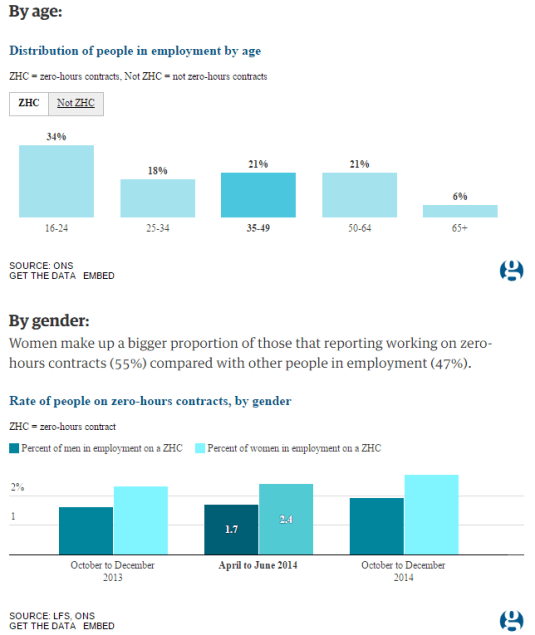
Firstly, those on zero hours contracts are overwhelmingly younger people and more often women. Both groups value flexible working hours more than others. That’s why they make up the majority of workers on zero hours contracts.
Also not surprisingly, people on zero hours contracts also tend to be more often in full-time education. Another group that values flexibility in hours. Furthermore, many of those on zero hours contracts have only been in the current job for less than 12 months. Again, suggesting they come from groups that change jobs frequently, which means they can easily quit and find another job if they don’t like a zero-hours contract.
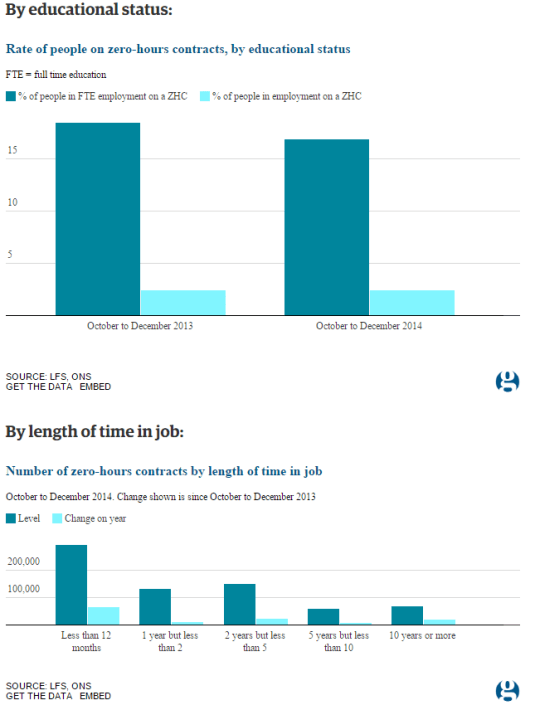
Via Zero-hours contracts in four charts | News | The Guardian


Recent Comments