
College graduates have a much higher opinion of themselves than do the recruiting employers
18 Feb 2015 Leave a comment
in economics of education, human capital, job search and matching, labour economics, labour supply, personnel economics Tags: job market signaling, recruitment standards
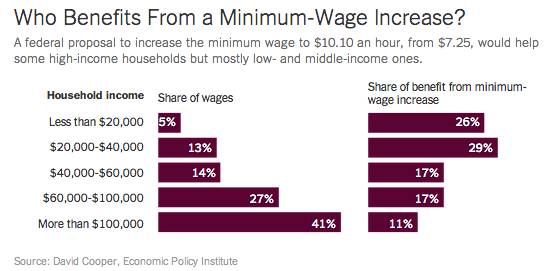
Who benefits from a minimum wage increase in the USA
17 Feb 2015 Leave a comment
in applied welfare economics, labour economics, minimum wage, politics - New Zealand, politics - USA Tags: poverty and inequality
HT David_Boaz’s Tweet – https://twitter.com/David_Boaz/status/477910953548197888?s=09
Economics as Incredulity : Working conditions during the Industrial Revolution
16 Feb 2015 Leave a comment

Was Moynihan Right?
16 Feb 2015 Leave a comment


Roland Fryer: Racial Inequality in the 21st Century – The Declining Significance of Discrimination
15 Feb 2015 Leave a comment
in discrimination, human capital, labour economics, poverty and inequality Tags: poverty and inequality, racial discrimination, Roland Fryer
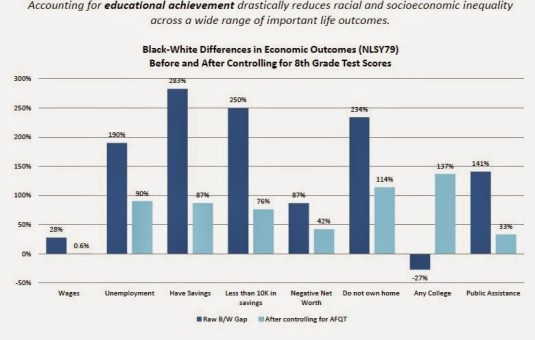
Roland Fryer carried a gun at 14 as a member of the gang; worked extra jobs at college to pay off his father’s bail bondsman; and an assistant professor at Harvard at the age of 27. He is the sharpest economist around working on the economics of inequality and discrimination.
Sam Peltzman on Teacher’s Unions
15 Feb 2015 Leave a comment
in economics of education, politics - New Zealand, politics - USA, unions Tags: School choice, teachers unions, union power, union wage premium
Ideology and child-rearing
15 Feb 2015 Leave a comment
in human capital Tags: child rearing, economics of personality traits, partisanship
The Affordable Care Act and the Labor Market
15 Feb 2015 Leave a comment
in fiscal policy, great recession, labour economics, labour supply, macroeconomics Tags: Casey Mulligan, Obamacare, taxation and the labour supply
The Law of Crappy Managers
14 Feb 2015 Leave a comment
in economics of bureaucracy, industrial organisation, managerial economics, occupational choice, organisational economics, personnel economics, survivor principle Tags: Peter Principle

An alternative to the no fault Accident Compensation Scheme in New Zealand
13 Feb 2015 Leave a comment
in health and safety, labour economics, law and economics, politics - Australia, politics - New Zealand, property rights Tags: ACC, accident compensation, right to sue, workers' compenstaion, workplace fatalities
New Zealand has a unique government monopoly since 1974 which provides compensation for personal injuries from accidents wherever they may occur in New Zealand.
The right to sue in court under tort law was abolished. Instead, there is a lower but more certain right to be compensated for loss of income and medical expenses and various other losses. The scheme is funded by a levy of about 1.4% on incomes earned, insurance premiums paid by employers and levies on motor car registrations.
The scheme essentially folds no fault workers compensation and no fault car accident insurance into a scheme that covers you for all other accidents.
What is peculiar is the abolition of the right to sue in court for ordinary damages. I never liked this taking away of the right of vindication in court.

In Australia, they have a much simpler system in some states. You can sue for personal injury under the common-law, but any damages you might win for loss of income, medical expenses and other losses is deducted dollar for dollar from any of damages you might be awarded under the compulsory insurance scheme for either workplace or car accidents. This system allows everyone to be compensated to some degree and protected against judgement proof employers, car owners and other wrongdoers. It also saves on legal costs.
The Australian dual system both gives people the right of vindication and allows those who are poorly compensated by the government monopoly to continue to be compensated for losses. For example, the compensation for lost income under the government monopoly is based on your last 12 months income rather than prospective income. This seriously disadvantages young people and students in particular at the start of their working lives and mothers who are out of the workforce.
Another thing I like about the Australian system and deeply dislike about the New Zealand system is you do not have the right to sue cowboy employers to bankrupt them.
The system of funding in New Zealand is simply a flat rate premium applies the different occupations. Premiums do not increase for high risk employers or employers who repeatedly have accidents because they are careless or negligent. This increases the number of accidents and deaths. The penalties for workplace accidents and deaths under New Zealand workplace safety regulation are rather weak. Reckless employers are fined, no one is bankrupted nor goes to prison.
The government monopoly insurer of personal accidents in New Zealand also doesn’t pay for pain and suffering. Initially it did, but that right of compensation was taken away as a cost-cutting measure about 20 years ago. Prior to that pain and suffering compensation was initially limited to $10,000, then increased to $17,000 before it was abolished.
This lack of a legal remedy for the pain and suffering from a personal injury is a grave injustice. The courts were pretty stingy on pain and suffering, so the government monopoly has taking away what was a pretty limited right anyway, but a very important right nonetheless. That common-law right was to be made whole again after being injured wrongfully.
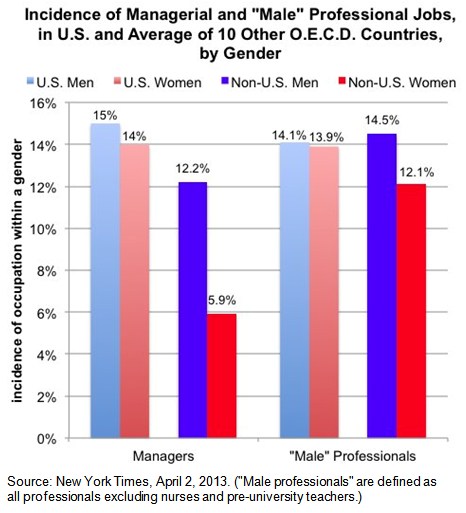
Lessons from a Feminist Paradise
12 Feb 2015 Leave a comment
in discrimination, economics of love and marriage, gender, labour economics, population economics Tags: gender wage gap

Is the middle-class disappearing?
12 Feb 2015 Leave a comment
in economic growth, human capital, income redistribution, politics - USA, poverty and inequality Tags: middle class stagnation
The Stigler diet is still as cheap as can be
12 Feb 2015 Leave a comment
in George Stigler, labour economics, poverty and inequality Tags: cost of subsistence, poverty and inequality, school breakfast programmes, School lunches
The always excellent Matthew Kahn reminded me today of the Stigler diet: George Stigler’s famous 1945 journal article The Cost of Subsistence in the Journal of Farm Economics. Stigler posed this problem:
For a moderately active man (economist) weighing 154 pounds, how much of each of 77 foods should be eaten on a daily basis so that the man’s intake of nine nutrients (including calories) will be at least equal to the recommended dietary allowances suggested by the National Research Council in 1943, with the cost of the diet being minimal.
Stigler managed to find a nearly optimal daily diet of:
- 1.6 pounds of wheat flour,
- 0.3 pounds of cabbage,
- 0.6 ounces of spinach,
- 0.4 pounds of pancake flour,
- 1.1 ounces of pork liver.
All of this food necessary to sustain health and weight of a moderately active man amounted to $0.16 per day in 1944, which is an annual cost of $39.93, not including leap years. A recent update for inflation put the annual cost of the Stigler diet at $561.43 in 2005. Not more than two dollars a day .

Stigler later concluded that the main issue about food consumption is a preference for a variety rather than a nutritional diet which could be obtained very low cost if you like cabbage, spinach, flour and a little bit of pork liver. For many years, pork liver was not available in my local supermarkets in Australia and New Zealand until recently when Asian buyers started to buy again.

When various claims made about child poverty and children going without food, and adults too, the purpose of the Stigler diet in the calculations of the cost of subsistence is to show that it is actually extremely cheap to get the necessities of life in a capitalist society. Something more than either a lack of income in a modern welfare state or far from high prices of this extremely cheap, but spartan diet must be playing a role.


Recent Comments