What does the media and Left give top athletes a pass on their membership of the top 0.1%?
28 Jan 2015 Leave a comment
in human capital, income redistribution, labour economics, labour supply Tags: Left-wing hypocrisy, Leftover Left, media bias, superstars, top 1%
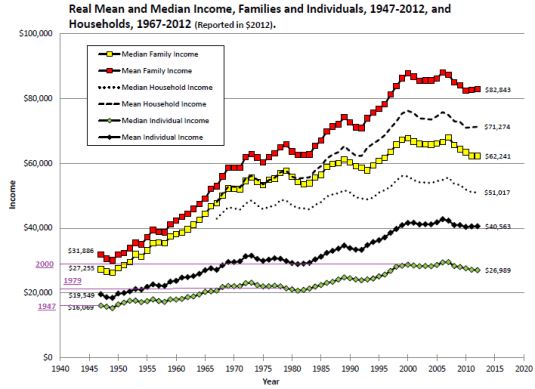
Postwar vs. New Gilded Age: How did the middle class do?
28 Jan 2015 Leave a comment
in applied welfare economics, economic growth, income redistribution, politics - USA, poverty and inequality Tags: middle class stagnation
The iron law of volunteering: the nicer the cause, the nastier the people
28 Jan 2015 Leave a comment
in economics of media and culture, liberalism, occupational choice Tags: activists, do gooders, expressive voting, Greens

Greece should default and abandon the euro – Jeff Miron
27 Jan 2015 Leave a comment
in budget deficits, currency unions, development economics, economic growth, economic history, Euro crisis, fiscal policy, global financial crisis (GFC), growth disasters, law and economics, macroeconomics, poverty and inequality Tags: currency unions, Euroland, Greece, optimal currency area, sovereign default

Creative Routines — Information is Beautiful Awards
27 Jan 2015 Leave a comment
in economics of education, entrepreneurship, human capital, labour economics Tags: creativity, economics of personality traits, entrepreneurial alertness

Definition of an Activist | Coyote Blog
27 Jan 2015 Leave a comment
in occupational choice, Public Choice Tags: activists, do gooders, fascism of good intentions

Activist: A person who believes so strongly that a problem needs to be remedied that she dedicates substantial time to … getting other people to fix the problem. It used to be that activists sought voluntary help for their pet problem, and thus retained some semblance of honor.
However, our self-styled elite became frustrated at some point in the past that despite their Ivy League masters degrees in sociology, other people did not seem to respect their ideas nor were they particularly interested in the activist’s pet issues.
So activists sought out the double shortcut of spending their time not solving the problem themselves, and not convincing other people to help, but convincing the government it should compel others to fix the supposed problem.
This fascism of good intentions usually consists of government taking money from the populace to throw at the activist’s issue, but can also take the form of government-compelled labor and/or government limitations on choice.
The Bechdel Test: whether women are in a movie as fully human characters, or as plot devices for the male characters
27 Jan 2015 Leave a comment
in discrimination, economics of media and culture, gender, industrial organisation, movies, occupational choice, survivor principle Tags: co-worker discrimination, consumer sovereignty, customer discrimination, employer discrimination, Hollywood economics, sex discrimination, The meaning of competition
/cdn0.vox-cdn.com/uploads/chorus_asset/file/3332436/hickey-bechdel-11.0.png)
Hollywood is a slave to the box office on the most cutthroat industry there is. Film producers and screenwriters will portray men and women in whatever roles and whatever extent sells tickets.
How women are represented in the movies is determined solely by the preferences of the audiences willing to buy tickets. It’s a buyers market out there. Film producers would do whatever it takes to finance films that sell tickets, as even Five Thirty-Eight realised:
“Movies that are female-driven do not travel,” said Krista Smith, West Coast editor of Vanity Fair, describing the broader sentiment in Hollywood. There are almost no women who have sales value in multiple international territories, maybe with the exception of Sandra Bullock, she said.
Times change, and film producers change with the times. Consumers are both sovereign and change their minds, and in the case of movie audiences, constantly demand novelty and surprises, as even Five Thirty-Eight picked up on:
Hollywood is the business of making money. Since our data demonstrates that films containing meaningful interactions between women do better at the box office than movies that don’t, it may be only a matter of time before the data of dollars and cents overcomes the rumours and prejudices defining the budgeting process of films for, by and about women.
This moral panic over gender wage gaps between millionaire actresses and actresses dare not say that for want of offending the audience that is actually the main driver of any gender gap in movies.

Hollywood activists complaining about the gender wage are to business minded to dare insult the audiences that pay their wages.
Everybody Hates Chris, “Everybody Hates Food Stamps” (2005)
27 Jan 2015 Leave a comment
in labour economics, TV shows, welfare reform Tags: Everybody Hates Chris, food stamps, welfare reform
Afghan Women in 1950 vs. 2013
26 Jan 2015 Leave a comment
Disability insurance recipients are disproportionately older and less educated
25 Jan 2015 Leave a comment
in labour economics, labour supply, occupational choice, welfare reform Tags: David Autor, disability insurance, social insurance, welfare reform
/cdn0.vox-cdn.com/uploads/chorus_asset/file/3329592/DI_Chartbook_Section_Three-04.0.png)
David Autor found that the effective replacement rate of Social Security disability insurance payments for labour earnings with SSDI benefits has also risen in recent decades due both to the rising value of in-kind Medicare benefits and to a subtle interaction between the benefits formula and rising income inequality in the U.S.
This interaction causes the effective generosity for low-wage workers to rise and encourages older workers with limited education to go on the disability benefit because its income replacement rate for what they can earn in the workforce can be as high as 80% when Medicare is included. As Autor and Duggan explain:
The rapid expansion of the beneficiary population has three main causes.
First, a set of congressional reforms in 1984 to Disability Insurance screening led to rapid growth in the share of recipients suffering from back pain and mental illness. Because these disorders have comparatively low mortality, the average duration of disability spells—and hence the size of the recipient population—has increased.
Second, a rise in the after-tax DI income replacement rate—that is, the ratio of disability income to former labour earnings—strengthened the incentives for workers to seek benefits.
Third, a rapid increase in female labour force participation expanded the pool of insured workers. The aging of the baby boom generation has contributed little to the rise of receipt of disability benefits, while improvements in population health have likely reduced the incidence of disabling medical disorders.
Overcoming Bias : Exposing Scientist Liberality
24 Jan 2015 Leave a comment
in economics of media and culture, environmental economics, global warming, occupational choice, personnel economics Tags: academic bias, activists, climate alarmism, expressive 13, rational ignorance, rational irrationality

If the public knew the truth, I expect two effects:
- The public would consider scientists to be less authoritative as a neutral source on policy questions, and
- Since scientists are respected, the public would become less conservative and more liberal.
Gordon Tullock on avoiding difficult decisions about saving lives – updated
24 Jan 2015 Leave a comment
in constitutional political economy, economics of bureaucracy, economics of regulation, Gordon Tullock, health and safety, health economics, income redistribution, James Buchanan, labour economics, Rawls and Nozick Tags: expressive voting, health and safety, James Buchanan, rational ignorance, rational irrationality, statistical life, veil of ignorance, veil of insignificance, veil of uncertainty

Gordon Tullock wrote a 1979 New York Law Review book about avoiding difficult choices. His review was of a book by Guido Calabresi and Philip Bobbitt called Tragic Choices which was about the rationing: the allocation of kidney dialysis machines (a “good”), military service in wartime (a “bad”), and entitlements to have children (a mixed blessing).
Tullock argued that we make a decision about how to allocate resources, how to distribute the resources, and then how to think about the previous two choices. People do not want to face up to the fact resources are scarce and they face limits on their powers.
To reduce the personal distress of making these tragic choices, Tullock observed that people often allocate and distribute resources in a different way so as to better conceal from themselves the unhappy choices they had to make even if this means the recipients of these choices are worse off and more lives are lost than if more open and honest choices were made up about there only being so much that can be done.
The Left over Left and union movement spends a lot of time pontificating about how we must not let economics influence health and safety policy rather than help frame public policy guidance on what must be done because scarcity of resources requires the valuation of life in everything from health, safety, and environmental regulations to road building. health budgeting is full of tragic choices about how much is spend to save so lives and where and for how long.
The Left over Left and the union movement deceive themselves and others into make futile gestures to make themselves feel good. These dilettantes cannot assume that they are safely behind a veil of insignificance. They have real influence on how public policy on health and safety are made.
A major driver of the opposition among the Left over Left and the union movement to the use of cost-benefit analysis and the valuation of statistical lives is its adoption makes people confront the tragic consequence of any of the choices available to them.
By saying how dare you value a statistical life does not change the fact that choices made without this knowledge will still have tragic consequences, and more lives may be lost because people want to conceal from themselves the difficult choices that they are making about others as voters and as policy-makers.
One of the purposes of John Rawls’ veil of ignorance and Buchanan and Tullock’s veil of uncertainty is that the basic social institutions be designed and agreed when we have abstracted from the grubby particulars of our own self-interest. Buchanan and Tullock explain the thought experiment this way
Agreement seems more likely on general rules for collective choice than on the later choices to be made within the confines of certain agreed-upon rules. …
Essential to the analysis is the presumption that the individual is uncertain as to what his own precise role will be in any one of the whole chain of later collective choices that will actually have to be made.
For this reason he is considered not to have a particular and distinguishable interest separate and apart from his fellows.
This is not to suggest that he will act contrary to own interest; but the individual will not find it advantageous to vote for rules that may promote sectional, class, or group interests because, by supposition, he is unable to predict the role that he will be playing in the actual collective decision-making process at any particular time in the future.
He cannot predict with any degree of certainty whether he is more likely to be in a winning or a losing coalition on any specific issue. Therefore, he will assume that occasionally he will be in one group and occasionally in the other.
His own self-interest will lead him to choose rules that will maximize the utility of an individual in a series of collective decisions with his own preferences on the separate issues being more or less randomly distributed.
Behind the veil of ignorance and the veil of uncertainty, we would all agree that resources are limited, including in the health sector and some drugs can’t be funded – choices must be made.
Once we go in front of the veil of ignorance and find out that we are the one missing out on that drug, naturally, our views will change. We agreed to these rules as fair for the distribution of basic social resources when, as John Rawls put it:
…no one knows his place in society, his class position or social status; nor does he know his fortune in the distribution of natural assets and abilities, his intelligence and strength, and the like.
Is always the case that someone just falls on the other side of any line in the sand. If you move that line, there is always another set of people who are just on the other side.


Recent Comments