You will be astonished, gentle reader, to learn that the question of whether worker pay has kept up with productivity growth turns out to depend on 1) how you measure worker pay; and 2) how you measure productivity growth. Scott Winship considers the alternatives and issues in “Understanding Trends in Worker Pay over the Past…
Article is by Chris Lynch and I have pinched this one from The BFD Blog. `ĀCT MP Karen Chhour has responded to the Maori Party’s “divisive outbursts.” Co-leader Rawiri Waititi said yesterday, ‘It’s now time for us to step comfortably into our rangatiratanga and to not give too much to this Pakeha Government with their […]
In this article we revive, extend and improve the approach used in a series of influential papers written in the 2000s to estimate how changes in the supply of immigrant workers affected natives’ wages in the US. We begin by extending the analysis to include the more recent years 2000-2022. Additionally, we introduce three important […]
And it looks like it’s well on the way to being so, given these interesting stats out of the USA. I’d love to know how New Zealand compares in many of these categories One more generation should see large numbers of these well-educated female graduates rising to high levels of private and public sector power. […]
A little more than half of America’s incorporated cities collectively lost 2.7 million residents between 2020 and 2023, according to estimates released by the Census Bureau earlier this week. New York City alone lost almost 500,000 residents, or 5.5 percent of its population, while the next 20 biggest losers together … Continue reading →
Previously, we could observe a higher proportion of men than women in, say, steel fabrication and suspect that men have “some sort” of physical or mental comparative advantage related to steel fabrication. But what does that mean?
If a Blogger accused immigrants of nicking houses & jobs off young native NZ’ers, causing them to leave the country, then we’d likely be prosecuted under anti-freedom of speech legislation. But seems our State-owned broadcaster, OneNews, can get away with it. After all, like the Reserve Bank, TVNZ can do what it wants. Its above…
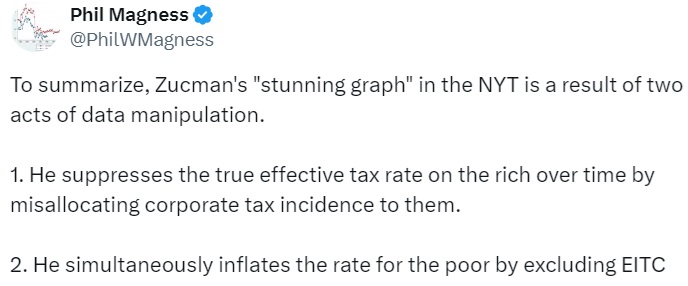
Like Thomas Piketty, Gabriel Zucman is a French economist who promotes economically destructive class-warfare tax policy. He’s also infamous for dodgy data manipulation, as Phil Magness explains in this Reason discussion. The interview lasts for 64 minutes, and I recommend the entire discussion. Yes, that’s a lot of time, but Phil has encyclopedic knowledge and […]
The New York Times (paywalled, but also available here) reported last month:At Sansan Chicken in Long Island City, Queens, the cashier beamed a wide smile and recommended the fried chicken sandwich.Or maybe she suggested the tonkatsu — it was hard to tell, because the internet connection from her home in the Philippines was spotty.Romy, who…
It is being reported (e.g., Politico, FT) that a coalition government is soon to be announced for the Netherlands, which a general election in late November. The government would consist of the following parties, with their seats noted: The far-right Freedom Party (PVV, 37), led by Geert Wilders, the center-right VVD (24), the Christian democratic/anti-establishment […]
Late last week The Treasury released a new 40 page report on “The productivity slowdown: implications for the Treasury’s forecasts and projections” (productivity forecasts and projections that is, rather than any possible fiscal implications – the latter will, I guess, be articulated in the Budget documents). In short, if (as it has) productivity growth has slowed down […]
Everything you need to know about wealth taxation can be summarized in two sentences. The biggest problem with most tax systems is the pervasive tax bias against income that is saved and invested, which discourages the accumulation of capital that helps to finance future growth. Wealth taxes would dramatically increase the tax bias against saving […]
Read the whole tweet. A Member of Parliament got up in the House and said the Government (which has a Cabinet which is 35% Māori) wants to exterminate Māori. Has the media reported this, with the editorials decrying such nonsensical and abusive language? Imagine if an ACT MP said in the House that a Labour-led […]
Deiana, Maheshr,and Mastrobuoniand have recently published an analysis of the effects of Search and Rescue operations on migration from Africa to Europe.Nearly half a century ago, Sam Peltzman showed that, because mandatory seat-belts made driving safer, drivers tended to drive more recklessly, partially offsetting the increased safety. Similar effects occurred in the search and rescue…
Why Evolution is True is a blog written by Jerry Coyne, centered on evolution and biology but also dealing with diverse topics like politics, culture, and cats.
“We do not believe any group of men adequate enough or wise enough to operate without scrutiny or without criticism. We know that the only way to avoid error is to detect it, that the only way to detect it is to be free to inquire. We know that in secrecy error undetected will flourish and subvert”. - J Robert Oppenheimer.


 Utopia, you are standing in it!
Recent Comments