More on the scourge of neoliberalism
18 Nov 2016 Leave a comment
in economic history, politics - USA, poverty and inequality, welfare reform
Roland Fryer | Education, Inequality, & Incentives
11 Nov 2016 Leave a comment
in applied price theory, applied welfare economics, economics of education, human capital, labour economics, labour supply, poverty and inequality Tags: child poverty, family poverty
.@JudithCollinsMP showed that @JacindaArdern does not know when to stop digging
13 Oct 2016 Leave a comment
in economics of crime, law and economics, politics - New Zealand, poverty and inequality, welfare reform Tags: crime and punishment, family poverty, law and order, New Zealand Labour Party
Judith Collins today in Question Time showed that Jacinda Ardern does not know when to stop digging. Ardern quoted a snippet of the question put to the police minister at the recent police conference.
That selectivity allowed Collins to right to quote the conference question in full and her full answer, which was not just about money poverty but also about
“… a poverty of ideas, a poverty of parental responsibility, a poverty of love, a poverty of caring …”.
Later Collins said she does not agree with Labour saying today that poverty causes crime.
The Labour Party showed that it is no longer rooted in working class values when it argues that poverty is not linked to a poverty of responsibility and of parental love.
There are plenty of poor people who do not resort to crime and who despise those that do, in part because they often make them the victims of their crimes including burglary.
The rise of a working rich in Australia
12 Oct 2016 Leave a comment
in economic history, human capital, industrial organisation, labour economics, labour supply, politics - Australia, poverty and inequality, survivor principle Tags: superstar wages, superstars, top 1%, top incomes
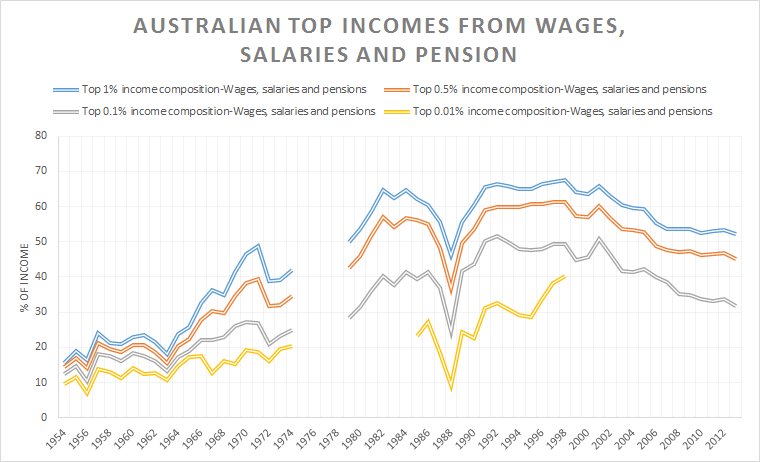
Source: The World Wealth and Income Database.
#homeslessnessinquiry champions contracting-out @NZLabour @NZGreens @Maori_Party
10 Oct 2016 Leave a comment
in economics of bureaucracy, politics - New Zealand, poverty and inequality Tags: homelessness
Did they swallow a dead rat! After complaining bitterly about the privatisation of social housing and the contracting out of government services and in particular social services generally, the New Zealand Labour Party, the New Zealand Greens and the Maori Party all accepted that part of the solution to better emergency housing services to the homelessness is to fund community housing providers to build them houses. A greater role for the private sector, be it the NGO sector, in solving pressing social problems.
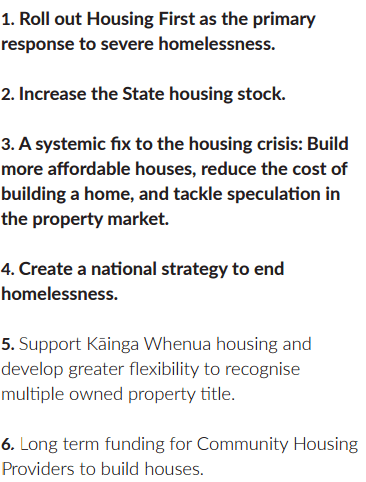
Source: Cross-party enquiry into homelessness.
It is pious to say that NGOs should build new social housing but existing social housing should not be sold to them to administer better than the bureaucrats.
The private sector has always been the last line of the defence for the social safety net for the homeless. Hotels and motels are used for emergency housing. There are plenty of them and it takes very little time to book into one as long as WINZ sends along the documentation to guarantee payment.
The report of Labour, the Greens and the Maori Party included reference to the Kate Amore data on homelessness which comfirms its credibility. That data shows that homelessness has fallen significantly in NZ since 2001 and 2006.
Homelessness is a by-product of bureaucratic inefficiency. So few people are actually sleeping rough or in shelters on any one night that is really an issue of why are those people are not in a shelter or permanent social housing.
The problem of homelessness is the efficiency of the bureaucracy in identifying these people, putting them in temporary quarters be at a hotel or motel if necessary, and then moving them into social housing.
No one is surprised at a homelessness shelter is run by a church or charity all with the assistance of government funding. No one seriously expects bureaucrats to be any good at running homeless shelters or the hotels or motels where the homeless are occasionally booked in.
Lazy Australian top 0.1% only increased their income under @AustralianLabour
09 Oct 2016 Leave a comment
in economic history, industrial organisation, politics - Australia, poverty and inequality, survivor principle Tags: antimarket bias, entrepreneurial alertness, superstar wages, superstars, top 1%, top incomes
Australia’s top income earners are a lazy lot. The top 0.1% only ever had a rising income share under a Labor government in the 1980s. Even the top 1% had a pretty lean time until the 1990s.

Source: The World Wealth and Income Database.
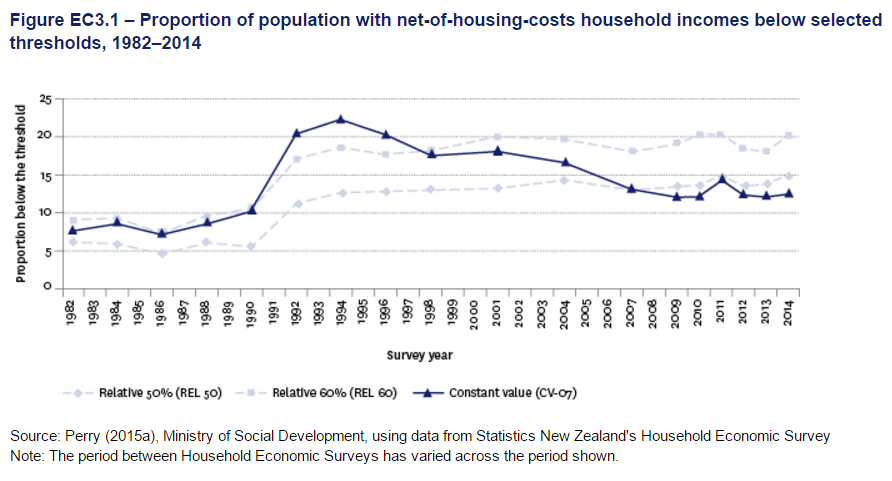
Poverty in NZ has been falling steadily for 20 years despite the dead hand of neoliberalism
26 Sep 2016 Leave a comment
in applied welfare economics, economic history, politics - New Zealand, poverty and inequality Tags: family poverty, job poverty, social insurance, The Great Enrichment
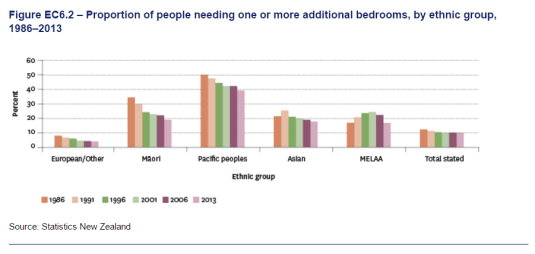
House crowding continues long run fall despite the dead hand of neoliberalism
24 Sep 2016 Leave a comment
in applied welfare economics, economic history, politics - New Zealand, poverty and inequality
What Wasn’t Said in “Wealth Inequality In America”
22 Sep 2016 Leave a comment
in applied welfare economics, politics - USA, population economics, poverty and inequality Tags: top 1%
Viagers as a way of funding retirements
12 Sep 2016 Leave a comment
in labour economics, labour supply, poverty and inequality, welfare reform Tags: economics of retirement, French law, old age pensions, property law, reverse mortgages, social insurance
A Viager is a French way of buying and selling property. We just watched the Kelvin Klein – Maggie Smith movie about it.
Not only does the seller remain as a life tenant of the property they sold, the buyer pays them an annuity as well as a down payment. The buyer gambles as all annuity providers do on the life expectancy of the vendor. One such vendor lived to 123 in France.
Back in 1965, when Mrs Calment was aged 90, she sold her apartment in Arles to a 44-years old man, on contract-conditions that seemed reasonable given the value of the apartment and the life-expectancy statistics that prevailed at the time.
The man turned out to be unlucky since Jeanne Calment lived a very long life. He died in 1995, two years before Mrs Calment, after having paid about FFr900,000 (twice the market value) for an apartment he never lived in.
The viager system is similar to the equity release and reverse mortgage systems more familiar in Anglo-Saxon countries. The viager shares the risk of running out of equity with the buyer. The contract is between two private parties and does not involve banks or insurance companies.

Sellers are typically widows, or widowers, who want to cash out the value of their property with a lump sum – the bouquet – and a monthly payment from the buyer for the rest of their lives. The seller remains as a life tenant. The bouquet is normally 15-30% of the value of the property.
French viager investors tend to be in their late 40s and early 50s wanting to set themselves up with a retirement home and hopefully get a good deal. If the buyer dies before the seller his children will be obliged to carry on paying the viager if they want to maintain the deal. In that sense, the vendor is gambling on the buyer’s life expectancy is well.
I have no information on who is responsible for payment of rates and the maintenance of the property. The maintenance of the property would be a bigger moral hazard problem than with tenants because of the difficulties with eviction and repair. The market for Viagers is fairly small.
Should the buyer default on the monthly instalments, he is warned to pay up. After a second warning, normally within weeks, he will get a further warning and one month to get up to date with payments. If this does not happen the seller keeps keeps the bouquet, all money received so far and gets back absolute ownership of the property they sold.
This home annuity option for selling the house could be away of getting around the rather small to non-existent annuity market in New Zealand for retirees. They have the advantage of sharing the risk of exhausting the equity of the property at the price of the buyer sometimes gets a really good deal. Sellers have on average shorter survival times than the general French population.
The Real “Truth About the Economy:” Have Wages Stagnated?
12 Sep 2016 Leave a comment
in applied welfare economics, economics, labour economics, poverty and inequality Tags: middle class stagnation, top 1%
Latest cherry picking of homelessness data allegation is from @MaxRashbrooke
09 Sep 2016 Leave a comment
in labour economics, politics - New Zealand, poverty and inequality Tags: homelessness, social insurance, social safety net, welfare state
I cherry picked data again by plotting it in full using the data labels and headings in the data tables at the original data source. I stand accused.
Max Rashbrooke is the latest to spit the dummy when reminded that the Otago report on homelessness actually was about the seriously housing deprived; their words, not mine.
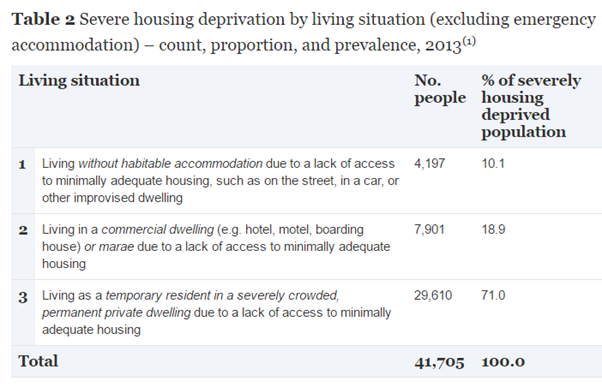
UOW researcher Dr Kate Amore, from the Health Research Council-funded He Kainga Oranga/Housing and Health Research Programme, measured the “severely housing deprived” population.
Table 2 below is from the media release Rashbrooke suggested I read to enlighten myself as to what homelessness is and is not. I am going to commit my third strike at cherry picking with snap-shots of the tables from the original source. I am a recidivist cherry picker.
Source: 3 June 2016, Homelessness accelerates between censuses, News, University of Otago, New Zealand.
Labour, the Greens and Max Rashbrooke all conflated living with friends and family or in commercial accommodation with homelessness. Saying that serious housing deprivation has gone up is not much of a sound bite compared to claiming homelessness is up with the associated images of people living rough or in cars. Who is spinning, who is cherry picking and who just can’t handle the truth? Homelessness has not increased under the National party government.
A statistical definition of homelessness that includes 70% of data observations as people living with friends and relatives on a temporary basis is miles away from sleeping rough, in a car or emergency accommodation such as a shelter or refuge run by an NGO. But at one point the Otago study does include these vastly different social situations under the same heading
“If the homeless population were a hundred people, 70 are staying with extended family or friends in severely crowded houses, 20 are in a motel, boarding house or camping ground, and 10 are living on the street, in cars, or in other improvised dwellings. They all urgently need affordable housing.”
Definitions are supposed to clarify, not confuse but the Statistics New Zealand definition does
Homelessness is defined as a living situation where people with no other options to acquire safe and secure housing are: without shelter, in temporary accommodation, sharing accommodation with a household, or living in uninhabitable housing.
The Oxford dictionary definition of homeless is “ (Of a person) without a home, and therefore typically living on the streets”.
Homelessness is different from those living in a hotel paid for by WINZ pending rehousing. Sleeping in the streets, in a car or living in emergency accommodation and waiting in a hotel for social housing are separate policy problems.
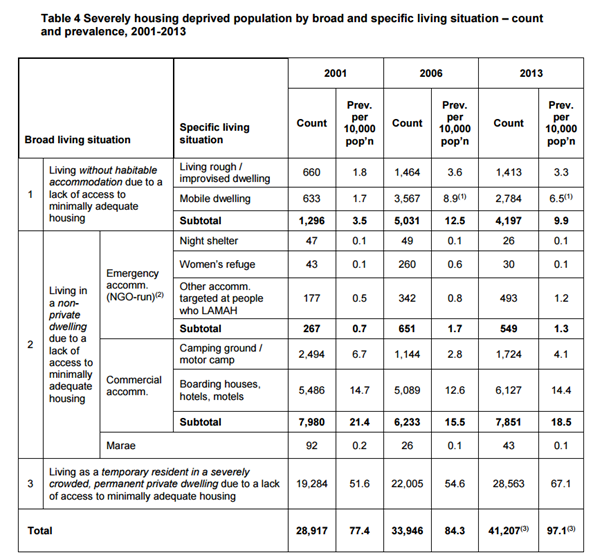
Source: Severe housing deprivation in Aotearoa/New Zealand 2001-2013 Kate Amore (2016).
Some of the seriously housing deprived data from the Otago study show the system failing, such as sleeping rough or in a car. Other parts of the data shows the social safety net working when people are in a hotel or emergency accommodation pending a move to better quarters.
Including in the same definition of homelessness someone who is sleeping in the street or in a car with someone who is in the queue for social housing but booked into a hotel insults those who are homeless. This spin mixes up situations where the social safety net has failed with situations where it is working to help those down on their luck but perhaps not to our full satisfaction.
Fast Car – Tracy Chapman: the trap of intergenerational poverty
06 Sep 2016 Leave a comment
in applied price theory, applied welfare economics, economics of media and culture, labour economics, poverty and inequality Tags: child poverty, family poverty, intergenerational poverty, Tracey Chapman
Fewer in emergency accommodation under @NZNationalParty? @PhilTwyford @cjsbishop
31 Aug 2016 Leave a comment
in labour economics, politics - New Zealand, poverty and inequality, urban economics Tags: homelessness, social insurance, social safety net, welfare state
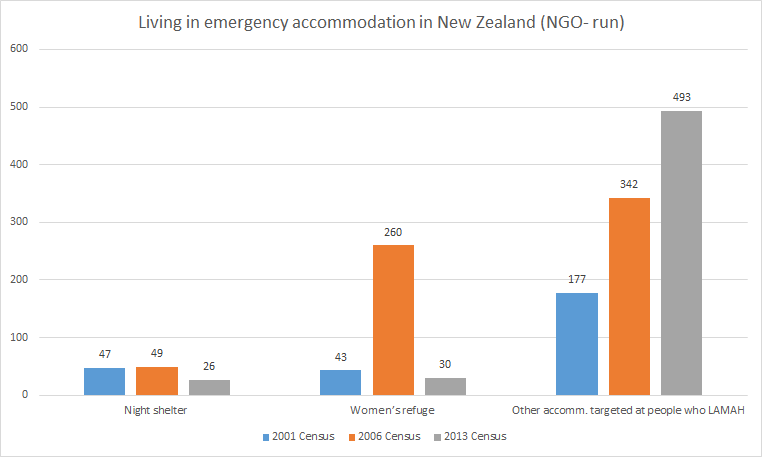
Source: 24 August 2016, Most homeless people working or studying, News, University of Otago, New Zealand, table 4.
More on homelessness fell under @NZNationalParty? @CarmelSepuloni @cjsbishop
30 Aug 2016 Leave a comment
in labour economics, politics - New Zealand, poverty and inequality, urban economics Tags: child poverty, family poverty, homelessness, New Zealand Greens, New Zealand Labour Party, social insurance, welfare state
I cherry picked my previous data on homelessness if the New Zealand sub-Reddit is to be believed and from which I am banned and cannot reply. Plotting the data in full is to cherry pick it. The chart below is simply the first two rows of the source data. The subsequent rows deal with those in emergency accommodation and in temporary accommodation.
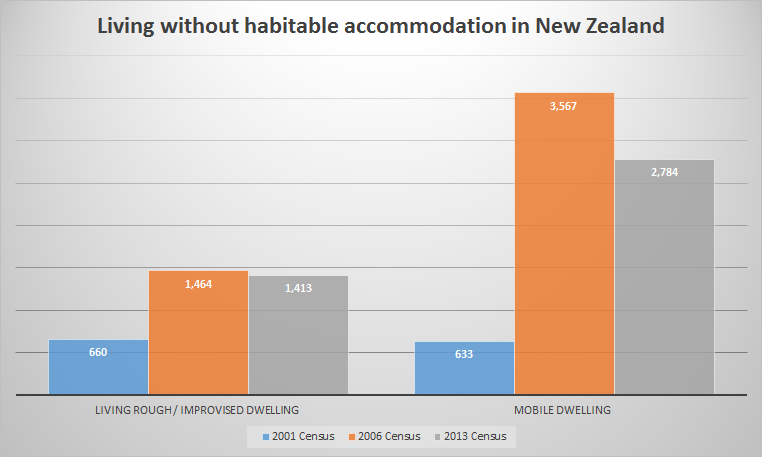
Source: 24 August 2016, Most homeless people working or studying, News, University of Otago, New Zealand, table 4.
When I shared this data on Carmel Sepuloni MP’s Facebook page, she rightly and constructively said
Thanks for your comment Jim. Unfortunately the number living rough has increased since 2001. We want to focus on improving the future, which is why we are holding our homeless inquiries so we can best understand and address this issue:
Rather than pointscoring, the issue is what to do to fix the problem. How desperate is much of the rest of the Left to beat up this issue as the fault of John Key. This is an an important issue that should not be used for point scoring by sufferers of John Key derangement syndrome.
Homeless people are those who I charted above. They are sleeping rough or in a car. They have slipped through the social safety net which is obviously not working for them. If you are in emergency accommodation, the social safety net is working. The issue is making that safety net work better in terms of moving quickly into more permanent accommodation..
 Utopia, you are standing in it!
Recent Comments