
HT: Matt Bruenig
Celebrating humanity's flourishing through the spread of capitalism and the rule of law
19 Mar 2016 Leave a comment
in labour economics, labour supply, occupational choice, poverty and inequality, welfare reform Tags: asymmetric marriage premium, child poverty, family poverty
HT: Matt Bruenig
17 Mar 2016 Leave a comment
in applied welfare economics, economic growth, economic history, labour economics, poverty and inequality, unemployment Tags: antimarket bias, pessimism bias, rational irrationality, The Great Enrichment, top 1%

Source: Do inequality and poverty matter? | Pundit – Brian Easton (2016) .
I will outsource to Brian Easton, the CTU, the CTU’s Bill Rosenberg and Closer Together Whakatata Mai – reducing inequalities because the continual correction of Max Rashbrooke on poverty and inequality is becoming tiring.
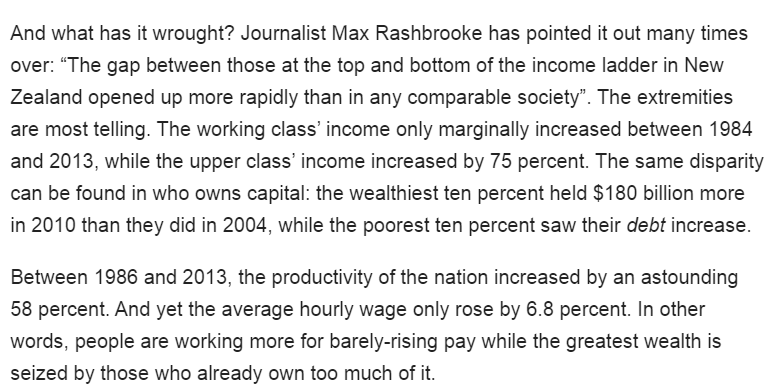
Source: Love in the time of crisis, James Robins, Wednesday, 16 March 2016, Newstalk NZ.
A brief history of inequality-from Treasury paper Fig4. Note Employment Contracts Act,GST,income tax,benefit cuts,WFF http://t.co/y4w3cUsgjD—
Bill Rosenberg (@WJRosenbergCTU) June 27, 2015
Inequality has not risen for at least 20 years as Bill Rosenberg tweeted. The rise in inequality in the late 1980s and early 1990s was followed by an employment boom that lasted to 2009.
Unemployment was as low as 3 1/2% for several years despite a large increase in labour force participation. Furthermore, the gender wage gap in New Zealand fell rapidly to now be the smallest in any industrialised country.
As the Facebook photos show, there has been strong income and wage growth despite the grizzling of the left. The return of income growth and wages growth after 20 years of real wage stagnation followed the economic reforms of the 1980s and the passage of the Employment Contracts Act in 1991.
As the CTU shows below, the economic reforms in the 1980s put an end to a sharp decline in the relative economic performance of the New Zealand economy.
17 Mar 2016 Leave a comment
in applied welfare economics, economic history, economics of education, entrepreneurship, human capital, labour economics, politics - New Zealand, poverty and inequality Tags: pension fund socialism, top 1%, Withering away of the proletariat
New Zealand working class is wealthier than the entire capitalist class. Their human capital, shown in the chart below as the human capital of the unskilled and non-degree workers, far exceeds the value of the physical capital stock of New Zealand.
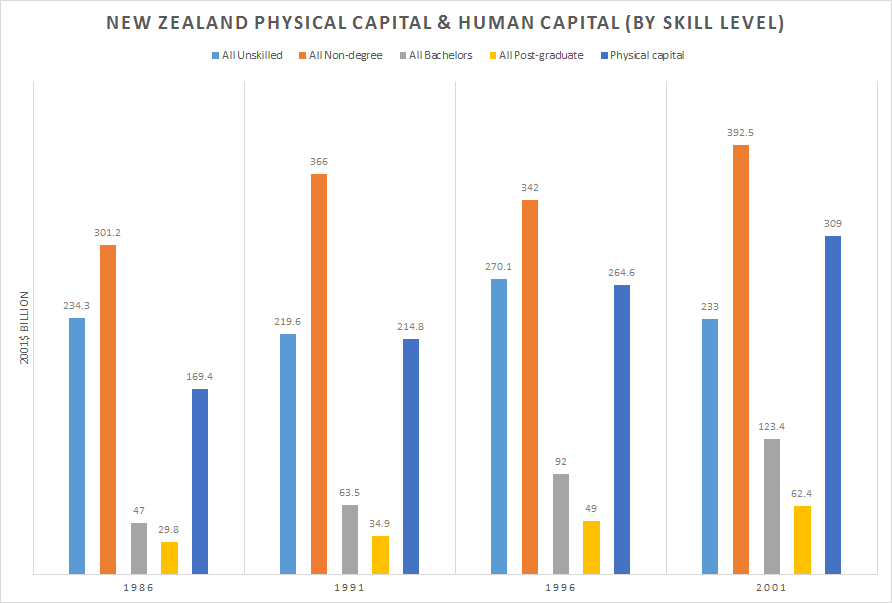
Source: Lˆe Thi. Vˆan Tr`ınh, Estimating the monetary value of the stock of human capital for New Zealand, University of Canterbury PhD thesis (September 2006).
Only part of this physical capital stock is owned by the capitalist class given we live in the era of pension fund socialism. About a 3rd of that physical capital stock is owner occupied homes.
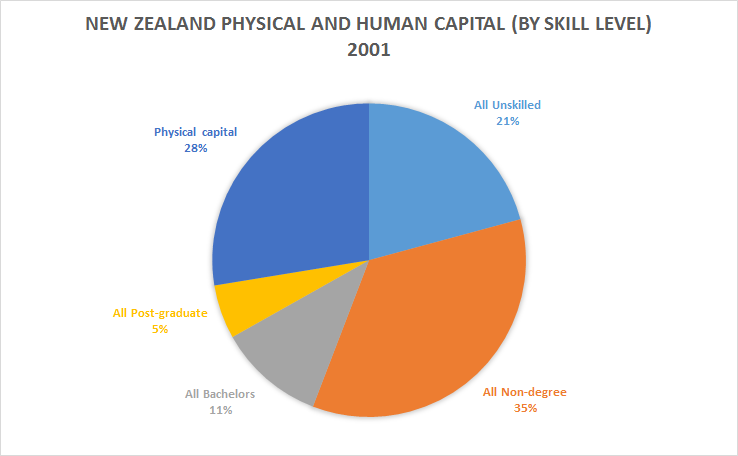
Source: Lˆe Thi. Vˆan Tr`ınh, Estimating the monetary value of the stock of human capital for New Zealand, University of Canterbury PhD thesis (September 2006).
The only reason that the share of unskilled and non-degree workers is in any way declining is the withering away of the proletariat. More and more people are joining the middle-class and going on to higher education.
Andrew Little is looking to update Labour's definition of the 'working class': stuff.co.nz/national/polit… http://t.co/AQ9mJL7CQf—
NZ Stuff Politics (@NZStuffPolitics) November 30, 2014
.
17 Mar 2016 Leave a comment
in applied welfare economics, economic history, economics of education, entrepreneurship, human capital, labour economics, politics - New Zealand, poverty and inequality, urban economics Tags: household wealth, housing prices, pessimism bias, top 1%
Tring Le found that the human capital stock was consistently 2.6 times the value of the physical capital stock of New Zealand.
I decided to apply that ratio to the net capital stock of New Zealand estimates of Statistics New Zealand back to 1987 to see what we get. It is pretty standard for the value of human capital to be two to two and one-half times the value of physical capital.

Source: National Accounts (Industry Benchmarks): Year ended March 2013 and Lˆe Thi. Vˆan Tr`ınh, Estimating the monetary value of the stock of human capital for New Zealand, University of Canterbury PhD thesis (September 2006), Table 4.8: Human and physical capital stocks.
All the above chart says it is most wealth in New Zealand is held by ordinary people either as their human capital or the value of their homes.
14 Mar 2016 Leave a comment
in economic history, politics - New Zealand, poverty and inequality
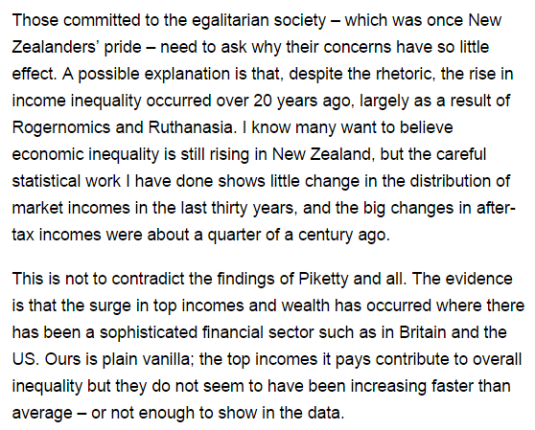
Source: Brian Easton (14 March 2016) Do inequality and poverty matter? | Pundit
08 Mar 2016 Leave a comment
in economics of education, politics - New Zealand, population economics, poverty and inequality, welfare reform

Source: The Economics of Human Development and Social Mobility, James J. Heckman, Stefano Mosso, NBER Working Paper No. 19925, February 2014.
08 Mar 2016 Leave a comment
in applied welfare economics, economic history, economics of bureaucracy, labour economics, politics - USA, poverty and inequality, Public Choice, welfare reform Tags: 1996 US welfare reforms, pessimism bias, social insurance, welfare state
From @EugeneSteuerle: Combined tax rates and creating a 21st century social welfare budget tpc.io/1GCdrYF http://t.co/aNRPqz5gAc—
Tax Policy Center (@TaxPolicyCenter) June 28, 2015

The only alternative offered by the Centre for American Progress is send them on a course. This response, which is the standard policy response to any labour market crisis, will not solve poverty, mush less inequality.
Will more education decrease inequality? A simulation provided an answer. nyti.ms/1xw5m9W http://t.co/paQp19BEWc—
The Upshot (@UpshotNYT) March 31, 2015
28 Feb 2016 Leave a comment
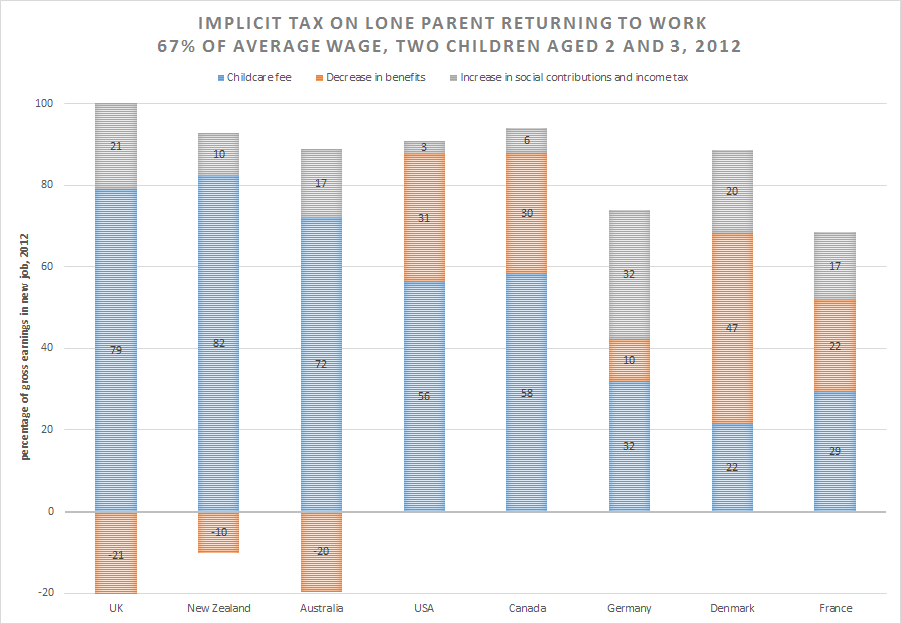
in applied price theory, fiscal policy, labour economics, labour supply, politics - Australia, politics - New Zealand, politics - USA, poverty and inequality, public economics, welfare reform Tags: poverty traps, single mothers, single parents, social insurance, taxation and labour supply, welfare state
26 Feb 2016 Leave a comment
in applied welfare economics, economic history, poverty and inequality
A Facebook photo by Mary Ruwart reminded me of the question I posed in previous blog posts about whether there will be poverty on the Star Trek enterprise. Those security officers in the red tunics get a really bad deal, especially if they beam down to the planet with Captain Kirk.
25 Feb 2016 Leave a comment
in applied welfare economics, economic history, entrepreneurship, human capital, labour economics, poverty and inequality Tags: entrepreneurial alertness, superstars, top 1%
17 Feb 2016 3 Comments
in applied price theory, economics of education, human capital, income redistribution, politics - New Zealand, poverty and inequality, rentseeking
How conceited students are to complain about a $20,000 student loan when they got $1/2 million coming down the pipe. 
Source: A Degree is a smart investment | Universities New Zealand – Te Pōkai Tara.
Self-appointed social justice warriors in the New Zealand Labour Party and New Zealand Greens pander to this middle class greed. They should be ashamed of themselves.
26% of eligible students do not take out a student loan so they would really get a leg up from the abolition of tuition fees.
The median repayment time for those who left study in 2011 and remained in New Zealand was 5.8 years.
16 Feb 2016 Leave a comment
in applied welfare economics, economic history, economics of regulation, entrepreneurship, financial economics, human capital, industrial organisation, labour economics, poverty and inequality, survivor principle Tags: billionaires, British economy, entrepreneurial alertness, superstars, top 1%

Inheriting wealth is not what it used to be in Britain. There are all these upstarts running businesses or working in the City.

Celebrating humanity's flourishing through the spread of capitalism and the rule of law
Scholarly commentary on law, economics, and more
Beatrice Cherrier's blog
Celebrating humanity's flourishing through the spread of capitalism and the rule of law
Celebrating humanity's flourishing through the spread of capitalism and the rule of law
Celebrating humanity's flourishing through the spread of capitalism and the rule of law
Why Evolution is True is a blog written by Jerry Coyne, centered on evolution and biology but also dealing with diverse topics like politics, culture, and cats.
Celebrating humanity's flourishing through the spread of capitalism and the rule of law
Celebrating humanity's flourishing through the spread of capitalism and the rule of law
A rural perspective with a blue tint by Ele Ludemann
DPF's Kiwiblog - Fomenting Happy Mischief since 2003
Celebrating humanity's flourishing through the spread of capitalism and the rule of law
The world's most viewed site on global warming and climate change
Tim Harding's writings on rationality, informal logic and skepticism
A window into Doc Freiberger's library
Let's examine hard decisions!
Commentary on monetary policy in the spirit of R. G. Hawtrey
Thoughts on public policy and the media
Celebrating humanity's flourishing through the spread of capitalism and the rule of law
Politics and the economy
A blog (primarily) on Canadian and Commonwealth political history and institutions
Reading between the lines, and underneath the hype.
Economics, and such stuff as dreams are made on
"The British constitution has always been puzzling, and always will be." --Queen Elizabeth II
Celebrating humanity's flourishing through the spread of capitalism and the rule of law
Celebrating humanity's flourishing through the spread of capitalism and the rule of law
WORLD WAR II, MUSIC, HISTORY, HOLOCAUST
Undisciplined scholar, recovering academic
Celebrating humanity's flourishing through the spread of capitalism and the rule of law
Res ipsa loquitur - The thing itself speaks
In Hume’s spirit, I will attempt to serve as an ambassador from my world of economics, and help in “finding topics of conversation fit for the entertainment of rational creatures.”
Researching the House of Commons, 1832-1868
Articles and research from the History of Parliament Trust
Reflections on books and art
Posts on the History of Law, Crime, and Justice
Celebrating humanity's flourishing through the spread of capitalism and the rule of law
Exploring the Monarchs of Europe
Cutting edge science you can dice with
Small Steps Toward A Much Better World
“We do not believe any group of men adequate enough or wise enough to operate without scrutiny or without criticism. We know that the only way to avoid error is to detect it, that the only way to detect it is to be free to inquire. We know that in secrecy error undetected will flourish and subvert”. - J Robert Oppenheimer.
The truth about the great wind power fraud - we're not here to debate the wind industry, we're here to destroy it.
Celebrating humanity's flourishing through the spread of capitalism and the rule of law
Celebrating humanity's flourishing through the spread of capitalism and the rule of law
Economics, public policy, monetary policy, financial regulation, with a New Zealand perspective
Celebrating humanity's flourishing through the spread of capitalism and the rule of law
Restraining Government in America and Around the World
 Utopia, you are standing in it!
Recent Comments