The 1st @PaulKrugman on @GrantRobertson1’s #futureofwork?
21 Mar 2016 Leave a comment
in economics of regulation, labour economics, minimum wage, politics - USA, poverty and inequality, unemployment Tags: employment law, employment protection laws, France, labour market regulation, New Zealand Labour Party, rent control, social insurance, The fatal conceit, unintended consequences
Source: Paul Krugman (1997) Unmitigated Gauls.
Just exactly how big is @grantrobertson1’s great big new tax?
20 Mar 2016 1 Comment
in labour economics, labour supply, politics - USA, poverty and inequality, welfare reform Tags: Director's Law, universal basic income
https://twitter.com/grantrobertson1/status/711303279284629505
Gareth Morgan’s universal basic income, by his own calculations, make well-to-do people better off and the poor and old age pensioners worse off at the cost of $12 billion tax rise. The Labour Party has now adopted this policy as worth considering.

Source: Gareth Morgan Presentation Slide 20 of 27 | Big Kahuna Book.
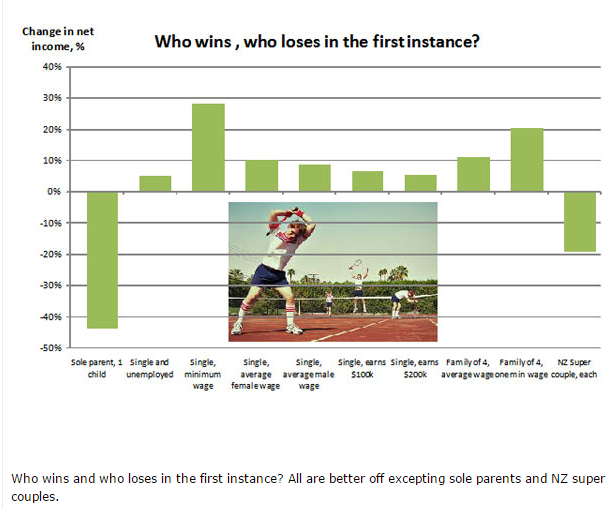
Source: Gareth Morgan Presentation Slide 20 of 27 | Big Kahuna Book.
The rising marriage premium for power couples
19 Mar 2016 Leave a comment
in economics of education, economics of love and marriage, economics of marriage, labour economics, population economics, poverty and inequality
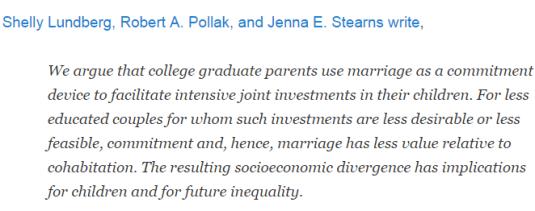
Source: Four Forces Watch | askblog.
Pizza and Conversation with James Heckman
19 Mar 2016 Leave a comment
in applied price theory, applied welfare economics, economics, economics of education, human capital, labour economics, labour supply, poverty and inequality Tags: James Heckman
Poverty rates in two-earner families in the USA
19 Mar 2016 Leave a comment
in labour economics, labour supply, occupational choice, poverty and inequality, welfare reform Tags: asymmetric marriage premium, child poverty, family poverty

HT: Matt Bruenig
@James_ARobins yet another @MaxRashbrooke #inequality fact check
17 Mar 2016 Leave a comment
in applied welfare economics, economic growth, economic history, labour economics, poverty and inequality, unemployment Tags: antimarket bias, pessimism bias, rational irrationality, The Great Enrichment, top 1%

Source: Do inequality and poverty matter? | Pundit – Brian Easton (2016) .
I will outsource to Brian Easton, the CTU, the CTU’s Bill Rosenberg and Closer Together Whakatata Mai – reducing inequalities because the continual correction of Max Rashbrooke on poverty and inequality is becoming tiring.
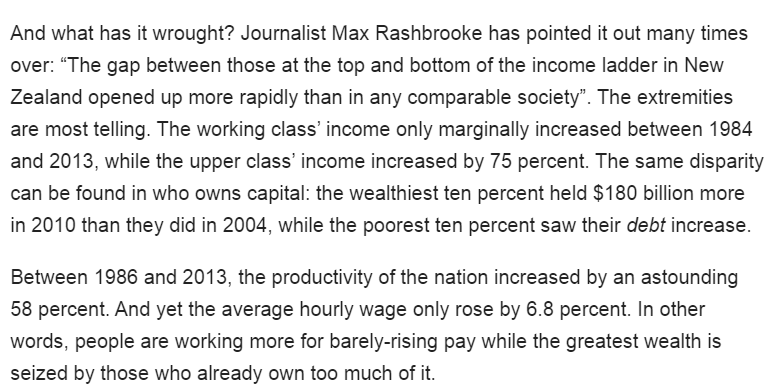
Source: Love in the time of crisis, James Robins, Wednesday, 16 March 2016, Newstalk NZ.
A brief history of inequality-from Treasury paper Fig4. Note Employment Contracts Act,GST,income tax,benefit cuts,WFF http://t.co/y4w3cUsgjD—
Bill Rosenberg (@WJRosenbergCTU) June 27, 2015
Inequality has not risen for at least 20 years as Bill Rosenberg tweeted. The rise in inequality in the late 1980s and early 1990s was followed by an employment boom that lasted to 2009.
Unemployment was as low as 3 1/2% for several years despite a large increase in labour force participation. Furthermore, the gender wage gap in New Zealand fell rapidly to now be the smallest in any industrialised country.
As the Facebook photos show, there has been strong income and wage growth despite the grizzling of the left. The return of income growth and wages growth after 20 years of real wage stagnation followed the economic reforms of the 1980s and the passage of the Employment Contracts Act in 1991.
As the CTU shows below, the economic reforms in the 1980s put an end to a sharp decline in the relative economic performance of the New Zealand economy.
New Zealand physical and human capital (by a skill level), 1986 – 2001
17 Mar 2016 Leave a comment
in applied welfare economics, economic history, economics of education, entrepreneurship, human capital, labour economics, politics - New Zealand, poverty and inequality Tags: pension fund socialism, top 1%, Withering away of the proletariat
New Zealand working class is wealthier than the entire capitalist class. Their human capital, shown in the chart below as the human capital of the unskilled and non-degree workers, far exceeds the value of the physical capital stock of New Zealand.
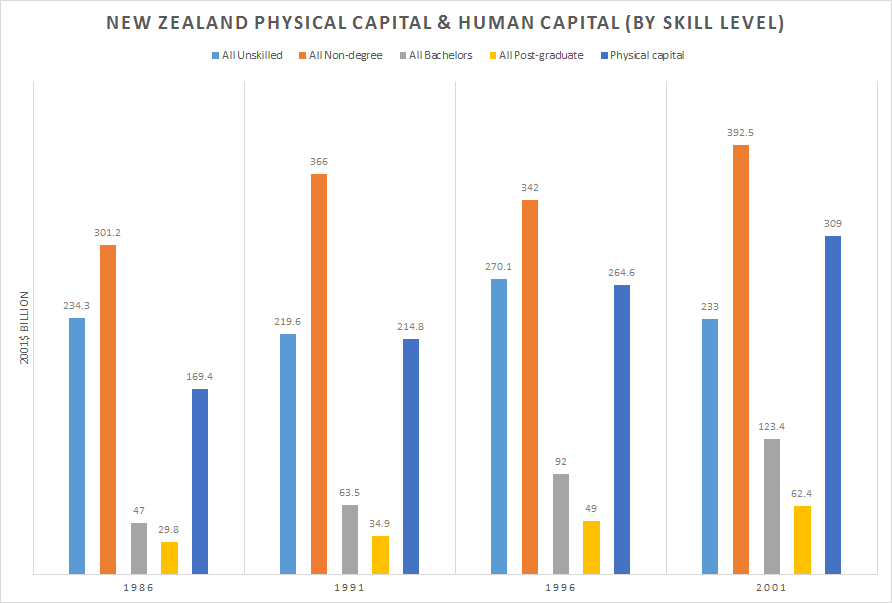
Source: Lˆe Thi. Vˆan Tr`ınh, Estimating the monetary value of the stock of human capital for New Zealand, University of Canterbury PhD thesis (September 2006).
Only part of this physical capital stock is owned by the capitalist class given we live in the era of pension fund socialism. About a 3rd of that physical capital stock is owner occupied homes.
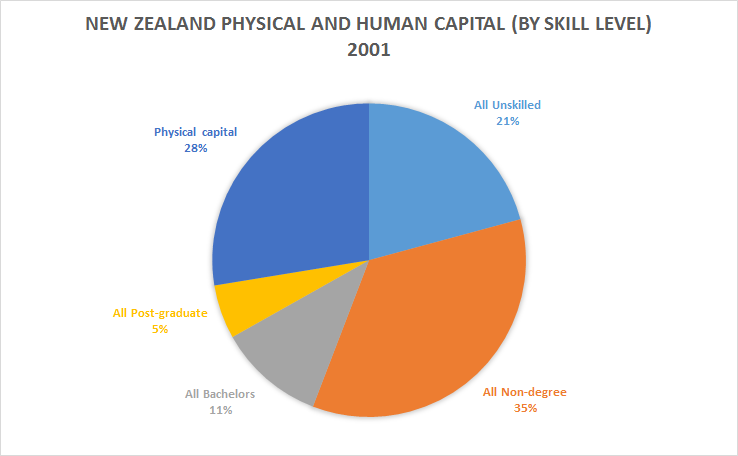
Source: Lˆe Thi. Vˆan Tr`ınh, Estimating the monetary value of the stock of human capital for New Zealand, University of Canterbury PhD thesis (September 2006).
The only reason that the share of unskilled and non-degree workers is in any way declining is the withering away of the proletariat. More and more people are joining the middle-class and going on to higher education.
Andrew Little is looking to update Labour's definition of the 'working class': stuff.co.nz/national/polit… http://t.co/AQ9mJL7CQf—
NZ Stuff Politics (@NZStuffPolitics) November 30, 2014
.
The value of New Zealand owner occupied homes, net capital stock and human capital stock since 1987
17 Mar 2016 Leave a comment
in applied welfare economics, economic history, economics of education, entrepreneurship, human capital, labour economics, politics - New Zealand, poverty and inequality, urban economics Tags: household wealth, housing prices, pessimism bias, top 1%
Tring Le found that the human capital stock was consistently 2.6 times the value of the physical capital stock of New Zealand.
I decided to apply that ratio to the net capital stock of New Zealand estimates of Statistics New Zealand back to 1987 to see what we get. It is pretty standard for the value of human capital to be two to two and one-half times the value of physical capital.

Source: National Accounts (Industry Benchmarks): Year ended March 2013 and Lˆe Thi. Vˆan Tr`ınh, Estimating the monetary value of the stock of human capital for New Zealand, University of Canterbury PhD thesis (September 2006), Table 4.8: Human and physical capital stocks.
All the above chart says it is most wealth in New Zealand is held by ordinary people either as their human capital or the value of their homes.
Brian Easton on whether inequality has risen in the past 20 years in New Zealand
14 Mar 2016 Leave a comment
in economic history, politics - New Zealand, poverty and inequality
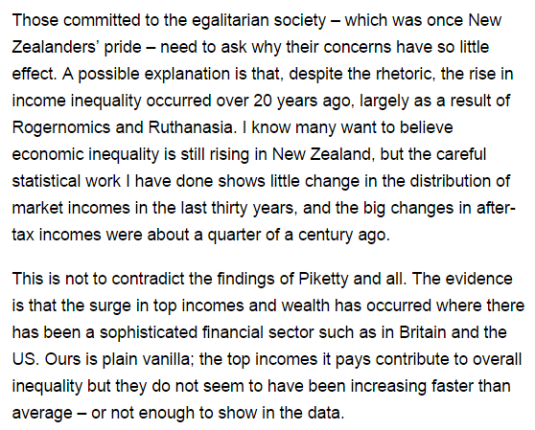
Source: Brian Easton (14 March 2016) Do inequality and poverty matter? | Pundit
James Heckman on what money cannot buy including a universal basic income
08 Mar 2016 Leave a comment
in economics of education, politics - New Zealand, population economics, poverty and inequality, welfare reform

Source: The Economics of Human Development and Social Mobility, James J. Heckman, Stefano Mosso, NBER Working Paper No. 19925, February 2014.
This @amprog conservative antipoverty dictionary does not add up
08 Mar 2016 Leave a comment
in applied welfare economics, economic history, economics of bureaucracy, labour economics, politics - USA, poverty and inequality, Public Choice, welfare reform Tags: 1996 US welfare reforms, pessimism bias, social insurance, welfare state
From @EugeneSteuerle: Combined tax rates and creating a 21st century social welfare budget tpc.io/1GCdrYF http://t.co/aNRPqz5gAc—
Tax Policy Center (@TaxPolicyCenter) June 28, 2015

The only alternative offered by the Centre for American Progress is send them on a course. This response, which is the standard policy response to any labour market crisis, will not solve poverty, mush less inequality.
Will more education decrease inequality? A simulation provided an answer. nyti.ms/1xw5m9W http://t.co/paQp19BEWc—
The Upshot (@UpshotNYT) March 31, 2015
 Utopia, you are standing in it!
Recent Comments