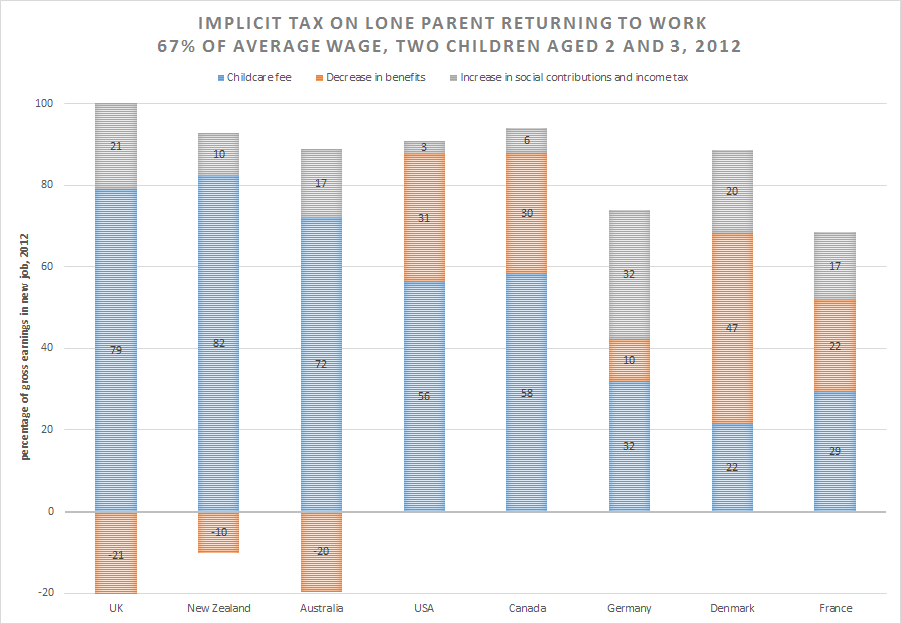
Source: Economic Policy Reforms: Going for Growth – OECD (2016).
Celebrating humanity's flourishing through the spread of capitalism and the rule of law
28 Feb 2016 Leave a comment
in applied price theory, fiscal policy, labour economics, labour supply, politics - Australia, politics - New Zealand, politics - USA, poverty and inequality, public economics, welfare reform Tags: poverty traps, single mothers, single parents, social insurance, taxation and labour supply, welfare state
26 Feb 2016 Leave a comment
in applied welfare economics, economic history, poverty and inequality
A Facebook photo by Mary Ruwart reminded me of the question I posed in previous blog posts about whether there will be poverty on the Star Trek enterprise. Those security officers in the red tunics get a really bad deal, especially if they beam down to the planet with Captain Kirk.
25 Feb 2016 Leave a comment
in applied welfare economics, economic history, entrepreneurship, human capital, labour economics, poverty and inequality Tags: entrepreneurial alertness, superstars, top 1%
17 Feb 2016 3 Comments
in applied price theory, economics of education, human capital, income redistribution, politics - New Zealand, poverty and inequality, rentseeking
How conceited students are to complain about a $20,000 student loan when they got $1/2 million coming down the pipe. 
Source: A Degree is a smart investment | Universities New Zealand – Te Pōkai Tara.
Self-appointed social justice warriors in the New Zealand Labour Party and New Zealand Greens pander to this middle class greed. They should be ashamed of themselves.
26% of eligible students do not take out a student loan so they would really get a leg up from the abolition of tuition fees.
The median repayment time for those who left study in 2011 and remained in New Zealand was 5.8 years.
16 Feb 2016 Leave a comment
in applied welfare economics, economic history, economics of regulation, entrepreneurship, financial economics, human capital, industrial organisation, labour economics, poverty and inequality, survivor principle Tags: billionaires, British economy, entrepreneurial alertness, superstars, top 1%

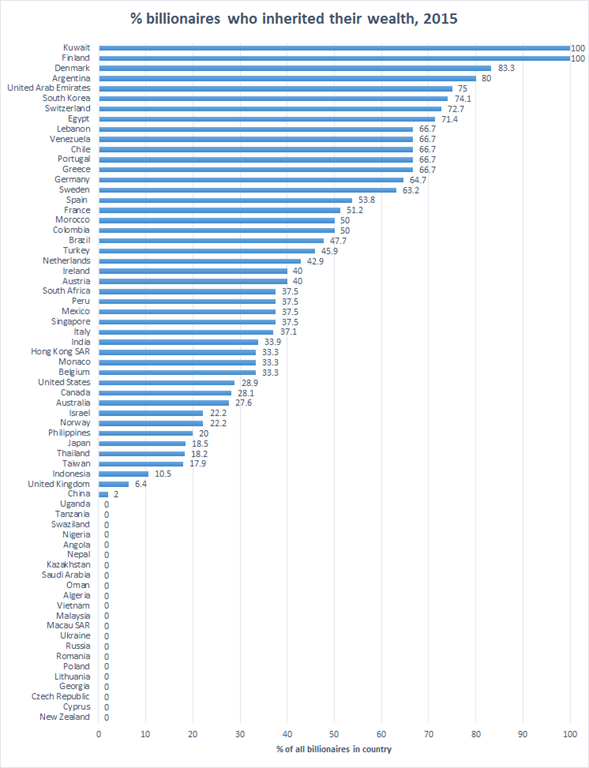
Inheriting wealth is not what it used to be in Britain. There are all these upstarts running businesses or working in the City.

14 Feb 2016 Leave a comment
in applied price theory, applied welfare economics, human capital, politics - New Zealand, poverty and inequality Tags: distributive justice, expressive politics, free tuition, rational irrationality, social justice, top 1%
14 Feb 2016 Leave a comment
in applied welfare economics, entrepreneurship, labour economics, poverty and inequality Tags: entrepreneurial alertness, inherited wealth, superstar wages, superstars, top 1%
China has been capitalist for long enough for a billionaire to actually inherit his wealth.
13 Feb 2016 Leave a comment
in economics of bureaucracy, economics of regulation, energy economics, entrepreneurship, industrial organisation, poverty and inequality, privatisation, rentseeking, resource economics
The 1826 Billionaires in the Forbes 2015 list are classified as rich through political connections if they made their money through past political positions, close relatives or friends in government, or questionable licenses, privatisations or resource extraction industries.
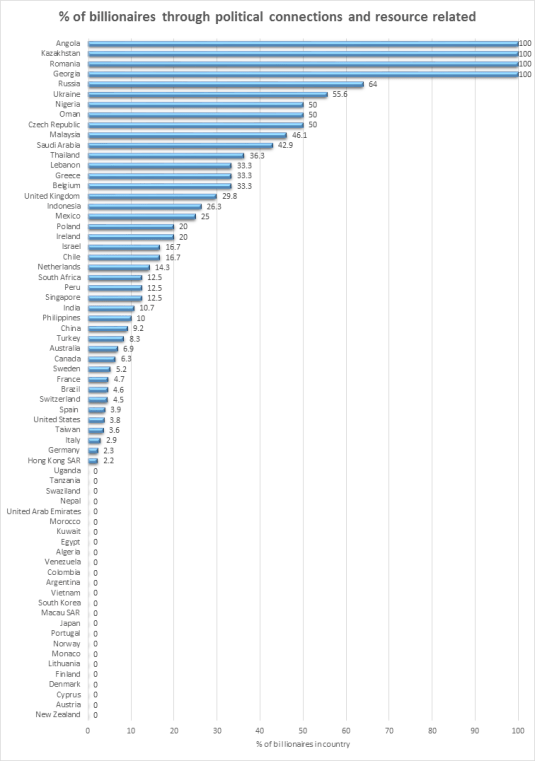
All privatizations were included in the politically-connected/resource-related category despite my data source acknowledging the possibility that the new owners may have transformed the company. Resource billionaires were all deemed to be lucky or cronies by my data source rather than diligent as some most certainly were. This is something of a slur by my data source given the industriousness of some resource billionaires some of whom were even geologists.
Political cronyism is a path to billionaire wealth mainly in the developing countries. Less than 10% of Chinese billionaires made their money through political connections, which is surprising.
12 Feb 2016 Leave a comment
in human capital, labour economics, labour supply, occupational choice, personnel economics, poverty and inequality, unions Tags: compensating differentials, union wage premium, unions

08 Feb 2016 Leave a comment
in applied welfare economics, economic history, labour economics, politics - USA, poverty and inequality Tags: living standards, rational ignorance, rational irrationality, withering away of proletariat

Both the proletariat and the middle class are withering away these days thanks to capitalism and freedom.

06 Feb 2016 Leave a comment
in economics of media and culture, fiscal policy, income redistribution, labour economics, labour supply, law and economics, poverty and inequality, property rights, public economics, rentseeking Tags: basic income, car racing, Finland, guaranteed minimum income, negative income tax
05 Feb 2016 Leave a comment
in labour economics, labour supply, politics - New Zealand, poverty and inequality, public economics
01 Feb 2016 Leave a comment
in labour economics, labour supply, politics - New Zealand, poverty and inequality, welfare reform Tags: Maori economic development, single mothers, single parents, welfare state
31 Jan 2016 Leave a comment
in discrimination, gender, labour economics, labour supply, occupational choice, poverty and inequality Tags: asymmetric marriage premium, gender wage gap, high-powered jobs, offsetting behaviour, Parental leave, paternity leave, unintended consequences
Celebrating humanity's flourishing through the spread of capitalism and the rule of law
Celebrating humanity's flourishing through the spread of capitalism and the rule of law
Celebrating humanity's flourishing through the spread of capitalism and the rule of law
Celebrating humanity's flourishing through the spread of capitalism and the rule of law
Celebrating humanity's flourishing through the spread of capitalism and the rule of law
A History of the Alt-Right
Econ Prof at George Mason University, Economic Historian, Québécois
Celebrating humanity's flourishing through the spread of capitalism and the rule of law
Scholarly commentary on law, economics, and more
Beatrice Cherrier's blog
Celebrating humanity's flourishing through the spread of capitalism and the rule of law
Celebrating humanity's flourishing through the spread of capitalism and the rule of law
Celebrating humanity's flourishing through the spread of capitalism and the rule of law
Why Evolution is True is a blog written by Jerry Coyne, centered on evolution and biology but also dealing with diverse topics like politics, culture, and cats.
Celebrating humanity's flourishing through the spread of capitalism and the rule of law
A rural perspective with a blue tint by Ele Ludemann
DPF's Kiwiblog - Fomenting Happy Mischief since 2003
Celebrating humanity's flourishing through the spread of capitalism and the rule of law
The world's most viewed site on global warming and climate change
Tim Harding's writings on rationality, informal logic and skepticism
A window into Doc Freiberger's library
Let's examine hard decisions!
Commentary on monetary policy in the spirit of R. G. Hawtrey
Thoughts on public policy and the media
Celebrating humanity's flourishing through the spread of capitalism and the rule of law
Politics and the economy
A blog (primarily) on Canadian and Commonwealth political history and institutions
Reading between the lines, and underneath the hype.
Economics, and such stuff as dreams are made on
"The British constitution has always been puzzling, and always will be." --Queen Elizabeth II
Celebrating humanity's flourishing through the spread of capitalism and the rule of law
Celebrating humanity's flourishing through the spread of capitalism and the rule of law
WORLD WAR II, MUSIC, HISTORY, HOLOCAUST
Undisciplined scholar, recovering academic
Celebrating humanity's flourishing through the spread of capitalism and the rule of law
Res ipsa loquitur - The thing itself speaks
In Hume’s spirit, I will attempt to serve as an ambassador from my world of economics, and help in “finding topics of conversation fit for the entertainment of rational creatures.”
Researching the House of Commons, 1832-1868
Articles and research from the History of Parliament Trust
Reflections on books and art
Posts on the History of Law, Crime, and Justice
Celebrating humanity's flourishing through the spread of capitalism and the rule of law
Exploring the Monarchs of Europe
Cutting edge science you can dice with
Small Steps Toward A Much Better World
“We do not believe any group of men adequate enough or wise enough to operate without scrutiny or without criticism. We know that the only way to avoid error is to detect it, that the only way to detect it is to be free to inquire. We know that in secrecy error undetected will flourish and subvert”. - J Robert Oppenheimer.

 Utopia, you are standing in it!
Recent Comments