Inequality has actually not risen since the financial crisis. http://t.co/HwlZDVqGDj pic.twitter.com/NsEOrP597e
— The Upshot (@UpshotNYT) February 17, 2015


Economics as Incredulity : Working conditions during the Industrial Revolution
16 Feb 2015 Leave a comment

Was Moynihan Right?
16 Feb 2015 Leave a comment


Roland Fryer: Racial Inequality in the 21st Century – The Declining Significance of Discrimination
15 Feb 2015 Leave a comment
in discrimination, human capital, labour economics, poverty and inequality Tags: poverty and inequality, racial discrimination, Roland Fryer
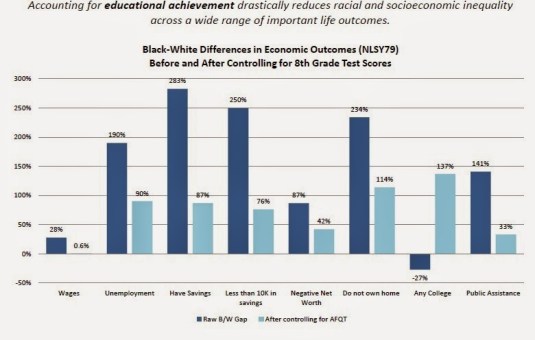
Roland Fryer carried a gun at 14 as a member of the gang; worked extra jobs at college to pay off his father’s bail bondsman; and an assistant professor at Harvard at the age of 27. He is the sharpest economist around working on the economics of inequality and discrimination.
Is the middle-class disappearing?
12 Feb 2015 Leave a comment
in economic growth, human capital, income redistribution, politics - USA, poverty and inequality Tags: middle class stagnation
The Stigler diet is still as cheap as can be
12 Feb 2015 Leave a comment
in George Stigler, labour economics, poverty and inequality Tags: cost of subsistence, poverty and inequality, school breakfast programmes, School lunches
The always excellent Matthew Kahn reminded me today of the Stigler diet: George Stigler’s famous 1945 journal article The Cost of Subsistence in the Journal of Farm Economics. Stigler posed this problem:
For a moderately active man (economist) weighing 154 pounds, how much of each of 77 foods should be eaten on a daily basis so that the man’s intake of nine nutrients (including calories) will be at least equal to the recommended dietary allowances suggested by the National Research Council in 1943, with the cost of the diet being minimal.
Stigler managed to find a nearly optimal daily diet of:
- 1.6 pounds of wheat flour,
- 0.3 pounds of cabbage,
- 0.6 ounces of spinach,
- 0.4 pounds of pancake flour,
- 1.1 ounces of pork liver.
All of this food necessary to sustain health and weight of a moderately active man amounted to $0.16 per day in 1944, which is an annual cost of $39.93, not including leap years. A recent update for inflation put the annual cost of the Stigler diet at $561.43 in 2005. Not more than two dollars a day .

Stigler later concluded that the main issue about food consumption is a preference for a variety rather than a nutritional diet which could be obtained very low cost if you like cabbage, spinach, flour and a little bit of pork liver. For many years, pork liver was not available in my local supermarkets in Australia and New Zealand until recently when Asian buyers started to buy again.

When various claims made about child poverty and children going without food, and adults too, the purpose of the Stigler diet in the calculations of the cost of subsistence is to show that it is actually extremely cheap to get the necessities of life in a capitalist society. Something more than either a lack of income in a modern welfare state or far from high prices of this extremely cheap, but spartan diet must be playing a role.

Everyone is richer in the USA and the middle class is moving up
09 Feb 2015 Leave a comment
in economic growth, great recession, macroeconomics, poverty and inequality Tags: The Great Enrichment
The middle class is shrinking in the USA because most of of 10% shrinkage is due to them becoming rich.

Everyone is wealthier than in the past and would have been wealthier but for the Great Recession and the countless tax rises of Obama.


The first Paul Krugman on efficiency wage arguments for a higher minimum wage
09 Feb 2015 Leave a comment
in labour economics, minimum wage, politics - Australia, politics - New Zealand, politics - USA, poverty and inequality Tags: George Bush derangement syndrome, living wage, Paul Krugman, public intellectuals

HT: economistsview
The three laws of behavioural genetics
08 Feb 2015 Leave a comment
in economics of education, human capital, occupational choice, poverty and inequality Tags: behavioural genetics, economics of personality traits, nature versus nurture


The Left and Right approaches to poverty
01 Feb 2015 Leave a comment
in applied price theory, applied welfare economics, comparative institutional analysis, liberalism, poverty and inequality, welfare reform Tags: capitalism and freedom, Leftover Left, poverty and inequality, The Great Enrichment


 Utopia, you are standing in it!
Recent Comments