Is Labour’s Loss Capital’s Gain? @MarjaLubeck @_chloeswarbrick

At a Parliamentary select committee this morning, a Labour and a Green MP were convinced that the labour’s falling share of GDP was evidence of rising profits to capital because of a loss of union bargaining power.

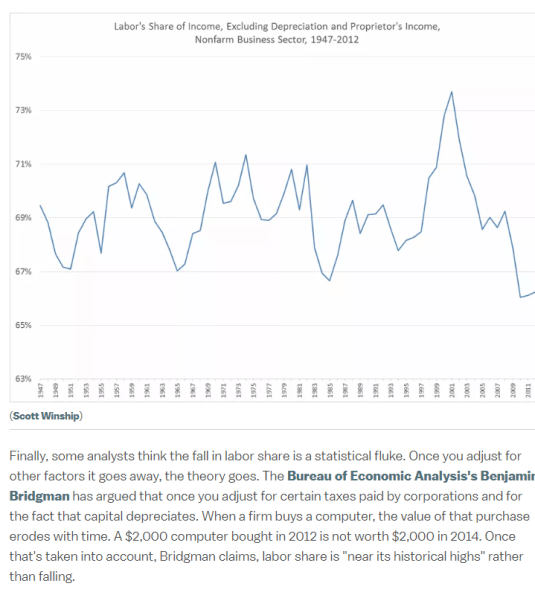
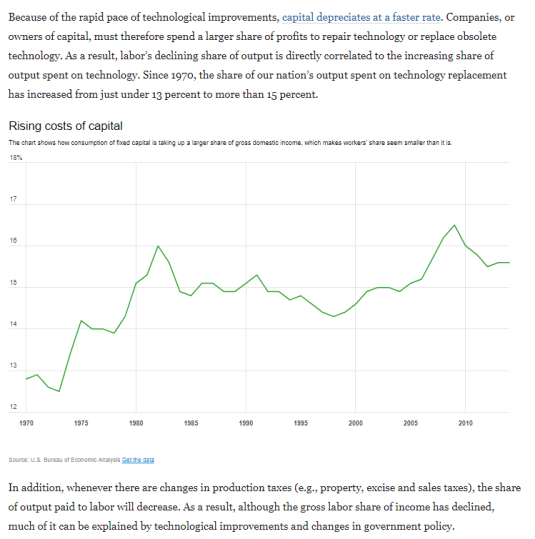
Instead, in the USA, where the data is best analysed, this decline in the gross labour share is a statistical illusion bought on by a greater part of GDP going to depreciation of ICT equipment which depreciates faster than in the past. The decline in the gross labour share does not mean the capitalists are sharing more of the total left. As Benjamin Bridgman said

US labor share has been falling since the 1970s. I show that it has not fallen as much once items that do not add to capital, depreciation and production taxes, are netted out. Recent net labor share is within its historical range, whereas gross share is at its lowest level. This effect holds for other high-income economies. The overall picture is no longer one of unprecedented, globally declining labor share. Using gross share as a proxy for net share can give misleading results. US gross share and inequality are correlated, whereas net share, the correct measure, is not.

From https://www.vox.com/2015/1/8/7511281/labor-share-income


https://www.washingtonpost.com/posteverything/wp/2016/02/17/yes-the-robots-will-steal-our-jobs-and-thats-fine/?utm_term=.b095f95cb97b

Employment Relations Amendment Bill kills incentive to join unions? @charles_finny @EricCrampton @oneforthedr

The only reason I joined a union at the Department of Labour was pay rises under the collective agreement were conditional upon union membership. They even ran a membership drive every time they negotiated a rise. Indeed, I might have joined up after the first of those membership drives.

I wish the Employment Relations Amendment Bill was in effect back then because it would have saved me a couple of hundred dollars a year. I would have started on the union wage at least and had no obligation to join the union to benefit from all the conditions they negotiated in the past. The amending bill inserts a new clause that says with regard to individual employment agreements that

No term or condition of employment may be expressed to alter automatically after the 30-day period in a way that makes it inconsistent with the collective agreement.

This new amendment requires all employees to start on the collective agreement terms for the first 30 days of their employment. You always start on the union rates. In the past, people could opt in to the union agreement. Now they can opt out but can keep all the benefits of that union agreement while not having to pay a union membership fee.

There is no incentive to join the union because nothing they offer you in terms of pay is conditional on continuing union membership. No employer offers less than the union pay and may wish to offer more to particularly appealing recruits without passing that pay rise on to the rest of the workforce.

I would join the union in the future if they delivered a pay rise that was not available to those on individual employment agreements. But I have no incentive to join the union prior to that time. I can keep my money.

Cartels usually want the cartel price to extend to all in the industry. Unions are different because they must collect fees from employees to pay their rent and meet their payroll. They need to have members to survive because unions are funded by membership fees. For them, compulsory union membership is all about the cash.

The unions seem to want to head in the same direction as France where about 10% of the French workforce are members are unions despite 90% of workers being covered by collective agreements. I do not know how French unions pay their bills because no one has an incentive to join a union if the union pay and conditions apply anyway.

If I was an employer, I would point out to an employee that they have no need to join the union because they already get all the union conditions and should save their money until the union delivers something more than they have now.

Unions want this amendment as a way of winning members. It backfires because the union conditions of employment are not conditional on union membership so no one has any reason to join the union unless they deliver more in the future. Save your union fee until you get something concrete in return for it in the future.

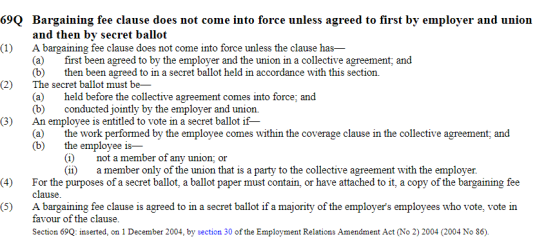
Unions can collect bargaining fees provided a workplace agrees to it in a secret ballot under the current law. I would certainly vote against a bargaining fee in that secret ballot.

The 2017 Labour Party manifesto does go on about the need for union won wage rises to be passed on to everyone in the industry. I am all for that if I was in that industry especially if I do not have to pay any union fees to get the pay rise.

Why join a union if none of its current benefits are conditional on union membership? Wait until they offer you something specific in the future before you part with your union fee. What have you done for me lately is the decision rule.

If unions want to unionise a new workplace, just wait and see whether they deliver a pay rise before joining them. Freeride for as long as you can. There is no incentive for new employees to join that union until they win another pay rise.

Maybe I should have delayed posting this until after the Bill was passed so that there is no time for last-minute amendments. But then again, the unions have blocked me on Twitter so maybe they will never find out.

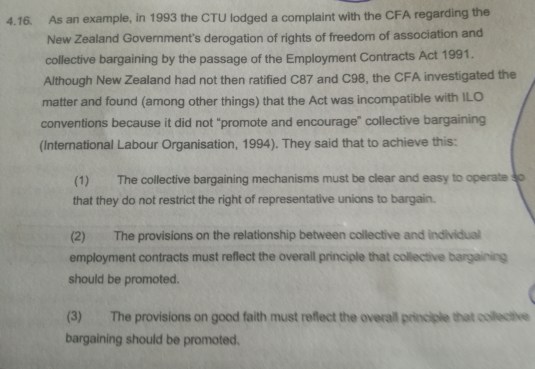
#TPPANoWay unions complain to secretive ILO disputes panel over breach of convention NZ never ratified!

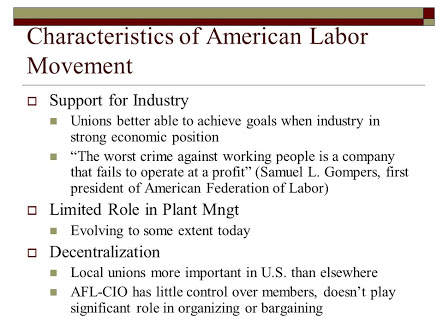
Early Unions were rather practical

My Select Committee submission on the Employment Relations Amendment Bill

The regulatory impact statement on the employment law amendments by the new government says that:

The bill aims to strengthen collective bargaining through a range of measures, including guaranteed rest and meal breaks, reasonable union access to a workplace, and bringing back the 30-day rule where a new worker must be given the same conditions as a collective agreement.

MBIE officials found that the cost of the proposals would mainly fall on employers, including from higher wages and compliance costs, and from a potential fall in productivity.

The MBIE papers identified the following risks associated with the bill:

• reduced employment due to changed incentives on employers to hire new workers • an increase in industrial action and protracted bargaining due to the need to conclude agreements and include pay rates in collective agreements
• an increase in partial strikes by removing an employer’s ability to deduct pay for partial striking
• lower productivity due to less flexibility (mainly from the need for guaranteed meal breaks)

These predictions ignore the main findings of labour macroeconomics on employment protection laws and of empirical labour economics regarding the power of unions and the size of the union wage premium in the private sector.

What do employment protection laws do?

Let us begin with what are the standard predictions of the effect of employment protection laws. They lower wages and have an ambiguous effect on employment because there is both less hiring and less firing. The only unambiguous effect is on the duration of unemployment because fewer vacancies are posted but once you get a job, you keep it for longer. The unemployed must remain unemployed longer because their own fewer job vacancies posted. They must wait longer for a new vacancy suitable to their background and skills to open.

To give a summary of the literature that appears to be unknown to the junior analyst writing the Regulatory Impact Statement from this Bill, graduate textbooks in labour economics show that a wide range of studies have found that:

1. Employment law protections make it costlier to both hire and fire workers.
2. The rigour of employment law has no great effect on the rate of unemployment. That being the case, stronger employment laws do not affect unemployment by much.
3. What is clear is that is more rigorous employment law protections increase the duration of unemployment spells. With fewer people hired, it takes longer to find a new job.
4. Stronger employment law protections also reduce the number of young people and older workers who hold a job. They are outside looking in on a privileged subsection of insiders in the workforce who have stable, long-term jobs and who change jobs infrequently.

When trying to work out what the effects of the effects of this Bill on the labour market, the key consideration is the extent to which wage bargaining can undo most if not all the effects of the employment protection regulation.

Can wage bargaining cancel out the effects of employment protection laws?

Let me start with a simple example. Suppose the only employment law in New Zealand was a requirement to pay redundancy pay. If wages are flexible, a key analytical assumption that I return to again and again, wage bargaining can completely undo the effects of the redundancy payment mandate by reducing the starting wages paid by the amount of the expected redundancy payment.

Employment protection laws give rise to two costs. The first of these are severance payments, these are transfers of from the employer to the employee. The 2nd type of cost are administrative or procedure costs within the firm and payments to 3rd parties such as for litigation. Advance notice of dismissal and an obligation to find another position within the firm are both administrative costs and transfers to the employee. Administrative costs and severance payments affect employment protection in different ways depending on the presence of wage bargaining. That nuance is completely omitted from the regulatory impact statement.

As illustrated with the example of redundancy pay, if there is no involvement of 3rd parties such as arbitrating the size or eligibility of the payment, it is formula driven by tenure as an example, starting wages are lowered and just as many job vacancies are created. Even if there are some administrative costs involving payments to 3rd parties such as arbitration over the eligibility for redundancy pay or something like that, the expected cost of those payments can be offset by a lower starting wage. This illustrates the effects of employment protection in a barebones manner. The next paragraphs will flash out this analysis.

What do employment protection laws do when no wage bargaining is permitted?

When no wage bargaining is permitted because of the presence of the minimum wage or a wage floor in a collective agreement, the impact of severance pay and procedure costs are the same. They make it less profitable to create vacancies, and less profitable to let people go because of the cost of replacing them. As there are fewer vacancies, there is less employment and spells of unemployment are longer because vacancies are posted less frequently.

When wage bargaining is not permitted either at hiring or when there are productivity shocks cast doubt on the profitability of the job, they have different effects. We are currently considering what happens when there is no wage bargaining

Firing costs certainly do reduce the rate of job destruction. For example, when there is a downturn in demand or some other productivity shock and the entrepreneur believes it is a short-term affair, he can avoid paying the severance pay and administrative costs of the firing by keeping the worker on. Firing costs result in labour hoarding. Employment law protections such as severance pay and any procedure costs encourage labour hoarding. In mild downturns it is cheaper to keep people on than let them go and pay the severance pay and incur various procedural costs.

Firing costs also reduce labour productivity because they induce firms to keep workers at lower productivity levels are slow the rate at which workers are reallocated to new more profitable, higher productivity jobs. This reduces wages in the long-term.

Firing costs have an ambiguous impact on the unemployment rate because they combine two effects that work against each other. By favouring labour hoarding, they reduced job destruction in mild recessions and mild downturns, but they reduced job creation because the higher firing costs downgrades the profit outlook for every new hire. There are fewer jobs, but these jobs last longer. Unemployment spells are also longer because there are fewer vacancies posted.

To complicate the story even more, because unemployment duration is longer and fewer vacancies are posted, labour market tightness is reduced and in consequence the bargaining power of workers is reduced. When labour markets are tight, there are many vacancies and few jobseekers, workers can seek pay rises. But when there are few jobs and long spells of unemployment, the unemployed offer to work for less and incumbent workers fear unemployment.

In summary, when employment protection laws cannot be offset by lower starting wages or other wage negotiations, there is less employment, longer spells of unemployment, lower wages in the long term because of lower productivity, and workers have less bargaining power because of the fear of longer spells of unemployment.

What do employment protection laws do when wage bargaining is possible?

The story complicates no end when wage bargaining is possible. This is because the severance pay and administrative costs or process costs of employment protection laws have different effects. They also cut in at different times.

At hiring stage, wage bargaining could offset both the costs of having to pay severance pay and any administrative costs. But once a vacancy has been filled and the worker hired, when there is a productivity shock, administrative costs, these are payments to 3rd parties, can be avoided if the worker is kept on. Because of this, the incumbent worker might be able to ask for higher wages than otherwise as a way of splitting this saving. The fact that it will cost the employer administrative costs if there is a layoff strengthens the bargaining hand of the employee’s job is at risk.

When the worker is hired, the failure of bargaining over the starting wage incurs neither the severance nor administrative costs of employment law. The twist in the tail is that when wages are renegotiated after hiring such as in the presence of some productivity shock or demand downturn, these costs and transfers are borne by the employer if the wage renegotiation fails. How these costs and the avoidance of these costs takes place depends upon the respective bargaining power of employers and employees and in turn the tightness of the labour market in which those workers will be laid off.

This is a complicated tale. Severance pay can be undone in starting wages, but the costs of firing lends some bargaining power to employees after they hired when wages must re-renegotiated in the face of the demand of productivity shock. But, if employment protection is a particularly strong and therefore the spell of unemployment is long if you do lose your job, labour market tightness offsets any incumbency advantage in the renegotiation of wages in the face of changing economic circumstances for the employer.

What is clear is labour hoarding persists irrespective of wage bargaining options. There are fewer job layoffs so the unemployed must wait longer for vacancies to open. Employment protection unambiguously prolongs spells of unemployment.

What do trial periods do?

The impact of the introduction of trial periods on employment will be ambiguous because the lack of a trial period can be undone by wage bargaining.

  • If you hire a worker with full legal protections against dismissal, you pay them less because the employer is taking on more of the risk if the job match goes wrong. If they work out, you promote them and pay them more.
  • If you hire a worker on a trial period, they may seek a higher wage to compensate for taking on more of the risks if the job match goes wrong and there is no requirement to work it out rather than just sack them.

The twist in the tail is when there is a binding minimum wage. If there is a binding minimum wage,  either the legal minimum or in a collective bargaining agreement, the employer cannot reduce the wage offer to offset the hiring risk so fewer are hired. The introduction of trial periods will affect both wages and employment and employment more in industries that has low pay or often pay the minimum wage.

Trial periods are common in OECD countries. There is plenty of evidence that increased job security leads to less employee effort and more absenteeism. Some examples are:

  • Sick leave spiking straight after probation periods ended;
  • Teacher absenteeism increasing after getting tenure after 5-years; and
  • Academic productivity declining after winning tenure.

Jacob (2013) found that the ability to dismiss teachers on probation – those with less than five years’ experience – reduced teacher absences by 10% and reduced frequent absences by 25%.

Studies also show that where workers are recruited on a trial, employers must pay higher wages. For example, teachers that are employed with less job security, or with longer trial periods are paid more than teachers that quickly secure tenure.

If employers take on more of the risk of a job match going wrong, they will pay recruits less. They can have a promotion round 6 or 12 months where pay is topped up if there is a good match. If minimum wage laws prevent starting salaries going low enough, there will be fewer job vacancies. But higher up the wage scales, the main effect of employment protection laws is to lower wages because the employer expects a wage discount to compensate for taking on more risk of an unsuccessful job match.

Consider, as an example, if there is a requirement to pay redundancy pay. Employers can easily undo this legal requirement by reducing wages. Another similarity is where employers pay completion bonuses on an offshore posting. They back-load compensation to make up for uncertainties about the willingness of the worker to last the posting. Because wages are lower for the duration of the posting, employees expect a big bonus. Also, there is self-selection, recruits are more likely to be those intending to stay for the whole posting. Both the employer and the employee split the greatest surplus from higher quality and longer lasting job matches arising from offering a completion bonus.

What the regulatory impact statement should have said

The regulatory impact statement should have said that many of the effects of employment law on job creation and job destruction can be undone by wage bargaining. But in the case of low paid and minimum wage workers, they have little or any ability to start on lower wages so fewer low paid vacancies will be created, few of them will be destroyed, but what is sure that the low-waged will face longer periods of unemployment.

The adverse effects of employment law on wages growth, productivity growth, and innovation come from their slowing down the rate in which workers are reallocated from old jobs to new jobs because fewer jobs are created and fewer jobs are destroyed.

What do unions still do in the private sector?

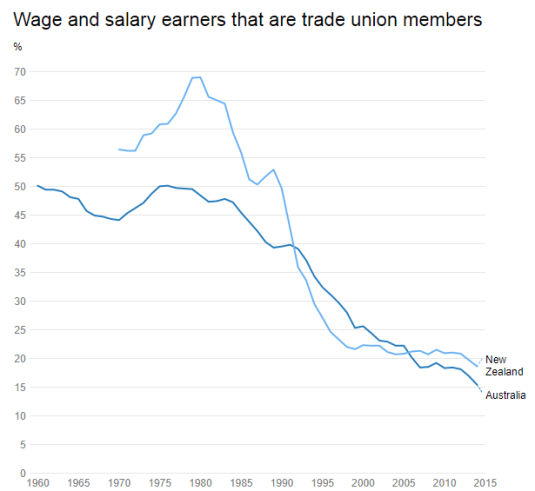
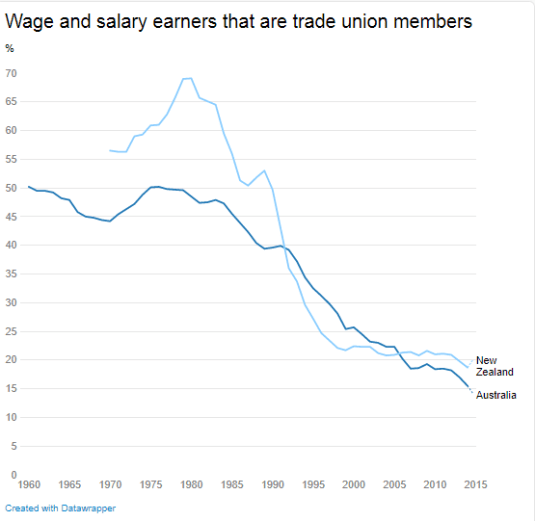
The analysis by the Ministry of the potential effects of unions is out of date. There are now doubts as to whether there is any union wage premium at all. The union wage premium is certainly withering away. Union membership was in freefall until they were saved by the passage of the Employment Contracts Act if simple correlations are to be believed.
Source: OECD Stat Extract.

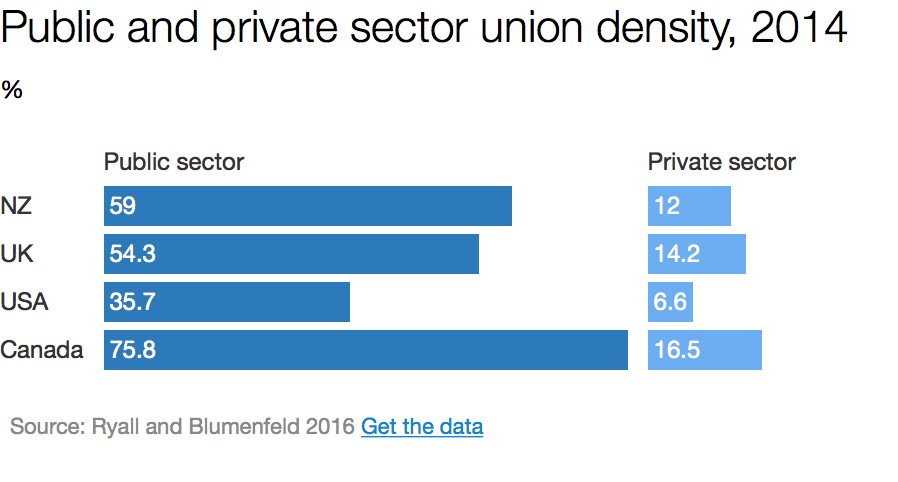
What is clear is unions are dead on their feet in the private sector. Struggling to keep membership in double digits as a share of the private sector workforce both at home and abroad.
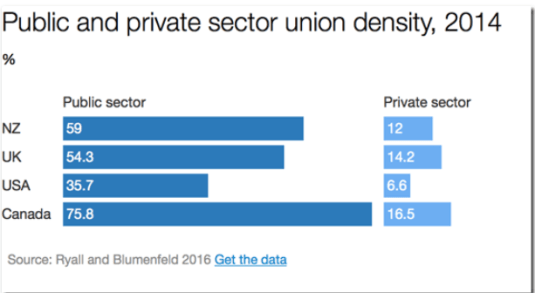
Any predictions about the effects of this amendment to the Employment Relations Act provided to you by the Ministry must be set against that background. How union so far gone in the private sector that this bill is more gesture than a real change to the economy?

We are not living in the 70s where most of the workforce are union members. The advice tended to you by officials may well have had some validity 40 years ago, but not now. Furthermore, the evidence doubting the very existence of a union wage premium is growing in jurisdictions where good data is available.

John DiNardo and David Lee compared business establishments from 1984 to 1999 where US unions barely won the union certification election (e. g., by one vote) with workplaces where the unions barely lost. If 50% plus 1 workers vote in favour of the union proposing to organise them, management must bargain for a collective agreement in good faith with the certified union, if the union loses, management can ignore that union.

Most winning union certification elections resulted in the signing of a collective agreement not long after. Unions who barely win have as good a chance of securing a collective agreement as those unions that win these elections by wide margins.

Importantly, few firms subsequently bargained with a union that just lost the certification election. Employers can choose to recognise a union. Because the vote is so close, a workplace becoming unionised was close to a random event.

This closeness of the union certification election may disentangle unionisation from just being coincident with well-paid workplaces, more skilled workers and well-paid industries. Unions could be organising at highly profitable firms that are more likely to grow and pay higher wages independent of any collective bargaining. The unions are possibly claiming credit for wage rises that would have happened anyway.

DiNardo and Lee found only small impacts of unionisation on all outcomes they examined:

  • The estimated changes for wages of unionisation are close to zero.
  • Impacts on survival rates of the unionised business and their profitability were equally tiny.

This evidence of DiNardo and Lee suggests that in recent decades in the USA, requiring an employer to bargain with a certified union has had little impact because unions have been unsuccessful in winning significant wage gains after unionisation. These findings by DiNardo and Lee suggests that there may not be a union wage premium at all since the early 1980s, at least in the USA.

In another paper DiNardo found a substantial union wage premium before the Second World War by studying the share price effects of unionisation. One of the differences back them that there was far more violence associated with strikes.

We find that strikes had large negative effects on industry stock valuation. In addition, longer strikes, violent strikes, strikes won by the union, strikes leading to union recognition, industry-wide strikes, and strikes that led to wage increases affected industry stock prices more negatively than strikes with other characteristics.

New Zealand and U.S. unions are similar in that both are on their own in bargaining with employers for a wage rise. Options for outside arbitration do not exist in New Zealand; there are some forms of compulsory arbitration in the USA The U.S. result sends a message to New Zealand that unions are a bit of a relic in terms of wage bargaining. MBIE seems to have missed that literature? When there is a literature out there saying that unions have passed into history that must be at least mentioned in passing to this Select Committee.

What the regulatory impact statement should have said

The regulatory impact statement should have said that private-sector unions are few and far between and have little bargaining power. As such, these new laws are unlikely to see a major revival of union membership. There is little evidence that unions have much power to extract higher wages in the private sector.

Summary

In summary, job protection laws reduce wages. For the low paid, they may also reduce employment rates if minimum wage rates are binding. Unions are a dinosaur that do not matter much anymore in the private sector.
Does @_chloeswarbrick believe @PPTAWeb betrays the working class? Are handmaidens of the bosses?

Unions fight for better playing conditions for their members. Is not that what the class war is all about? Unions are not there to act as management consultants to the employer, working out ways to make their wage slaves profitable – extract more labour surplus.

Please do not mention that the employer of teachers is the state sector. That is an argument against unions in the state sector, a very slippery slope.

When the interests of the union and it is teacher members and the interests of children conflict, the union will do what its mission is which is to protect its members.

The first jobs to be unionised were craft jobs. The craft unions certainly foster the marketability of their members but were keen to suppress competition nonetheless. To quote Charles Baird

Most unions in the private sector are in crafts and industries that have few companies or that are concentrated in one region of the country. This makes sense. Both factors—few employers and regionally concentrated employers—make organizing easier. Conversely, the large number of employers and the regional dispersion of employers sharply limit unionization in trade, services, and agriculture. A 2002 unionization rate of 37.5 percent in the government sector, more than four times the 8.5 percent rate in the private sector, further demonstrates that unions do best in heavily regulated, monopolistic environments. Even within the private sector, the highest unionization rates (23.8 percent) are in transportation (airlines, railroads, trucking, urban transit, etc.) and public utilities (21.8 percent), two heavily regulated industries.

Craft unions opposed unionisation of less skilled workers because it threatens their own ability to extract higher wages as explained in the Wikipedia entry:

The concept of organizing a strong federation on the basis of craft evolved out of conflict between the Knights of Labor (KOL), which organized mass organizations of unskilled, semiskilled and skilled workers by territory, and the American Federation of Labor (AFL), which organized only skilled workers.[1] The craft workers were capable of demanding more from their employers due to their skills, and therefore organized into stronger organizations pursuing narrower interests.[2] The AFL was formed as a direct result of the perceived need by skilled workers to defend their individual craft organizations from poaching by the Knights of Labor.[3] The Knights of Labor believed that skilled workers should dedicate their greater leverage to benefit all workers.[4] Selig Perlman wrote in 1923 that this resulted in “a clash between the principle of solidarity of labor and that of trade separatism.”[2] The trade unions “declared that their purpose was ‘to protect the skilled trades of America from being reduced to beggary’.”[5]… As long as the craft unions were the dominant power in the AFL, they took every step possible to block the organizing of mass production industries. This led to challenges from both inside and outside the Federation.

The craft unions such as teachers unions have more bargaining power because they are difficult to replace on short notice unlike less skilled workers. In addition, teachers are much more difficult to automate away. I am not too sure what the teachers union might think of giving more responsibility to teachers aides?

The 30 Mile Zone That Explains Why Hollywood Exists

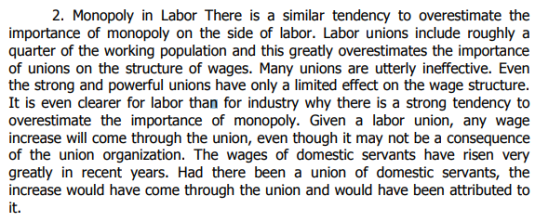
Milton Friedman did not see much of a threat from unions

Source: Capitalism and Freedom.

Was @MBIEgovtnz misreported on the effects of job protection laws and unions? @EricCrampton

News reports have it that the regulatory impact statement on the new employment law amendments by the new government says that:

The bill aims to strengthen collective bargaining through a range of measures, including guaranteed rest and meal breaks, reasonable union access to a workplace, and bringing back the 30-day rule where a new worker has to be given the same conditions as a collective agreement.

MBIE officials found that the cost of the proposals would mainly fall on employers, including from higher wages and compliance costs, and from a potential fall in productivity.

The MBIE papers identified the following risks associated with the bill:
• reduced employment due to changed incentives on employers to hire new workers • an increase in industrial action and protracted bargaining due to the need to conclude agreements and include pay rates in collective agreements
• an increase in partial strikes by removing an employer’s ability to deduct pay for partial striking
• lower productivity due to less flexibility (mainly from the need for guaranteed meal breaks)

These predictions must be a misreporting of an earlier draft by a junior analyst, perhaps they were not a recruit with a background in economics. The predictions of the effects of employment protection laws and union bargaining seem to be wrong for the former and seriously out of date for the latter.

Let us begin with what are the standard predictions of the effect of employment protection laws. They lower wages and have an ambiguous effect on employment because there is both less hiring and less firing. The only unambiguous effect is on the duration of unemployment because fewer vacancies are posted but once you get a job, you keep it for longer.

To give a summary of the literature that appears to be unknown to the junior analyst writing this early draft, graduate textbooks in labour economics show that a wide range of studies have found that:

1. Employment law protections make it more costly to both hire and fire workers.

2. The rigour of employment law has no great effect on the rate of unemployment. That being the case, stronger employment laws do not affect unemployment by much.

3. What is clear is that is more rigourous employment law protections increase the duration of unemployment spells. With fewer people hired, it takes longer to find a new job.

4. Stronger employment law protections also reduce the number of young people and older workers who hold a job. They are outside looking in on a privileged subsection of insiders in the workforce who have stable, long-term jobs and who change jobs infrequently.

The impact of the introduction of trial periods on employment will be ambiguous because the lack of a trial period can be undone by wage bargaining.

  • If you have to hire a worker with full legal protections against dismissal, you pay them less because the employer is taking on more of the risk if the job match goes wrong. If they work out, you promote them and pay them more.
  • If you hire a worker on a trial period, they may seek a higher wage to compensate for taking on more of the risks if the job match goes wrong and there is no requirement to work it out rather than just sack them.

The twist in the tail is whether there is a binding minimum wage. If there is a binding minimum wage,  either the legal minimum or in a collective bargaining agreement, the employer cannot reduce the wage offer to offset the hiring risk so fewer are hired. The introduction of trial periods will affect both wages and employment and employment more in industries that has low pay or often pay the minimum wage.

Trial periods are common in OECD countries. There is plenty of evidence that increased job security leads to less employee effort and more absenteeism. Some examples are:

  • Sick leave spiking straight after probation periods ended;
  • Teacher absenteeism increasing after getting tenure after 5-years; and
  • Academic productivity declining after winning tenure.

Jacob (2013) found that the ability to dismiss teachers on probation – those with less than five years’ experience – reduced teacher absences by 10% and reduced frequent absences by 25%.

Studies also show that where workers are recruited on a trial, employers have to pay higher wages. For example, teachers that are employed with less job security, or with longer trial periods are paid more than teachers that quickly secure tenure.

If employers take on more of the risk of a job match going wrong, they will pay recruits less. They can have a promotion round 6 or 12 months where pay is topped up if there is a good match. If minimum wage laws prevent starting salaries going low enough, there will be fewer job vacancies. But higher up the wage scales, the main effect of employment protection laws is to lower wages because the employer expects a wage discount to compensate for taking on more risk of an unsuccessful job match.

Consider, as an example, if there is a requirement to pay redundancy pay. Employers can easily undo this legal requirement by reducing wages. Another similarity is where employers pay completion bonuses on an offshore posting. They back-load compensation to make up for uncertainties about the willingness of the worker to last the posting. Because wages are lower for the duration of the posting, employees expect a big bonus. Also, there is self-selection, recruits are more likely to be those intending to stay for the whole posting. Both the employer and the employee split the greatest surplus from higher quality and longer lasting job matches arising from offering a completion bonus.

The analysis by the Ministry of the potential effects of unions is out of date. There are now doubts as to whether there is any union wage premium at all. The union wage premium is certainly withering away.

John DiNardo and David Lee compared business establishments from 1984 to 1999 where US unions barely won the union certification election (e. g., by one vote) with workplaces where the unions barely lost. If 50% plus 1 workers vote in favour of the union proposing to organise them, management has to bargain for a collective agreement in good faith with the certified union, if the union loses, management can ignore that union.

Most winning union certification elections resulted in the signing of a collective agreement not long after. Unions who barely win have as good a chance of securing a collective agreement as those unions that win these elections by wide margins.

Importantly, few firms subsequently bargained with a union that just lost the certification election. Employers can choose to recognise a union. Because the vote is so close, a particular workplace becoming unionised was close to a random event.

This closeness of the union certification election may disentangle unionisation from just being coincident with well-paid workplaces, more skilled workers and well-paid industries. Unions could be organising at highly profitable firms that are more likely to grow and pay higher wages independent of any collective bargaining. The unions are possibly claiming credit for wage rises that would have happened anyway.

DiNardo and Lee found only small impacts of unionisation on all outcomes they examined:

  • The estimated changes for wages of unionisation are close to zero.
  • Impacts on survival rates of the unionised business and their profitability were equally tiny.

This evidence of DiNardo and Lee suggests that in recent decades in the USA, requiring an employer to bargain with a certified union has had little impact because unions have been unsuccessful in winning significant wage gains after unionisation. These findings by DiNardo and Lee suggests that there may not be a union wage premium at all since the early 1980s, at least in the USA.

In another paper DiNardo found a substantial union wage premium before the Second World War by studying the share price effects of unionisation. One of the differences back them that there was far more violence associated with strikes.

We find that strikes had large negative effects on industry stock valuation. In addition, longer strikes, violent strikes, strikes won by the union, strikes leading to union recognition, industry-wide strikes, and strikes that led to wage increases affected industry stock prices more negatively than strikes with other characteristics.

New Zealand and U.S. unions are similar in that both are on their own in bargaining with employers for a wage rise. Options for outside arbitration do not exist in New Zealand; there are some forms of compulsory arbitration in the USA. These US result sends a message to New Zealand that unions are a bit of a relic in terms of wage bargaining. MBIE seems to have missed that literature?

In summary, job protection laws reduce wages. For the low paid, they may also reduce employment rates if minimum wage rates are binding. Unions are a dinosaur that do not matter much anymore.


Union membership stopped falling after the passage of Employment Contracts Act

Data extracted on 28 Aug 2017 05:36 UTC (GMT) from OECD.Stat.

Labor and Unions – Murray N Rothbard

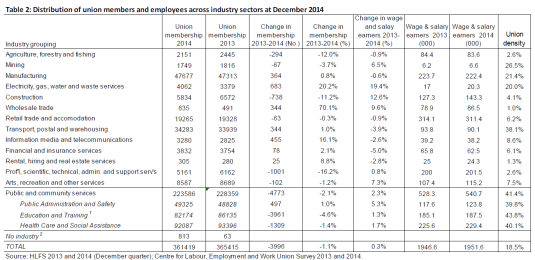
Union membership by sector in New Zealand

Source: The state of New Zealand Union membership in 2014, Sue Ryall and Stephen Blumenfeld.

Image

Public and private sector union membership

public and private sector union membership in New Zealand and abroad

Image

Information costs in the labour market

Every worker, even the low-paid worker, is alert to their opportunities and take the best jobs that come to their notice but it is gaps in their information is the sand in the wheels of this search. As Manning (2005) observed in his superb Monopsony in Motion:

That important frictions exist in the labor market seems undeniable: people go to the pub to celebrate when they get a job rather than greeting the news with the shrug of the shoulders that we might expect if labor markets were frictionless. And people go to the pub to drown their sorrows when they lose their job rather than picking up another one straight away. The importance of frictions has been recognized since at least the work of Stigler (1961, 1962) (Manning 2005, p. 4).

The left has a certain view of how the labour market works and how to best move workers into better paying jobs. Standing against this are arguments that it is a want of information rather than weak bargaining power is what slows workers down from moving to a better job. As Stigler (1961, 1962) argued, information is costly to obtain in the labour market:

No worker, unless his degree of specialization is pathological, will ever be able to become informed on the prospective earnings which would be obtained from every one of these potential employers at any given time, let alone keep this information up to date. He faces the problem of how to acquire information on the wage rates, stability of employment, conditions of employment, and other determinants of job choice, and how to keep this information current (Stigler 1962, p. 94).

The left accepts that low-paid workers respond actively to news of better paying job opportunities. They do this by arguing that a living wage improves the quality of recruitment pools. More workers apply for the living wage vacancies on the news of a living wage policy. Fewer employees quit and they work harder in response to a living wage.

image

Activists should mind how they go by stressing an inequality of bargaining power but also letting through the door even one market discipline such as a sensitivity of wage offers and profits to job turnover rates:

Let us consider the extreme case of highly specialized, non-versatile labor. If we consider (a) the continuous replacement of personnel who gradually leave through competing employment openings, retirement and death, and (b) (in an expanding industry) the recruitment needed for expansion, we must recognize that the probability of the workers’ exploitation is remote. The observable labor turnover between firms suggests indeed that collusive action to reduce the price of labor has virtually never been regarded as profitable (Hutt 1973, p. 4).

But not every worker knows there are better paying options which may be even just a few steps away from their current job. Information costs are a better explanation than pinning everything on an inequality in bargaining power. This is because information costs have a profound impact on labour market workings (Stigler 1962; Alchian 1969; Alchian and Allen 1967, 1983). For unequal bargaining power to keep the wages of the low-paid down, collusion must succeed between a great many employers recruiting across many industry and occupational labour markets (Hutt 1973, Alchian and Allen 1983).

More insight is gleaned from the fact that job seekers do not initially know the location of suitable vacancies, the wages for various skills, differences in job security and other factors. They must find this knowledge, keep it current and forecast whether better vacancies may open soon. Employers must learn the location, availability and asking wages of suitable applicants.

Long-term contracts arise to share risks and curb opportunism over sunken investments in specialised human capital. These factors lead to queues, unemployment, spare capacity, layoffs, shortages, inventories and non-price rationing in conjunction with wage rigidity (Alchian 1969; Alchian and Allen 1967, 1983). Labour market analysis must stay within McCloskey’s maxim that

Every piece of economic analysis is not complete until everyone is earning only normal profits, or at least the analyst can identify a reason why not (McCloskey 1985).

The labour market has good and bad jobs, the jobs that can pay more than or less than the going rate, resulting from the costs of job search and matching. These good and bad jobs arise from the element of chance in every job search and job match rather than betting it all on an enduring employer conspiracy to keep wages down. Some workers are paid less than the going rate because they are down on their luck rather than under the thumb.

The compassion of unions towards the minimum waged

image

Source: page 451 and page 828 of the 3rd edition (1972) of University Economics by Armen Alchian and William Allen; the first part of the quotation is Question #30 at the end of Chapter 22. via Bonus Quotation of the Day… – Cafe Hayek

Previous Older Entries Next Newer Entries

Bassett, Brash & Hide

Celebrating humanity's flourishing through the spread of capitalism and the rule of law

Truth on the Market

Scholarly commentary on law, economics, and more

The Undercover Historian

Beatrice Cherrier's blog

Matua Kahurangi

Celebrating humanity's flourishing through the spread of capitalism and the rule of law

Temple of Sociology

Celebrating humanity's flourishing through the spread of capitalism and the rule of law

Velvet Glove, Iron Fist

Celebrating humanity's flourishing through the spread of capitalism and the rule of law

Why Evolution Is True

Why Evolution is True is a blog written by Jerry Coyne, centered on evolution and biology but also dealing with diverse topics like politics, culture, and cats.

Down to Earth Kiwi

Celebrating humanity's flourishing through the spread of capitalism and the rule of law

NoTricksZone

Celebrating humanity's flourishing through the spread of capitalism and the rule of law

Homepaddock

A rural perspective with a blue tint by Ele Ludemann

Kiwiblog

DPF's Kiwiblog - Fomenting Happy Mischief since 2003

The Dangerous Economist

Celebrating humanity's flourishing through the spread of capitalism and the rule of law

Watts Up With That?

The world's most viewed site on global warming and climate change

The Logical Place

Tim Harding's writings on rationality, informal logic and skepticism

Doc's Books

A window into Doc Freiberger's library

The Risk-Monger

Let's examine hard decisions!

Uneasy Money

Commentary on monetary policy in the spirit of R. G. Hawtrey

Barrie Saunders

Thoughts on public policy and the media

Liberty Scott

Celebrating humanity's flourishing through the spread of capitalism and the rule of law

Point of Order

Politics and the economy

James Bowden's Blog

A blog (primarily) on Canadian and Commonwealth political history and institutions

Science Matters

Reading between the lines, and underneath the hype.

Peter Winsley

Economics, and such stuff as dreams are made on

A Venerable Puzzle

"The British constitution has always been puzzling, and always will be." --Queen Elizabeth II

The Antiplanner

Celebrating humanity's flourishing through the spread of capitalism and the rule of law

Bet On It

Celebrating humanity's flourishing through the spread of capitalism and the rule of law

History of Sorts

WORLD WAR II, MUSIC, HISTORY, HOLOCAUST

Roger Pielke Jr.

Undisciplined scholar, recovering academic

Offsetting Behaviour

Celebrating humanity's flourishing through the spread of capitalism and the rule of law

JONATHAN TURLEY

Res ipsa loquitur - The thing itself speaks

Conversable Economist

Celebrating humanity's flourishing through the spread of capitalism and the rule of law

The Victorian Commons

Researching the House of Commons, 1832-1868

The History of Parliament

Articles and research from the History of Parliament Trust

Books & Boots

Reflections on books and art

Legal History Miscellany

Posts on the History of Law, Crime, and Justice

Sex, Drugs and Economics

Celebrating humanity's flourishing through the spread of capitalism and the rule of law

European Royal History

Exploring the Monarchs of Europe

Tallbloke's Talkshop

Cutting edge science you can dice with

Marginal REVOLUTION

Small Steps Toward A Much Better World

NOT A LOT OF PEOPLE KNOW THAT

“We do not believe any group of men adequate enough or wise enough to operate without scrutiny or without criticism. We know that the only way to avoid error is to detect it, that the only way to detect it is to be free to inquire. We know that in secrecy error undetected will flourish and subvert”. - J Robert Oppenheimer.

STOP THESE THINGS

The truth about the great wind power fraud - we're not here to debate the wind industry, we're here to destroy it.

Lindsay Mitchell

Celebrating humanity's flourishing through the spread of capitalism and the rule of law

Alt-M

Celebrating humanity's flourishing through the spread of capitalism and the rule of law

croaking cassandra

Economics, public policy, monetary policy, financial regulation, with a New Zealand perspective

The Grumpy Economist

Celebrating humanity's flourishing through the spread of capitalism and the rule of law

International Liberty

Restraining Government in America and Around the World