Union membership by sector in New Zealand
28 Apr 2017 Leave a comment
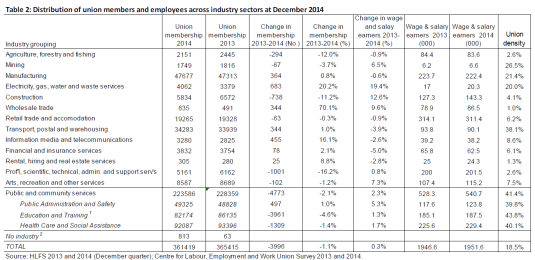
Source: The state of New Zealand Union membership in 2014, Sue Ryall and Stephen Blumenfeld.
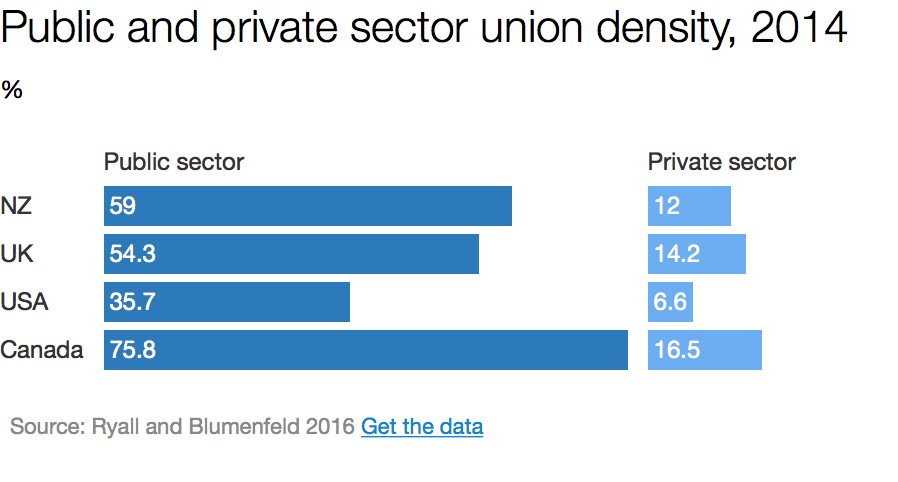
Information costs in the labour market
31 Jan 2017 Leave a comment
in job search and matching, labour economics, labour supply, minimum wage, unions Tags: inequality of bargaining power, job matching, job search, monopsony

Every worker, even the low-paid worker, is alert to their opportunities and take the best jobs that come to their notice but it is gaps in their information is the sand in the wheels of this search. As Manning (2005) observed in his superb Monopsony in Motion:
That important frictions exist in the labor market seems undeniable: people go to the pub to celebrate when they get a job rather than greeting the news with the shrug of the shoulders that we might expect if labor markets were frictionless. And people go to the pub to drown their sorrows when they lose their job rather than picking up another one straight away. The importance of frictions has been recognized since at least the work of Stigler (1961, 1962) (Manning 2005, p. 4).
The left has a certain view of how the labour market works and how to best move workers into better paying jobs. Standing against this are arguments that it is a want of information rather than weak bargaining power is what slows workers down from moving to a better job. As Stigler (1961, 1962) argued, information is costly to obtain in the labour market:
No worker, unless his degree of specialization is pathological, will ever be able to become informed on the prospective earnings which would be obtained from every one of these potential employers at any given time, let alone keep this information up to date. He faces the problem of how to acquire information on the wage rates, stability of employment, conditions of employment, and other determinants of job choice, and how to keep this information current (Stigler 1962, p. 94).
The left accepts that low-paid workers respond actively to news of better paying job opportunities. They do this by arguing that a living wage improves the quality of recruitment pools. More workers apply for the living wage vacancies on the news of a living wage policy. Fewer employees quit and they work harder in response to a living wage.
Activists should mind how they go by stressing an inequality of bargaining power but also letting through the door even one market discipline such as a sensitivity of wage offers and profits to job turnover rates:
Let us consider the extreme case of highly specialized, non-versatile labor. If we consider (a) the continuous replacement of personnel who gradually leave through competing employment openings, retirement and death, and (b) (in an expanding industry) the recruitment needed for expansion, we must recognize that the probability of the workers’ exploitation is remote. The observable labor turnover between firms suggests indeed that collusive action to reduce the price of labor has virtually never been regarded as profitable (Hutt 1973, p. 4).
But not every worker knows there are better paying options which may be even just a few steps away from their current job. Information costs are a better explanation than pinning everything on an inequality in bargaining power. This is because information costs have a profound impact on labour market workings (Stigler 1962; Alchian 1969; Alchian and Allen 1967, 1983). For unequal bargaining power to keep the wages of the low-paid down, collusion must succeed between a great many employers recruiting across many industry and occupational labour markets (Hutt 1973, Alchian and Allen 1983).

More insight is gleaned from the fact that job seekers do not initially know the location of suitable vacancies, the wages for various skills, differences in job security and other factors. They must find this knowledge, keep it current and forecast whether better vacancies may open soon. Employers must learn the location, availability and asking wages of suitable applicants.
Long-term contracts arise to share risks and curb opportunism over sunken investments in specialised human capital. These factors lead to queues, unemployment, spare capacity, layoffs, shortages, inventories and non-price rationing in conjunction with wage rigidity (Alchian 1969; Alchian and Allen 1967, 1983). Labour market analysis must stay within McCloskey’s maxim that
Every piece of economic analysis is not complete until everyone is earning only normal profits, or at least the analyst can identify a reason why not (McCloskey 1985).
The labour market has good and bad jobs, the jobs that can pay more than or less than the going rate, resulting from the costs of job search and matching. These good and bad jobs arise from the element of chance in every job search and job match rather than betting it all on an enduring employer conspiracy to keep wages down. Some workers are paid less than the going rate because they are down on their luck rather than under the thumb.
The compassion of unions towards the minimum waged
24 Jan 2017 1 Comment
in labour economics, minimum wage, poverty and inequality, unemployment, unions Tags: do gooders, The fatal conceit, The pretense to knowledge
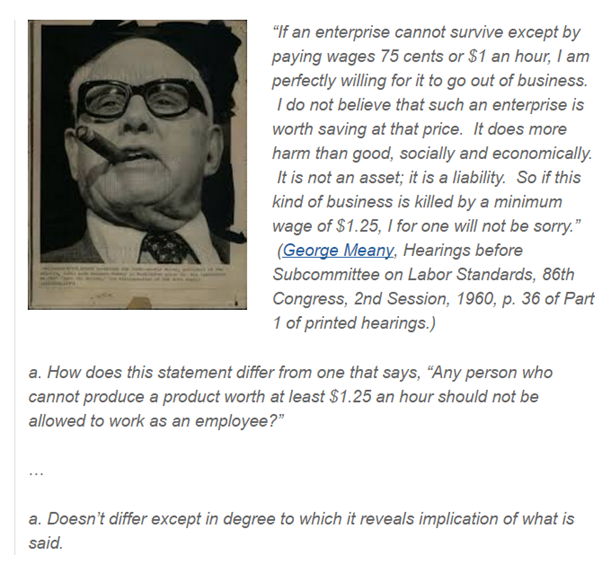
Source: page 451 and page 828 of the 3rd edition (1972) of University Economics by Armen Alchian and William Allen; the first part of the quotation is Question #30 at the end of Chapter 22. via Bonus Quotation of the Day… – Cafe Hayek
Don Bordeaux was right! Monopsony is a great business opportunity
27 Oct 2016 Leave a comment
in industrial organisation, labour economics, labour supply, unions Tags: inequality of bargaining power, job search, monotony power, search and matching
What would you do if you could cut your prices by 25% and still make a profit? Suppose you could pay your workers 25% more, recruit the best and brightest, still make a profit and greatly expand your business and bottom line?
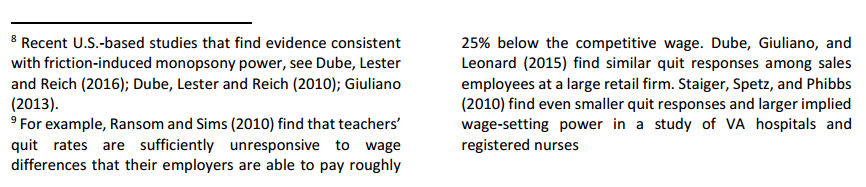
A survey on monopsony power of employers by the Council of Economic Advisors at the White House suggests that this is so. Employers are paying up to 25% below the competitive wage.
Don Bordeaux has repeatedly pointed out that monopsony power is a marvellous business opportunity:
whenever I encounter the assertion that minimum-wage legislation is justified because employers of low-skilled workers allegedly possess monopsony power, I point out to those who assert the existence in reality of monopsony power as a reason to impose a minimum wage that their assertion implies the existence of profit opportunities for anyone who enters the market to hire away these allegedly underpaid workers.
So I ask those who assert that monopsony power is real and relevant to start their own businesses to give solid evidence of the strength of their belief.
The best and brightest in many occupational labour markets underpaid by a 25% according to the literature survey by the Council of Economic Advisors. This means a budding entrepreneur could recruit a top-quality labour force and still make a big profit by paying a bit more than the current wage in his industry
Just in case you are a novice at starting a business, Bordeaux was good enough to identify a consultant willing to provide advice on how you can seize this resistant, no but untapped opportunity for long run super-normal profits:
I know a very successful and savvy businessman in California, Mike Long – a man of enormous integrity and experience – who stands ready to share with you his time, expertise, and counsel in order to guide you in starting and operating your own businesses. All you need do is to supply some of your own seed capital – say, a minimum of $25,000 – and Mike will help guide you to launch and run your business in order to take advantage of the profit opportunity that your identification of monopsony power implies is available for the taking.
Mike can even share with you his knowledge of how to get from the capital markets any additional financing you might need.
Almost every market failure is a business opportunity including market power of employers over workers as Bordeaux explains
In short, monopsony power in labor markets keep workers underpaid. With all those underpaid workers out there – and because there are no government-enforced prohibitions on starting companies that employ low-skilled workers – a true believer that monopsony power is a prevalent reality can profit by exploiting this pool of underpaid workers. Yet they do not. They remain in their faculty offices writing papers and issuing commentary. I continue to insist that this inaction is sufficient evidence against the proposition that monopsony power prevails in the market for low-skilled workers – and, hence, conclusive evidence that the higher the minimum wage, the worse are the job prospects of low-skilled workers.
If an academic tells you that his research finds that the price of Acme Corp. stock – a stock traded, say, on the NYSE – is too low, what would be the first question you ask this scholar? The first question I would ask him is “How much of that stock are you buying?” If the scholar tells me “none,” or looks at me befuddled as he explains that he’s an academic and not an investor, I would dismiss his research on this front. That person, as I see him here, offers proof as good as it gets that he does not believe what he asserts.
Just as identifying systematically undervalued shares as an opportunity for critics of the efficient markets hypothesis to profit, those who believe the competition in the labour market is less than it should jump in and exploit those walkers for themselves.
They can assuage their consciousness by knowing that they are exploiting these workers by paying them more than the other exploiting employers currently do.This is no more than a variation of the argument that if workers are underpaid, they can establish a workers co-operative to buy out their employer, pay themselves more and still profit.
One of the curios of the monopsony argument is it was originally based on company towns exploiting the captive labour market in the old mining days.
Trouble is that modern research showed the company towns where the employer owned the houses and rented them to employees was a way of showing would-be recruits that they would not exploit them. Because the worker did not have to buy a house or sign a lease to go to the company town, he could quit at any time and not be trapped in a lease or mortgage that locked him into his current job. Tabarrok explains
On the one hand, this did mean that during a lengthy strike the firm could evict the workers from their housing. On the other hand, would you want to buy a house in an isolated town dependent on a single industry? Would you want to own a major asset that was likely to fall in price at the same time that you were likely to lose your job? Probably not.
Rental housing meant that workers had the freedom to leave town easily when better work opportunities were available elsewhere – i.e., it meant that the workers were less isolated from the national labor market than they would be if they owned their homes and were tied down to a single place and a single employer
What brought company towns to their knees were something as simple as the widespread ownership of an automobile. These days, employers have to offer large inducements to get workers to move to isolated places to work. That includes accommodation and various other premiums over the going rate in the industry.
Labour economics is falling to the same trap industrial organisation fell into in the mid-20th century when it encounters phenomena which it has trouble explaining as Coase said at the time:
One important result of this preoccupation with the monopoly problem is that if an economist finds something—a business practice of one sort or other—that he does not understand, he looks for a monopoly explanation. And as in this field we are very ignorant, the number of ununderstandable practices tends to be rather large, and the reliance on a monopoly explanation, frequent.
Economists’ understanding of industrial organisation improved greatly when it started studying contracting in greater detail, especially long-term contracting. Labour economists are doing the same when they consider search and matching as a better explanation of how the labour market works. The monopsony argument is fragile when closely examined as Kuhn said:
… as Manning himself acknowledges, if matching is balanced (which effectively amounts to constant returns to scale in the technology for recruiting new workers), all elements of monopsony disappear from the model and the neoclassical equilibrium again prevails: in the long run firms can expand without limit without needing to raise their wages.
Thus it is absolutely critical to the search-based monopsony model at the core of this book that there be diminishing returns to scale in the technology for recruiting new workers. In other words, for the theory to apply, firms must find it harder to recruit a single new worker the larger the absolute number of workers they currently employ.
Alan Manning wrote a great book called Monopsony in Motion: Imperfect Competition in Labor Markets but in a great review of it, Peter Kuhn said
The key point seems to be that the title Search Models with Ex-Ante Posted Wages in Motion, while considerably more accurate than Manning’s, is certainly less catchy.
How to show that unions & income inequality are unrelated when attempting to show a link
22 Sep 2016 Leave a comment
in human capital, labour economics, labour supply, politics - USA, unions Tags: superstar wages, superstars, top 1%
Fight for $15 tried to show a link between unions and rising income inequality but all it managed to show that unions went into decline several decades before inequality started to rise.
Is the union wage premium negative in New Zealand? @FairnessNZ
07 Sep 2016 Leave a comment
in economics of education, labour economics, unions

Best defence of Employment Contracts Act is a @FairnessNZ graphic
24 Jul 2016 1 Comment
in economic growth, economic history, labour economics, macroeconomics, politics - New Zealand, unions Tags: economic reform, Employment Contracts Act, employment protection laws, employment regulation, Leftover Left, neoliberalism, pessimism bias
Source: Low Wage Economy | New Zealand Council of Trade Unions – Te Kauae Kaimahi, with extra annotations by this blogger.
Few of the top 50 billionaires inherited their wealth
01 Jun 2016 Leave a comment
in applied price theory, applied welfare economics, economic history, entrepreneurship, financial economics, human capital, labour economics, poverty and inequality, unions Tags: entrepreneurial alertness, inherited wealth, superstar wages, superstars, top 0.1%, top 1%
Of the 15 inheritance based billionaires, three are from the Walton family, two are the Koch brothers and another three are from the Mars family.

Source: The world’s top 50 billionaires: A demographic breakdown.
US union membership in public and private sectors and federal, state and local governments since 1983
15 Mar 2016 Leave a comment
in economic history, labour economics, unions Tags: public sector unions, union membership, union power
Unions are dead on their feet in the private sector in the USA but going strong as ever in the public sector, especially in local government.

Source: Bureau of Labour Statistics Table 3. Union affiliation of employed wage and salary workers by occupation and industry
#TPPA CTU @FairnessNZ appeals to secretive @ILO committee to challenge NZ sovereignty over employment law
09 Mar 2016 Leave a comment
in constitutional political economy, international economic law, International law, law and economics, unions Tags: Left-wing hypocrisy, union power
The unions are very much against investor state dispute settlement provisions of trade agreements, but are happy to be serial complainants to secretive International Labour Organisation (ILO) committees about employment law amendments they do not like. A fair defeat in the floor of parliament was not good enough for them.
As far back as 1993 the Council of Trade Unions has complained to secretive ILO committees about labour market deregulation in New Zealand. These secretive committees are formed under ILO conventions in New Zealand signed decades go.

The competence of these ILO committees are clearly in question if they hear an appeal under a convention New Zealand has not ratified. Imagine the outrage if an investor state dispute settlement panel heard on appeal despite New Zealand having a carve-out for the topic concerned. An example would be tobacco regulation.
Justice Scalia has a fine critique of those who believe in activist judges and living constitutions that applies just as well as to activist international adjudicators and living international treaties:
You think there ought to be a right to abortion? No problem. The Constitution says nothing about it. Create it the way most rights are created in a democratic society. Pass a law. And that law, unlike a Constitutional right to abortion created by a court can compromise. It can…I was going to say it can split the baby! …A Constitution is not meant to facilitate change. It is meant to impede change, to make it difficult to change.
Rather than use normal democratic means – trying to persuade each other and elections – the union movement threatened to go to a secretive ILO committee made up of members of uncertain competence and impartiality over the recent laws on collective bargaining.

The union movement was outraged at the fact that New Zealand laws it likes could be questioned at international forums. It said this in a recent submission to the Health Select Committee of Parliament.
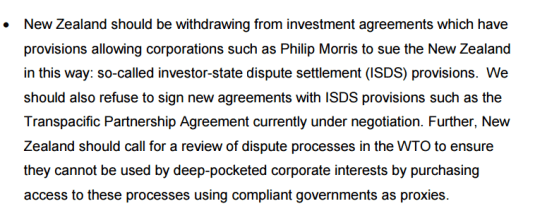
The unions were equally outraged about dispute settlement procedures in the recent free trade agreement with Korea. The unions were absolutely affronted at the idea that the sovereignty of the New Zealand Parliament could be challenged at a foreign forum.
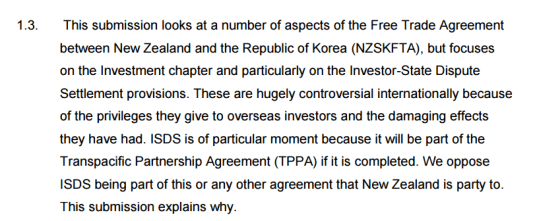
Source: Submission of the New Zealand Council of Trade Unions Te Kauae Kaimahi to the Foreign Affairs, Defence and Trade Select Committee on the Free Trade Agreement between New Zealand and the Republic of Korea, Wellington 24 April 2015.
These protestations of the union movement would have much more credibility if union did not run off to a UN or ILO committee every time they were on the losing side of a vote in parliament. The unions are happy with those parts of international economic law that serve its interests but behave hypocritical about the other parts that do not. As United States Supreme Court Justice Antonin Scalia said
The virtue of a democratic system [with a constitutionally guaranteed right to free speech] is that it readily enables the people, over time, to be persuaded that what they took for granted is not so and to change their laws accordingly.
Nothing stirs up the impassioned (and most other people as well) more than depriving them of their right to support or oppose what is important to them through political campaigns and at an election.
The losing side, and we all end up on the losing side at one time or another, are much more likely to accept an outcome if they had their say and simply lost the vote at the election or in Parliament. Power to the people as long as I am on the winning side instead is the motto of the union movement.
The unions losing on labour market deregulation is no different from any other political difference within New Zealand. Both sides passionately but respectfully attempt to persuade their fellow citizens to accept their views.
Win or lose, advocates for today’s losing causes can continued pressing their cases, secure in the knowledge that an electoral loss today can be negated by a later electoral win, which is democracy in action as Justice Kennedy explained recently in the US context:
…a democracy has the capacity—and the duty—to learn from its past mistakes; to discover and confront persisting biases; and by respectful, rationale deliberation to rise above those flaws and injustices…
It is demeaning to the democratic process to presume that the voters are not capable of deciding an issue of this sensitivity on decent and rational grounds.
The process of public discourse and political debate should not be foreclosed even if there is a risk that during a public campaign there will be those, on both sides, who seek to use racial division and discord to their own political advantage.
An informed public can, and must, rise above this. The idea of democracy is that it can, and must, mature. Freedom embraces the right, indeed the duty, to engage in a rational, civic discourse in order to determine how best to form a consensus to shape the destiny of the Nation and its people. These First Amendment dynamics would be disserved if this Court were to say that the question here at issue is beyond the capacity of the voters to debate and then to determine.
Inequality is not getting worse and worse says @WJRosenbergCTU!?
09 Mar 2016 Leave a comment
in economic growth, economic history, politics - New Zealand, unions
Bill Rosenberg of the Council of Trade Unions is one of many economists who point out that income inequality has not been getting worse and worse in New Zealand since the 1990s. Inequality rose sharply in the late 1980s and early 90s but has remained high but nevertheless stable since then as he says in his 2014 paper of trends in living standards:
This is another symptom of the sharp rise in income inequality between the mid 1980s and mid 1990s, which remains high.
His employer, the Council of Trade Unions when it was denouncing the Employment Contracts Act 1991 as the reason for low wages growth has also drawn attention to the early 1990s as a turning point in the relationship between inequality, union bargaining power and wages growth.
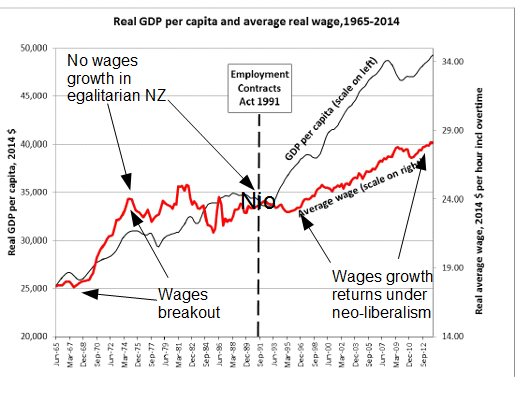
As the Council of Trade Unions showed in the chart it published during the last election campaign, which I snapshoted below and also annotated, from 1970 to 1975 there was rapid real wages growth, well in excess of real growth in per capita GDP. This wages breakout was followed by some ups and downs but essentially wages in 1995 were no higher per hour from what they were in 1975. Real wages were about $24 per hour in real terms in New Zealand for about 20 years – from 1975 to 1995.
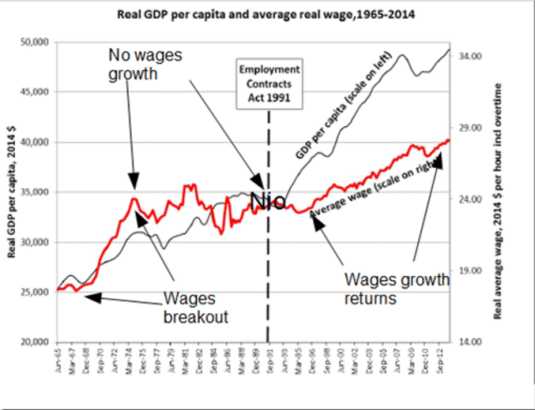
There was no real GDP per capita growth from 1975 until 1979 nor in the five years leading up to the passage of the Employment Contracts Act 1991. The period leading up to 1975 wages breakout wages was the zenith of union membership; nearly 70% of all workers belonging to a union. Less than 20% do now and less than 10% in the private sector.
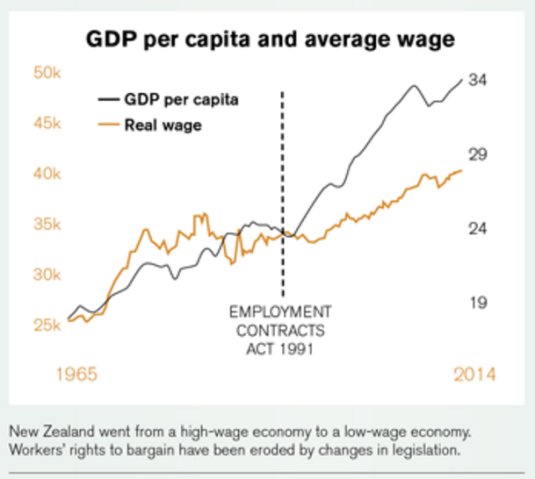
Source: Income Gap | New Zealand Council of Trade Unions – Te Kauae Kaimahi.
After staying at about $24 per hour for 20 years from 1975 to the early 1990s, following the passage of the Employment Contracts Act in 1991, average wages in New Zealand have increased steadily from $24 an hour to about $28 per hour by 2014 in one of the most deregulated labour markets in the world.
As Rosenberg, who is chief economist at the Council of Trade Unions, and the Council of Trade Unions itself pointed out, there were major changes in the New Zealand economy in terms of inequality of incomes and union bargaining power in the late 80s and early 1990s.
These changes referred to by the unions as an erosion of workers bargaining power, brought an end to wage stagnation. Steady real wages growth returned after two lost decades: next to no growth in either GDP per capita or incomes of workers.
Harvard business School survey discovers that workers want more
12 Feb 2016 Leave a comment
in human capital, labour economics, labour supply, occupational choice, personnel economics, poverty and inequality, unions Tags: compensating differentials, union wage premium, unions

F A Hayek – Unemployment And The Free Market
12 Feb 2016 Leave a comment
in applied price theory, Austrian economics, business cycles, economic growth, F.A. Hayek, fiscal policy, job search and matching, labour economics, labour supply, macroeconomics, unemployment, unions Tags: job search, mismatch unemployment, search unemployment, union power, union wage premium, waiting unemployment


Recent Comments