British union membership is very much a public sector phenomena. Outside of the public sector, union membership is low but stable for 20 years now.
Source: Office of National Statistics, Trade Union Membership 2014
Celebrating humanity's flourishing through the spread of capitalism and the rule of law
15 Dec 2015 Leave a comment
in economic history, labour economics, unions Tags: British economy, union membership, union power, union wage premium
British union membership is very much a public sector phenomena. Outside of the public sector, union membership is low but stable for 20 years now.
Source: Office of National Statistics, Trade Union Membership 2014
14 Dec 2015 Leave a comment
in economic history, economics of bureaucracy, labour economics, politics - USA, Public Choice, rentseeking, unions Tags: union membership, union power, union wage premium
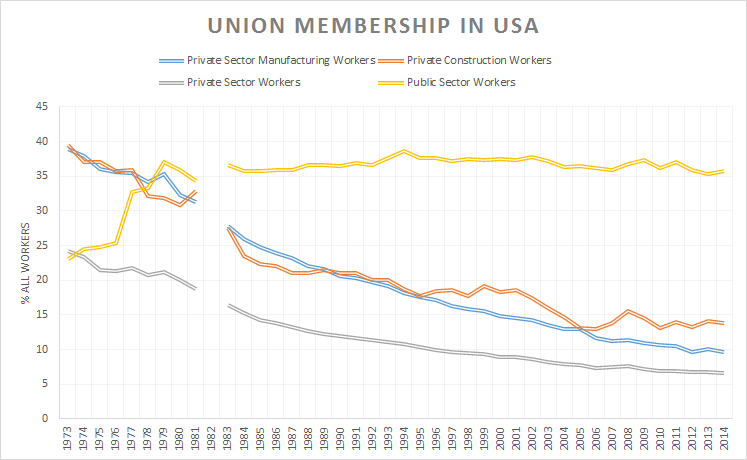
Public and private sector union membership took completely different paths in the USA over the last 40 years. Public sector union memberships held its own. There is been a steady decline in union membership in the private sector. The exception is construction unions which held their own in membership for the last 10 years.
Source: unionstats.com.
04 Dec 2015 2 Comments
in labour economics, politics - Australia, politics - New Zealand, politics - USA, unions Tags: union membership, union power
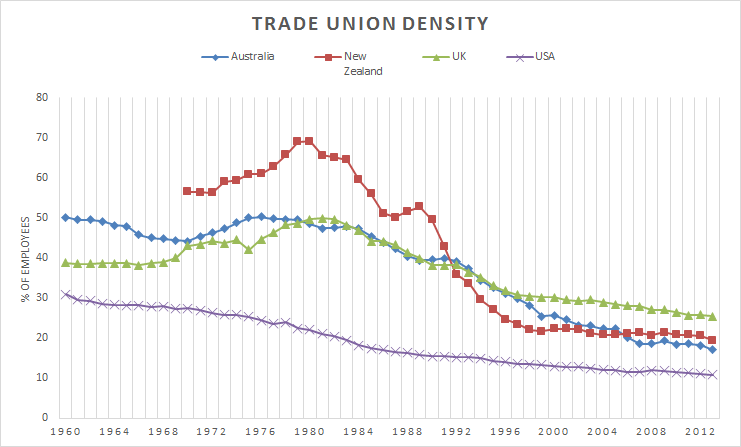
Union membership was in a long-term decline in New Zealand before the passage of the hated Employment Contracts Act in 1991. If anything, union membership stopped falling after the passage of that law.
Source: OECD Stat.
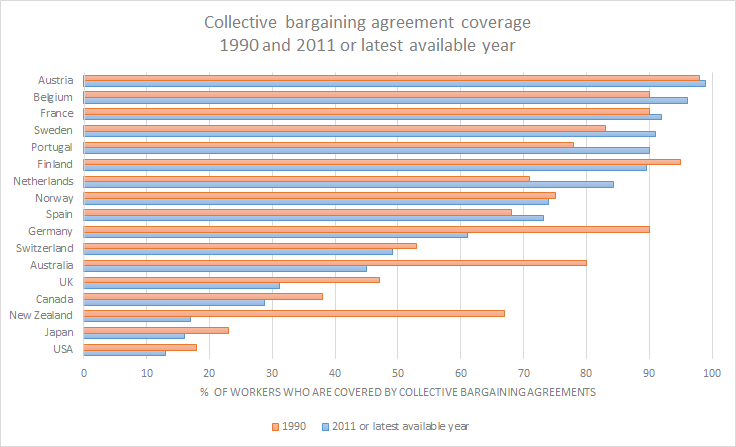
As for the other countries, steady decline in membership has been the trend since 1980. The already low level of union membership in the USA has been in a steady decline since at least 1960.
18 Nov 2015 Leave a comment
in applied price theory, Austrian economics, entrepreneurship, human capital, industrial organisation, labour economics, labour supply, Milton Friedman, minimum wage, occupational choice, poverty and inequality, survivor principle, unions Tags: market process, The meaning of competition
12 Nov 2015 2 Comments
in labour economics, labour supply, managerial economics, occupational choice, organisational economics, personnel economics, politics - New Zealand, unions Tags: compensating differentials, part-time work, zero hour contracts
My submission to the Transport and Industrial Relations Committee today on the Employment Standards Bill is there should be no regulation of zero hours contracts:
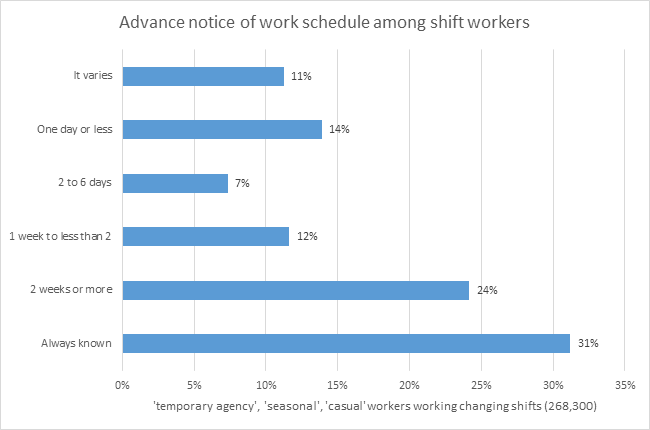
Always knowing your working hours in advance is known only to about 30% of shift workers; and
Workers command a wage premium when they sign zero hours contracts.
The obvious question is why do jobseekers sign a zero hours contract if it is not in their interests? Most of all, why would a worker who already has a job quit to work on a zero hours contract unless it is to their advantage?
If zero hours contracts are oppressive, the only workers hired on them would be the unemployed. Anyone who has a job would refuse such offers. Those unemployed that do sign a zero hours contract would quit as soon as a better offer comes along. 50% of job offers to British welfare beneficiaries to work on a zero hours contract are turned down.
This frequent refusal of zero hours contracts not only suggests there are options for jobseekers including the unemployed but there are costs to employers. The most likely employer response to reduce these costs of rejection is a offer to pay more to sign a zero hours contract. Everyone in this room knows contractors who work in much more than those in regular employment.
Unless labour markets are highly uncompetitive with employers having massive power over employees, employers should have to pay a wage premium if zero-hour contracts are a hassle for workers. It is standard for unusual, irregular or casual work to come with a wage premium. If you want regular hours, fixed hours, that comes at a price – a lower wage per hour.
Zero hours contracts is creative destruction in the labour market. Plenty of new ways of working have emerged in recent years: the proliferation of part-time work, temporary workers, leased workers, working from home, teleworking and contracting. Employment laws rest on the now decaying assumption that workers have long, stable relationships with single employers.
At least a quarter of a million New Zealanders already work shifts often with little notice of changes. Work schedules are always known in advance only to 31% of temporary, seasonal and casual employees. Another quarter of these have about two weeks or more notice of shifts. Hundreds of thousands of New Zealand workers freely sign on for variable hours.
Source: Survey of Working Life December Quarter 2012, Statistics New Zealand, Table 13.
Something new and innovative such a zero hours contract should not be regulated because it is not well understood. Zero hours contracts don’t come cheap for employers because of the risk of job offer rejection. There must be offsetting advantages that allow this practice to survive in competition with other ways of hiring a cost competitive labour force.
The fixed costs of recruitment and training are such that one 40-hour worker is cheaper than hiring and training two 20-hour workers. Zero hour contracts would be most likely in jobs with low recruitment costs, few specialised training needs and highly variable customer flows.
This business variability can be borne by the employer with the worker on regular hours but paid less. The alternative is the employee shares this risk with a wage premium for their troubles.
Workers with low fixed costs of working at different times profit from a move onto zero-hours contracts. Those with higher fixed costs of changing their working hours will stay on lower hourly rates but more certain working times
To summarise my points today:
Advance notice of working hours is not as common as people think for shift workers; and
Irregular and unusual working arrangements usually command a wage premium.
Employers must pay a wage premium to induce in workers to sign zero hours contracts. This Bill undermines the right of workers to seek those higher wages. Thanks for your time and attention.
10 Nov 2015 Leave a comment
in applied price theory, applied welfare economics, economic history, entrepreneurship, health and safety, human capital, industrial organisation, labour economics, labour supply, Marxist economics, minimum wage, politics - Australia, politics - New Zealand, politics - USA, poverty and inequality, unions Tags: The Great Enrichment, union power, union wage premium
09 Nov 2015 Leave a comment
in applied price theory, applied welfare economics, labour economics, labour supply, Milton Friedman, unemployment, unions Tags: union membership, union power, union wage premium
06 Nov 2015 Leave a comment
in econometerics, economic history, labour economics, labour supply, minimum wage, politics - USA, unions Tags: conspiracy theories, conspiracy theorists, Leftover Left, living standards, Maori economic development, neoliberalism, top 1%, Twitter left, union power, union wage premium
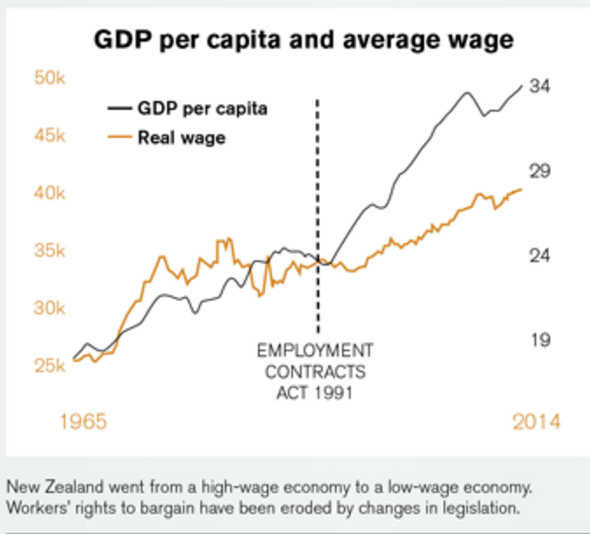
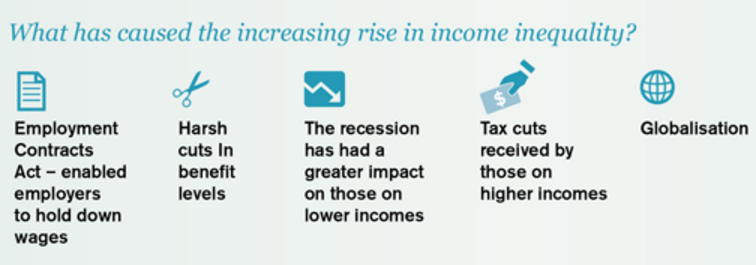
The Council of Trade Unions and Closer Together Whakatata Mai charted similar statistics to show that everything has gone to hell in a hand basket since neoliberalism seized power in New Zealand in 1984 and in particular after the passing of the Employment Contracts Act in 1991.
Source: Income Gap | New Zealand Council of Trade Unions – Te Kauae Kaimahi.
The passage of the Employment Contracts Act greatly reduced union power and union membership and with it wages growth in New Zealand, according to what is left of the New Zealand union movement.
Source: Income Gap | New Zealand Council of Trade Unions – Te Kauae Kaimahi.
Unfortunately, both charts of the same statistics show the exact opposite to what was intended by The Council of Trade Unions and Closer Together Whakatata Mai.
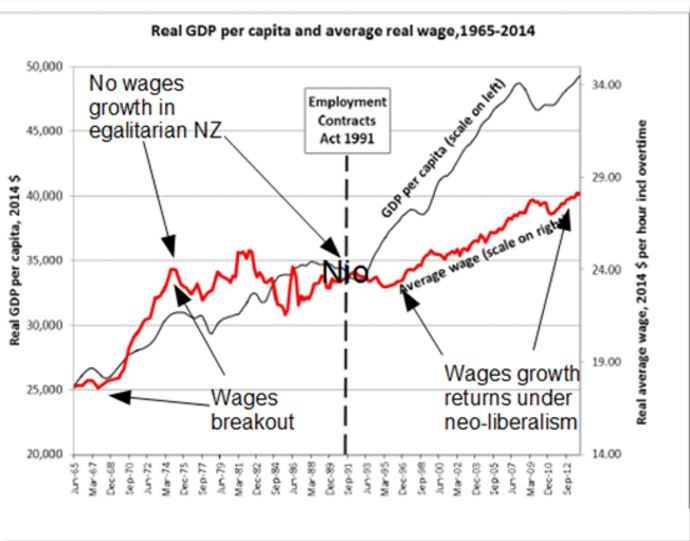
Even the most casual inspection of the data charted above and reproduced below with some annotations shows that real wages growth returned to New Zealand in the early 1990s after 20 years of real wage stagnation.
Source: Income Gap | New Zealand Council of Trade Unions – Te Kauae Kaimahi.
The reforms of the 1980s stopped what was a long-term decline in average real wages. The reforms of the early 1990s including the passing of the Employment Contracts Act was followed by the resumption of sustained growth in average real wages with little interruption since.
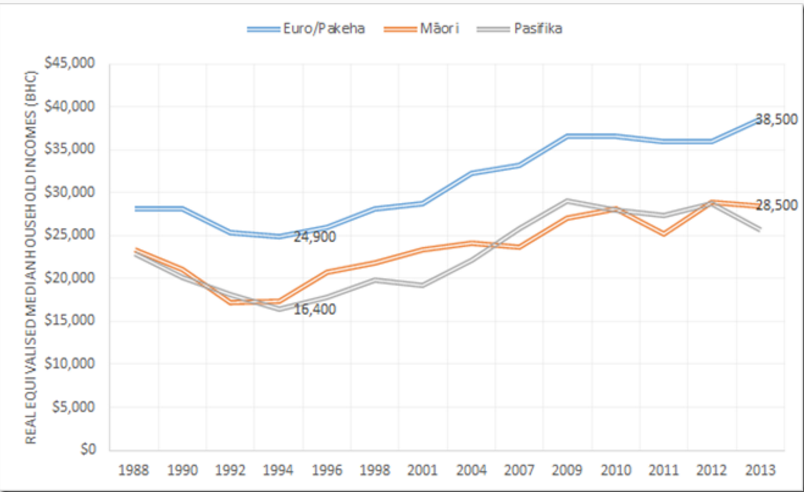
Closer Together Whakatata Mai has even stumbled onto the great improvements in household incomes across all ethnicities since the early 1990s.
The increase in percentage terms of Maori and Pasifika real household income is much larger than for Pakeha. As Bryan Perry (2015, p. 67) explains when commenting on the very table D6 sourced by Closer Together Whakatata Mai:
From a longer-term perspective, all groups showed a strong rise from the low point in the mid 1990s through to 2010. In real terms, overall median household income rose 47% from 1994 to 2010: for Maori, the rise was even stronger at 68%, and for Pacific, 77%. These findings for longer- term trends are robust, even though some year on year changes may be less certain. For 2004 to 2010, the respective growth figures were 21%, 31% and 14%.
Source: Bryan Perry, Household Incomes in New Zealand: trends in indicators of inequality and hardship 1982 to 2014 – Ministry of Social Development, Wellington (August 2015), Table D6.
As Closer Together Whakatata Mai documented, incomes increased in real terms by 14% for the bottom and 19% for the middle.
Perry noted that in the lowest decile had too many implausible incomes including many on zero income so he was wary of relying on it. I have therefore charted the second, median and top decile before and after housing costs below. All three deciles charted showed substantial improvements in incomes both before and after housing costs.
Source: Bryan Perry, Household Incomes in New Zealand: trends in indicators of inequality and hardship 1982 to 2014 – Ministry of Social Development, Wellington (August 2015).
Naturally, measuring changes in living standards over long periods of time is fraught with under-estimation. There are new goods to be accounted for and product upgrades too.
The apps in your smartphone cost $900,000 thirty years ago —@datarade https://t.co/pjw7q4QGDp—
Vala Afshar (@ValaAfshar) October 29, 2015
05 Nov 2015 Leave a comment
in economics of education, entrepreneurship, politics - New Zealand, politics - USA, unions
04 Nov 2015 Leave a comment
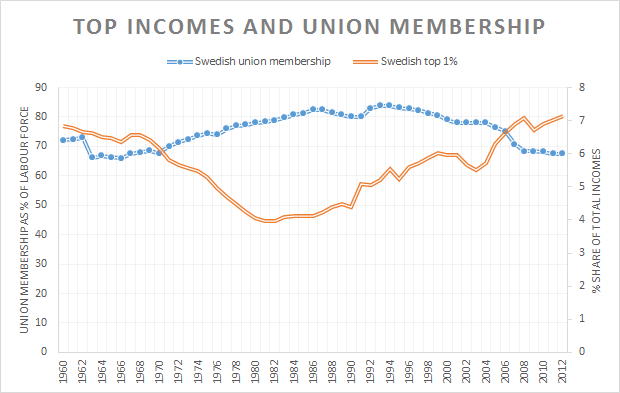
in applied price theory, applied welfare economics, econometerics, entrepreneurship, labour economics, Public Choice, rentseeking, unions Tags: Denmark, labour surplus, Sweden, top 1%, union power, union wage premium
The Danish top 1% and top 10% is even lazier than their transnational co-conspirators. No success at all at either grinding the Danish unions down or extracting more labour surplus from the long-suffering Danish proletariat.
Source: OECD StatExtract and Top Incomes Database.
The Swedish top 10% and top 1% have done a bit better since the economic liberalisation in that country from the early 1990s. But none of that additional labour surplus has anything to do with grinding the unions down because Swedish union membership has not declined.
Source: OECD StatExtract and Top Incomes Database.
03 Nov 2015 Leave a comment
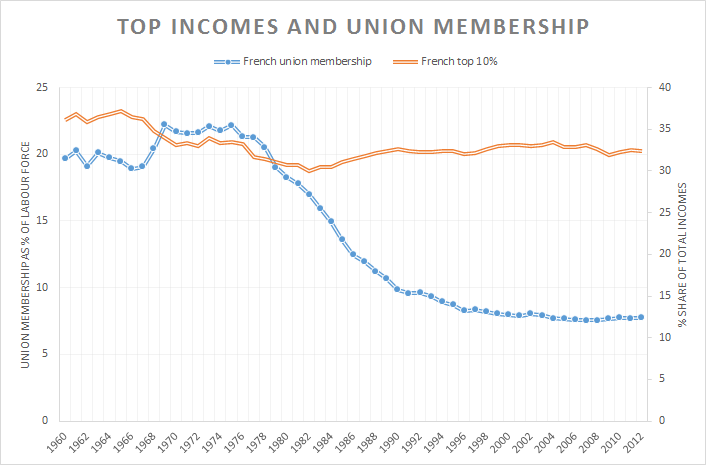
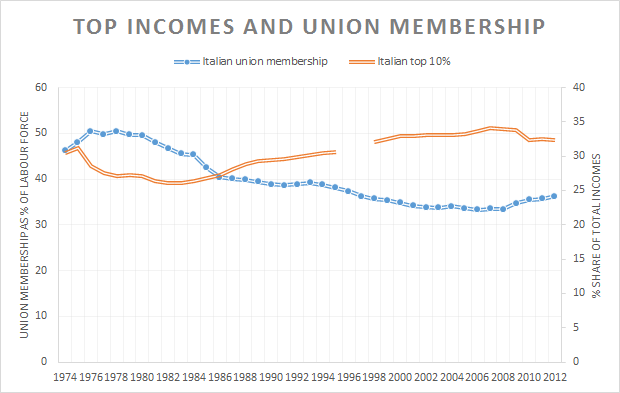
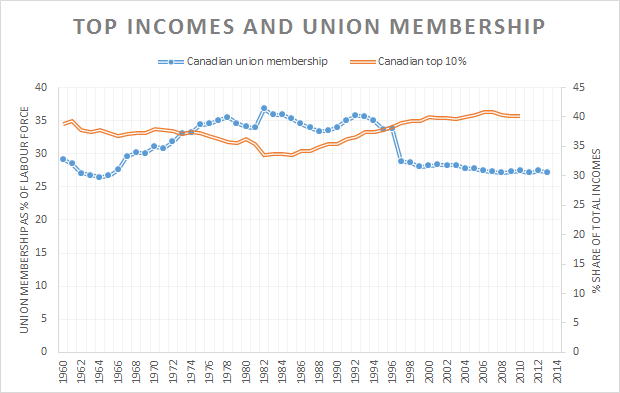
in applied price theory, applied welfare economics, economic history, entrepreneurship, industrial organisation, labour economics, labour supply, Milton Friedman, poverty and inequality, Public Choice, rentseeking, unions Tags: Canada, entrepreneurial alertness, France, Italy, top 1%, union power, union wage premium
The French ruling class is as lazy as their transnational co-conspirators down under. French union membership is in serious decline albeit from a low base. An opportunity lost for the French ruling class. It has not lifted a finger to extract additional labour surplus from the downtrodden French proletariat now stripped of their only line of collective defence against capitalist exploitation.
Source: OECD Stat and Top Incomes Database.
The top 10% and top 1% in France are no better off than two generations ago despite the decline of French unions. The French Left must be most disappointed. No kicking in the rotten door of the permanent revolution anytime soon after the immiserised French proletariat rises up because it has nothing to lose but its chains. The 21st century version of the Marxist call to the barricades would be a proletariat stirred to revolution with nothing to lose but their suburban home, motorcar, IPad and air points
Source: OECD Stat and Top Incomes Database.
The Italian ruling class has had little success in bringing Italian unions down. The top 10% in Italy is earning no more now than back when the Red Brigades were gunning for them.
Source: OECD Stat and Top Incomes Database.
The top 1% in Italy is doing a little bit better than when the Red Brigade was gunning for them, but not much more. Unions don’t figure in explaining that small rise in Italian top 1% incomes over the last 40 years. Italian unions are pretty much a strong as they were 40 years ago in membership. Italian employment protection laws are pretty much as strong as they used to be too.
Source: OECD Stat and Top Incomes Database.
The Canadian ruling classes even more incompetent than their transnational co-conspirators over in Italy. There appears to have been next to no decline in union membership in Canada. The Canadian top 10% is not earning any more than back in the 60s.
Source: OECD Stat and Top Incomes Database.
The Canadian top 1% is doing a little bit better than 25 years ago also but not off the back of unions which are almost as strong as in the past. The Canadian Left will have to look for a different hypothesis than the ravages of the top 1%.
Source: OECD Stat and Top Incomes Database.
All in all, the Economic Policy Institute simply got lucky with a spurious correlation between top incomes and union membership in the USA.
02 Nov 2015 4 Comments
in applied welfare economics, labour economics, Marxist economics, politics - Australia, politics - New Zealand, politics - USA, unions Tags: top 1%, union power, union wage premium
The Left in the USA and the UK like to show correlations between top incomes and the decline of union membership.
I thought I would check how this hypothesis travelled to European offshoots such as Australia and New Zealand. For example, in the USA, top income shares have been increasing while union membership has been in decline since 1960.

Source: OECD Stat and Top Incomes Database.

Source: OECD Stat and Top Incomes Database.
In the UK, the relationship between union membership and top incomes is gentler than in the USA.

Source: OECD Stat and Top Incomes Database.

Source: OECD Stat and Top Incomes Database.
Moving down under, the relationship between top incomes and union membership is non-existent in New Zealand.

Source: OECD Stat and Top Incomes Database.

Source: OECD Stat and Top Incomes Database.
The same pretty much goes for Australia in terms of no relationship between top incomes in union membership to extent that this relationship is anything more than a spurious correlation.

Source: OECD Stat and Top Incomes Database.

Source: OECD Stat and Top Incomes Database.
09 Oct 2015 Leave a comment
02 Oct 2015 Leave a comment
in economic history, labour economics, unions Tags: union power, union wage premium
Those reading Nick Kristof's pro-union piece should also consider their impact on job growth economy.com/dismal/analysi… http://t.co/xJwbJQmQth—
Modeled Behavior (@ModeledBehavior) February 19, 2015
17 Sep 2015 1 Comment
in applied price theory, economic history, economics of regulation, industrial organisation, job search and matching, labour economics, minimum wage, survivor principle, unions Tags: Australia, employment law, employment protection law, federalism, labour market deregulation, labour market regulation, union power, unions
Celebrating humanity's flourishing through the spread of capitalism and the rule of law
A History of the Alt-Right
Econ Prof at George Mason University, Economic Historian, Québécois
Celebrating humanity's flourishing through the spread of capitalism and the rule of law
Scholarly commentary on law, economics, and more
Beatrice Cherrier's blog
Celebrating humanity's flourishing through the spread of capitalism and the rule of law
Why Evolution is True is a blog written by Jerry Coyne, centered on evolution and biology but also dealing with diverse topics like politics, culture, and cats.
Celebrating humanity's flourishing through the spread of capitalism and the rule of law
A rural perspective with a blue tint by Ele Ludemann
DPF's Kiwiblog - Fomenting Happy Mischief since 2003
Celebrating humanity's flourishing through the spread of capitalism and the rule of law
The world's most viewed site on global warming and climate change
Tim Harding's writings on rationality, informal logic and skepticism
A window into Doc Freiberger's library
Let's examine hard decisions!
Commentary on monetary policy in the spirit of R. G. Hawtrey
Thoughts on public policy and the media
Celebrating humanity's flourishing through the spread of capitalism and the rule of law
Politics and the economy
A blog (primarily) on Canadian and Commonwealth political history and institutions
Reading between the lines, and underneath the hype.
Economics, and such stuff as dreams are made on
"The British constitution has always been puzzling, and always will be." --Queen Elizabeth II
Celebrating humanity's flourishing through the spread of capitalism and the rule of law
WORLD WAR II, MUSIC, HISTORY, HOLOCAUST
Undisciplined scholar, recovering academic
Celebrating humanity's flourishing through the spread of capitalism and the rule of law
Res ipsa loquitur - The thing itself speaks
In Hume’s spirit, I will attempt to serve as an ambassador from my world of economics, and help in “finding topics of conversation fit for the entertainment of rational creatures.”
Researching the House of Commons, 1832-1868
Articles and research from the History of Parliament Trust
Reflections on books and art
Posts on the History of Law, Crime, and Justice
Celebrating humanity's flourishing through the spread of capitalism and the rule of law
Exploring the Monarchs of Europe
Cutting edge science you can dice with
Small Steps Toward A Much Better World
“We do not believe any group of men adequate enough or wise enough to operate without scrutiny or without criticism. We know that the only way to avoid error is to detect it, that the only way to detect it is to be free to inquire. We know that in secrecy error undetected will flourish and subvert”. - J Robert Oppenheimer.
The truth about the great wind power fraud - we're not here to debate the wind industry, we're here to destroy it.
Celebrating humanity's flourishing through the spread of capitalism and the rule of law
Recent Comments