02 Nov 2015
by Jim Rose
in applied welfare economics, labour economics, Marxist economics, politics - Australia, politics - New Zealand, politics - USA, unions
Tags: top 1%, union power, union wage premium
The Left in the USA and the UK like to show correlations between top incomes and the decline of union membership.
I thought I would check how this hypothesis travelled to European offshoots such as Australia and New Zealand. For example, in the USA, top income shares have been increasing while union membership has been in decline since 1960.

Source: OECD Stat and Top Incomes Database.

Source: OECD Stat and Top Incomes Database.
In the UK, the relationship between union membership and top incomes is gentler than in the USA.
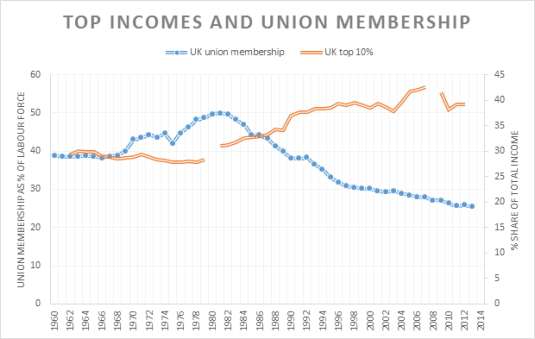
Source: OECD Stat and Top Incomes Database.
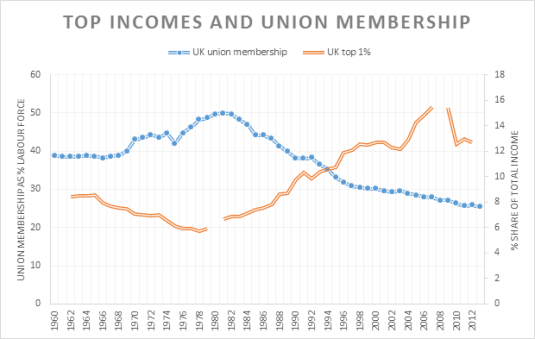
Source: OECD Stat and Top Incomes Database.
Moving down under, the relationship between top incomes and union membership is non-existent in New Zealand.

Source: OECD Stat and Top Incomes Database.

Source: OECD Stat and Top Incomes Database.
The same pretty much goes for Australia in terms of no relationship between top incomes in union membership to extent that this relationship is anything more than a spurious correlation.

Source: OECD Stat and Top Incomes Database.
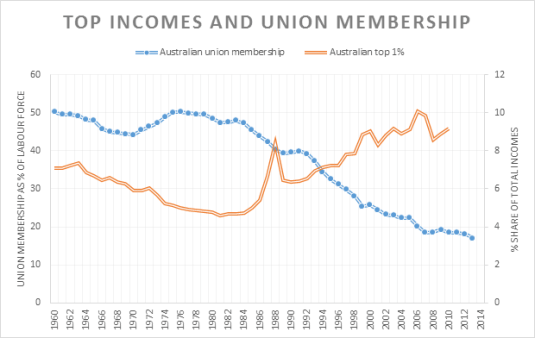
Source: OECD Stat and Top Incomes Database.
17 Sep 2015
by Jim Rose
in applied price theory, economic history, economics of regulation, industrial organisation, job search and matching, labour economics, minimum wage, survivor principle, unions
Tags: Australia, employment law, employment protection law, federalism, labour market deregulation, labour market regulation, union power, unions
17 Aug 2015
by Jim Rose
in business cycles, currency unions, economic growth, economic history, Euro crisis, job search and matching, labour economics, labour supply, macroeconomics, occupational choice, unemployment, unions, welfare reform
Tags: employment law, equilibrium unemployment, Greece, Italy, labour market regulation, natural unemployment rate, Portugal, Spain, unemployment duration
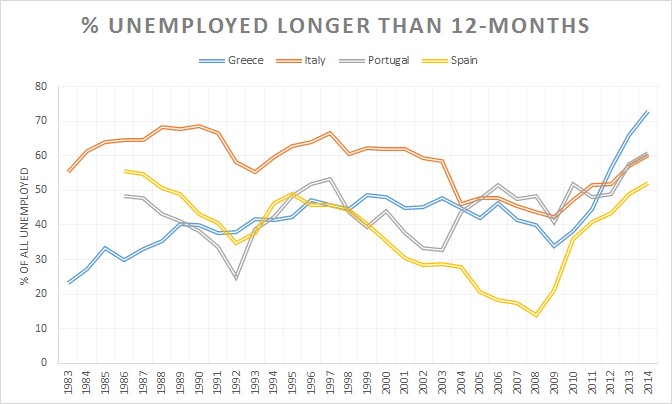
The boom that preceded the bust in the Greek economy did nothing for the rate of long-term unemployment among Greeks. Long-term unemployment had been pretty stable prior to the economic boom after joining the euro currency union.
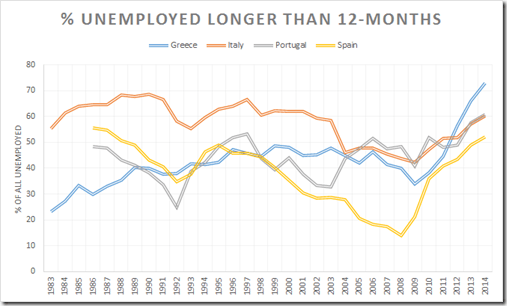
Source: OECD StatExtract.
Nothing much happened to long-term unemployment in Italy or Portugal in recent decades. Spanish long-term unemployment fell in line with the economic boom in Spain over the 1980s and 1990s up until the global financial crisis.
16 Aug 2015
by Jim Rose
in labour economics, unions
Tags: collective bargaining, union membership, union power, union wage premium
In the USA, UK, Australia, New Zealand, and Canada, if you want to be covered by a union collective-bargaining agreement, join a union. Does not seem to matter if you are a union member in France, Germany, Portugal, Spain and the Netherlands and to a lesser extent Italy because you is covered by collective bargaining agreements in most jobs.

Source: OECD estimates and J. Visser, Amsterdam Institute for Advanced Labour Studies (2011), ICTWSS Database on Institutions, Coordination, Trade Unions, Wage Setting and Social Pacts (version 3.0) in OECD (2013) Economic Policy Reforms 2013: Going for Growth.
In the Nordic countries, it runs the other way with most workers covered by collective bargaining agreement but also are union members.
15 Aug 2015
by Jim Rose
in economic history, labour economics, unions
Tags: Denmark, Finland, Norway, Sweden, union membership, union power, union wage premium
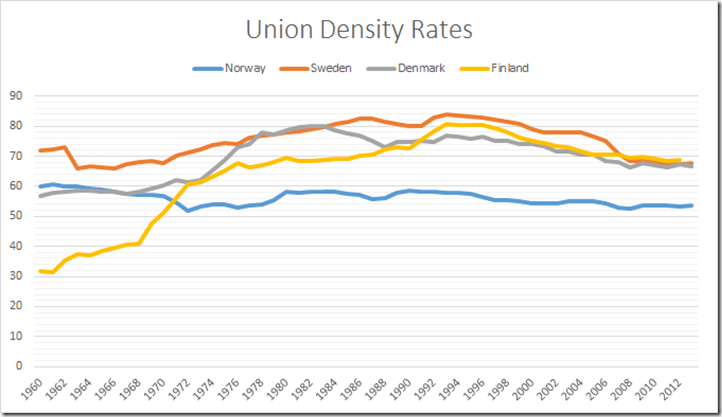
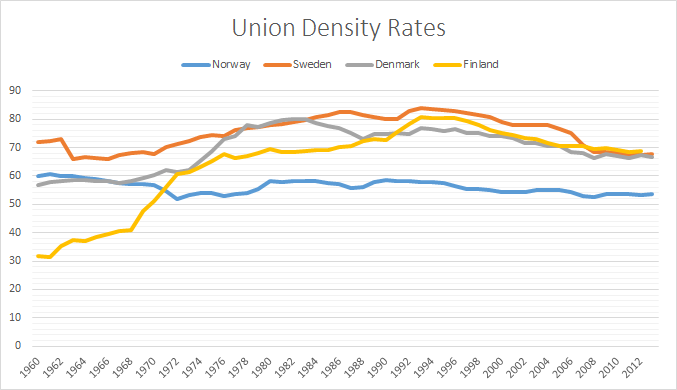
Union membership has been very high all the time in Norway, Sweden, Denmark and Finland.
Source: OECD Stat Extract.
14 Aug 2015
by Jim Rose
in economic history, Euro crisis, labour economics, unions, urban economics
Tags: Eurosclerosis, France, German unification, Germany, Italy, union membership, union power, union wage premium
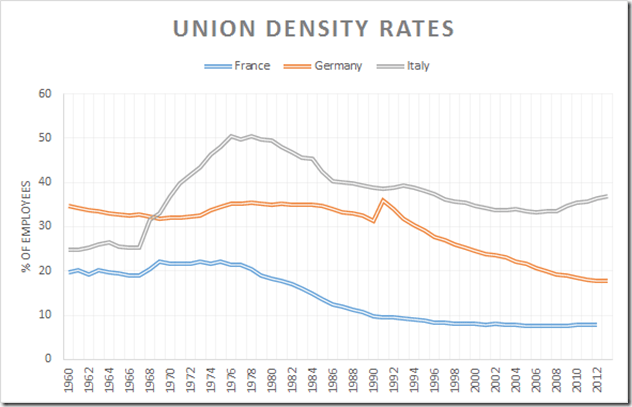
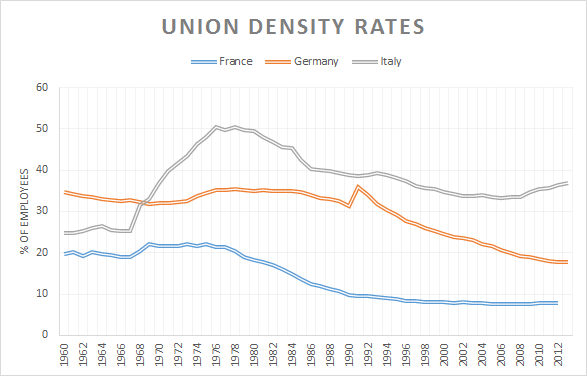
There are large differences in unionisation rates between the three countries. France has always had low levels of unionisation which halved since the 1970s. Italy had a sharp boost in union membership in the number of unions in the 1960s and 70s. This may have been associated with increased urbanisation. Union membership rate stayed pretty high in Italy ever since with a small taper downwards. Germany had stable unionisation rates prior to German unification after which the numbers about halved up in a slow taper.
Source: OECD Stat Extract.
13 Aug 2015
by Jim Rose
in labour economics, politics - Australia, politics - New Zealand, politics - USA, unions
Tags: Australia, British economy, union membership, union power, union wage premium
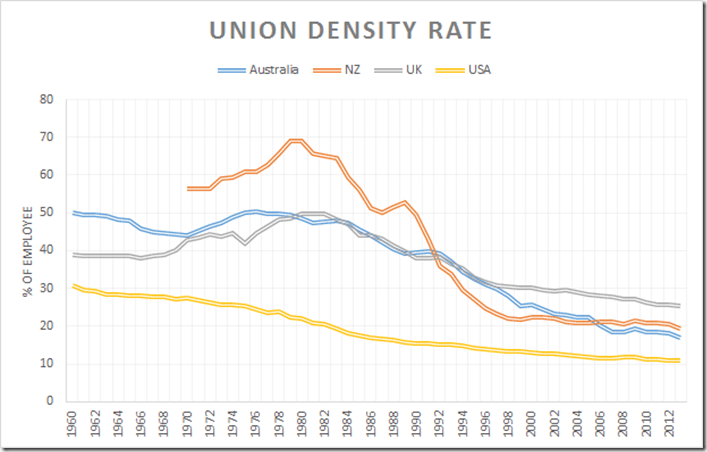
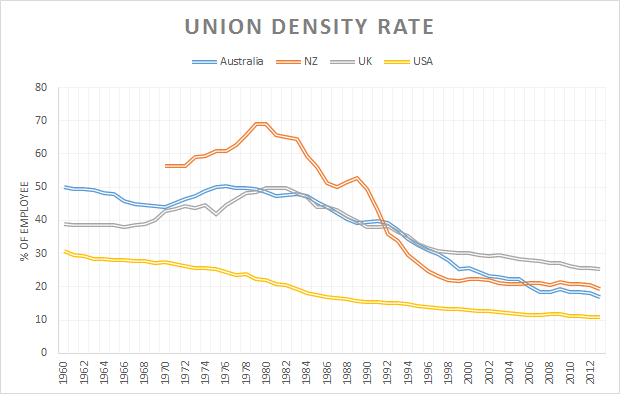
Unions have been in a long-term decline in Australia, New Zealand, the UK and the USA for as far back as survey and administrative data can be collected. There is a bit of a hump in union membership in the mid-1970s in New Zealand, Australia and the UK but that was about it.
Source: Source: OECD and J.Visser, ICTWSS database (Institutional Characteristics of Trade Unions, Wage Setting, State Intervention and Social Pacts, 1960-2010), version 3.0 (http://www.uva-aias.net/).
29 Jul 2015
by Jim Rose
in economic history, job search and matching, labour economics, labour supply, law and economics, minimum wage, politics - Australia, politics - New Zealand, politics - USA, unions
Tags: Australia, British economy, employment law, employment law regulation
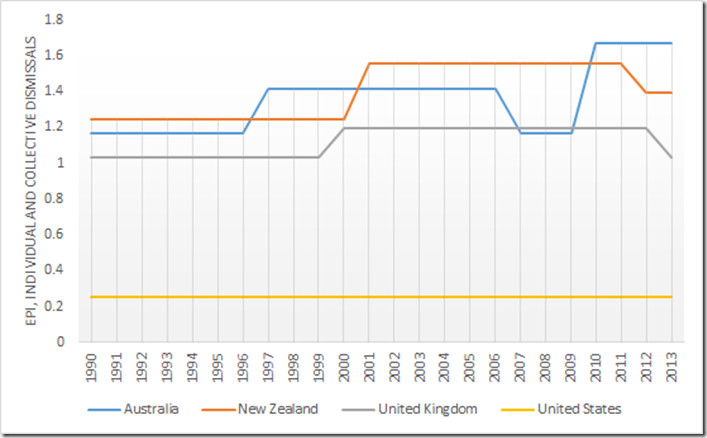
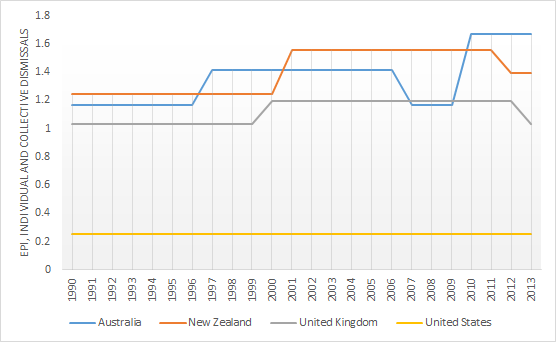
Major deregulations and re-regulations of the labour market in Australia and New Zealand did not move the employment protection inducts around that much in figure 1. All is been quiet on the labour market regulation front of the UK pretty much since the index was started.
Figure 1: OECD employment protection index (EPI), strictness of employment protection – individual and collective dismissals, USA, UK, Australia and New Zealand, 1990 – 2013
Source: OECD StatExtract.
The Work Choices legislation in Australia in 2006 was looked upon by the OECD as a somewhat minor deregulation not much more in scale than the deregulation introduced in 2008 with the election of the National Party led government.

Nobody told the unions that.
24 Jul 2015
by Jim Rose
in business cycles, econometerics, economic growth, economic history, job search and matching, labour economics, labour supply, macroeconomics, politics - New Zealand, Public Choice, unemployment, unions, welfare reform
Tags: antimarket bias, Don Brash, economic reform, expressive voting, Homer Simpson, Leftover Left, lost decades, makework bias, neoliberalism, rational ignorance, rational irrationality, Sir Roger Douglas, Twitter left
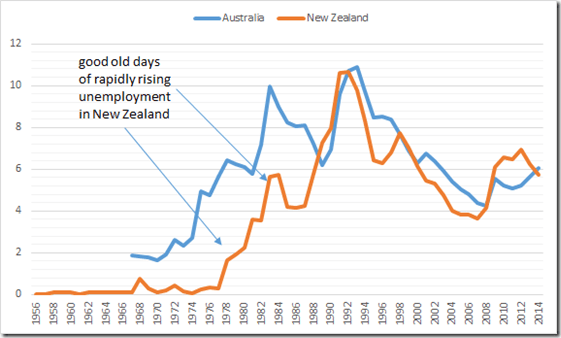
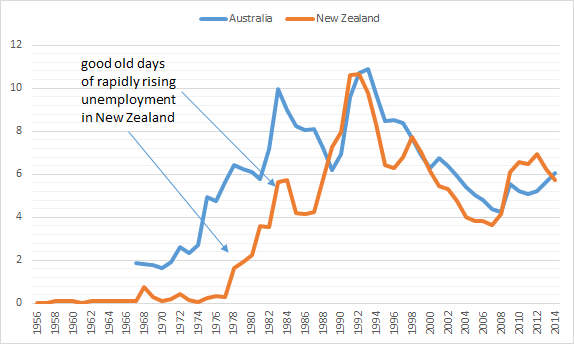
Today, Closing The Gap – The Income Inequality Project boldly claimed today that there was next to no unemployment in New Zealand prior to the onset of the curse of neoliberalism.

There is an Internet on computers now where it is easy to find data showing that the unemployment rate was rising rapidly in New Zealand in the 1970s and in double digits by the end of the 1980s – see figure 1.
Figure 1: harmonised unemployment rates, Australia and New Zealand, 1956-2014
Source: OECD StatExtract.
Figure 1 shows unemployment was rising rapidly in the 1970s and wasn’t much different by the end of the 1970s to the unemployment rates recorded after about 2000 in New Zealand.

One of the reasons that Sir Roger Douglas wrote There’s Got To Be A Better Way was the rapidly rising unemployment in New Zealand and the stagnant economic growth in the late 1970s and early 1980s.

New Zealand was one of the most regulated economies, so much so that Prime Minister David Lange said:
We ended up being run very similarly to a Polish shipyard.
As for those jobs on the railways, the then Reserve Bank Governor Don Brash said in 1996:
Railways cut its freight rates by 50 percent in real terms between 1983 and 1990, reduced its staff by 60 percent, and made an operating profit in 1989/90, the first for six years.
Previous Older Entries Next Newer Entries




Recent Comments