Basic Income: Better Than Welfare?
06 May 2017 Leave a comment
in politics - New Zealand, politics - USA, welfare reform Tags: Bryan Caplan, universal basic income
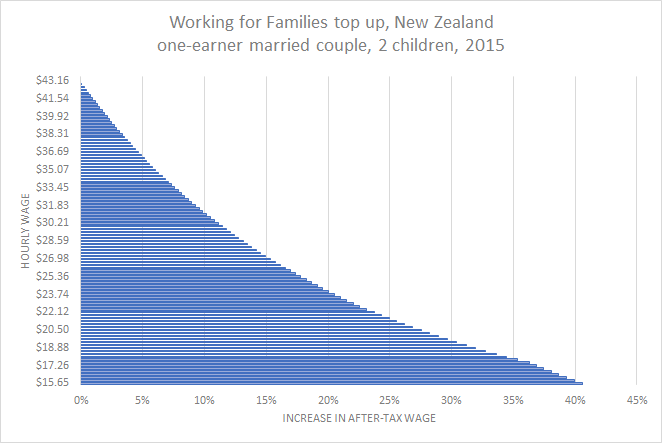
Important to mention tax credits when discussing the working poor? @JordNZ
21 Apr 2017 Leave a comment
in labour economics, politics - New Zealand, poverty and inequality, public economics, welfare reform Tags: child poverty, family poverty, family tax credits, taxation and labour supply
Why did poverty start falling noticeably in the 1990s in the USA?
06 Dec 2016 Leave a comment
in economic history, labour economics, labour supply, politics - USA, poverty and inequality, welfare reform
More on the scourge of neoliberalism
18 Nov 2016 Leave a comment
in economic history, politics - USA, poverty and inequality, welfare reform
.@JudithCollinsMP showed that @JacindaArdern does not know when to stop digging
13 Oct 2016 Leave a comment
in economics of crime, law and economics, politics - New Zealand, poverty and inequality, welfare reform Tags: crime and punishment, family poverty, law and order, New Zealand Labour Party
Judith Collins today in Question Time showed that Jacinda Ardern does not know when to stop digging. Ardern quoted a snippet of the question put to the police minister at the recent police conference.
That selectivity allowed Collins to right to quote the conference question in full and her full answer, which was not just about money poverty but also about
“… a poverty of ideas, a poverty of parental responsibility, a poverty of love, a poverty of caring …”.
Later Collins said she does not agree with Labour saying today that poverty causes crime.
The Labour Party showed that it is no longer rooted in working class values when it argues that poverty is not linked to a poverty of responsibility and of parental love.
There are plenty of poor people who do not resort to crime and who despise those that do, in part because they often make them the victims of their crimes including burglary.
Viagers as a way of funding retirements
12 Sep 2016 Leave a comment
in labour economics, labour supply, poverty and inequality, welfare reform Tags: economics of retirement, French law, old age pensions, property law, reverse mortgages, social insurance
A Viager is a French way of buying and selling property. We just watched the Kelvin Klein – Maggie Smith movie about it.
Not only does the seller remain as a life tenant of the property they sold, the buyer pays them an annuity as well as a down payment. The buyer gambles as all annuity providers do on the life expectancy of the vendor. One such vendor lived to 123 in France.
Back in 1965, when Mrs Calment was aged 90, she sold her apartment in Arles to a 44-years old man, on contract-conditions that seemed reasonable given the value of the apartment and the life-expectancy statistics that prevailed at the time.
The man turned out to be unlucky since Jeanne Calment lived a very long life. He died in 1995, two years before Mrs Calment, after having paid about FFr900,000 (twice the market value) for an apartment he never lived in.
The viager system is similar to the equity release and reverse mortgage systems more familiar in Anglo-Saxon countries. The viager shares the risk of running out of equity with the buyer. The contract is between two private parties and does not involve banks or insurance companies.

Sellers are typically widows, or widowers, who want to cash out the value of their property with a lump sum – the bouquet – and a monthly payment from the buyer for the rest of their lives. The seller remains as a life tenant. The bouquet is normally 15-30% of the value of the property.
French viager investors tend to be in their late 40s and early 50s wanting to set themselves up with a retirement home and hopefully get a good deal. If the buyer dies before the seller his children will be obliged to carry on paying the viager if they want to maintain the deal. In that sense, the vendor is gambling on the buyer’s life expectancy is well.
I have no information on who is responsible for payment of rates and the maintenance of the property. The maintenance of the property would be a bigger moral hazard problem than with tenants because of the difficulties with eviction and repair. The market for Viagers is fairly small.
Should the buyer default on the monthly instalments, he is warned to pay up. After a second warning, normally within weeks, he will get a further warning and one month to get up to date with payments. If this does not happen the seller keeps keeps the bouquet, all money received so far and gets back absolute ownership of the property they sold.
This home annuity option for selling the house could be away of getting around the rather small to non-existent annuity market in New Zealand for retirees. They have the advantage of sharing the risk of exhausting the equity of the property at the price of the buyer sometimes gets a really good deal. Sellers have on average shorter survival times than the general French population.
Poverty in America after 20 years of welfare reform
01 Sep 2016 Leave a comment
in applied welfare economics, economic history, labour economics, politics - USA, welfare reform Tags: 1996 US welfare reforms, child poverty, family poverty, single mothers, single parents, social insurance, welfare state
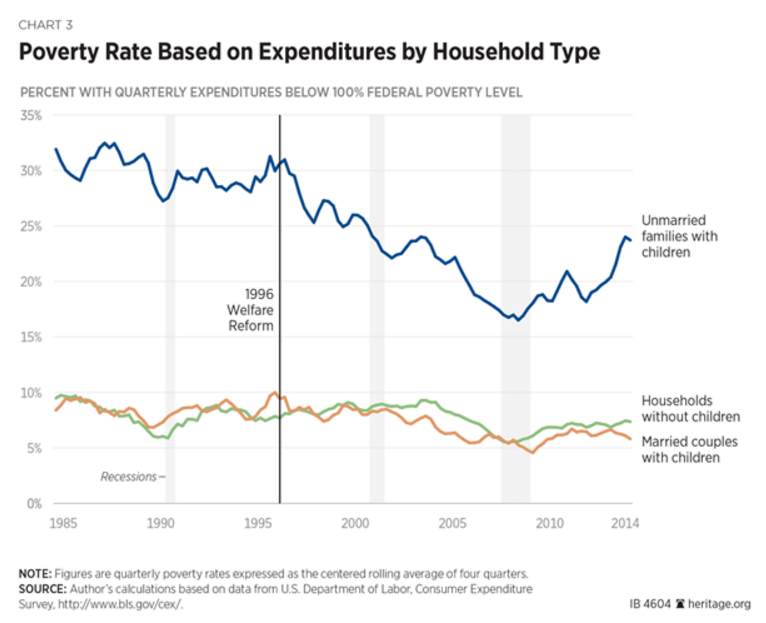
Source: Did Welfare Reform Increase Extreme Poverty in the United States?
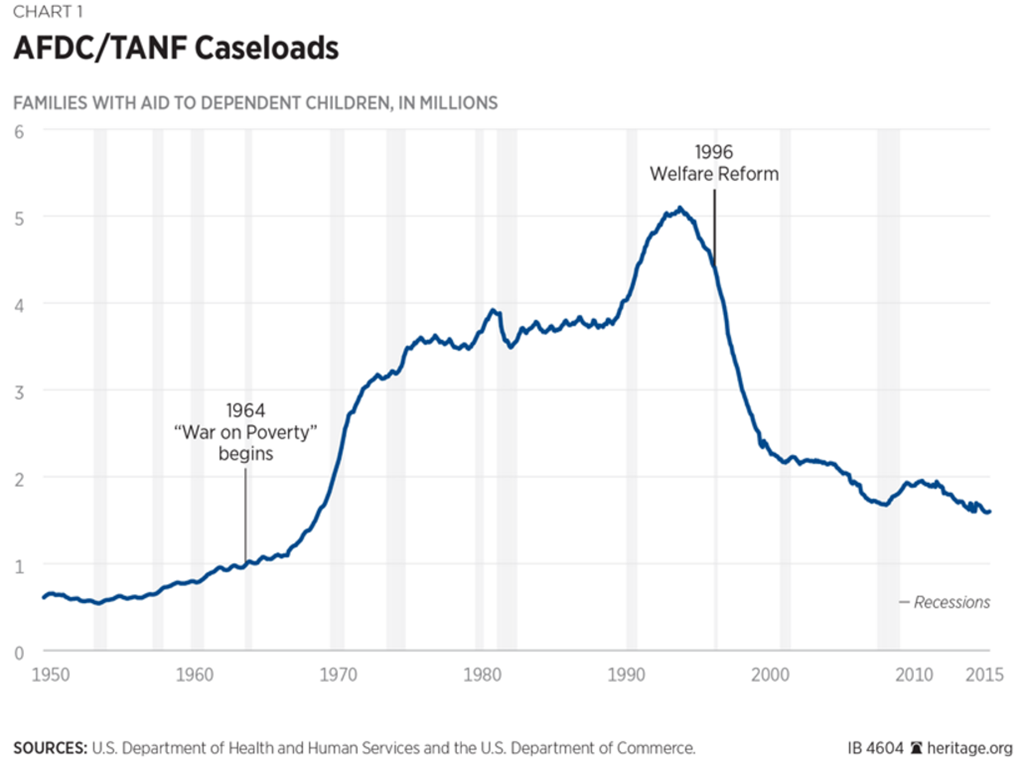
Source: Did Welfare Reform Increase Extreme Poverty in the United States?
Down and out in America after 20 years of welfare reform
28 Aug 2016 Leave a comment
in applied welfare economics, economic history, labour economics, welfare reform Tags: 1996 U.S. welfare reforms, child poverty, family poverty
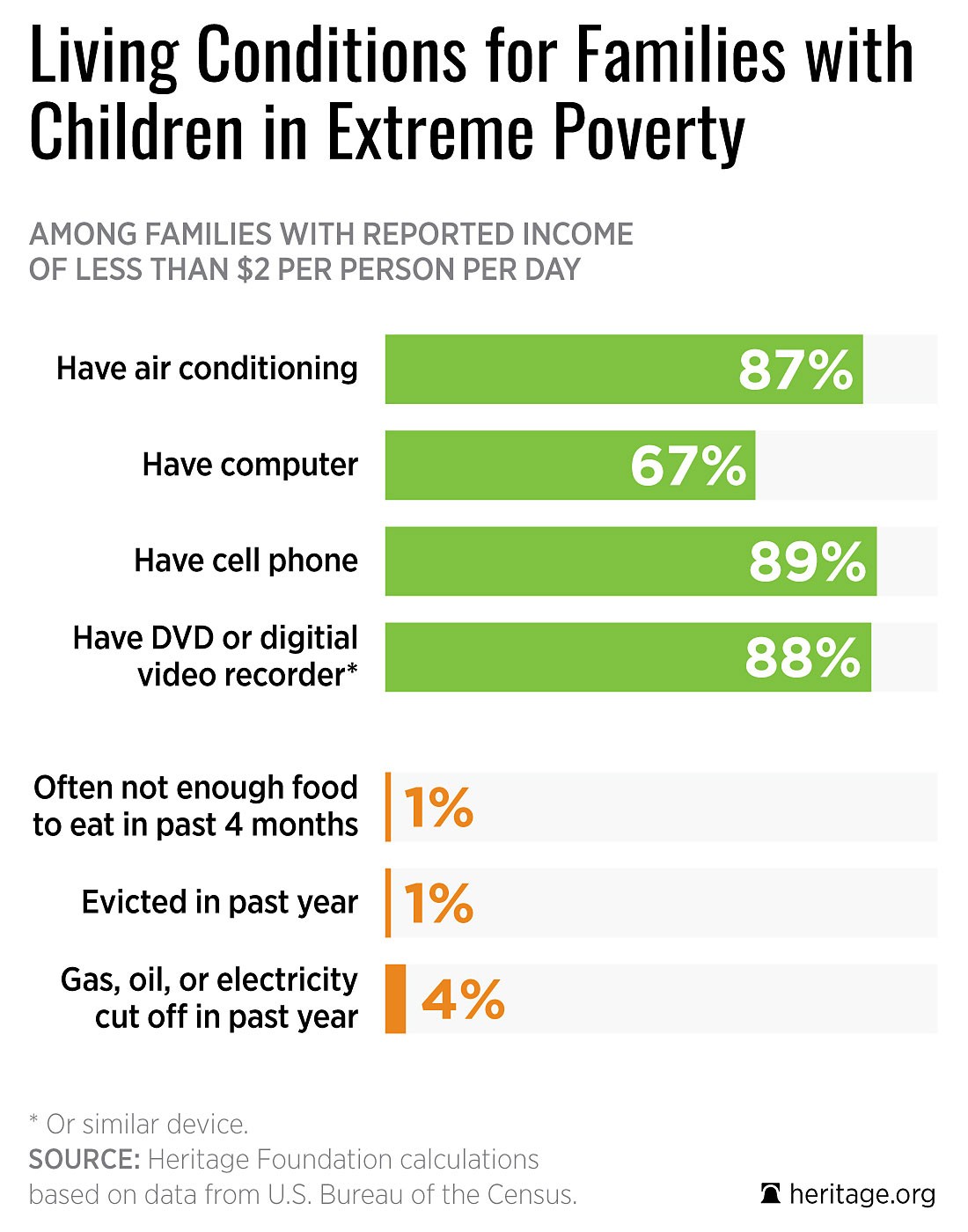
Poverty Has Declined a Lot Over the Past 30 Years in the USA
27 Aug 2016 Leave a comment
in economic history, labour economics, labour supply, politics - USA, poverty and inequality, welfare reform Tags: 1996 US welfare reforms, child poverty, family poverty, single parents, social insurance, welfare state
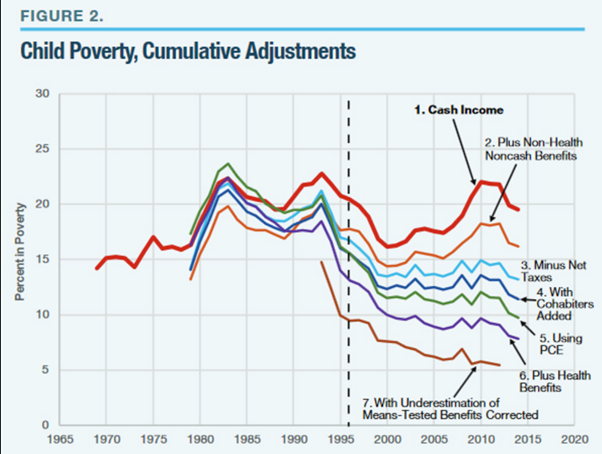
Source: Poverty Has Declined a Lot Over the Past 30 Years | Mother Jones from Poverty After Welfare Reform | Manhattan Institute.
But @EleanorAingeRoy child poverty has not changed much in 20 years
16 Aug 2016 Leave a comment
in applied welfare economics, labour economics, labour supply, politics - New Zealand, poverty and inequality, urban economics, welfare reform Tags: child poverty, family poverty, housing affordability, RMA
Today in the Guardian writing on trends in family poverty New Zealand, Eleanor Roy said that
The fact that twice as many children now live below the poverty line than did in 1984 has become New Zealand’s most shameful statistic.
Roy goes back to the 1980s as her base because child poverty has not gone up or down by that much since that sharp rise in the late 1980s.
Child poverty among single-parent households has doubled since 1990 and tripled since 1988. Poverty in families with two parents present is not much higher now than it was in 1988.

Source: Bryan Perry, Household Incomes in New Zealand: trends in indicators of inequality and hardship 1982 to 2014 – Ministry of Social Development, Wellington (August 2015), Table H.4.
Child poverty rates among single-parent families that live with other adults is one-quarter that of single-parent families who live alone. The reasons behind that should be explored more by those concerned with child poverty.

Source: Bryan Perry, Household Incomes in New Zealand: trends in indicators of inequality and hardship 1982 to 2013 – Ministry of Social Development, Wellington (2014), Tables F.6 and F.7.
The evidence is overwhelming that the main driver of the increases in the child poverty since the 1980s is rising housing costs.
In the longer run, after housing costs child poverty rates in 2013 were close to double what they were in the late 1980s mainly because housing costs in 2013 were much higher relative to income than they were in the late 1980s.
– Bryan Perry, 2014 Household Incomes Report – Key Findings. Ministry of Social Development (July 2014).
Any policy to reduce child poverty must increase the supply of houses by reducing regulatory restrictions on the supply of land.
Rather than blame the callousness of government in accepting higher rates of child poverty, Roy should blame its inability to take on the restrictions on land supply in the Resource Management Act that drive up housing costs for the poor. Increased child poverty in New Zealand is a by-product of housing unaffordability.
Child poverty in single parent and two-parent households in New Zealand
06 Jul 2016 Leave a comment
in economics of love and marriage, labour economics, labour supply, poverty and inequality, welfare reform Tags: child poverty, family poverty, single mothers, single parents
Looks like the greed of the top 1% was targeted exclusively as single parents since the 1980s. Child poverty in two-parent families has not risen much at all. These households often have jobs and will presumably be under the jackboot of neoliberalism stripping away their bargaining power through the decimation of unions and the introduction of the Employment Contracts Act. Despite these horrors, family poverty did not increase much if there are two parents in the house.
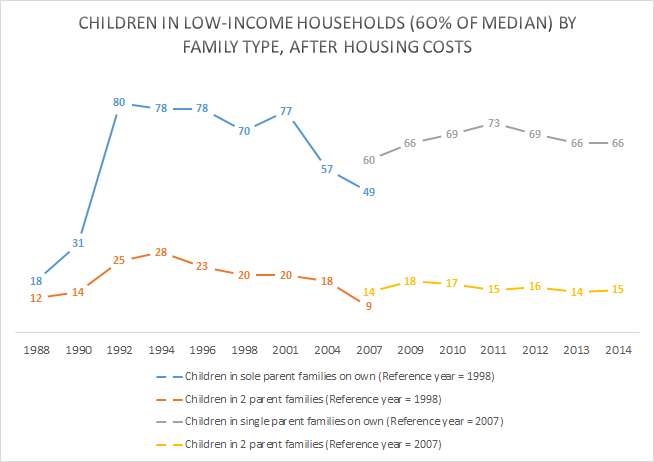
Source: Bryan Perry, Household Incomes in New Zealand: trends in indicators of inequality and hardship 1982 to 2014 – Ministry of Social Development, Wellington (August 2015), Table H.4.
Bryan Caplan argues that there is an undeserving poor if they fail to follow the following reasonable steps to avoid poverty and hardship:
- Work full-time, even if the best job you can find isn’t fun;
- Spend your money on food and shelter before cigarettes and cable TV; and
- Use contraception if you can’t afford a child.
4 Lessons for Morgan Foundation on How to Sell the #UBI @JordNZ
13 Apr 2016 Leave a comment
in applied welfare economics, labour economics, labour supply, politics - New Zealand, welfare reform Tags: expressive voting, rational irrationality, universal basic income
![clip_image002[4]](https://utopiayouarestandinginit.com/wp-content/uploads/2016/04/clip_image0024.gif "clip_image002[4]")
Source: Morgan Foundation (12 April 2016) Four Lessons for Labour on How to Sell the UBI.
I will contract out to Geoff Simmons of the Morgan Foundation my reply to the claim yesterday by the Morgan Foundation’s Susan Guthrie that there are no negatives from a Universal Basic income. Simmons said:
With an unconditional basic income, most beneficiaries would be no better off than they are now (in fact sole parents would almost certainly receive a lower benefit).
Single parents are $150 a week worse off and retirees are $50 worse off per week if their current income support were replaced by a Universal Basic Income of $11,000 per adult.
Both were entitled to much more under the current welfare benefit system and New Zealand Superannuation respectively. Unemployment, sickness and invalid beneficiaries are about 5% better off under a Universal Basic Income.
Labour’s background paper described a Universal Basic Income of $11,000 as not enough. Guthrie is even franker yesterday about how inadequate a Universal Basic Income is for the poor:
A basic income policy would provide everyone aged 18 and over with an unconditional, tax free survival-level of income each and every year.
I will contract out to Gareth Morgan (2011) why a Universal Basic Income that provides a “survival-level of income” is not good enough:
Rather than decreeing a minimum wage and discovering the consequences for jobs and top-up payments, let’s agree on what is a minimum income every adult should have in order to live a dignified life and then see what flows from that.
We begin by specifying the income level below which we are not prepared to see anyone having to live.
A survival-level of income and a minimum income on which every adult can live a dignified life are not the same thing.
Gareth Morgan’s universal basic income of $11,000 for adults makes most better off except those for whom the modern welfare state was established to protect.
Most of the evidence against the Universal Basic Income comes from examining the numbers put forward by its proponents such as the Morgan Foundation and its excellent online tool. Brian Easton (2015) put it well when he said:
Many advocates put the UMI forward without doing the sums.
Those who do, find that the required tax rates are horrendous or the minimum income is so low that it is not a viable means of eliminating poverty. Among the latter are New Zealanders Douglas, Gareth Morgan and Keith Rankin.
 Utopia, you are standing in it!
Recent Comments