Lessons from field trials with work mandates

Table1_RANDRevRevised_1202

One of the most controversial aspect of the U.S. program changes are the negative incentives – time limits, sanctions, and diversion – that are built into their structure.

All of these policies limit the entitlement to cash public assistance, by either enforcing behavioural requirements (such as work search) or limiting the availability of assistance.

As Besley and Coate (1992) pointed out, linking such requirements with public assistance payments can help deter welfare participation among those who could find a job on their own.

The majority of evaluations of mandatory welfare-to-work programs show significant increases in labour supply and reduced welfare dependency. The drawback is the increase in wage income is greatly offset by the decline in benefit income. In–work tax credits played a major role in making work pay in 1996 U.S. welfare reform

The Minnesota Family Investment Program (MFIP) was implemented in 1994 and provided a strong earnings threshold, allowing women to receive some cash assistance until their earnings reached about 140 per cent of the U.S. poverty line. It also required participation in mandatory job search programs.

A randomly assigned control group remained in AFDC without work requirements or substantial earnings thresholds. MFIP involved both strong negative and positive work incentives. A subset of the treatment group (also randomly assigned) was provided with the earnings thresholds but not the mandatory work requirements.

The MFIP results allow the separate and joint effects of mandatory job search and earnings thresholds to be explored. When only positive work incentives are provided through an expanded earnings threshold, this has little effect on labour supply, consistent with earlier results. The additional income provided by these higher thresholds had strong income-increasing and poverty-reducing effects. Once mandatory work requirements are added to MFIP, then labour supply increases as well, but there is little further effect on income or poverty.

The evaluations of MFIP suggest that the stick of work requirements increases labour supply, but has little effect on overall income as increases in earnings are offset by reduced benefits.

The carrot of greater earnings thresholds provides an income enhancing effect. When used together, there is increased work and higher earnings, along with reduced poverty.

The relatively strong measures to mandate work participation can be effective. Work mandates with sanctions are more effective at inducing work than are more financial incentives. Strict work requirements by themselves may have little income-enhancing effects if they are not combined with some form of wage support for the low-skilled.

Education and training programs do not seem any more effective in promoting labour force attachment and increased earnings than work experience programs. In various welfare reform experiments in the U.S. during the 1990s, states tested training programs – human capital development programs — against work first programs – labour force attachment programs.

The work-first programs increased earnings and decreased welfare usage faster, while human capital development programs cost more, particularly in the first year when women were training rather than working.

But even three years out, after women from human capital development programs had been in the labour market two years, human capital development participants still did not outperform labour force attachment participants.

This may suggest that the gains to experience among women who have been out of the labour market may be larger than the gains to formal education and training. Employment outcomes did not seem significantly worse among less skilled participants or participants with identifiable barriers to work, such as child care or health problems. Learning by doing and job match and job search capital are major sources of hard-to-measure post-school human capital and wages growth even for less skilled workers. Work-first programmes suggest that the reward from working which is human capital as well as wages are greater than an investment in time away from working to train.

The dual emphasis in the U.S. welfare reforms on positive work incentives and more punitive work mandates seems to have been important.

Work mandates (mandatory welfare-to-work programs, backed by sanctions and time limits) forced more people into work faster than would have naturally left welfare even strong economic environments. With low wages and (often) part-time hours, many welfare leavers would have gained little in income without subsidies to low-wage work. Reduced earnings thresholds, the expanded EITC, and subsidies to assist with child care or other work related expenses, all helped make work pay.

Table4_RANDRevised_1202

Diagrams HT: rand.org Conflicting Benefits Trade-Offs in Welfare Reform by Jeffrey Grogger, Lynn A. Karoly, and Jacob Alex Klerman (2002).

Will work-for-the-dole work in Australia?

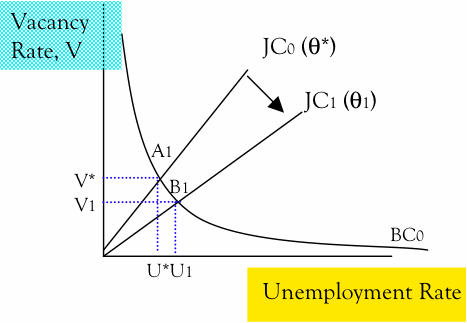
One of the strongest empirical findings of modern labour economics is the benefit exhaustion spike. This is the large increase, shown in the diagram, in the probability of finding a job on the eve of exhausting unemployment benefits or unemployment insurance eligibility.

This benefit exhaustion spike is mobile: when unemployment  insurance eligibility is lengthened, the benefit exhaustion spike moves out to the new benefit exhaustion date. For example, from 26 weeks, then to 39 weeks, then 52 weeks and then to 99 weeks. There is also a benefit exhaustion spike where the generosity of unemployment or other insurance decreases after a certain time. The alleged decay in the human capital of the  long-term unemployed does not seem to affect this benefit exhaustion spike.

In addition, in the EU,  the job finding probability of unemployment insurance recipients eligible for other welfare schemes are less sensitive to changes in the level and duration of their unemployment benefits benefits.

The benefit exhaustion spike shows that job seekers have much more control over their re-employment prospects than is commonly granted even in the worst of economic conditions such as in Pittsburgh in the early 1980s in a major recession  and when US manufacturing industry industry was in  a  long-term decline.

The individual’s reservation wage (i.e. the  lowest wage wage at which individuals  will accept a job offer) decreases whilst search intensity increases as they approach unemployment benefit eligibility  exhaustion.

This reduction in reservation wages or the asking wages of job seekers increases the incentives for employers to post new vacancies because they can fill them at a lower cost. Both more intensive job search and more vacancies will see jobs filled faster, and more jobs created and filled.

A mechanism for reducing welfare programme entry rate while increasing welfare benefit exits is mandatory  minimum job search and mandatory work requirements such as those proposed this week for Australia. These minimum hours can be spent working part time, in study and training, work preparation and job search assistance or volunteering. A work requirement is a screening device that removes any advantage of moving on to welfare in terms of more leisure time.

The proposals announced this week in Australia are most job seekers will be required to look for up to 40 jobs per month and work for the dole will be mandatory for all jobseekers younger than 50. Job seekers younger than 30 would have to work 25 hours a week under the expanded programme, while those between 30 and 49 will be asked to do 15 hours work a week, and those aged 50-60, 15 hours a week.

At least 13 OECD member countries require at least monthly visits to a local employment office by unemployment beneficiaries to present job-search evidence and also perhaps to receive advice and even referrals to specific job openings.

Reforms in a range of overseas countries that introduced more intensive monitoring of job search and stronger sanctions on benefits for non-compliance significantly reduced unemployment spells.

One of the surprising results of more intensive monitoring of job search and a requirement to sign on regularly at the local employment office or Social Security office is the sheer horror of having to sign-on and talk to caseworker for five minutes encourages  5 to 10% of unemployed beneficiaries to find a job. When unemployment and sickness beneficiaries are required to undergo a full reassessment of their eligibility, it is common for up to 30% of them simply to not reapply.

The stronger monitoring of job search and the real prospect of stiffer sanctions for non-compliance encourages all benefit claimants, current and future, and not just those actually sanctioned to search harder for jobs. This anticipation of stricter monitoring and more frequent eligibility reviews has a much larger effect of welfare dependency than the actual sanctioning of the non-complaint. People review their options and marshalled their resources to find or stay in work.

The welfare exit effect and welfare entry deterrence arises from mandatory work requirements from the relative non-financial rewards of working and not working having changed in favour of staying in full-time and semi-work for persistent workers temporarily on a welfare benefit.

Persistent workers gain from anticipating the onerous nature of work requirements and searching more intensively for jobs which are more stable and enduring. These job seekers may reduce their asking wage to win a lower paid but steadier job.

Seasonal and temporary jobs will be less attractive if there are work requirements. The incentive to cycle between the benefit and part-time and full-time work including seasonal and temporary jobs are reduce because work requirements make welfare receipt more onerous. Those job seekers with fewer outside of the workforce obligations such as young children are the most likely to move to (stable) full-time work because of work requirements.

A work requirement  as a condition for a welfare benefit  receive unambiguously increases net labour supply and reduces the number of people relying on the welfare system now and into the future.

The number of people working increase and some leave welfare rather than comply with the mandatory work programmes. Work requirements make welfare receipt unambiguously less attractive and will close the gap between earning full-time wages and the net rewards of not working or part-time work and partial benefit receipt.

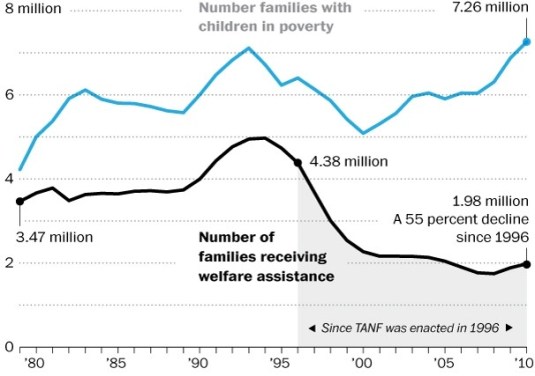
There was a more than 60% reduction in welfare caseloads after the 1996 federal welfare reform in the USA that introduced work requirement and  five year lifetime federal welfare eligibility time limits on a national basis. In the four decades preceding the 1996 welfare reform, the number of Americans on welfare had never significantly decreased.

The gains in U.S. employment after the 1996  Federal welfare reform were largest among the single mothers previously thought to be most disadvantaged: young (ages 18-29), mothers with children aged under seven, high school drop-outs, and black and Hispanic mothers. These low-skilled single mothers in the USA were thought to face the greatest barriers to employment.

The U.S. literature has many competing estimates of the relative effects of work requirements, lifetime time limits and a far more generous earned income tax credit  (EITC). It is agreed that work requirements and time limits reduced entry into welfare caseloads. The relative importance of time limits, work mandates and greater EITC generosity for exits is more disputed.

The Minnesota Family Investment Program (MFIP) had a more complex experimental design that allowed separate evaluation of the mandatory welfare-to-work program and the lower benefit reduction rate. The results indicated that the lower benefit abatement rates appear to have had little labour supply effect. The increase in labour supply seems to have come almost entirely from the mandatory welfare-to-work program and its associated sanctions.

Much was  initially made in the US empirical literature of the strong state of the American economy in the 1990s as an explanation for  part of the drop in welfare caseloads. The relevance of this faded when welfare caseloads did not increase again when the economy deteriorated after 2007 in the USA.

From The Economist’s 1963 review of Capitalism and Freedom

Curiously, a family tax credit or earned income tax credit is the most successful anti-poverty tool in the late 20th century. Furthermore, those on the Left are relatively convinced that the sole cause of poverty is a lack of money, and the solution is to give the poor more money.

Friedman, Hayek in the Constitution of Liberty, and George Stigler in his great paper on the minimum wage in 1946 all supported a guaranteed minimum income.

via A Tract for the Times | The Economist.

Healthier, living longer but many more workers on disability benefits

Graph: Newly Disabled Workers, By Diagnoses

In the past three decades, the number of people who are on disability benefit has skyrocketed.

There is no compelling evidence that the incidence of disabling health conditions among the working age population is rising. Autor (2006) found that disability rolls in the USA expanded because:

  1. congressional reforms to disability screening in 1984 that enabled workers with low mortality disorders such as back pain, arthritis and mental illness to more readily qualify for benefits;
  2. a rise in the after-tax income replacement rate, which strengthened the incentives for lower-skilled workers to seek benefits; (3) and
  3. a rapid increase in female labour force participation that expanded the pool of insured workers.

Autor found that the aging of the baby boom generation has contributed little to the growth of disability benefit numbers to date.

Total_Disabled_Workers_Planet_Money.gif

David Autor and Mark Duggan (2003) found that low-skills and a poor education is predictor of disability: in the USA in 2004, nearly one in five male high school dropouts between ages 55 and 64 were in the disability program; that was more than double that of high school graduates of the same age and more than five times higher than the 3.7 % of college graduates of that age who collect disability. Unemployment is another driver of disability.

The proportion of working-age people receiving a Sickness Benefit, an Invalid’s Benefit or Accident Compensation weekly compensation  in New Zealand rose from around 1% in the 1970s to 5% in June 2002.

Figure 1 The Number of People Receiving Benefit as a Primary Recipient, All Age Groups, 1975–2005

The Number of People Receiving Benefit as a Primary Recipient, All Age Groups, 1975–2005

Source: DSW Annual Reports or Statistical Information Reports and MSD SWIFFT data from Dwyer and McLeod (2006).

Most other OECD countries also experienced a rise in the proportion of the working-age population claiming incapacity benefits over this period. By the late 1990s and early 2000s, it was common for around 4–6.5% of the working-age population to receive such benefits. Some European countries have up to 10% of their working age population on disability or sickness benefit!

When the UK undertook reassessments of those on its disability and sickness benefit, fewer than one in 10 people assessed for the new sickness benefit has been deemed too ill to carry out any work.

More than a third of the 1.3million people who applied for Employment and Support Allowance were found to be fully capable of working; a similar proportion abandoned their claims while they were still being processed. Moral hazard seems to be the main explanation of the rise in disability roles.

Before 15 July 1980, a victim of a workplace accident in the state of Kentucky received a payment proportional to his or her wage with an upper limit of $131 per week. On 15 July 1980, the limit was raised to $217 per week. This increase made a considerable difference to the best-paid workers: their periods of convalescence grew 20% longer (Cahuc and Zylberberg 2006).

Did the 1996 U.S. Welfare Reforms Work?

Welfare Caseloads have declined since 1996

At the same time as major changes in program structure occurred during the 1990s, there were also stunning changes in behaviour. Strong adjectives are appropriate to describe these behavioural changes.

Nobody – of any political persuasion – predicted or would have believed possible the magnitude of change that occurred in the behaviour of low-income single-parent families over this decade.

Rebecca Blank (2002).

The subsequent declines in welfare participation rates and gains in employment were largest among the single mothers previously thought to be most disadvantaged: young (ages 18-29), mothers with children aged under seven, high school drop-outs, and black and Hispanic mothers. These low-skilled single mothers who were thought to face the greatest barriers to employment.

Percentage of the New Zealand population on a welfare benefit since 1970

Issue 13 2014

But a different story in the USA

Graph comparing the ln(percent) from FY1997 - FY2007 of California and District of Columbia child-only, TANF and state population

Robert Doar on 10 welfare reform lessons

In the National Review, Robert Doar set-out these from his time as commissioner of the New York City social service agency between 2007 and 2013:

  1. Always promote personal responsibility.
  2. Employment is far better than training and education.
  3. Making work pay is welfare reform too.
  4. Be honest about the importance of married two-parent families.
  5. Caseworkers don’t cost much; benefits do.
  6. Medicaid is where the money is.
  7. Immigrants get welfare too.
  8. Welfare recipients (and workers too) will try to "get over."  "To get over" is a very New York expression meaning to steal 
  9. When it comes to the disabled, trust but verify.
  10. Always cheer for the economy.

Figure 1: WELFARE CASELOADS AND RECIPIENTS (AFDC AND TANF PROGRAMS), IN THOUSANDS

Welfare caseloads have declined since the 1996 welfare reform

Source: Administration for Children and Families, TANF caseload data, 2011.

I should add that after the 1996 federal welfare reforms in the USA that time limited life-time federal welfare receipt to 5-years, the 2/3rd decline in welfare participation and the gains in employment were largest among the single mothers previously thought to be most disadvantaged: young (ages 18-29), mothers with children aged under seven, high school drop-outs, and black and Hispanic mothers. These low-skilled single mothers were thought to face the greatest barriers to employment. Blank (2002) found that:

nobody of any political persuasion predicted or would have believed possible the magnitude of change that occurred in the behaviour of low-income single-parent families.

Why only Nixon could go to China and Clinton finish the Reagan Revolution

The secret of winning the swing vote is having policies slightly different from your opponent. Recall Tyler Cowen and Daniel Sutter’s Why Only Nixon Could Go to China in Public Choice.


File:Nixon Mao 1972-02-29.png

Cowen and Sutter say that a policy could depend on information – on which policies or values everyone could potentially agree, or on which agreement is impossible.

Politicians, who value both re-election and policy outcomes, realise the nature of the issue better through inside and secret information and superior analytical skills (or access to those skills), whereas voters do not have access to such information base or skills.

Only a right-wing president can credibly signal the desirability of a left-wing course of action. A left-wing president’s rapprochement with China would be dismissed as a dovish sell-out. The Nixon paradox held because citizens could vote retrospectively on the issue.

Left-wing parties adopt right-wing policies because they are good ideas that will get them re-elected. Bob Hawke, Tony Blair, and Bill Clinton were firmly camped over the middle-ground.

Only centre-left economic reformers can credibly signal the desirability of their economic reforms because of the brand name capital they invested in distributional concerns and protecting the poor.

Because of their proven record and brand name, they do not jeopardise their support or credibility by seemingly departing from their core values. They must have done so because it was the right thing to do given events and the long-term interests of the lower-income groups they represent.

Bill Clinton balanced the budget and introduced sweeping welfare reforms in 1996 after vetoing two earlier bills because this finally fulfilled his 1992 campaign promise to “end welfare as we have come to know it”. As he signed the bill on August 22, 1996, Clinton stated that the act:

gives us a chance we haven’t had before to break the cycle of dependency that has existed for millions and millions of our fellow citizens, exiling them from the world of work. It gives structure, meaning and dignity to most of our lives.

Jimmy Carter was a bigger deregulator than Reagan. Obama uses drones far more often than Bush did.

Major labour law reforms were passed in Germany under a left-wing government after decades of 10% unemployment rates and average German unemployment spells for about a year. The key part of these reforms came into play just before the global financial crisis hit and was a major reason for the unemployment rate in Germany falling despite the onset of GFC.

Why Only Nixon Could Go to China also explains why hawks such as Reagan and Begin and other right wing party leaders were able to negotiate peace treaties that eluded more dovish politicians who ran on ‘peace now’ slogans.

Reagan signed the Intermediate-Range Nuclear Forces treaty, walked with Gorbachev in Red Square and seriously offered complete mutual nuclear disarmament in Reykjavik in 1986. Any other American President who offered complete mutual nuclear disarmament would have been impeached.

https://i0.wp.com/www.reagan.utexas.edu/archives/photographs/large/c47345-10.jpg

Hawks also have the right negotiating stance. Robert Aumann argues that:

If you are ready for war, you will not need to fight. If you cry ‘peace, peace,’ you will end up fighting… What brings war is that you signal weakness and concessions.

Only then will both sides negotiate because they know that the other side is willing to walk away and perhaps not come back for a long time. Unless it gets reasonable offers that will be binding on both sides for a long time because both win more for honouring their promises rather than threatening war again soon.

Left-wing politicians can deliver economic reforms because they can deliver new voting blocs to the realignment of political coalitions. This new bloc of centre-left voters and some members of existing political and special interest groupings benefit from regrouping and joining new political coalitions that push through the reforms. An ageing society, budget deficits, technological innovations and shifts in production cost structures and in consumer demand can all make the existing political coalitions less rewarding than in the past.

Next Newer Entries

Bassett, Brash & Hide

Celebrating humanity's flourishing through the spread of capitalism and the rule of law

Truth on the Market

Scholarly commentary on law, economics, and more

The Undercover Historian

Beatrice Cherrier's blog

Matua Kahurangi

Celebrating humanity's flourishing through the spread of capitalism and the rule of law

Temple of Sociology

Celebrating humanity's flourishing through the spread of capitalism and the rule of law

Velvet Glove, Iron Fist

Celebrating humanity's flourishing through the spread of capitalism and the rule of law

Why Evolution Is True

Why Evolution is True is a blog written by Jerry Coyne, centered on evolution and biology but also dealing with diverse topics like politics, culture, and cats.

Down to Earth Kiwi

Celebrating humanity's flourishing through the spread of capitalism and the rule of law

NoTricksZone

Celebrating humanity's flourishing through the spread of capitalism and the rule of law

Homepaddock

A rural perspective with a blue tint by Ele Ludemann

Kiwiblog

DPF's Kiwiblog - Fomenting Happy Mischief since 2003

The Dangerous Economist

Celebrating humanity's flourishing through the spread of capitalism and the rule of law

Watts Up With That?

The world's most viewed site on global warming and climate change

The Logical Place

Tim Harding's writings on rationality, informal logic and skepticism

Doc's Books

A window into Doc Freiberger's library

The Risk-Monger

Let's examine hard decisions!

Uneasy Money

Commentary on monetary policy in the spirit of R. G. Hawtrey

Barrie Saunders

Thoughts on public policy and the media

Liberty Scott

Celebrating humanity's flourishing through the spread of capitalism and the rule of law

Point of Order

Politics and the economy

James Bowden's Blog

A blog (primarily) on Canadian and Commonwealth political history and institutions

Science Matters

Reading between the lines, and underneath the hype.

Peter Winsley

Economics, and such stuff as dreams are made on

A Venerable Puzzle

"The British constitution has always been puzzling, and always will be." --Queen Elizabeth II

The Antiplanner

Celebrating humanity's flourishing through the spread of capitalism and the rule of law

Bet On It

Celebrating humanity's flourishing through the spread of capitalism and the rule of law

History of Sorts

WORLD WAR II, MUSIC, HISTORY, HOLOCAUST

Roger Pielke Jr.

Undisciplined scholar, recovering academic

Offsetting Behaviour

Celebrating humanity's flourishing through the spread of capitalism and the rule of law

JONATHAN TURLEY

Res ipsa loquitur - The thing itself speaks

Conversable Economist

Celebrating humanity's flourishing through the spread of capitalism and the rule of law

The Victorian Commons

Researching the House of Commons, 1832-1868

The History of Parliament

Articles and research from the History of Parliament Trust

Books & Boots

Reflections on books and art

Legal History Miscellany

Posts on the History of Law, Crime, and Justice

Sex, Drugs and Economics

Celebrating humanity's flourishing through the spread of capitalism and the rule of law

European Royal History

Exploring the Monarchs of Europe

Tallbloke's Talkshop

Cutting edge science you can dice with

Marginal REVOLUTION

Small Steps Toward A Much Better World

NOT A LOT OF PEOPLE KNOW THAT

“We do not believe any group of men adequate enough or wise enough to operate without scrutiny or without criticism. We know that the only way to avoid error is to detect it, that the only way to detect it is to be free to inquire. We know that in secrecy error undetected will flourish and subvert”. - J Robert Oppenheimer.

STOP THESE THINGS

The truth about the great wind power fraud - we're not here to debate the wind industry, we're here to destroy it.

Lindsay Mitchell

Celebrating humanity's flourishing through the spread of capitalism and the rule of law

Alt-M

Celebrating humanity's flourishing through the spread of capitalism and the rule of law

croaking cassandra

Economics, public policy, monetary policy, financial regulation, with a New Zealand perspective

The Grumpy Economist

Celebrating humanity's flourishing through the spread of capitalism and the rule of law

International Liberty

Restraining Government in America and Around the World