David Friedman – Market Failure: An Argument Both For and Against Government
04 Jun 2014 Leave a comment
in applied welfare economics, constitutional political economy, David Friedman Tags: comparative institutional analysis, David Friedman, government failiure, market failure
Who gains from anti-imperialism and opposition to foreign investment?
21 May 2014 Leave a comment
in applied price theory, David Friedman, development economics, Public Choice Tags: bootleggers and baptists, expressive voting, foreign investment, imperialism, marxist fallacies
Much more commonly, [economic imperialism] is used by Marxists to describe–and attack–foreign investment in “developing” (i.e., poor) nations.
The implication of the term is that such investment is only a subtler equivalent of military imperialism–a way by which capitalists in rich and powerful countries control and exploit the inhabitants of poor and weak countries.
There is one interesting feature of such “economic imperialism” that seems to have escaped the notice of most of those who use the term.
Developing countries are generally labour rich and capital poor; developed countries are, relatively, capital rich and labour poor. One result is that in developing countries, the return on labour is low and the return on capital is high–wages are low and profits high. That is why they are attractive to foreign investors.
To the extent that foreign investment occurs, it raises the amount of capital in the country, driving wages up and profits down.
The effect is exactly analogous to the effect of free migration. If people move from labour-rich countries to labour-poor ones, they drive wages down and rents and profits up in the countries they go to, while having the opposite effect in the countries they come from.
If capital moves from capital-rich countries to capital-poor ones, it drives profits down and wages up in the countries it goes to and has the opposite effect in the countries it comes from.
The people who attack “economic imperialism” generally regard themselves as champions of the poor and oppressed.
To the extent that they succeed in preventing foreign investment in poor countries, they are benefiting the capitalists of those countries by holding up profits and injuring the workers by holding down wages.
It would be interesting to know how much of the clamour against foreign investment in such countries is due to Marxist ideologues who do not understand this and how much is financed by local capitalists who do.
David D. Friedman
Opposition to immigration might protect the wages of local workers. Opposition to foreign investment might increase the profits of local capitalists.
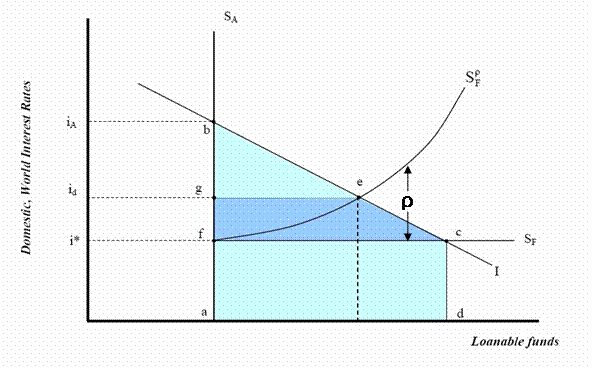
How does more competition help the local capitalists? The foreign investment is in response to the high returns in the local market and that inflow of foreign capital will continue until local rates of return match those in other countries.
Equalisation of risk-adjusted rate of returns is central to the operation of capital markets.
Stopping this process of equalisation through regulation only benefits the capitalists inside the country. It reduces the wages of workers because they have less capital and fewer modern technologies to work with.
The Right Minimum Wage: $0.00 – New York Times 1987–Updated Again
19 May 2014 1 Comment
in Alfred Marshall, applied welfare economics, David Friedman, labour economics, minimum wage Tags: David Card, interpersonal comparision of utility, Milton Friedman, minimum wage, offsetting behaviour, The fatal conceit, The pretense to knowledge
Raising the minimum wage by a substantial amount would price working poor people out of the job market.
A far better way to help them would be to subsidize their wages or – better yet – help them acquire the skills needed to earn more on their own…
Raise the legal minimum price of labour above the productivity of the least skilled workers and fewer will be hired.
If a higher minimum means fewer jobs, why does it remain on the agenda of some liberals?
A higher minimum would undoubtedly raise the living standard of the majority of low-wage workers who could keep their jobs. That gain, it is argued, would justify the sacrifice of the minority who became unemployable.
The argument isn’t convincing. Those at greatest risk from a higher minimum would be young, poor workers, who already face formidable barriers to getting and keeping jobs. Indeed, President Reagan has proposed a lower minimum wage just to improve their chances of finding work.
What does the New York Times say in 2014?
The minimum wage is specifically intended to take aim at the inherent imbalance in power between employers and low-wage workers that can push wages down to poverty levels.…
The weight of the evidence shows that increases in the minimum wage have lifted pay without hurting employment
Both the White House and the New York Times are not the best of Bayesian updaters because the author of the one study on which they are very much hang their hats for their policy conclusions about no job losses from a minimum wage increase interprets his results with very much less zeal than they do:
I think careful research on the topic has found that for this range of minimum wage increase, the almost unmistakable conclusion is that there will be little in the way of job losses, while the wages of low-end workers will get a boost (his underlining).
The claims of the White House and the New York Times that the minimum wage can be lifted without hurting employment are a long bow from what Andrajit Dube said about small changes in the minimum wage having small adverse effects on unemployment:
What Andrajit Dube said s not much different from everyone else on the minimum wage – Nuemark is an example:
a 10 per cent increase in the minimum wage could reduce young adult employment by up to 2 per cent
David Card was always very careful amount about how his pioneering research was about how small increases in the minimum wage not reducing employment in the presence of search and matching costs:
From the perspective of a search paradigm, these policies make sense, but they also mean that each employer has a tiny bit of monopoly power over his or her workforce.
As a result, if you raise the minimum wage a little—not a huge amount, but a little—you won’t necessarily cause a big employment reduction. In some cases you could get an employment increase.
There is always offsetting behaviour: Barry Hirsch found that when the federal minimum wage went up in 2007, businesses just made their employees work harder to justify the expense.
I am always surprised that people might think that the minimum wage will have anywhere near its intended effects after market participants have had time to act to counter its effects as Peltzman explains:
Regulation creates incentives for behaviour to offset some or even all of the intended effect of the regulation…
Regulation seldom changes the forces that produces the particular results the regulators seek to change. So we need to ask whether the regulation really changes result or only the form in which the market forces assert themselves.
Is a minimum wage increase a Pareto improvement – a policy action done in an economy that harms no one and helps at least one person?

Obviously there are winners and losers from a minimum wage increase and these wins and loses must be summed up in some way as they are for all public policy changes.

When there are winners and losers from deregulation, the only thing seems to matter to many of those who support a minimum wage increase are the losses to the incumbent industry and its often well-paid workers rather than the gains to consumers, rich or poor.
For there to be a Marshall improvement, the sum of all of the gains and losses must sum to a positive.
A Marshall improvement from a minimum wage or any other change is measured by adding utilities as if everyone receives the same utility from a dollar. A dollar is a dollar to everyone as David Friedman explains:
A net improvement in the sense used by Marshall–what I have elsewhere called a Marshall improvement–is a change whose net value is positive, meaning that the total value to those who benefit, measured as the sum of the number of dollars they would each, if necessary, pay to get the change, is larger than the total cost to those who lose, measured similarly.
The advantage of the Marshall improvement criterion is we commonly observe people’s values of different things by seeing how much they are willing to pay for it.
Alfred Marshall was aware that treating people as if they all had the same utility for a dollar was a stretch but this was considered less relevant for policy changes that affect large and diverse groups of people. Individual differences could be expected to cancel out over a broad suite of policies in a well-functioning democracy so that most people gain in net terms through time. David Friedman explains:
I prefer to use the Marshallian approach, which makes the interpersonal comparison explicit, instead of hiding it in the ‘could be made but isn’t’ compensating payment…
a change that benefits a millionaire by $10 and costs a pauper $9 is a potential Pareto improvement, since if combined with a payment of $9.50 from the millionaire to the pauper it would benefit both. If the payment is not made, however, the change is not an actual Pareto improvement.
The ‘potential Paretian’ approach reaches the same conclusion as the Marshallian approach and has the same faults; it simply hides them better. That is why I prefer Marshall…
It is worth noting that although a Marshall improvement is usually not a Pareto improvement, the adoption of a general policy of ‘Wherever possible, make Marshall improvements’ may come very close to being a Pareto improvement…
Add up all the effects and, unless one individual or group is consistently on the losing side, everyone, or almost everyone, is likely to benefit.
This is the latest review of the minimum wage research from David Neumark:
The potential benefits of higher minimum wages come from the higher wages for affected workers, some of whom are in poor or low-income families.
The potential downside is that a higher minimum wage may discourage employers from using the low-wage, low-skill workers that minimum wages are intended to help.
If minimum wages reduce employment of low-skill workers, then minimum wages are not a “free lunch” with which to help poor and low-income families, but instead pose a trade-off of benefits for some versus costs for others.
Research findings are not unanimous, but evidence from many countries suggests that minimum wages reduce the jobs available to low-skill workers.
George Stigler set-out the conditions for a minimum wage to achieve its purported objectives in 1946, which have not been bettered:
If an employer has a significant degree of control over the wage rate he pays for a given quality of labour, a skilfully-set minimum wage may increase his employment and wage rate and, because the wage is brought closer to the value of the marginal product, at the same time increase aggregate output…
This arithmetic is quite valid but it is not very relevant to the question of a national minimum wage. The minimum wage which achieves these desirable ends has several requisites:
1. It must be chosen correctly… the optimum minimum wage can be set only if the demand and supply schedules are known over a considerable range…
2. The optimum wage varies with occupation (and, within an occupation, with the quality of worker).
3. The optimum wage varies among firms (and plants).
4. The optimum wage varies, often rapidly, through time.
A uniform national minimum wage, infrequently changed, is wholly unsuited to these diversities of conditions.
The case for a minimum wage was therefore hung, drawn and quartered in 1946 by Stigler. Not every cause and effect is open to policy manipulation because of the lack of the necessary knowledge about the relationship and insufficiently deft policy tools to exploit that knowledge in a timely fashion and as circumstances change. This information and organisational burden is such that the process of setting minimum wage increases is an example of public policy making that is groping about in the dark. Success can be neither appraised in advance nor later retrospectively determined.
David Friedman on Bits From the Latest IPCC Report
02 Apr 2014 Leave a comment
in applied welfare economics, David Friedman, economics of natural disasters, environmental economics
I have not yet gotten into the full report but, judging from accounts I have seen, 2°C of additional warming is about what it suggests we can expect by 2100 if we don’t do much to prevent it. So if policies to prevent warming reduce the annual growth rate of world income from (say) 2% to 1.98%, the resulting loss will just about cancel the gain. Not a compelling argument for switching from fossil fuels to solar power.
via Ideas: Bits From the Latest IPCC Report.

What global warming will cost us if we do nothing
18 Mar 2014 1 Comment
in David Friedman, economics of climate change, environmental economics, Public Choice Tags: climate change, global warming, ice ages, social cost
David Friedman at Ideas delved into the best estimate of the global cost of global warming – by William Nordhaus – $4.1 trillion this century. This is $48 billion a year – 1/20th of one per cent of world income! Friedman then asked this:

Friedman’s even better argument on the social costs of global warming is that the costs of unlikely but catastrophic risks are included in the social cost arithmetic to make the problem serious. Without including them, global warming up to about a 2-degree warming provides a net benefit.

Friedman shows great insight when he goes on to say that there is “no similar attempt to take account of low probability, high cost consequences of preventing global warming”.
That low probability, high cost consequence, which will occur sooner or later, is the next ice age. The next ice age could include a drop in sea levels of three hundred feet and half a mile of ice over the top of London and Chicago. That would bring a new meaning to climate change refugees. We are in a relatively warm period – an interglacial – in an ice age that started two million years ago.
Friedman asked whether “It is at least possible that global warming is all that is preventing the interglacial from ending”.
The great tactical victory of environmentalists is keeping the debate on the science going because even if the science is right, the economic costs are small.
How much will global warming cost is the correct question for policy debate. Let the science be settled!
Economists have no more expertise to judge the science of global warming than they do in judging the science behind the inevitability of super volcanoes going off again such as the one just north of me. The Yellow stone national park super volcano is 50,000 years overdue, by the way.
Economists can comment on the likely consequences, intended and unintended, of different choices and the constraints that different national and international institutional frameworks place on what policy choices might be made.
The chances of India, China and the rest of the Third World agreeing to forego or even slow their economic development to fight global warming is zero even before you consider the international collective action, verification and free rider problems. Adaptation and ‘richer is safer’ are the only game in town whichever way the climate goes!
 Utopia, you are standing in it!
Recent Comments