Dailychart: How FIFA spends and makes its money econ.st/1HQpec4 http://t.co/cEHEsvvWyr—
The Economist (@TheEconomist) May 29, 2015
How FIFA spends and makes its money
29 May 2015 Leave a comment
Principled BDS activists have been the subject of mass kidnappings
27 May 2015 Leave a comment
in economics of crime, law and economics, politics, politics - Australia, politics - New Zealand, politics - USA, war and peace Tags: Amnesty International, BDS, Gaza Strip, Hamas, Left-wing hypocrisy
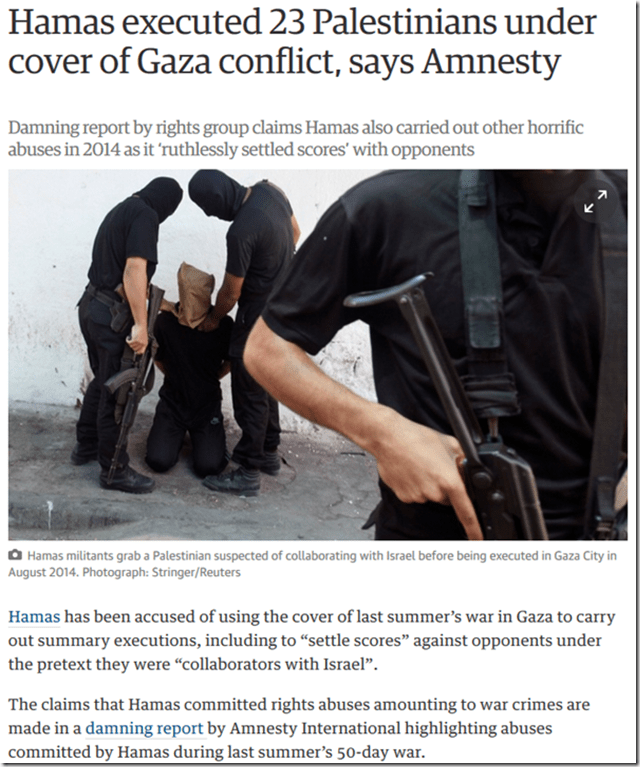
Can there be any other explanation for why the BDS activists are not protesting in the streets against these summary executions by Hamas other than mass kidnappings.
What else is stopping them from protest against these flagrant human rights violations and calling for boycotts, disinvestment and sanctions against the Gaza Strip? Kudos to Amnesty International for finally putting out this report.
Family structure and children witnessing domestic violence
25 May 2015 Leave a comment
in economics of crime, economics of love and marriage, law and economics Tags: child abuse, child poverty, domestic violence, economics of the family, marriage and divorce, single parents
Children's likelihood of witnessing domestic violence, by family structure (w/ controls) family-studies.org/children-in-si… http://t.co/V1YGUZTSTh—
Inst. Family Studies (@FamStudies) January 05, 2015
US imprisonment rates by race and education
18 May 2015 Leave a comment
in economics of crime, labour economics, law and economics, occupational choice Tags: crime and punishment, criminal deterrence, imprisonment rates
Fatal terrorist attacks in Europe since 2001
15 May 2015 Leave a comment
in economics of crime, law and economics Tags: European politics, terrorist attacks, war against terror
#Dailychart: Fatal terrorist attacks in Western Europe since 2001 econ.st/1CnBN87 http://t.co/pu2LBS7Qb7—
The Economist (@ECONdailycharts) January 18, 2015
Public confidence in the police in America
14 May 2015 Leave a comment
in economics of bureaucracy, economics of crime, politics - USA Tags: crime and punishment, law and order, police, voter demographics
Do violent protests win votes for your cause?
12 May 2015 Leave a comment
in constitutional political economy, economic history, economics of crime, law and economics, politics - Australia, politics - New Zealand, politics - USA, Public Choice Tags: 1960s, activists, civil disobedience, Democratic Party, George Wallace, nonviolent protest, Richard Nixon, riots, Vietnam war, violent protests
Monkey Cage blogged on a very timely study on the impact of violent and nonviolent protests on voting behaviour. Non-violent protest in the 60s enticed sympathy and increased voter support for the Democratic Party in the 1964, 1968 to 1972 presidential elections:
Black-led nonviolent protests… exhibit a statistically significant positive relationship with county-level Democratic vote-share in the same period.
This is not surprising because nonviolent protest acknowledge fidelity to law and democratic equality. No one likes to be bullied and one of the purposes of the secret ballot is to prevent voters from being bullied because no one knows how you voted.
Indeed, there is a long history of anonymous pamphleteering, which has evolved into anonymous trolling as a way of people expressing their political views without facing backlash from both the majority and a vindictive minority.
In a democracy, it’s up to me to persuade you to change your mind – that what you took for granted for so long is not so. That’s how liberal democracies work: by trying to persuade each other and voting.
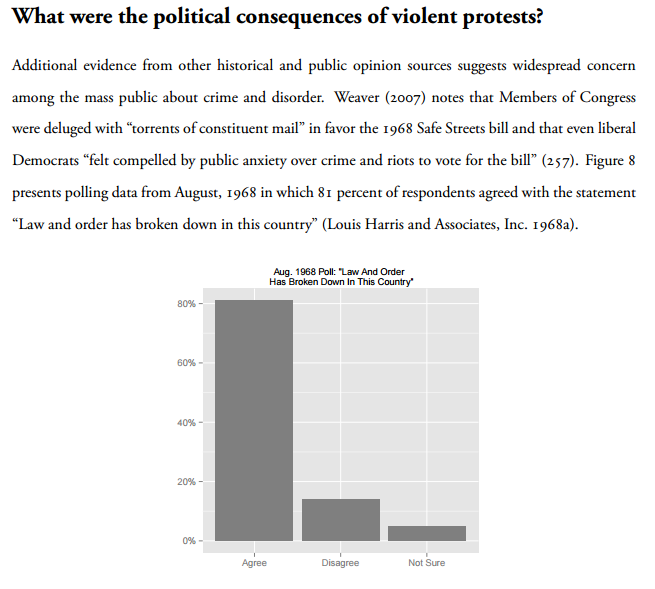
Violent protests had the exact opposite effect to peaceful protests on Democratic Party voting shares in the 1964, 1968 in 1972 presidential elections. There was a law and order backlash among voters against what were relatively widespread rioting and civil disorder:
…black-led protests in which some violence occurs are associated with a statistically significant decline in Democratic vote-share in the 1964, 1968 and 1972 presidential elections.
This is a roundabout way of saying that a Republican won the 1968 election on a law and order platform, not a Democrat on a peace platform. The country was convinced, including Liberal Democrats, that law and order had broken down and that the Democratic Party could not restore law and order.
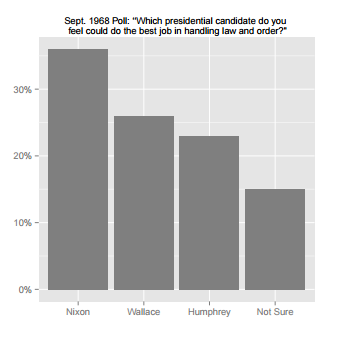
In the 1968 presidential election, there is a third party candidate, George Wallace, who won won almost ten million popular votes and 46 electoral votes, including in the electoral college on an even harsher law and order platform than Nixon.
Wallace was a racist Southern Democrat the Democratic Party would prefer us to forget and a nasty political opportunist to boot. His political rhetoric included the only words four letter words the protesters didn’t know was work and soap.
As I recall warmed over Marxism, the idea of violent protests is to provoke a law and order backlash, initially with popular support of the working class. The resulting police repression will overreach and cause the proletariat to breakthrough their false consciousness to see that capitalists for whom they are and rise up to overthrow them.

Rise up ye workers, rise up for you have nothing to lose but your chains. These days that call to the barricades would have to be rise up ye workers, rise up for you have nothing to lose what your smart phone and air points.
Hypocritical Greens betray NZ sovereignty to US court decision but oppose investor state dispute settlement on sovereignty grounds
10 May 2015 Leave a comment
in defence economics, economics of crime, international economic law, international economics, International law, law and economics, politics - New Zealand, politics - USA Tags: foreign policy, free trade agreements, green hypocrisy, green party, investor state disputes settlement, national security, preferential trading agreements, war against terror
The Greens are happy to betray New Zealand’s sovereignty to a US court where New Zealand’s side of the story was not heard, New Zealand was not a litigant, New Zealand was not named in the proceedings and New Zealand had not agreed to waive its sovereign immunity under US law.
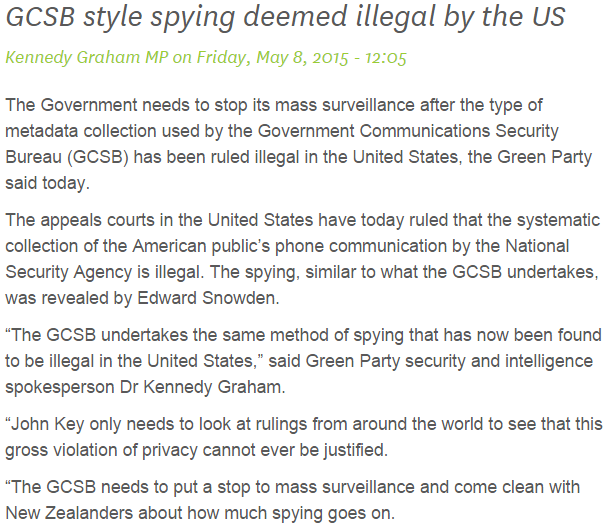
The Greens on the other hand are hysterical about the prospect of New Zealand voluntarily submitting to investor state disputes settlement through an international treaty. International treaties normally are about trading in sovereignty: you give up some form of sovereignty return for something you value more.
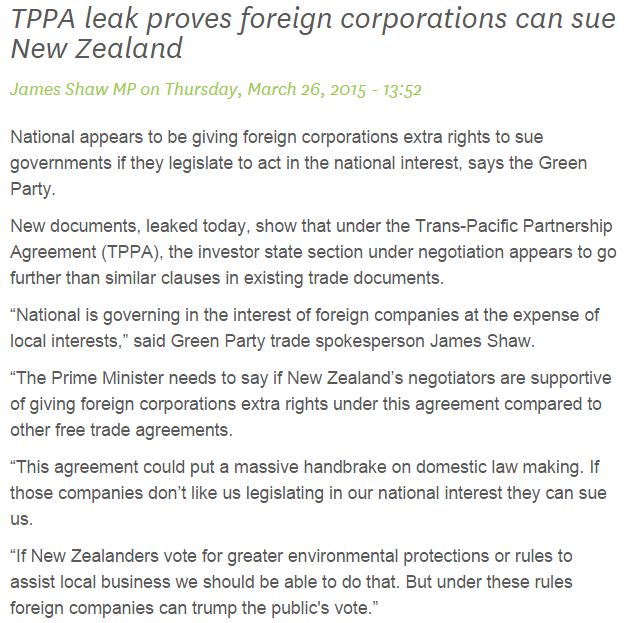
It is thoroughly hypocritical of the Greens to argue the New Zealand should bow down to a foreign court when that court rules in a way that it favours its ideological agenda but refuse to support the principle of international arbitration in circumstances where that may advance New Zealand’s national interests.
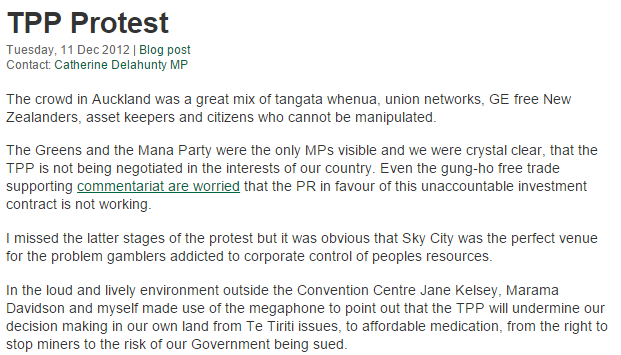
At a minimum, New Zealand itself chose to give up its sovereignty if it agrees to investor state dispute settlement in a trade agreement. The decision was not imposed by a foreign court where it was not heard nor was a party.


Of particular concern to the Greens is international arbitration could "trump the public’s vote vote". New Zealand has repeatedly elected parties that support the alliance with America, and support a robust security and intelligence policy, including electronic surveillance as part of the war on terror.
The last week of the 2014 general election campaign was dominated by the Government Security Communications Bureau and its cooperation with the National Security Agency and the extent to which New Zealand security services engaged in electronic surveillance in New Zealand and abroad.
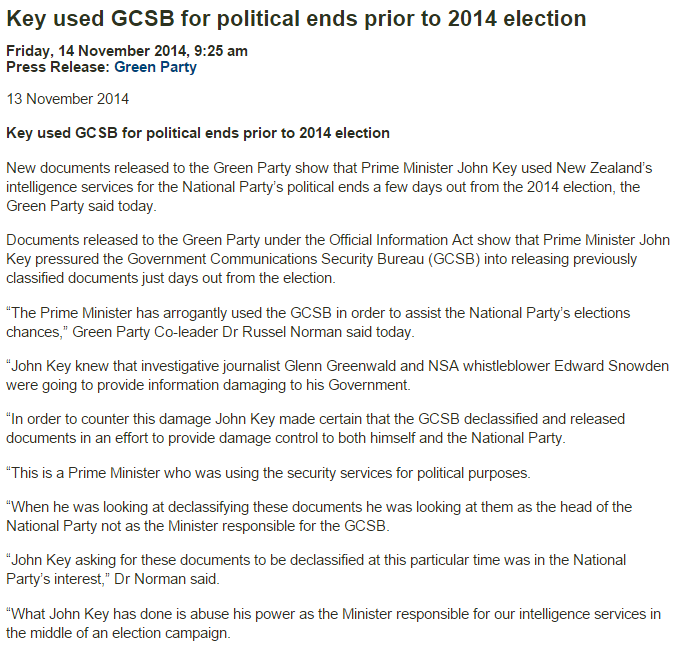
The Greens want to subvert that democratic decision that has been repeated over many New Zealand elections about national security and foreign relations to defer to an American court when New Zealand didn’t even appear as a party.

The US Court of appeal was deciding an issue of statutory interpretation of the Patriot Act. There was no constitutional issues at hand.
The Patriot Act expires in a month unless it is extended. Congress has ample opportunity to amend the renewed law to overturn the appeal court’s decision for the future operation of its security and intelligence laws.
The Greens want a Court of Appeal interpretation of the American Patriot Act to extend to New Zealand without a vote of the New Zealand people or the parliament having any say on whether to give up New Zealand’s sovereignty or waive sovereign immunity in American courts.
.
What are the prices on the black market for animal parts?
01 May 2015 Leave a comment
in economics of crime, economics of regulation, entrepreneurship, environmentalism, law and economics, property rights Tags: black markets, economics of prohibition, endangered species, offsetting behaviour, or unintended consequences
Animated #Dailychart: Bear bile, rhino horn, tiger bone–how much do animal products cost? econ.st/1nfrFKf http://t.co/oG5HtZvzOL—
The Economist (@ECONdailycharts) July 23, 2014
Does vertical political integration reduce corruption in government?
01 May 2015 Leave a comment
in economics of crime, industrial organisation, law and economics Tags: bribery and corruption, chain of monopolies problem, Japan, ODA, overseas aid, Pakistani
Anti-Dismal blogged today on how vertical integration can reduce the double mark-up problem of monopolies. The one thing worse than a monopoly is dealing with a chain of monopolies. Buyers must pay a monopoly price to each step in the chain.
If these monopolies were to merge into one single monopoly, the monopolist would charge a lower single monopoly price. The vertical integration captures the deadweight social loss of the chain of monopoly prices. Monopoly profits are higher, yet the monopoly price paid by buyers is lower.
This blog post reminded me of a particularly astute short article in the Economist 15 or so years ago analysing Benazir Bhutto’s husband as a solution to the chain of monopolies problem.
When Benazir Bhutto became Prime Minister of Pakistan for the first, she appointed her husband Minister of Investments. He became known as Mr 10%.

The welfare gain for the downtrodden Pakistani’s was that if you paid Benazir Bhutto’s husband is 10%, you got what you pay for. No further bribes of more junior and petty officials were required if you paid Benazir Bhutto’s husband his 10%. Many investments and business that otherwise would have been blocked but for countless bribes to a chain of corrupt politicians and bureaucrats at every turn went ahead.
When Benazir Bhutto became Prime Minister of Pakistan for the second time, not only was her husband again appointed Minister of Investments, he had better economic advisers. He became Mr 40%. Benazir Bhutto’s husband wanted to capture the economic gains of single-stop bribery and corruption for his family.
My experience with Japanese overseas development assistance confirms the same. They budget 10% for bribes. Their main interest is effective bribery. If they pay a bribe, the Japanese ODA agency expects to get what they pay and not have to pay a chain of more junior officials as well for the same thing.
How much is your hacked data worth?
28 Apr 2015 Leave a comment
in economics of crime, law and economics Tags: crime and punishment, electronic crime, hacking
Interesting overview of how much your stolen data is worth: informationisbeautiful.net/visualizations…. Source: @infobeautiful http://t.co/aTc9KOPpCm—
Matt Berryman (@mattberryman) October 09, 2014


Recent Comments